
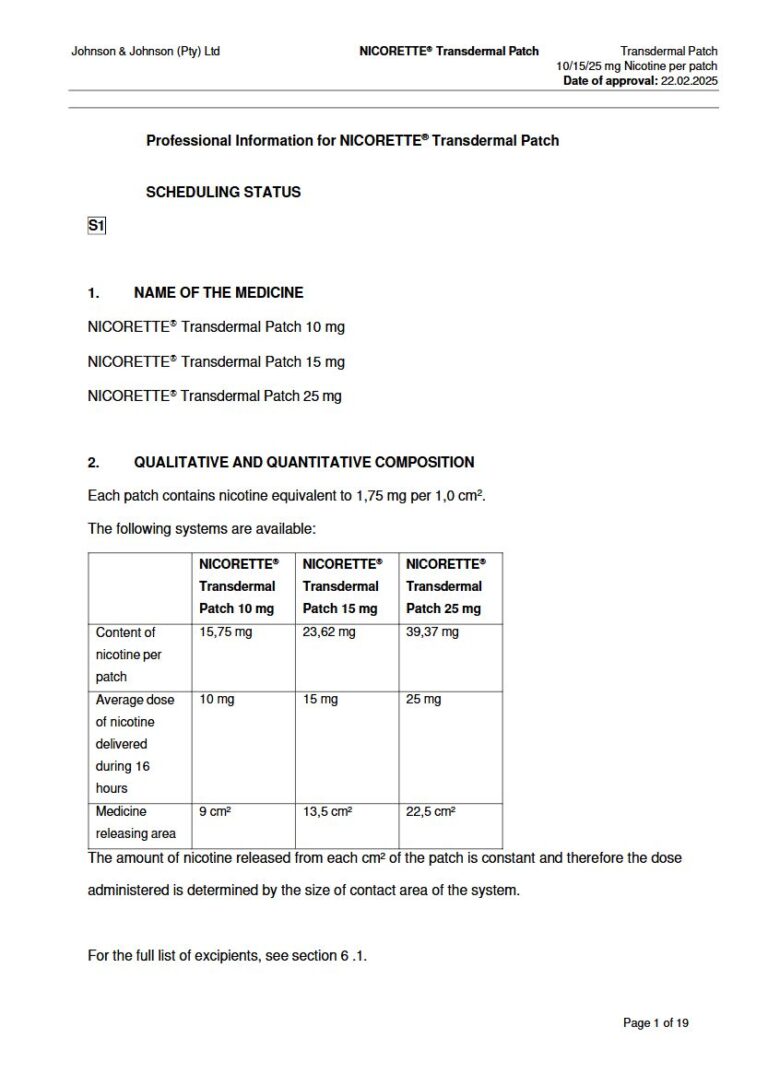
Nicorette Transdermal Patch 25 mg Patch
PDF Leaflet Revision Date: 22 February 2025
Clinical Summary
Quick overview from the medicine insert
Indication
Smoking cessation aid.
Dosage (summary)
Apply one patch daily; heavy smokers start with 25 mg, light smokers with 15 mg.
Special Populations
- Cardiovascular disease
- Diabetes mellitus
- Renal impairment
- Hepatic impairment
Pregnancy & Breastfeeding
Contraindicated in pregnancy and lactation due to potential harm to fetus and infant.
Key Drug Interactions
- CYP1A2 enzyme inducers
- Adrenergic agonists
- Adrenergic blockers
Contraindications
- Hypersensitivity to nicotine
- Recent myocardial infarction
- Severe cardiac dysrhythmias
- Severe angina
- Acute stroke
Common side effects
- Dizziness
- Headache
- Nausea
- Skin reactions
Counselling Points
- Do not smoke while using the patch.
- Rotate application sites daily.
- Seek medical advice if symptoms persist.
Serious warnings
- Potential for nicotine overdose
- Caution in cardiovascular disease
- Monitor blood sugar in diabetes
Important Disclaimer
The Nicorette Transdermal Patch 25 mg Patch professional information leaflet below is the property of Johnson & Johnson and is provided on Medinsert exactly as issued, with no.. alterations or editorial changes. We make every effort to keep content current by updating documents as soon as new versions become available. Medinsert serves as a trusted access point for healthcare professionals, but does not replace official sources or clinical judgement. For more details, please read our full disclaimer. read more>>
 Healthcare Professionals Only
This content is for registered healthcare professionals
Sign in or create a free account to read the full package insert.
Free for HPCSA-registered professionals. Powered by Medinsert.
Clinical Particulars
Section 4 of the official insert — extracted exactly as issued, no alterations
4.1 Therapeutic indications
NICORETTE uf0d2 Transdermal Patch is indicated to be used as part of a smoking cessation programme as a temporary aid to the cigarette smoker seeking to give up the smoking habit.
4.2 Posology and method of administration
Posology
NICORETTE uf0d2 Transdermal Patch can be used as monotherapy or in combination with 2 mg nicotine gum or a 1 mg/spray nicotine oromucosal spray.
Monotherapy: Adults and the elderly
The patch should be applied to an intact area of the skin upon waking up in the morning and removed at bedtime. Patch treatment mimics the fluctuations of nicotine over the day in smokers, with no nicotine administration during sleep. Daytime nicotine patch treatment does not give the nicotine induced sleep disturbances seen with nicotine administration during sleep. Heavy smokers are recommended to start at Step 1 with the 25 mg/16 hours patch and use one patch daily for 8 weeks.
Gradual weaning from the patch should then be initiated. One 15 mg/16 hours patch should be used daily for 2 weeks followed by one 10 mg/16 hours patch daily for 2 weeks. Light smokers are recommended to start at Step 2 (15 mg) for 8 weeks and decrease the dose to Step 3 (10 mg) for the final 4 weeks.
Table 1
Heavy smokers Light Smokers
Dose regimen Duration Dose regimen Duration
Step 1 Nicorette uf0d2 Transdermal patch 25 mg First weeks 8 Step 2 Nicorette uf0d2 Transdermal patch 15 mg Next weeks 2
Step 2 Nicorette uf0d2 Transdermal patch 15 mg First weeks 8 Step 3 Nicorette uf0d2 Transdermal patch 10 mg Last weeks 2
Step 3 Nicorette uf0d2 Transdermal patch 10 mg Last weeks 4
Use of the patch beyond 6 months is generally not recommended.
Children and adolescents
NICORETTE uf0d2 Transdermal patch should not be administered to persons under 18 years of age without recommendation from a health care provider. There is limited experience of treating this age group with NICORETTE uf0d2 Transdermal Patch.
Method of administration
NICORETTE uf0d2 Transdermal Patch should be applied to clean, dry intact areas of hairless skin, for example on the hip, upper arm, or chest. These areas should be varied each day and the same site should not be used on consecutive days.
1. Wash your hands before applying the patch.
2. Cut open the pouch with scissors along the side, as indicated. Select a clean, dry, hairless intact area of skin, such as the hip, upper arm or chest.
3. Peel one part of the silvery aluminium backing away as far as possible. Avoid touching the sticky surface of the patch with your fingers, as far as possible.
4. Apply the sticky part of the patch carefully onto the skin and peel off the remaining half of the silvery aluminium backing.
5. Press the patch firmly onto the skin with your palm or finger-tips.
6. Rub your fingers firmly round the edge to ensure that the patch sticks firmly. After removal, used patches should be disposed of carefully. Advice and support improve the success rate.
Combination therapy
Highly dependent smokers, smokers who experience breakthrough cravings or those who have failed with single nicotine replacement therapy (NRT), can use NICORETTE uf0d2 Transdermal Patch in combination with an oromucosal NRT product for fast relief of cravings. The oromucosal format to consider in combination with the NICORETTE uf0d2 Transdermal Patch are 2 mg nicotine gum or 1 mg/spray nicotine oromucosal spray. Smokers should use the same dosing recommendations for the patch and for the chosen oromucosal format as in monotherapy. For the dosing recommendations for the oromucosal format chosen, the user needs to refer to the product information of the specific product. NICORETTE uf0d2 Transdermal Patch 25 mg should be applied in the morning and removed at bedtime. The dosing schedule for use of the oral pharmaceutical form in combination with the patch is flexible and the users are dosing based on their requirements. For combination therapy, patients are advised to only use one oromucusal format over a 24 h period. Smokers should stop smoking completely during the course of treatment with NICORETTE uf0d2 Transdermal Patch.
4.3 Contraindications
NICORETTE uf0d2 Transdermal Patch is contraindicated in the following circumstances:
- Known hypersensitivity of the skin or allergy to nicotine or any of the excipients of NICORETTE uf0d2 Transdermal Patch (see section 6.1), and generalised skin disorders.
- Hypersensitivity to any component of the patch (see section 6.1).
- In persons during the immediate post-myocardial infarction period (within 3 months).
- In persons with severe, life-threatening cardiac dysrhythmias.
- In persons with severe or worsening angina pectoris.
- In persons with Prinzmetalu2019s variant angina.
- In persons with stroke in the acute phase.
- Pregnancy and lactation.
- Women who are planning to fall pregnant.
4.4 Special warnings and precautions for use
Persons diagnosed with the following conditions, should be carefully screened and evaluated, by a health care provider before NICORETTE uf0d2 Transdermal Patch is prescribed:
- Cardiovascular disease: Serious cardiovascular event, or hospitalisation due to cardiovascular complaint, in the previous 4 weeks (e.g. stroke, myocardial infarction, unstable angina, cardiac dysrhythmia, coronary artery bypass graft and angioplasty) or those who suffer from uncontrolled hypertension (see section 4.3). Patients should be encouraged to stop smoking and non-pharmacological interventions (such as counselling) should be considered. If this fails, the initiation of pharmacological intervention should be under close medical supervision.
- Diabetes mellitus: Patients with diabetes mellitus should be advised to monitor their blood sugar levels more closely than usual when smoking is stopped, and NICORETTE uf0d2 Transdermal Patch is initiated as reductions in nicotine-induced catecholamine release can affect carbohydrate metabolism. Patients with diabetes mellitus may require lower doses of insulin as a result of smoking cessation.
- Vasospastic diseases (Buergeru2019s disease).
- Renal and hepatic impairment: Use with caution in patients with severe to moderate hepatic impairment and/or severe renal impairment as the clearance of nicotine or its metabolites may be decreased with the potential for increased adverse effects.
- Phaeochromocytoma and uncontrolled hyperthyroidism: Use with caution in patients with uncontrolled hyperthyroidism or phaeochromocytoma as nicotine causes release of catecholamines from the adrenal medulla.
- Gastrointestinal disease: Nicotine may exacerbate symptoms in patients suffering from oesophagitis; active duodenal and gastric ulcers. NICORETTE uf0d2 Transdermal Patch should be used with caution in these conditions.
- Occlusive peripheral arterial diseases.
- Heart failure. In case of severe or persistent skin reaction, treatment should be discontinued.
Cigarette smoking is thought to play a perpetuating role in hypertension and peptic ulcer disease, therefore, NICORETTE uf0d2 Transdermal Patch should not be used in patients with systemic hypertension or history of peptic ulcer. NICORETTE uf0d2 Transdermal Patch should not be administered to persons under the age of 18 years of age without recommendation from a health care provider. There is limited experience of treating this age group with NICORETTE uf0d2 Transdermal Patch. NICORETTE uf0d2 Transdermal Patch must be kept out of reach of children at all times i.e. before and after use. Transferred dependence: Transferred dependence can occur but is unusual and is both less harmful and easier to break than smoking dependence. Non-smokers should not use NICORETTE uf0d2 Transdermal Patch as they may experience adverse reactions similar to those associated with nicotine administration. Patients should not smoke whilst using NICORETTE uf0d2 Transdermal Patch. If the NICORETTE uf0d2 Transdermal Patch is being used to supplement a behavioural tobacco withdrawal programme, the dosage should be adapted accordingly, in order to avoid intoxication and presentation of the side effects of nicotine.
NICORETTE uf0d2 Transdermal Patch should be removed prior to undergoing any magnetic resonance imaging (MRI) procedures to prevent the risk of burns. If symptoms persist or get worse, or if new symptoms occur, patients should stop use and consult a physician. Special warnings and precautions for the combination of NICORETTE uf0d2 Transdermal Patch with nicotine 2 mg chewing gum/ oromucosal spray 1 mg/spray are the same as those for each treatment alone (refer to the Professional Information of each product respectively).
4.5 Interaction with other medicines and other forms of interaction
Smoking cessation, with or without nicotine substitutes, may alter response to concomitant medication in ex-smokers. Smoking (but not nicotine) is associated with an increase in CYP1A2 enzyme activity, and therefore, considered to increase the metabolism and thus lower blood levels of medicines with a narrow therapeutic window, such as caffeine, theophylline, imipramine, tacrine, clozapine and ropinirole, through enzyme induction. Limited data indicate that the metabolism of flecainide and pentazocine may also be induced by smoking. After cessation of smoking, reduced clearance of the substrates for the CYP1A2 enzyme may occur and result in increased plasma levels of other medicines (including olanzapine, clomipramine and fluvoxamine); however data in support of this is lacking and the possible clinical significance of this effect for these medicines is unknown. Absorption of glutethimide may be decreased and the u201cfirst passu201d metabolism of propoxyphene decreased by smoking cessation.
Other reported effects of smoking, which do not involve enzyme induction, include reduced diuretic effects of furosemide and decreased cardiac output, and increased blood pressure with propranolol, which may also relate to the hormonal effects of nicotine. Smoking cessation may reverse these actions. Both smoking and nicotine can increase circulating cortisol and catecholamines. Therapy with adrenergic agonists or with adrenergic blockers may need to be adjusted according to changes in nicotine therapy or smoking status.
No clinically relevant interactions between NICORETTE uf0d2 Transdermal Patch and other medicines have definitely been established. However, nicotine may possibly enhance the haemodynamic effects of adenosine i.e. increase in blood pressure and heart rate and also increased pain response (angina pectoris type chest pain) provoked by adenosine administration.
4.6 Fertility, pregnancy and lactation
Pregnancy: The nicotine in NICORETTE uf0d2 Transdermal Patch may cause foetal harm when administered to pregnant women and is therefore contraindicated in women who are or who may become pregnant. Nicotine passes to the foetus and affects its breathing movements and circulation. The effect on the circulation is dose-dependent. Therefore, the pregnant smoker should always be advised to stop smoking completely without use of nicotine replacement therapy. The risks to the foetus from NICORETTE uf0d2 Transdermal Patch are not known. Maternal smoking in pregnancy is associated with low birth weight infants and increased risk of abortion, still birth and neonatal death.
Lactation: Nicotine passes freely into breast milk in quantities that even at therapeutic doses may affect the infant, therefore the NICORETTE uf0d2 Transdermal Patch is contraindicated during lactation or breastfeeding.
Fertility In females, tobacco smoking delays time to conception, decreases in-vitro fertilisation success rates, and significantly increases the risk of infertility. In males, tobacco smoking reduces sperm production, increases oxidative stress, and DNA damage. Spermatozoa from smokers have reduced fertilising capacity. The specific contribution of nicotine to these effects in humans is unknown. Female patients should be advised to take adequate precautions to avoid becoming pregnant. The doctor may wish to consider a pregnancy test before instituting therapy with NICORETTE uf0d2 Transdermal Patch.
4.7 Effects on ability to drive and use machines
NICORETTE u00ae Transdermal Patch can cause side effects, such as dizziness. Caution is advised before driving a vehicle or operating machinery until the effects of NICORETTE u00ae Transdermal Patch are known.
4.8 Undesirable effects
NICORETTE uf0d2 Transdermal Patch can cause adverse reactions similar to those associated with nicotine administered by other means and are mainly dose-dependent. About 20 % of users experienced mild local skin reactions during the first weeks of treatment. The best way to avoid this is to regularly alternate the position where the patch is applied. Some symptoms, such as dizziness, headache and sleeplessness may be related to withdrawal symptoms associated with abstinence from smoking. Increased frequency of aphthous ulcer may occur after abstinence from smoking is achieved. The causality is unclear. If the user continues to smoke whilst applying the NICORETTE uf0d2 Transdermal Patch, the central nervous system (CNS) adverse effects may become more frequent and more pronounced, and become indistinguishable from the tobacco withdrawal symptoms. The most commonly reported adverse or withdrawal symptoms include systemic and local effects.
Immune system disorders: Less frequent: hypersensitivity
Nervous system disorders: Frequent: dizziness, headache
Less frequent: sleep disorders, vivid dreams, irritability, paraesthesia
Cardiac disorders: Less frequent: palpitations, reversible atrial fibrillation
Gastrointestinal disorders: Frequent: gastrointestinal discomfort, nausea, vomiting, constipation
Skin and subcutaneous tissue disorders: Frequent: itching, erythema
Less frequent: urticaria
General disorders and administration site conditions: Less frequent: fatigue
Post-marketing experience: Immune system disorders: Frequency unknown: anaphylactic reaction** , angioedema**
Psychiatric disorders: Less frequent: abnormal dream**, ***
Cardiac disorders: Less frequent: tachycardia**
Vascular disorders: Less frequent: flushing**, hypertension**
Respiratory, thoracic and mediastinal disorders: Less frequent: dyspnoea**
Skin and subcutaneous tissue disorders: Frequent: rash**, urticaria**
Less frequent: hyperhidrosis**
Musculoskeletal and connective tissue disorders: Less frequent: myalgia*
Frequency unknown: pain in extremity
General disorders and administration site conditions: Less frequent: application site reaction, asthenia**, chest discomfort and pain**, malaise**
* In vicinity/region of patch ** systemic effects *** systemic effect, identified only for formulations administered during night
Adverse events that may occur during the use of combination treatment (patch and chewing gum, oromucosal spray) only differ from those of each treatment alone in terms of local adverse events related to the pharmaceutical forms. The frequency of these adverse events is comparable to that listed in the Professional Information of each product.
Reporting of suspected adverse reactions: Reporting suspected adverse reactions after authorisation of NICORETTE u00ae Transdermal Patch is important. It allows continued monitoring of the benefit/risk balance of NICORETTE u00ae Transdermal Patch. Healthcare providers are asked to report any suspected adverse reactions to SAHPRA via the u201c 6.04 Adverse Drug Reactions Reporting Form u201d, found online under SAHPRAu2019s publications: https:// www.sahpra.org.za/Publications/Index/8 . For further information, please contact the Johnson & Johnson call centre on 0860 410032 (landline).
4.9 Overdose
Excessive use of nicotine from either nicotine replacement products and / or smoking might cause symptoms of an overdose. Overdosage of NICORETTE uf0d2 Transdermal Patch can only occur if more than one patch is applied simultaneously, or if the user has very low nicotine dependence or uses other forms of nicotine concomitantly including smoking. The fatal oral dose of nicotine in man is about 60 mg. Symptoms of overdosage are those associated with nicotine poisoning and include nausea, salivation, abdominal pain, vomiting, diarrhoea, cold sweat, headache, tremor, dizziness, faintness, disturbed hearing and vision, mental confusion and marked weakness. At high doses, these symptoms may be followed by hypotension, weak and irregular pulse, breathing difficulties, prostration, circulatory collapse and general convulsions. Death may result within a few minutes from respiratory failure caused by paralysis of the muscles of respiration. Doses of nicotine that are tolerated by adult smokers during treatment may produce severe symptoms of poisoning in small children and may prove fatal. Nicotine is excreted four times more rapidly in acid than alkaline urine.
Management of overdosage:
Prompt treatment is essential. If patient shows signs of overdosage, the patch or administration of nicotine must be removed or stopped immediately and the patient should be treated symptomatically. Activated charcoal reduces gastrointestinal absorption of nicotine. Other therapy, including treatment of shock, is purely symptomatic.
