
Nur-Isterate 200 mg/mL Solution for injection
PDF Leaflet Revision Date: 14 April 2022
Clinical Summary
Quick overview from the medicine insert
Indication
Hormonal contraception.
Dosage (summary)
200 mg IM within first 5 days of cycle; subsequent injections every 8 weeks, then every 12 weeks.
Special Populations
- Breastfeeding women
- Diabetics
Pregnancy & Breastfeeding
Contraindicated in pregnancy; minimal transfer to breast milk.
Key Drug Interactions
- Enzyme inducers (e.g., rifampicin)
- CYP3A4 inhibitors (e.g., azole antifungals)
Contraindications
- Hypersensitivity
- Pregnancy
- Venous thromboembolic disorders
- Arterial disease
- Uncontrolled hypertension
Common side effects
- Cycle disturbances
- Dizziness
- Nausea
- Depressed mood
Counselling Points
- Use barrier method for first 7 days after switching
- Report any mood changes
- Not effective against STIs
Serious warnings
- Increased risk of thromboembolic events
- Monitor for signs of depression
Important Disclaimer
The Nur-Isterate 200 mg/mL Solution for injection professional information leaflet below is the property of Bayer and is provided on Medinsert exactly as issued, with no.. alterations or editorial changes. We make every effort to keep content current by updating documents as soon as new versions become available. Medinsert serves as a trusted access point for healthcare professionals, but does not replace official sources or clinical judgement. For more details, please read our full disclaimer. read more>>
 Healthcare Professionals Only
This content is for registered healthcare professionals
Sign in or create a free account to read the full package insert.
Free for HPCSA-registered professionals. Powered by Medinsert.
Clinical Particulars
Section 4 of the official insert — extracted exactly as issued, no alterations
4.1. Therapeutic indications
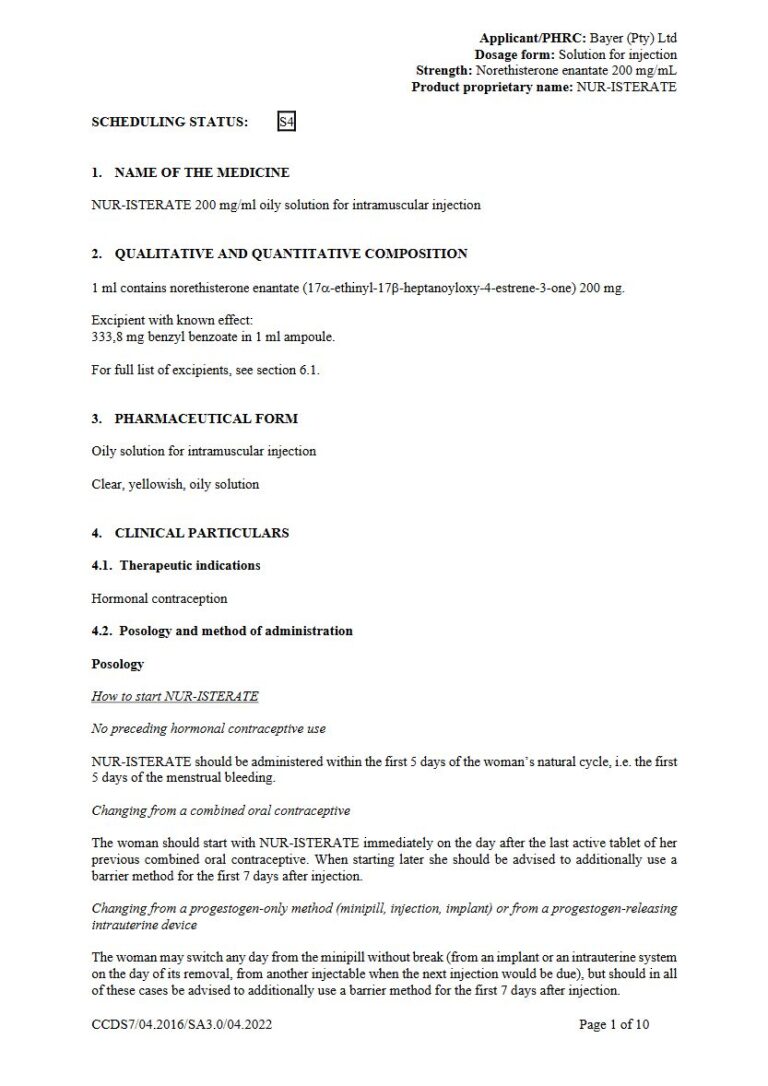
Hormonal contraception
4.2. Posology and method of administration
Posology
How to start NUR - ISTERATE
No preceding hormonal contraceptive use
NUR - ISTERATE should be administered within the first 5 days of the womanu2019s natural cycle, i.e. the first 5 days of the menstrual bleeding.
Changing from a combined oral contraceptive
The woman should start with NUR - ISTERATE immediately on the day after the last active tablet of her previous combined oral contraceptive. When starting later she should be advised to additionally use a barrier method for the first 7 days after injection.
Changing from a progestogen - only method (minipill, injection, implant) or from a progestogen - releasing intrauterine device
The woman may switch any day from the minipill without break (from an implant or an intrauterine system on the day of its removal, from another injectable when the next injection would be due), but should in all of these cases be advised to additionally use a barrier method for the first 7 days after injection.
Following abortion or delivery
NUR - ISTERATE may be used immediately after delivery or abortion as long as there are no medical objections. For breastfeeding women see section 4.6.
Management of next injections
The next three injections are to be given in intervals of 8 weeks, after which a further injection is required every 12 weeks (84 days). If the injection interval is extended beyond this, no adequate contraceptive protection will be available from the 13th week onwards and the woman should be advised accordingly to use additional contraceptive measures. Should technical reasons make it impossible to maintain the 84 - day injection interval, a 2 - month regimen can alternatively be adopted, as was done in an extensive WHO study. In any case, if no withdrawal bleeding has occurred within the preceding 10 weeks, pregnancy must be ruled out by means of a suitable test.
Method of administration
NUR - ISTERATE must always be administered as a deep intramuscular injection (preferably intragluteal, alternatively into the upper arm deltoid muscle). The injection must be administered extremely slowly (see section 4.8). It is advisable to place a plaster over the injection site after the injection to prevent any reflux of the NUR - ISTERATE solution.
4.3. Contraindications
- Hypersensitivity to the active substance or to any of the excipients listed in section 6.1.
- Known or suspected pregnancy.
- Venous thromboembolic disorders or history thereof.
- Arterial and cardiovascular disease present or in history (e.g. myocardial infarction, cerebrovascular accident, ischaemic heart disease).
- Uncontrolled hypertension.
- Acute hepatic disease or history of severe hepatic disease as long as liver function values have not returned to normal.
- Primary biliary cirrhosis, Dubin - Johnson syndrome, Rotor syndrome.
- Presence or history of liver tumours (benign or malignant).
- History of idiopathic jaundice of pregnancy or severe pruritus of pregnancy.
- Known or suspected sex - steroid influenced malignancies (e.g. of the genital organs or the breast).
- Diabetes mellitus with vascular involvement.
- Disturbances of lipometabolism.
- Undiagnosed vaginal bleeding.
- Porphyria
4.4. Special warnings and precautions for use
Circulatory disorders
According to the present state of knowledge, an association between the use of hormonal contraceptives and an increased risk of venous and arterial thromboembolic diseases cannot be ruled out. The relative risk of arterial thromboses (e.g. stroke, myocardial infarction) appears to increase further when heavy smoking, increasing age and the use of hormonal contraceptives coincide. In women with hypertension the risk of stroke may be slightly enhanced by NUR - ISTERATE. There may be an increased risk of venous thromboembolism (deep venous thrombosis, pulmonary embolism) associated with the use of NUR - ISTERATE. In case of prolonged immobilisation it is advisable to discontinue the use of NUR - ISTERATE (in the case of elective surgery, 12 weeks in advance) and not to resume until two weeks after complete remobilisation.
No further injection should be given:
- if first signs of thrombophlebitis or thromboembolic disease (e.g. unusual pain in the legs or swelling of the legs, stabbing pains on breathing, or coughing for no apparent reason) are noted, or if a feeling of pain and tightness in the chest are experienced,
- in case of symptoms of an arterial or venous thrombotic event or suspicion thereof,
- if migrainous headaches occur for the first time,
- if recurrent, unusually severe headaches or headaches with a new pattern develop,
- if sudden perceptual disorders (e.g. disturbances of vision or hearing) occur.
Tumours
Cases of benign liver tumours, and malignant liver tumours have been reported in users of hormonal contraceptives. In isolated cases, these tumours have led to life - threatening intra - abdominal haemorrhages. A hepatic tumour should be considered in the differential diagnosis when severe upper abdominal pain, liver enlargement or signs of intra - abdominal haemorrhage occur in women using NUR - ISTERATE.
Other conditions
Progestogen - only contraceptives such as NUR - ISTERATE generally do not appear to affect blood pressure in normotensive women. Small increases in blood pressure have been reported in one study using injectable contraceptives, however, clinically relevant increases are rare. If a sustained clinically significant hypertension develops, then it is prudent for the physician to stop using NUR - ISTERATE and treat the hypertension. Where considered appropriate, the use of NUR - ISTERATE may be resumed if normotensive values can be achieved with antihypertensive therapy.
The following conditions have been reported to occur or deteriorate, but the evidence of an association is inconclusive: jaundice and/or pruritus related to cholestasis; gallstone formation; systemic lupus erythematosus; haemolytic uraemic syndrome; Sydenhamu2019s chorea. Recurrence of cholestatic jaundice and/or pruritus which occurred first during pregnancy or previous use of sex steroids necessitates the discontinuation of NUR - ISTERATE. Chloasma may occur, especially in women with a history of chloasma gravidarum. Women with a tendency to chloasma should not use NUR - ISTERATE. If there is a history of extrauterine pregnancy or one tube is missing, the use of NUR - ISTERATE should be decided on only after carefully weighing the benefits against the risks. If obscure lower abdominal complaints occur together with an irregular cycle pattern (above all amenorrhoea followed by persistent bleeding), an extrauterine pregnancy must be considered.
Depressed mood and depression are well - known undesirable effects of hormonal contraceptive use (see section 4.8). Depression can be serious and is a well - known risk factor for suicidal behaviour and suicide. Women should be advised to contact their physician in case of mood changes and depressive symptoms, including shortly after initiating the treatment. No further injection should be given, if during treatment, recurrence of earlier depression is experienced.
Although NUR - ISTERATE may have a slight effect on peripheral insulin resistance and glucose tolerance there is generally no need to alter the therapeutic regimen in diabetics using progestogen - only contraceptives. However, diabetic women, also those with a history of gestational diabetes mellitus, should be carefully observed while using NUR - ISTERATE.
Partial metabolism of norethisterone to ethinylestradiol
Norethisterone is partly metabolised to ethinylestradiol after intramuscular NUR - ISTERATE administration in humans. This conversion results in a systemic ethinylestradiol exposure corresponding to an oral equivalent dose of about 4 u03bcg ethinylestradiol per day on average over 8 weeks. Mean oral equivalent doses per day are about 10 u03bcg ethinylestradiol during the first 2 weeks after NUR - ISTERATE administration and decline to about 5 u03bcg ethinylestradiol in the 3rd week and about 2 u03bcg ethinylestradiol from the 5th week onwards. Mean maximum oral equivalent dose of 20 u03bcg ethinylestradiol per day were not exceeded (see section 5.2). Based on these data systemic estrogen effects cannot be excluded.
Medical examination/consultation
A complete medical history should be taken and a physical and gynaecological examination should be performed prior to the initiation or reinstitution of the use of NUR - ISTERATE, guided by the contraindications and warnings (see sections 4.3 and 4.4) and these should be repeated at least annually during the use of NUR - ISTERATE. The frequency and nature of these assessments should be adapted to the individual woman but should generally include special reference to blood pressure, breasts, abdomen and pelvic organs, and should also include cervical cytology. Women should be advised that progestogen - only contraceptives do not protect against HIV infections (AIDS) and other sexually transmitted infections.
Reduced efficacy
The efficacy of NUR - ISTERATE will be reduced in the event of e.g. a prolonged injection interval (see section 4.2) or concomitant medication (see section 4.5).
Reduced cycle control
Menstrual bleeding
Individually different cycle disturbances commonly occurs during the treatment. If, however, the women are informed about this before the start of the treatment, these disturbances are rarely a reason for the withdrawal of NUR - ISTERATE. In general, the cycle under NUR - ISTERATE does not change significantly in about 50 to 70 % of the women (bleeding intervals between 26 and 35 days, duration of bleeding 1 to 7 days). However, only about 15 % will have consistently normal cycles.
Amenorrhoea
Amenorrhoea occurred in 8 to 25 % of the women during clinical investigations. It was generally of short duration and disappeared again in the further course of treatment. However, 0.5 % of women had persistent amenorrhoea for at least one year. If the use of NUR - ISTERATE has been discontinued because of amenorrhoea, further diagnostic measures are necessary to exclude pregnancy or other causes.
Procedure in the event of intermenstrual bleeding
Intermenstrual bleeding can occur either as spotting or with menstrual intensity. These disturbances need not concern the patient and do not impair the contraceptive reliability. Treatment is usually unnecessary. If bleeding irregularities persist or occur after previous regular cycles, then non - hormonal causes should be considered and adequate diagnostic measures are indicated to exclude malignancy or pregnancy.
Return to fertility
In clinical studies, ovulatory patterns are restored in most women within 12 weeks after discontinuation of NUR - ISTERATE. The normal ability to conceive usually returns about 4 to 5 months after the last injection. If a physiological cycle pattern fails to develop within this period of time, appropriate treatment is indicated in women who want children.
4.5. Interaction with other medicines and other forms of interaction
Note: The prescribing information of concomitant medications should be consulted to identify potential interactions.
There are no data on progestogen - only injectable drug interactions. Therefore, the following interactions are based on findings with combined oral contraceptives:
Effects of other medicines on NUR - ISTERATE
Interactions can occur with medicines that induce microsomal enzymes which can result in increased clearance of sex hormones and which may lead to changes in the uterine bleeding profile and/or contraceptive failure. Enzyme induction can already be observed after a few days treatment. Maximal enzyme induction is generally seen within a few weeks. After the cessation of medicine therapy enzyme induction may be sustained for about 4 weeks. Women on treatment with any of these medicines should temporarily use a barrier method in addition to NUR - ISTERATE or choose another method of contraception. The barrier method should be used during the time of concomitant medicine administration and for 28 days after their discontinuation.
Substances increasing the clearance of sex hormones (diminished efficacy by enzyme induction) e.g.: Phenytoin, barbiturates, primidone, carbamazepine, rifampicin and possibly also oxcarbazepine, topiramate, felbamate, griseofulvin, rifabutin and products containing St Johnu2019s wort.
Substances with variable effects on the clearance of sex hormones
When co - administered with sex hormones, many HIV/HCV protease inhibitors and non - nucleoside reverse transcriptase inhibitors can increase or decrease plasma concentrations of the progestin. These changes may be clinically relevant in some cases.
Substances decreasing the clearance of sex hormones (enzyme inhibitors)
Strong and moderate CYP3A4 inhibitors such as azole antifungals (e.g. fluconazole, itraconazole, ketoconazole, voriconazole), verapamil, macrolides (e.g. clarithromycin, erythromycin), diltiazem and grapefruit juice can increase plasma concentrations of the progestin.
Effects of NUR - ISTERATE on other medicines
Hormonal contraceptives may affect the metabolism of certain other medicines. Accordingly, plasma and tissue concentrations may be affected (e.g. ciclosporin).
Other forms of interactions
Laboratory tests
The use of contraceptive steroids may influence the results of certain laboratory tests, including biochemical parameters of liver, thyroid, adrenal and renal function, plasma levels of (carrier) proteins, e.g. corticosteroid binding globulin and lipid/lipoprotein fractions, parameters of carbohydrate metabolism and parameters of coagulation and fibrinolysis. Changes generally remain within the normal laboratory range.
4.6. Pregnancy and lactation
Pregnancy
The administration of NUR - ISTERATE during pregnancy is contraindicated (see section 4.3). If pregnancy occurs during treatment, further injections must not be given. Virilisation of the external sex characteristics of female neonates were described following administration of preparations containing norethisterone, such as NUR - ISTERATE, this being associated with the androgenic residual effect of these substances. Since it cannot be stated unequivocally that such a situation will not occur with NUR - ISTERATE, injection during pregnancy u2013 and particularly in the sensitive phase after the first month of pregnancy u2013 is contraindicated.
Lactation
NUR - ISTERATE has no inhibiting influence on lactation. However, small quantities of NUR - ISTERATE may be eliminated with the milk. It is therefore possible that the degradation of bilirubin in neonates will be impaired, particularly during the first week of life. If the newborn is suffering from severe or persistent jaundice which requires medical treatment, breastfeeding must be interrupted for the time of treatment. There appear to be no adverse effects on infant growth or development when using any progestogen - only method after six weeks postpartum. Progestogen - only methods do not appear to affect the quantity or quality of breast milk, however, minute amounts of the active substance are excreted with the milk. Transfer of norethisterone into motheru2019s milk is negligible. During the first week after IM injection 200 mg norethisterone enantate, a daily intake of norethisterone with motheru2019s milk in the range of 0.5 u03bcg to 2.4 u03bcg was calculated from norethisterone concentrations in the milk, assuming that the infant ingests 600 ml milk daily.
4.7. Effects on ability to drive or use machines
NUR - ISTERATE may cause adverse reactions such as dizziness that may affect the ability to drive and use machinery. Patients should be advised not to drive and use machines if they feel dizzy.
4.8. Undesirable effects
Relatively frequent side effects are cycle disturbances in the form of spotting, excessive menstrual bleeding, breakthrough bleeding and amenorrhoea of short duration. These disturbances do not impair contraceptive reliability. Treatment should only be considered for persistent bleeding.
Cycle disturbances are rarely reasons for withdrawal of NUR - ISTERATE.
System organ class
Very common (u2265 1/10)
Common (u2265 1/100 and < 1/10)
Uncommon (u2265 1/1000 and < 1/100)
Immune system disorders
Hyper sensitivity reaction
Metabolism and nutrition disorders
Increased weight
Psychiatric disorders
Depressed mood
Nervous system disorders
Dizziness
Headache
Gastrointestinal disorders
Nausea
Skin and subcutaneous tissue disorders
Skin disorder
Reproductive system and breast disorders
Uterine/vaginal bleeding including spotting
Amenorrhoea (short lasting)
Breast discomfort
General disorders and administration site conditions
Injection site reaction
Bloating
The most appropriate MedDRA term is used to describe a certain reaction and its synonyms and related conditions.
Respiratory, thoracic and mediastinal disorders
Experience has shown that the short - lasting reactions (urge to cough, paroxysmal cough, respiratory distress) which occur in isolated cases during or immediately after the injection of oily solutions can be avoided by injecting the solution extremely slowly.
Reporting of suspected adverse reactions
Reporting suspected adverse reactions after authorisation of the medicine is important. It allows continued monitoring of the benefit/risk balance of the medicine. Health care providers are asked to report any suspected adverse reactions to SAHPRA via the u201c6.04 Adverse Drug Reactions Reporting Formu201d found online under SAHPRAu2019s publications: https://www.sahpra.org.za/Publications/Index/8
4.9. Overdose
There have been no reports of serious deleterious effects from overdose. There are no antidotes and further treatment should be symptomatic.
