
Xolair 75 mg/0,5 ml/150 mg/1,0 ml Solution
PDF Leaflet Revision Date: 08 April 2025
Clinical Summary
Quick overview from the medicine insert
Indication
For severe persistent allergic asthma, chronic spontaneous urticaria, and nasal polyps.
Dosage (summary)
75-600 mg subcutaneously every 2-4 weeks based on IgE levels and body weight.
Onset of Action / Duration
Onset: 4 weeks, Duration: Varies
Special Populations
- Elderly
- Children under 6 years
- Renal impairment
- Hepatic impairment
Pregnancy & Breastfeeding
Safety in pregnancy and breastfeeding not established.
Key Drug Interactions
- Corticosteroids
- Beta agonists
- Antihistamines
Contraindications
- Hypersensitivity to omalizumab or excipients
Common side effects
- Headache
- Injection site reactions
- Fatigue
Counselling Points
- Monitor for signs of anaphylaxis
- Do not discontinue corticosteroids abruptly
- Store in refrigerator
Serious warnings
- Risk of anaphylaxis
- Not for acute asthma exacerbations
Important Disclaimer
The Xolair 75 mg/0,5 ml/150 mg/1,0 ml Solution professional information leaflet below is the property of Novartis South Africa and is provided on Medinsert exactly as issued, with no.. alterations or editorial changes. We make every effort to keep content current by updating documents as soon as new versions become available. Medinsert serves as a trusted access point for healthcare professionals, but does not replace official sources or clinical judgement. For more details, please read our full disclaimer. read more>>
 Healthcare Professionals Only
This content is for registered healthcare professionals
Sign in or create a free account to read the full package insert.
Free for HPCSA-registered professionals. Powered by Medinsert.
Clinical Particulars
Section 4 of the official insert — extracted exactly as issued, no alterations
4.1 Therapeutic indications
Allergic Asthma: Adults and adolescents (12 years of age and older) XOLAIR is indicated for the prevention of asthma exacerbations and control of asthma symptoms, when given as add-on therapy for patients with severe persistent allergic asthma who have a positive skin test or in vitro reactivity to a perennial aeroallergen and who have reduced lung function (FEV 1 < 80 %), as well as frequent daytime symptoms or night-time awakenings, and who have had multiple documented severe asthma exacerbations, despite daily high-dose inhaled corticosteroids, plus a long-acting inhaled beta 2 -agonist.
Children (6 to < 12 years of age) XOLAIR is indicated as add-on therapy to reduce the dose of inhaled corticosteroids in patients with severe persistent allergic asthma who have a positive skin test or in vitro reactivity to a perennial aeroallergen and frequent daytime symptoms or night-time awakenings.
XOLAIR treatment should only be considered for patients with convincing IgE (immunoglobulin E) mediated asthma. Safety and efficacy have not been established in other allergic conditions.
Chronic Spontaneous Urticaria (CSU): XOLAIR (omalizumab) is indicated for adults and adolescents (12 years of age and above) with chronic spontaneous urticaria refractory to standard of care.
Nasal Polyps: XOLAIR (omalizumab) is indicated for adults (18 years of age and above) for the treatment of nasal polyps with inadequate response to intranasal corticosteroids.
4.2 Posology and method of administration
Posology For subcutaneous administration only. Do not administer by the intravenous or intramuscular route.
Dosage for Allergic Asthma and Nasal Polyps: Dosing for asthma and nasal polyps follows the same dosing principles. The appropriate dose and dosing frequency of XOLAIR for these conditions is determined by baseline IgE (IU/mL), measured before the start of treatment, and body weight (kg). Prior to initial dosing, patients should have their IgE level determined by any commercial serum total IgE assay for their dose assignment. Based on these measurements 75 u2013 600 mg of XOLAIR in 1 to 4 injections may be needed for each administration. Patients with IgE lower than 76 IU/mL were less likely to experience benefit. Prescribing physicians should ensure that patients with IgE below 76 IU/mL have unequivocal in vitro reactivity (RAST) to a perennial allergen before starting therapy. See Table 4-1 and 4-2 for a conversion chart and Tables 5 and 6 for the dose determination charts in children (6 years to less than 12 years of age) and in adults and adolescents (12 years of age and older). Patients whose baseline IgE levels or body weight in kilograms are outside the limits of the dosing table should not be given XOLAIR.
Table 4-1: Conversion from dose to number of vials, number of injections and total injection volume for each administration
Table 4-2: Conversion from dose to number of pre-filled syringes, number of injections and total injection volume for each administration
Administration For information on reconstitution of XOLAIR, see Instructions for use and handling, and disposal. Treatment duration, monitoring and dose adjustments At 16 weeks after commencing XOLAIR therapy patients should be assessed by their physician for treatment effectiveness before further injections are administered. The decision to continue XOLAIR should be based on whether a marked improvement in overall asthma control is seen.
Dosage for Chronic Spontaneous Urticaria (CSU): The recommended dose is 300 mg by subcutaneous injection every four weeks. Some patients may achieve control of their symptoms with a dose of 150 mg every four weeks. Dosing of XOLAIR in CSU patients is not dependent on serum total IgE (IU/mL) or body weight (kg).
Elderly (65 years of age and older) There are limited data available on the use of XOLAIR in patients older than 65 years but there is no evidence that elderly patients require a different dosage from younger adult patients.
Children (below 6 years of age) In allergic asthma, XOLAIR is not recommended for use in children below age 6 due to insufficient data on safety and efficacy. In chronic spontaneous urticaria, safety and efficacy in paediatric patients below the age of 12 years have not been established.
Special populations Paediatric population In nasal polyps, safety and efficacy in patients below the age of 18 years have not been established.
Method of administration Pre-filled syringe and pre-filled pen For subcutaneous administration only. XOLAIR must not be administered by the intravenous or intramuscular route. Doses of more than 150 mg should be divided across two or more injection sites. Patients with no known history of anaphylaxis may self-inject XOLAIR or be injected by a caregiver from the 4th dose onwards if a physician determines that this is appropriate (see section 4.4). The patient or the caregiver must have been trained in the correct injection technique and the recognition of the early signs and symptoms of serious allergic reactions. Patients or caregivers should be instructed to inject the full amount of XOLAIR according to the instructions for use provided in section 4.2.
4.3 Contraindications
- Known hypersensitivity to the active substance or to any of the excipients.
4.4 Special warnings and precautions for use
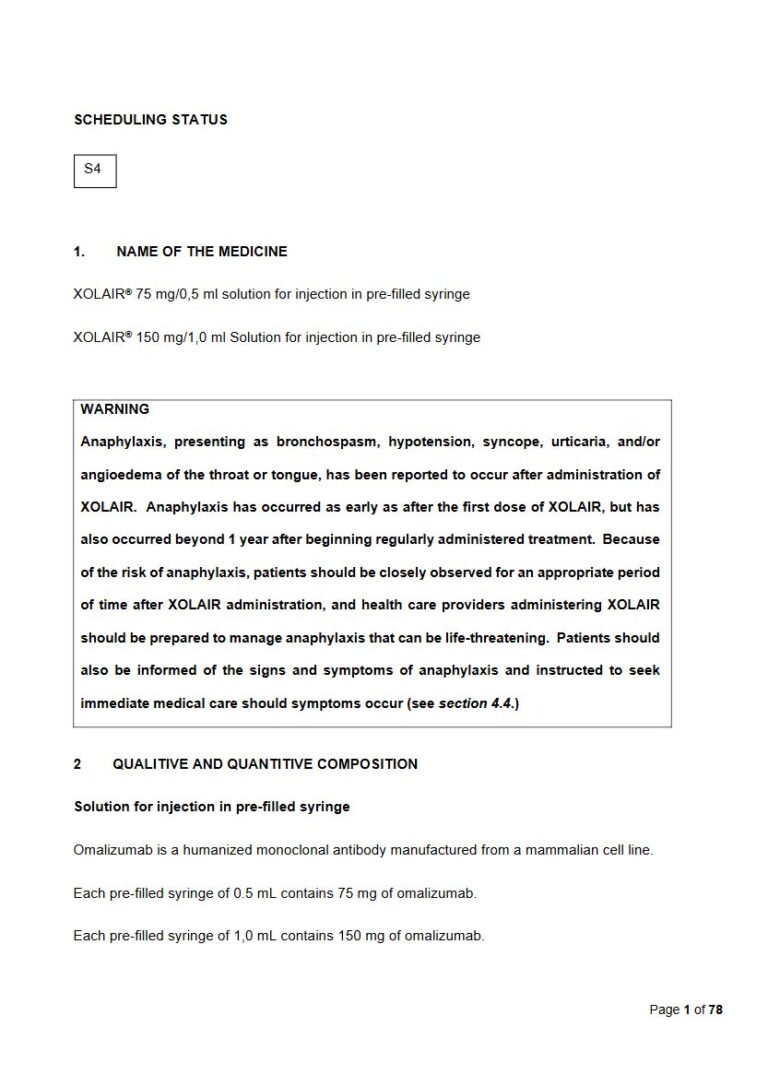
Anaphylaxis Anaphylaxis has been reported to occur after administration of XOLAIR in pre-marketing clinical trials and in post-marketing spontaneous reports. Signs and symptoms in these reported cases have included bronchospasm, hypotension, syncope, urticaria, and/or angioedema of the throat or tongue. Some of these events have been life-threatening. In pre-marketing clinical trials the frequency of anaphylaxis attributed to XOLAIR use was estimated to be 0,1 %. In post-marketing spontaneous reports, the frequency of anaphylaxis attributed to XOLAIR use was estimated to be at least 0,2 % of patients based on an estimated exposure of about 57,300 patients from June 2003 through December 2006. Anaphylaxis has occurred as early as after the first dose of XOLAIR, but has also occurred beyond one year after beginning regularly scheduled treatment. XOLAIR should only be administered in a healthcare setting by healthcare providers prepared to manage anaphylaxis that can be life-threatening. Patients should be closely observed for an appropriate period of time after administration of XOLAIR, taking into account the time to onset of anaphylaxis seen in pre-marketing clinical trials and post-marketing spontaneous reports (see section 4.4). Patients should be informed of the signs and symptoms of anaphylaxis, and instructed to seek immediate medical care should signs or symptoms occur.
XOLAIR should be discontinued in patients who experience a severe hypersensitivity reaction (see section 4.3).
Special precautions General XOLAIR is not indicated for the treatment of acute asthma exacerbations, acute bronchospasm or status asthmaticus. XOLAIR has not been studied in patients with hyper immunoglobulin E syndrome or allergic bronchopulmonary aspergillosis or for the prevention of anaphylactic reactions, including those provoked by food allergy. XOLAIR is not intended for the treatment of these conditions. XOLAIR has not been adequately studied in atopic dermatitis or allergic rhinitis. XOLAIR therapy has not been studied in patients with autoimmune diseases, immune complex-mediated conditions, or those with pre-existing renal or hepatic impairment. Caution should be exercised when administering XOLAIR in these patient populations. Abrupt discontinuation of systemic or inhaled corticosteroids after initiation of XOLAIR therapy in allergic asthma or nasal polyps is not recommended. Decreases in corticosteroids should be performed under the direct supervision of a physician and may need to be performed gradually.
Immune system disorders Allergic reactions type I Type I local or systemic allergic reactions, including anaphylaxis and anaphylactic shock, may occur when taking omalizumab, also with onset after a long duration of treatment. Most of these reactions occurred within 2 hours after the first and subsequent injections of XOLAIR but some started beyond 2 hours and even beyond 24 hours after the injection. Therefore, medicinal products for the treatment of anaphylactic reactions should be available for immediate use following administration of XOLAIR. Patients should be informed that such reactions are possible, and prompt medical attention should be sought if allergic reactions occur. Patients may in rare cases develop antibodies to omalizumab.
Serum Sickness Serum sickness and serum sickness-like reactions, which are delayed allergic type III reactions, have rarely been seen in patients treated with humanized monoclonal antibodies including omalizumab. The suggested pathophysiologic mechanism includes immune-complex formation and deposition due to development of antibodies against omalizumab. The onset has typically been 1 - 5 days after administration of the first or subsequent injections, also after long duration of treatment. Symptoms suggestive of serum sickness include arthritis/arthralgiau2019s, rash (urticaria or other forms), fever and lymphadenopathy. Antihistamines and corticosteroids may be useful for preventing or treating this disorder, and patients should be advised to report any suspected symptoms.
Churg-Strauss syndrome and hypereosinophilic syndrome Patients with severe asthma may rarely present with systemic hypereosinophilic syndrome or allergic eosinophilic granulomatous vasculitis (Churg-Strauss syndrome), both of which are usually treated with systemic corticosteroids. Patients on therapy with anti-asthma agents, including XOLAIR, may present or develop systemic eosinophilia and vasculitis. These events are commonly associated with the reduction of oral corticosteroid therapy. In these patients, physicians should be alert to the development of marked eosinophilia, vasculitic rash, worsening pulmonary symptoms, paranasal sinus abnormalities, cardiac complications, and/or neuropathy. Discontinuation of XOLAIR should be considered in all severe cases with the above-mentioned immune system disorders.
Parasitic (helminth) infections IgE may be involved in the immunological response to some helminth infections. In patients at chronic high risk of helminth infection, a placebo-controlled trial in allergic patients showed a slight increase in infection rate with omalizumab, although the course, severity, and response to treatment of infection were unaltered. The helminth infection rate in the overall clinical program, which was not designed to detect such infections, was less than 1 in 1,000 patients. However, caution may be warranted in patients at high risk of helminth infection, in particular when traveling to areas where helminthic infections are endemic. If patients do not respond to recommended anti-helminth treatment, discontinuation of XOLAIR should be considered.
Pre-filled syringe, latex-sensitive individuals The removable needle cap of XOLAIR solution for injection in pre-filled syringe contains a derivative of natural rubber latex. Although no natural rubber latex is detected in the removable needle cap, the safe use of XOLAIR solution for injection in pre-filled syringe in latex-sensitive individuals has not been studied.
4.5 Interaction with other medicines and other forms of interactions
Cytochrome P450 enzymes, efflux pumps and protein binding mechanisms are not involved in the clearance of omalizumab, thus there is little potential for drug-drug interactions. Medicinal product or vaccine interaction studies have not been performed with XOLAIR. There is no pharmacological reason to expect that commonly prescribed medicinal products used in the treatment of asthma or CSU will interact with omalizumab.
Allergic Asthma: In clinical studies XOLAIR was commonly used in conjunction with inhaled and oral corticosteroids, inhaled short-acting and long-acting beta agonists, leukotriene modifiers, theophyllines and oral antihistamines. There was no indication that the safety of XOLAIR was altered with these other commonly used asthma medications. Limited data are available on the use of XOLAIR in combination with specific immunotherapy (hypo-sensitisation therapy).
Chronic Spontaneous Urticaria (CSU): In clinical studies in CSU XOLAIR was used in conjunction with antihistamines (anti-H1, anti-H2) and leukotriene receptor antagonists (LTRAs). In the phase III studies Q4881g and Q4882g all patients received H1 antihistamines in addition to XOLAIR or placebo. In the phase III study Q4883g, all patients received one or more H1 antihistamine(s), and/or H2 antihistamines and/or LTRAs in addition to XOLAIR or placebo. There was no evidence that the safety of omalizumab was altered when used with these medicinal products relative to its known safety profile in allergic asthma. In addition, a population pharmacokinetic analysis showed no relevant effect of H2 antihistamines and LTRAs on omalizumab pharmacokinetics (see section 5.2).
Usage of XOLAIR in combination with immunosuppressive therapies has not been studied.
Nasal Polyps In clinical studies XOLAIR was used in conjunction with intranasal mometasone spray per protocol. Other commonly used concomitant medications included other intranasal corticosteroids, bronchodilators, antihistamines, leukotriene receptor antagonists, adrenergics/sympathomimetics, and local nasal anaesthetics. There was no indication that the safety of XOLAIR was altered with these other commonly used nasal polyps medications.
4.6 Fertility, pregnancy and lactation
Women of childbearing potential/ Contraception in males and females There are no special recommendations for women of childbearing potential.
Pregnancy Safety in pregnancy has not been established.
Breastfeeding Safety with lactation has not been established.
Fertility No data available.
4.7 Effects on ability to drive and use machines
Patients receiving XOLAIR should be warned that if they experience dizziness, fatigue, faintness or drowsiness, they should not drive or use machinery.
4.8 Undesirable effects
a. Summary of the safety profile Allergic Asthma: Over 4,400 allergic asthma patients were randomised in controlled efficacy trials with XOLAIR. During clinical trials with adults and adolescent patients 12 years of age and older the most commonly reported adverse reactions were headaches and injection site reactions, including injection site pain, swelling, erythema and pruritus. In clinical trials with patients 6 to < 12 years of age, the most commonly reported adverse reactions were headache, pyrexia and upper abdominal pain. Most of the reactions were mild or moderate in severity.
Table 7 lists the adverse reactions recorded in clinical studies in the total allergic asthma safety population treated with XOLAIR by system organ class and by frequency. Within each frequency grouping, adverse reactions are presented in order of decreasing seriousness. Frequencies are defined as: Very common ( u2265 1/10), common ( u2265 1/100; < 1/10), uncommon ( u2265 1/1000; < 1/100), rare (< 1/1000), very rare (< 1/10,000).
Table 7: Adverse reactions from the clinical studies Infections and infestations Uncommon Rare Pharyngitis Parasitic infections Immune system disorders Rare Anaphylactic reaction and other serious allergic conditions, antitherapeutic antibody development Nervous system disorders Common Headache** Uncommon Syncope, paraesthesia, somnolence, dizziness Vascular disorders Uncommon Postural hypotension, flushing Respiratory, thoracic and mediastinal disorders Uncommon Allergic bronchospasm, pharyngitis, coughing Rare Laryngoedema Gastrointestinal disorders Common Abdominal pain upper* Uncommon Dyspeptic signs and symptoms, diarrhoea, nausea Skin and subcutaneous tissue disorders Uncommon Photosensitivity, urticaria, rash, pruritus Rare Angioedema General disorders and administration site conditions Very common Pyrexia* Common Injection site reactions such as swelling, erythema, pain, pruritus Uncommon Influenza-like illness, swelling arms, weight increase, fatigue ** Very common in children 6 to < 12 years of age * In children 6 to < 12 year of age.
Events reported in the post-marketing setting are listed with frequency not known (cannot be estimated from the available data): Blood and the lymphatic system disorders Not known Idiopathic severe thrombocytopenia Immune system disorders Not known Serum sickness, may include fever and lymphadenopathy Anaphylaxis and anaphylactoid reactions have been reported following the first or subsequent administrations, serum sickness Respiratory, thoracic and mediastinal disorders Not known Allergic granulomatous vasculitis (i.e. Churg Strauss syndrome) Skin and subcutaneous tissue disorders Not known Alopecia Musculoskeletal and connective tissue disorders Not known Arthralgia, myalgia, joint swelling Blood (platelets) Not known Cases of idiopathic thrombocytopenia Parasitic infections Not known Increase in the infection rate in patients at chronic high risk of helminth infection.
4.9 Overdose
In overdose, side effects can be precipitated and/or be of increased severity (see section 4.8). Maximum tolerated dose of XOLAIR has not been determined. Single intravenous doses up to 4000 mg have been administered to patients without evidence of dose-limiting toxicities. The highest cumulative dose administered to patients was 44,000 mg over a 20-week period and this dose did not result in any untoward acute effects.
