
Oritaxim 500 and 1000mg sterile powder for injection
PDF Leaflet Revision Date: 08 August 2025
Clinical Summary
Quick overview from the medicine insert
Indication
Indicated for various infections including genito-urinary, skin, respiratory, gastrointestinal, and meningitis.
Dosage (summary)
Adults: 2 g daily in 2 injections; may increase to 3-4 g in severe cases. Pediatrics: 50-100 mg/kg daily.
Onset of Action / Duration
Onset: 30 mins, Duration: 6-8 hours
Special Populations
- Renal impairment
Pregnancy & Breastfeeding
Not established as safe in pregnancy; crosses into breast milk.
Key Drug Interactions
- Aminoglycosides
- Probenecid
Contraindications
- Hypersensitivity to cefotaxime
- History of immediate-type hypersensitivity to cephalosporins
Common side effects
- Superinfection
- Leukopenia
- Dizziness
- Diarrhea
Counselling Points
- Monitor for allergic reactions
- Report severe diarrhea
- Avoid driving if dizzy
Serious warnings
- Serious hypersensitivity reactions
- Pseudomembranous colitis
- Severe skin reactions
Important Disclaimer
The Oritaxim 500 and 1000mg sterile powder for injection professional information leaflet below is the property of Pharma-Q and is provided on Medinsert exactly as issued, with no.. alterations or editorial changes. We make every effort to keep content current by updating documents as soon as new versions become available. Medinsert serves as a trusted access point for healthcare professionals, but does not replace official sources or clinical judgement. For more details, please read our full disclaimer. read more>>
 Healthcare Professionals Only
This content is for registered healthcare professionals
Sign in or create a free account to read the full package insert.
Free for HPCSA-registered professionals. Powered by Medinsert.
Clinical Particulars
Section 4 of the official insert — extracted exactly as issued, no alterations
4.1 Therapeutic indications
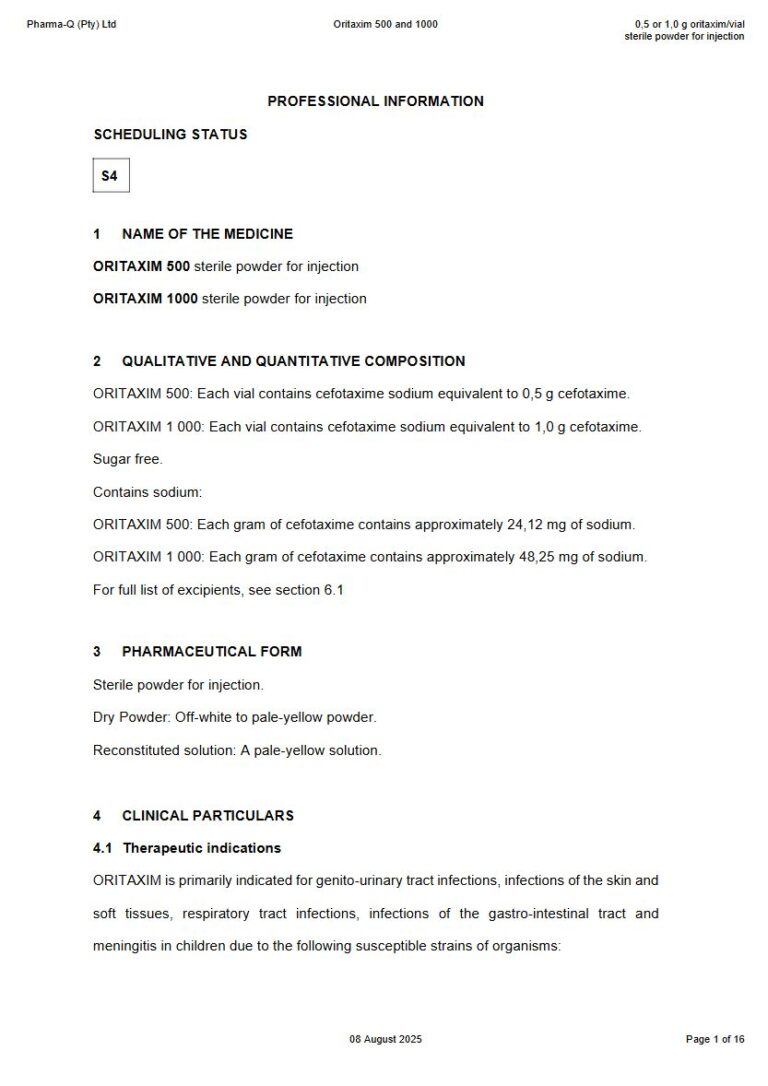
ORITAXIM is primarily indicated for genito-urinary tract infections, infections of the skin and soft tissues, respiratory tract infections, infections of the gastro-intestinal tract and meningitis in children due to the following susceptible strains of organisms:
Infections due to Streptococcus (Group D Streptococci and B-haemolytic Streptococci): Otitis media, sinusitis, pneumonia, pharyngitis, follicular tonsillitis, scarlet fever, urinary tract infections, (enterococci), meningitis in children, septic sore throat and cellulitis.
Infections due to Staphylococcus (Infections of non-penicillinase- and penicillinase producing strains included): Bronchitis, impetigo, furunculosis and abscess.
Infections due to Escherichia coli: Infections of the urinary tract, meningitis in paediatrics and lobar pneumonia.
Infections due to Haemophilius influenzae: Meningitis in paediatrics, otitis media and bronchitis of the larynx and trachea.
Gonococcal infections: Gonorrhoea.
Infections due to Neisseria meningitides: Paediatric meningitis.
Infections due to Salmonella: Enteritis.
Infections due to Shigella: Dysentery (Bacillus).
Pseudomonoas aeruginosa (Sensitive strains): Sepsis.
Infections due to Pneumococcus: Cellulitis, lobar pneumonia, otitis and bronchitis.
The causative organisms and its sensitivity to cefotaxime sodium must be determined by means of bacteriological studies.
Prophylactically: If administered peri-operatively in patients undergoing surgery, ORITAXIM may reduce the incidences of potentially contaminating post-operative infections. 1 g of ORITAXIM administered half-an-hour (30 mins) to one-and-a-half hours (90 mins) before surgery has been found to be the minimum effective dose.
4.2 Posology and method of administration
Posology
Dosage, route of administration and frequency of injections depends on the nature and severity of the infection, the condition of the patient and the sensitivity of the pathogens to ORITAXIM.
Prophylactically: The minimum effective dose has been found to be 1 g ORITAXIM 30 u2013 90 minutes prior to surgery.
Adults: 2 g daily administered as two injections of 1 g. In severe infections, the dose may be increased to 3 g to 4 g daily given in two (2) to four (4) administrations.
Paediatrics: Infants and Children: A daily dose of 50 - 100 mg/kg body mass in two (2) to four (4) injections is usually recommended. Up to 200 mg/kg body mass daily may be administered in exceptional cases.
Neonates: The recommended dosage regimen for neonates is as follows:
- Neonates (0 to 1 week of age): 50 mg/kg body weight IV 12-hourly
- Neonates (1 to 4 weeks of age): 50 mg/kg body weight IV 8-hourly
The dosages above are applicable to both premature and full-term infants.
Special populations
Renal function impairment: Reduce the dose by 50 % in patients with a creatinine clearance of less than 20 ml/minute. Do not alter the dosing interval.
Method of administration
For intravenous or intramuscular use. See section 6.6 for the directions for preparation of injections.
4.3 Contraindications
- Hypersensitivity to cefotaxime, cephalosporin antibiotics or to any of the excipients of ORITAXIM (see section 6.1).
- Allergic cross reactions can exist between penicillins and cephalosporins (see section 4.4).
4.4 Special warnings and precautions for use
Anaphylactoid reactions
Preliminary enquiry about hypersensitivity to penicillin and other u03b2-Lactam antibiotics is necessary before prescribing cephalosporins since cross allergy occurs in 5 u2013 10 % of cases. The use of cefotaxime as in ORITAXIM is strictly contraindicated in subjects with a previous history of immediate-type hypersensitivity to cephalosporins. Since cross allergy exists between penicillins and cephalosporins, use of the latter should be undertaken with extreme caution in penicillin sensitive subjects. Serious, including fatal hypersensitivity reactions have been reported in patients receiving cefotaxime as in ORITAXIM (see sections 4.3 and 4.8). If a hypersensitivity reaction occurs, treatment must be stopped.
Hypersensitivity reactions can also progress to Kounis syndrome, a serious allergic reaction that can result in myocardial infarction (see section 4.8).
Superinfection
Prolonged use of ORITAXIM may result in the overgrowth of non-susceptible organisms i.e. superinfection with Candida, Enterococci or Clostridium difficile.
Clostridium difficile associated disease (e.g. pseudomembranous colitis)
Pseudomembranous colitis has been reported with the use of ORITAXIM. This side effect, which may occur more frequently in patients receiving higher doses for prolonged periods, should be considered as potentially serious. Diarrhoea, particularly if severe and/or persistent, occurring during treatment or in the initial weeks following treatment, may be symptomatic of Clostridium difficile associated disease (CDAD). CDAD may range in severity from mild to life-threatening, the most severe form of which is pseudo-membranous colitis. The diagnosis of this rare but possibly fatal condition can be confirmed by endoscopy and/or histology.
It is important to consider this diagnosis in patients who present with diarrhoea during or subsequent to the administration of ORITAXIM. If a diagnosis of pseudomembranous colitis is suspected, ORITAXIM should be stopped immediately, and appropriate specific antibody therapy should be started without delay. Clostridium difficile associated disease can be favoured by faecal stasis. Medicines that inhibit peristalsis should not be given.
Severe skin reactions
Severe cutaneous adverse reactions (SCARs) including acute generalised exanthematous pustulosis (AGEP), Stevens-Johnson syndrome (SJS), toxic epidermal necrolysis (TEN), drug reaction with eosinophilia and systemic symptoms (DRESS), which can be life-threatening or fatal, have been reported post-marketing in association with cefotaxime treatment. At the time of prescription patients should be advised of the signs and symptoms for skin reactions. If signs and symptoms suggestive of these reactions appear, ORITAXIM should be withdrawn immediately. If the patient has developed AGEP, SJS, TEN or DRESS with the use of ORITAXIM, treatment with ORITAXIM must not be restarted and should be permanently discontinued.
In children, the presentation of a rash can be mistaken for the underlying infection or an alternative infectious process, and medical practitioners should consider the possibility of a reaction to ORITAXIM in children that develop symptoms of rash and fever during therapy with ORITAXIM.
Patients with renal insufficiency
The dosage should be modified according to the creatinine clearance calculated. Patients with severe renal dysfunction should be placed on the dosage schedule recommended under section 4.2.
Caution should be exercised if ORITAXIM is administered together with aminoglycosides, probenecid or other nephrotoxic medicines (see section 4.5). Renal function must be monitored in these patients, the elderly, and those with pre-existing renal impairment.
Haematological reactions: Leukopenia, neutropenia, and less frequently, agranulocytosis may develop during treatment with ORITAXIM, particularly if given over long periods. For treatment courses lasting longer than 7 - 10 days, the blood white cell count should be monitored and treatment stopped in the event of neutropenia. Some cases of eosinophilia and thrombocytopenia, rapidly reversible on stopping treatment, have been reported. Cases of haemolytic anaemia have also been reported (see section 4.8).
Neurotoxicity
High doses of beta-lactam antibiotics, including ORITAXIM, particularly in patients with renal insufficiency, may result in encephalopathy (e.g. impairment of consciousness, abnormal movements and convulsions) (see section 4.8). Patients should be advised to contact their doctor immediately prior to continuing treatment if such reactions occur.
Precautions for administration
During post-marketing surveillance, potentially life-threatening dysrhythmia has been reported in a very few patients who received rapid intravenous administration of cefotaxime through a central venous catheter. The recommended time for injection or infusion should be followed (see section 4.2).
Sodium
ORITAXIM 500 contains 24,12 mg sodium per 500 mg vial, equivalent to 1,2 % of the WHO recommended maximum daily intake of 2 g sodium for an adult. ORITAXIM 1 000 contains 48,25 mg sodium per 500 mg vial, equivalent to 2,4 % of the WHO recommended maximum daily intake of 2 g sodium for an adult.
4.5 Interaction with other medicines and other forms of interaction
Aminoglycoside antibiotics and diuretics
ORITAXIM may potentiate the nephrotoxic effects of nephrotoxic medicines such as aminoglycosides or potent diuretics (e.g. furosemide). Renal function must be monitored (see section 4.4).
Uricosurics
Probenecid interferes with renal tubular transfer of cefotaxime, thereby increasing cefotaxime exposure about 2-fold and reducing renal clearance to about half at therapeutic doses. Due to the large therapeutic index of ORITAXIM, no dosage adjustment is needed in patients with normal renal function. Dosage adjustment may be needed in patients with renal impairment (see sections 4.4 and 4.2).
Interactions with Laboratory Tests
A false positive Coombs test may be seen during treatment with ORITAXIM. Haemolysis is not usually associated with the phenomenon, but it may interfere with cross-matching of blood. A false positive reaction to urinary glucose may occur with copper reduction methods (Benedict's, Fehling's or Clinitest), but not with the use of specific glucose oxidase methods. There is a potential for mezlocillin and azlocillin to reduce the clearance of cefotaxime.
4.6 Fertility, pregnancy and lactation
Pregnancy
The safety of ORITAXIM has not been established in human pregnancy. Animal studies do not indicate direct or indirect harmful effects with respect to reproductive toxicity. There are, however, no adequate and well controlled studies in pregnant women. Cefotaxime crosses the placental barrier. Therefore, ORITAXIM should not be used during pregnancy.
Breastfeeding
The safety of ORITAXIM has not been established in lactation. Cefotaxime passes into human breast milk in small amounts. Effects on the physiological intestinal flora of the breast-fed infant leading to diarrhoea, colonisation by yeast-like fungi, and sensitisation of the infant cannot be excluded.
4.7 Effects on ability to drive and use machines
ORITAXIM has been associated with dizziness, which may affect the ability to drive or operate machinery. There is no evidence that ORITAXIM directly impairs the ability to drive or to operate machines. High doses of ORITAXIM, particularly in patients with renal insufficiency, may cause encephalopathy (e.g. impairment of consciousness, abnormal movements and convulsions) (see section 4.8). Patients should be advised not to drive or operate machinery if any such symptoms occur.
4.8 Undesirable effects
Tabulated summary of adverse reactions
MedDRA system organ class Frequency Adverse reactions
Infections and infestations Frequency unknown Superinfection (see section 4.4)
Blood and lymphatic system disorders Less frequent Leukopenia, eosinophilia, thrombocytopenia Frequency unknown Neutropenia, granulocytopenia, agranulocytosis (see section 4.4), haemolytic anaemia
Immune system disorders Less frequent Jarisch-Herxheimer reaction Frequency unknown Anaphylactic reactions, angioedema, bronchospasm, anaphylactic shock
Nervous system disorders Less frequent Convulsions (see section 4.4) Frequency unknown Headache, dizziness, encephalopathy (e.g. impairment of consciousness, abnormal movements) (see section 4.4)
Cardiac disorders Frequency unknown Dysrhythmia following rapid bolus infusion through central venous catheter. Kounis syndrome (see section 4.4)
Gastrointestinal disorders Less frequent Diarrhoea Frequency unknown Nausea, vomiting, abdominal pain, Pseudomembranous colitis (see section 4.4)
Hepato-biliary disorders Less frequent Increase in liver enzymes (ALT, AST, LDH, gamma-GT and/or alkaline phosphatise) and/or bilirubin Frequency unknown Hepatitis (sometimes with jaundice)
Skin and subcutaneous tissue disorders Less frequent Rash, pruritus, urticaria, drug fever Frequency unknown Erythema multiforme, Stevens-Johnson syndrome SJS), toxic epidermal necrolysis (TEN), drug reaction with eosinophilia and systemic symptoms (DRESS) (see section 4.4), linear IgA disease
Renal and urinary disorders Less frequent Decrease in renal function/ increase of creatinine (particularly when co-prescribed with aminoglycosides) Frequency unknown Interstitial nephritis, candidiasis
General disorders and administration site conditions Frequent Tenderness and pain at the injection site Less frequent Fever, inflammatory reactions at the injection site, including phlebitis/thrombophlebitis
Description of selected adverse reactions
Jarisch-Herxheimer reaction For the treatment of borreliosis, a Jarisch-Herxheimer reaction may develop during the first days of treatment. The occurrence of one or more of the following symptoms has been reported after several week's treatment of borreliosis: skin rash, itching, fever, leukopenia, increase in liver enzymes, difficulty of breathing, joint discomfort.
Hepatobiliary disorders Increase in liver enzymes (ALAT, ASAT, LDH, gamma-GT and/or alkaline phosphatase) and/or bilirubin have been observed. These laboratory abnormalities may rarely exceed twice the upper limit of the normal range and elicit a pattern of liver injury, usually cholestatic and most often asymptomatic.
Reporting of suspected adverse reactions
Reporting suspected adverse reactions after authorisation of the medicine is important. It allows continued monitoring of the benefit/risk balance of the medicine. Health care providers are requested to report any suspected adverse drug reactions to SAHPRA via the Med Safety APP (Medsafety X SAHPRA) and eReporting platform (who-umc.org) found on SAHPRA website.
4.9 Overdose
Symptoms of overdose: Encephalopathy (impairment of consciousness, abnormal movements and seizures) has been reported.
Treatment of overdose: Treatment is symptomatic and supportive.
