
Zoxadon Odt Tablet
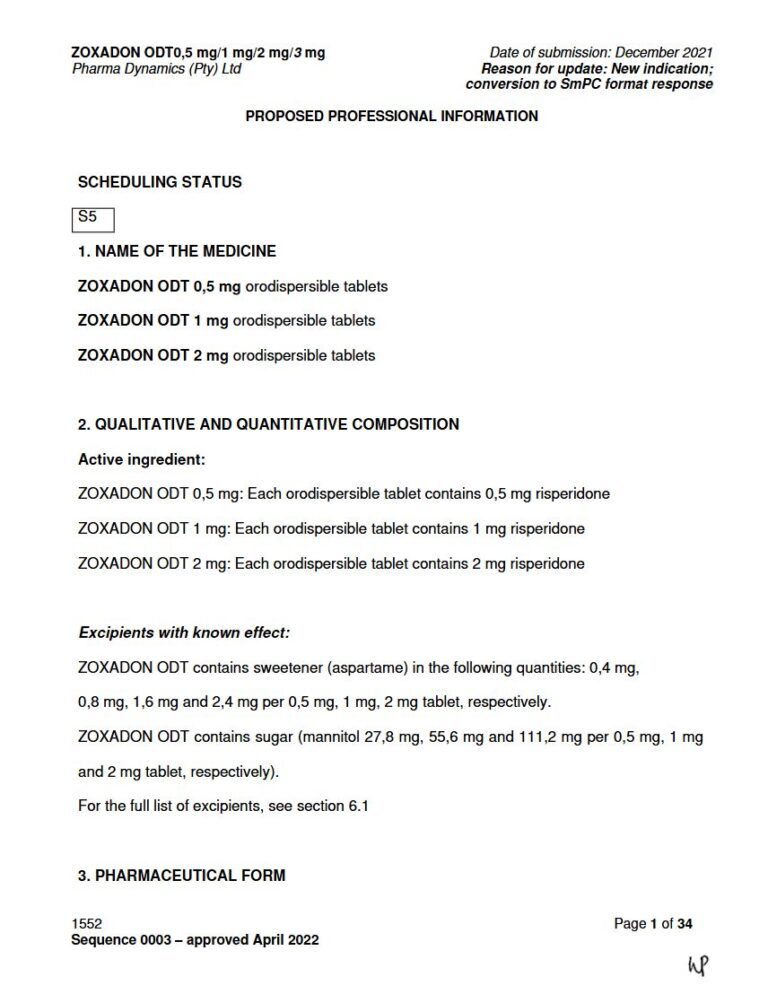
PDF Leaflet Revision Date: 06 April 2022
Clinical Summary
Quick overview from the medicine insert
Indication
Treatment of schizophrenia, conduct disorders in children, and mania in bipolar disorder.
Dosage (summary)
Adults: Start at 2 mg/day, may increase to 4-8 mg/day. Elderly: Start at 0.5 mg twice daily.
Special Populations
- Elderly
- Renal impairment
- Hepatic impairment
Pregnancy & Breastfeeding
Not established; avoid breastfeeding.
Key Drug Interactions
- QT prolonging drugs
- Centrally acting medicines
- Levodopa
Contraindications
- Hypersensitivity
- Children under 5 years
- Parkinson's disease
Common side effects
- Parkinsonism
- Headache
- Insomnia
Counselling Points
- Monitor weight regularly.
- Avoid abrupt discontinuation.
- Caution with driving and machinery.
Serious warnings
- Increased mortality in elderly with dementia
- Neuroleptic malignant syndrome
- Tardive dyskinesia
Important Disclaimer
The Zoxadon Odt Tablet professional information leaflet below is the property of Pharma Dynamics and is provided on Medinsert exactly as issued, with no.. alterations or editorial changes. We make every effort to keep content current by updating documents as soon as new versions become available. Medinsert serves as a trusted access point for healthcare professionals, but does not replace official sources or clinical judgement. For more details, please read our full disclaimer. read more>>
 Healthcare Professionals Only
This content is for registered healthcare professionals
Sign in or create a free account to read the full package insert.
Free for HPCSA-registered professionals. Powered by Medinsert.
Clinical Particulars
Section 4 of the official insert — extracted exactly as issued, no alterations
4.1 Therapeutic indications
ZOXADON ODT tablets are indicated for the treatment of:
- Acute and chronic schizophrenic psychoses and related psychosis in which positive symptoms (such as hallucinations, delusions, thought disturbances, hostility and suspicion) and/or the negative symptoms (such as blunted affect, emotional and social withdrawal, poverty of speech) are prominent. ZOXADON ODT tablets also alleviate affective symptoms (such as depression, guilt feelings, anxiety) associated with schizophrenia. In patients who have shown an initial treatment response, ZOXADON ODT tablets are also effective in maintaining the clinical improvement.
- Conduct and other disruptive behaviour disorders in children (aged 5 - 12 years), with sub-average intellectual functioning or mental retardation in whom destructive behaviours (e.g. aggression, impulsivity and self-injurious behaviours) are prominent. The weight of the child should be 50 kg and above to take ZOXADON ODT.
- Mania in bipolar disorder. These episodes are characterised by symptoms such as elevated, expansive or irritable mood, inflated self-esteem, decreased need for sleep, pressured speech, racing thoughts, distractibility, or poor judgment, including disruptive or aggressive behaviours.
4.2 Posology and method of administration
Posology
Schizophrenia: Switching from other antipsychotics to ZOXADON ODT: When medically appropriate, gradual discontinuation of the previous treatment, while ZOXADON ODT therapy is initiated, is recommended. Also if medically appropriate, when switching patients from depot antipsychotics, initiate ZOXADON ODT therapy in place of the next scheduled injection. The need for continuing existing anti-Parkinson medicines should be re-evaluated periodically.
Adults
ZOXADON ODT may be given once or twice daily. Patients should start with ZOXADON ODT 2 mg/day. The dosage may be increased on the second day to 4 mg/day. From then on, the dosage can be maintained unchanged, or further individualised, if needed. Most patients will benefit from daily doses of between 4 mg/day and 8 mg/day. Doses above 6 mg/day (when administered twice daily) were associated with more extrapyramidal symptoms and other adverse effects and are not recommended. In some patients, particularly with first episode acute psychosis, a slower titration phase and a lower starting and maintenance dose may be appropriate. Doses above 10 mg/day have not been shown to be superior in efficacy to lower doses and may cause an increased incidence of side effects such as extrapyramidal symptoms. Dosages above 10 mg/day should only be considered if the benefits outweigh the risk. The maximum total daily dose is 16 mg/day. A benzodiazepine may be added to ZOXADON ODT if additional sedation is required.
Elderly
It is recommended to half both the starting dose and the subsequent dose increments in elderly patients. A starting dose of 0,5 mg twice daily is recommended. This dosage can be individually adjusted with 0,5 mg twice daily increments to 1 - 2 mg twice daily.
Special populations
Paediatric population
Children Not for children under 15 years as efficacy and safety in children under the age of 15 years have not been demonstrated in schizophrenia. Mania in bipolar disorders: Adults ZOXADON ODT should be administered on a once daily schedule, starting with 2 or 3 mg. Dosage adjustments, if indicated, should occur at intervals of not less than 24 hours and in dosage increments of 1 mg per day. Efficacy was demonstrated in flexible doses over a range of 1 to 6 mg per day. The continued use of ZOXADON ODT must be evaluated and justified on an ongoing basis.
Special populations
Paediatric Experience is lacking in bipolar mania in children and adolescents less than 18 years of age. Conduct and other disruptive behaviour disorders in children 5 - 12 years of age (50 kg and over) This formulation is not suitable for the treatment of behavioural disturbances in children under 50 kg. A starting dose of 0,01 mg/kg once daily is recommended. This dosage can be individually adjusted by increments of 0,01 mg/kg once daily, not more frequently than every other day, if needed. The recommended maintenance dose is 0,02 - 0,04 mg/kg once daily. The mean dose is 0,03 mg/kg once daily. The continued use of ZOXADON ODT must be evaluated and justified on an ongoing basis. Experience is lacking in children aged less than 5 years (see CONTRAINDICATIONS).
Renal and hepatic impairment
Patients with renal impairment have less ability to eliminate the active antipsychotic fraction than normal adults. Patients with impaired hepatic function have increases in plasma concentration of the free fraction of risperidone. Irrespective of the indication, starting and consecutive dosing should be halved, and dose titration should be slower for patients with renal or hepatic impairment. ZOXADON ODT should be used with caution in these groups of patients.
Method of administration
ZOXADON ODT can be taken before or after food (see section 5.1) Only remove a tablet from the blister when it is time to take your medicine. Peel open a blister to expose the tablet. Do not push the tablet through the foil as the tablet is fragile and may break. Remove the tablet from the blister with clean dry hands and place the tablet on your tongue straight away. The tablet will begin to disintegrate immediately. It can then be swallowed with or without water.
4.3 Contraindications
ZOXADON ODT is contraindicated in patients with known hypersensitivity to any of the ingredients of ZOXADON ODT. Conduct and other disruptive behaviour disorders in children: ZOXADON ODT is contraindicated in children under 5 years of age as efficacy and safety in these children have not been demonstrated. Safety of ZOXADON ODT tablets in pregnancy or lactating women has not been established (see section 4.6). Parkinsonu2019s disease and Lewy body dementia (see section 4.4).
4.4 Special warnings and precautions for use
This formulation is not suitable for the treatment of behavioural disturbances in children weighing less than 50 kg, and adults with dementia. Dementia associated with Parkinson's disease and senile dementia Patients with Parkinson's disease or dementia with Lewy bodies (DLB) may be at risk of neuroleptic malignant syndrome (NMS) as well as an increased sensitivity to antipsychotic medicines such as ZOXADON ODT. Manifestations of this increased sensitivity can include confusion, obtundation, and postural instability with frequent falls, in addition to extrapyramidal symptoms. In clinical trials, elderly ZOXADON ODT treated patients had a higher mortality than placebo treated elderly patients. Caution should be used when prescribing ZOXADON ODT to patients with Parkinsonu2019s disease since it might cause a deterioration of the disease (see CONTRAINDICATIONS). Increased mortality in elderly people with dementia Elderly patients with dementia, when treated with atypical antipsychotics such as ZOXADON ODT, have an increased mortality. Paediatric population Before ZOXADON ODT is prescribed to a child or adolescent with a conduct disorder, they should be carefully assessed for physical and social causes of the aggressive behaviour such as pain or inappropriate environmental demands. The sedative effect should be carefully monitored in this population due to the possible impact on learning ability. A change in the time of administration of ZOXADON ODT could improve the impact of the sedation on attention faculties of children and adolescents. ZOXADON ODT is associated with increases in body weight and body mass index, therefore baseline weight measurement prior to treatment, and regular weight monitoring, is recommended. Because of the potential effects of prolonged hyperprolactinaemia on growth and sexual maturation in children and adolescents, regular clinical evaluation of endocrinological status should be considered, including measurements of height, weight, sexual maturation, monitoring of menstrual functioning, and other potential prolactin-related effects. Regular examination for extrapyramidal symptoms and other movement disorders should also be conducted during treatment with ZOXADON ODT. Renal and hepatic impairment Patients with renal impairment have less ability to eliminate the active antipsychotic fraction of ZOXADON ODT than adults with normal renal function. Patients with impaired hepatic function have increases in plasma concentration of the free fraction of risperidone (see section 4.2).
4.5 Interactions with other medicines
Pharmacodynamic-related interactions Medicines known to prolong the QT interval: Caution is advised when prescribing ZOXADON ODT with medicines known to prolong the QT interval, such as antidysrhythmics (e.g. quinidine, dysopiramide, procainamide, propafenone, amiodarone, sotalol), tricyclic antidepressants (i.e. amitriptyline), tetracyclic antidepressants (i.e. maprotiline), some antihistamines, other antipsychotics, some antimalarials (i.e. quinine and mefloquine) and with medicines causing electrolyte imbalance (hypokalemia, hypomagnesaemia), bradycardia, or those which inhibit the hepatic metabolism of ZOXADON ODT. This list is indicative and not exhaustive.
Centrally-acting medicines and alcohol: Given the primary CNS depressive effects of ZOXADON ODT, it should be used with caution in combination with alcohol and other centrally acting medicines, including opiates, antihistamines and benzodiazepines due to increased risk of sedation.
Levodopa and dopamine agonists: ZOXADON ODT may antagonise the effect of levodopa and other dopamine agonists. If this combination is deemed necessary, particularly in end-stage Parkinsonu2019s disease, the lowest effective dose of each treatment should be prescribed.
Medicines with hypotensive effect: Clinically significant hypotension has been observed with concomitant use of ZOXADON ODT and antihypertensive treatment.
Paliperidone: Concomitant use of ZOXADON ODT with paliperidone is not recommended as paliperidone is the active metabolite of risperidone, and the combination of the two may lead to additive antipsychotic fraction exposure.
Pharmacokinetic-related interactions Risperidone, as in ZOXADON ODT, is mainly metabolised through CYP2D6, and to a lesser extent through CYP3A4. Both risperidone and its active metabolite 9-hydroxyrisperidone are substrates of P-glycoprotein (P-gp) activity. Substances that modify CYP2D6 activity, or substances strongly inhibiting or inducing CYP3A4 and P-gp, may influence the pharmacokinetics of risperidone active antipsychotic fraction.
4.6 Fertility, pregnancy and lactation
The safety of ZOXADON ODT in pregnancy and lactating women has not been established (see section 4.3). Pregnancy Reversible extrapyramidal symptoms, including hypertonia, hypotonia, jitteriness, tremor, muscle rigidity, twitching and convulsions, feeding disorder and withdrawal symptoms have been observed in neonates following use of risperidone, as in ZOXADON ODT, during the last trimester of pregnancy. Breastfeeding Risperidone and 9-hydroxyrisperidone are excreted in human breast milk. Therefore, women receiving ZOXADON ODT should not breastfeed their infants.
4.7 Effects on ability to drive and use machines
ZOXADON ODT may impair mental alertness. Patients should therefore be advised not to drive or operate machinery until their individual susceptibility is known.
4.8 Undesirable effects
Summary of the safety profile The most frequently reported adverse drug reactions (ADRs) (incidence .10%) are: Parkinsonism, headache, and insomnia.
Tabulated list of adverse effects
System Organ Class Frequency Side effects Infections and Infestations Frequent Urinary tract infection, pneumonia, influenza, bronchitis, upper respiratory tract infection Less frequent Respiratory tract infection, cystitis, eye infection, ear infection, otitis media, tonsillitis, onychomycosis, cellulitis localised infection, viral infection, acrodermatitis Blood and lymphatic system disorders Less frequent A decrease in neutrophil and/or thrombocyte count, leukopenia, neutropenia, granulocytopenia, anaemia, decreased haemocrit count, increased eosinophil count Frequency unknown Agranulocytosis Immune system disorders Less frequent Hypersensitivity, drug hypersensitivity Frequency unknown Angioedema, anaphylactic reaction Endocrine disorders Frequent Increased plasma prolactin levels and associated manifestations Less frequent Water intoxication, either due to polydipsia or the syndrome of inappropriate secretion of the antidiuretic hormone (SIADH) Frequency unknown Body temperature dysregulation Metabolism and nutrition disorders Frequent Weight increase, increase/decrease appetite Less frequent Diabetes mellitus, hyperglycaemia, polydipsia, weight decrease, anorexia, blood cholesterol increase, hypoglycaemia, hyperinsulinaemia, blood triglycerides increase, diabetic ketoacidosis Psychiatric disorders Frequent Insomnia, agitation, anxiety, sleep disorder, impaired concentration, memory problems, mood or mental changes including aggressive behaviour, depression Less frequent Mania, hypomania, confusional state, libido decrease, listless, nervousness, nightmare, blunted affect Nervous system disorders Frequent Parkinsonism, headache, extrapyramidal disorder, dizziness, sedation, increased dream activity, somnolence. Dose dependant extrapyramidal symptoms including tremor, rigidity, hypersalivation, bradykinesia, oculogyric crisis, akathisia (hyperkinesia) and acute dystonia, hypokinesia. Less frequent Tardive dyskinesia, neuroleptic malignant syndrome, cerebro-vascular incidents, cerebral ischaemia, unresponsive to stimuli, loss of consciousness, decreased level of consciousness, convulsion, syncope, psychomotor hyperactivity, balance disorder, abnormal co-ordination, postural dizziness, disturbance in attention, dysarthria, dysgeusia, hypoaesthesia, paraesthesia, cerebrovascular disorder, diabetic coma, head titubation Eye disorders Frequent Blurred vision Less frequent Photophobia, dry eyes, increased lacrimation, ocular hyperaemia, glaucoma, eye movement disorder, eye rolling, eyelid margin crusting, floppy iris syndrome (intraoperative), conjunctivitis Ear and labyrinth disorders Less frequent Vertigo, tinnitus, ear pain Cardiac disorders Frequent Tachycardia Less frequent Chest pain, palpitations, atrial fibrillation, aterioventricular block, QT prolongation, abnormal electrocardiogram, conduction disorders, sinus dysrhythmia, bradycardia Vascular disorders Frequent Hypertension Less frequent Hypotension, orthostatic hypotension, flushing, pulmonary embolism, venous thrombosis Respiratory, thoracic and mediastinal disorders Frequent Dyspnoea, rhinitis, cough, pharyngolaryngeal pain, pharyngitis, epistaxis, nasal congestion Less frequent Pneumonia aspiration, pulmonary congestion, respiratory tract congestion, rales, wheezing, dysphonia, sinusitis, upper respiratory tract infection, respiratory disorder, sleep apnoea syndrome, hyperventilation Gastrointestinal disorders Frequent Constipation, dyspepsia, nausea, decreased salivation, diarrhoea, vomiting, abdominal pain, abdominal discomfort, dry mouth, toothache Less frequent Hypersalivation, faecal incontinence, faecaloma, gastroenteritis, dysphagia, flatulence, intestinal obstruction, pancreatitis, swollen tongue, swollen lips, cheilitis Frequency unknown IIeus Hepato-biliary disorders Less frequent Increased transaminases, gammaglutamyltransferase and hepatic enzymes, jaundice Skin and subcutaneous tissue disorders Frequent Skin rash, itching, erythema Less frequent Dry skin, increased pigmentation, increased sweating, photosensitivity, seborrhoea, urticaria, pruritus, alopecia, eczema, acne, hyperkeratosis, skin disorder, skin lesions, drug eruption, dandruff, skin discolouration Musculoskeletal, connective tissue and bone disorders Frequent Back pain, arthralgia, muscle spasms, musculoskeletal pain, pain in extremities Less frequent Increase in blood creatine phosphokinase, abnormal posture, joint stiffness, joint swelling, muscular weakness, myalgia, neck pain, rhabdomyolysis Renal and urinary disorders Frequent Enuresis, micturition disturbances or polyuria Less frequent Pollakiuria, urinary retention, dysuria, urinary incontinence Pregnancy, puerperium, and neonatal conditions Frequency unknown Drug withdrawal syndrome in neonates Reproductive system and breast disorders Less frequent Erectile dysfunction, ejaculatory dysfunction, orgasmic dysfunction, priapism, gynaecomastia, galactorrhoea, disturbances in the menstrual cycle, amenorrhoea, sexual dysfunction, breast pain, breast discomfort, breast enlargement, breast discharge, vaginal discharge Frequency unknown Priapism General disorders and administration site conditions Frequent Fatigue, pyrexia, chest pain, asthenia, peripheral oedema Less frequent Chills, increase in body temperature, abnormal gait, thirst, chest discomfort, malaise, feeling abnormal, discomfort, hypothermia, decrease in body temperature, peripheral coldness, drug withdrawal syndrome, face oedema Frequency unknown Induration Injury, poisoning and procedural complications Frequent Fall Less frequent Procedural pain
4.9 Overdose
Signs and symptoms: Reported signs and symptoms have been those resulting from an exaggeration of ZOXADON ODTu2019s known pharmacological effects. Symptoms of acute overdosage include drowsiness, sedation, hypotension, tachycardia and extrapyramidal symptoms. In overdose, cases of QT-prolongation have been reported.
Management of overdose: Establish and maintain a clear airway and ensure adequate oxygenation and ventilation. Administration of activated charcoal together with a laxative should be considered. Cardiovascular monitoring should commence immediately and should include continuous electrocardiographic monitoring to detect possible dysrhythmias. Since there is no known antidote if accidental poisoning or overdosage is suspected, appropriate supportive measures should be instituted. Hypotension and circulatory collapse should be treated with appropriate measures such as intravenous fluids and/or sympathomimetic medicines. In case of severe extrapyramidal symptoms, anticholinergic medicine should be administered. Close medical supervision and monitoring should continue until the patient recovers.
