
Cipla Oseltamivir 75 mg Capsules.
PDF Leaflet Revision Date: 20 May 2023
Clinical Summary
Quick overview from the medicine insert
Indication
Treatment and prophylaxis of influenza.
Dosage (summary)
Adults: 75 mg twice daily for 5 days; Children: weight-based dosing.
Onset of Action / Duration
Onset: 30 mins, Duration: 6-8 hours
Special Populations
- Renal impairment
- Hepatic impairment
- Elderly
- Immunocompromised patients
Pregnancy & Breastfeeding
Safety not established; avoid breastfeeding during treatment.
Key Drug Interactions
- Cimetidine
- Probenecid
- Amoxicillin
- Paracetamol
Contraindications
- Hypersensitivity to oseltamivir
Common side effects
- Nausea
- Vomiting
- Headache
Counselling Points
- Take with or without food
- Monitor for neuropsychiatric symptoms
- Not a substitute for vaccination
Serious warnings
- Neuropsychiatric events reported
- Monitor for abnormal behavior
Important Disclaimer
The Cipla Oseltamivir 75 mg Capsules. professional information leaflet below is the property of Cipla Medpro and is provided on Medinsert exactly as issued, with no.. alterations or editorial changes. We make every effort to keep content current by updating documents as soon as new versions become available. Medinsert serves as a trusted access point for healthcare professionals, but does not replace official sources or clinical judgement. For more details, please read our full disclaimer. read more>>
 Healthcare Professionals Only
This content is for registered healthcare professionals
Sign in or create a free account to read the full package insert.
Free for HPCSA-registered professionals. Powered by Medinsert.
Clinical Particulars
Section 4 of the official insert — extracted exactly as issued, no alterations
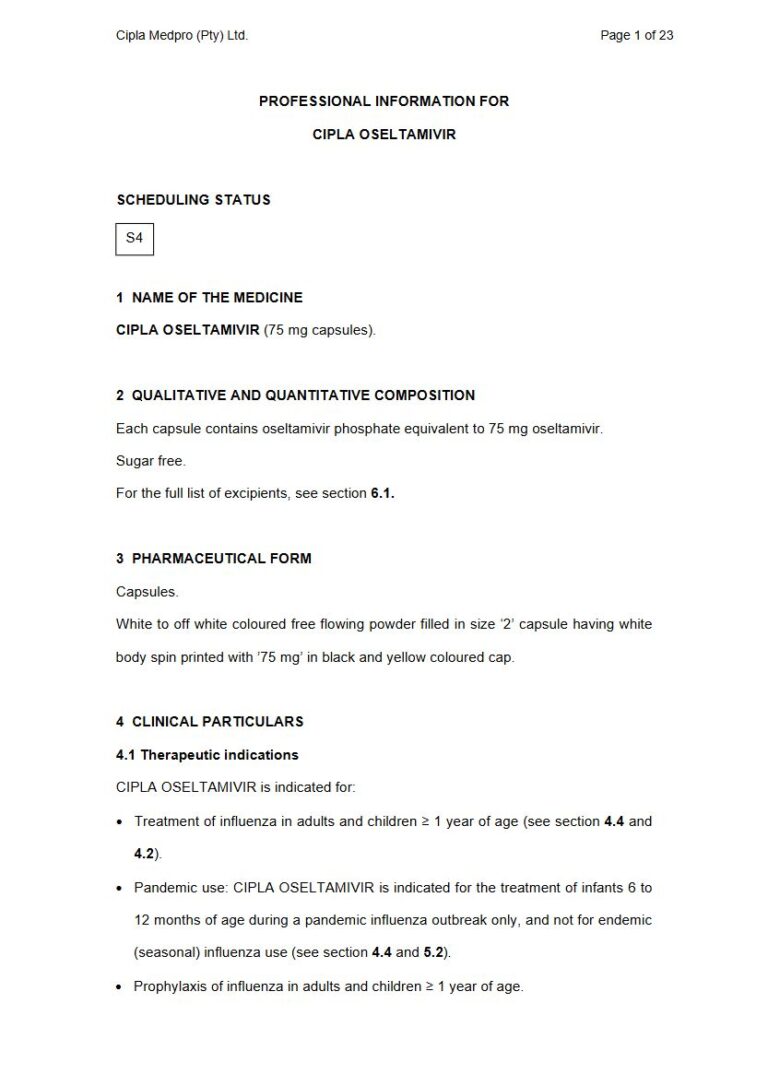
4.1 Therapeutic indications
CIPLA OSELTAMIVIR is indicated for:
- Treatment of influenza in adults and children u2265 1 year of age (see section 4.4 and 4.2).
- Pandemic use: CIPLA OSELTAMIVIR is indicated for the treatment of infants 6 to 12 months of age during a pandemic influenza outbreak only, and not for endemic (seasonal) influenza use (see section 4.4 and 5.2).
- Prophylaxis of influenza in adults and children u2265 1 year of age.
4.2 Posology and method of administration
Posology
Standard dosage
Treatment of influenza
Treatment should be initiated within the first or second day of onset of influenza symptoms.
Adults and adolescents
In adults and adolescents u2265 13 years the recommended oral dose of CIPLA OSELTAMIVIR is one 75 mg capsule twice daily for 5 days.
Children
Treatment with one 75 mg capsule twice daily may also be administered to children > 40 kg who are able to swallow capsules.
Children u2265 1 year of age who are not able to swallow capsules (refer to Method of administration below)
Body weight Recommended dose for 5 days
- u2264 15 kg 30 mg twice daily
- > 15 to 23 kg 45 mg twice daily
- > 23 to 40 kg 60 mg twice daily
- > 40 kg 75 mg twice daily
The recommended oral dose of CIPLA OSELTAMIVIR for children 6 to 12 months of age who are not able to swallow capsules (refer to Method of administration below)
Based on limited pharmacokinetic data currently available, a dosage of 3 mg/kg twice daily in children 6 to 12 months of age provides plasma exposure to the active metabolite in the majority of patients similar to that shown to be clinically efficacious in older children and adults.
Body weight (kg) CIPLA OSELTAMIVIR (mg)
- 6 18
- 7 21
- 8 24
- 9 27
- u2265 10 30
Use the smallest graduated oral syringe that will accurately deliver the appropriate volume.
The recommended treatment dose for infants 6 to 12 months is 3 mg/kg twice daily for 5 days, during a pandemic influenza outbreak only, and not for endemic (seasonal) influenza use (see section 5.2).
Prophylaxis of influenza
Adults and adolescents
For the prophylaxis of influenza following close contact with an infected individual the recommended oral dose of CIPLA OSELTAMIVIR is 75 mg once daily for at least 10 days. Prophylactic therapy should be initiated within two days of exposure. During a community outbreak of influenza the recommended dose for prophylaxis is 75 mg once daily. Safety and efficacy have been demonstrated for up to six weeks. Protection lasts for the duration of prophylactic treatment.
Children u2265 1 year of age
Children weighing > 40 kg, who are able to swallow capsules, may also receive prophylaxis with a 75 mg capsule once daily, for 10 days.
The recommended prophylactic oral dose of CIPLA OSELTAMIVIR for children u2265 1 year of age who are not able to swallow capsules (refer to Method of administration below)
Body weight Recommended dose for 5 days
- u2264 15 kg 30 mg once daily
- > 15 to 23 kg 45 mg once daily
- > 23 to 40 kg 60 mg once daily
- > 40 kg 75 mg once daily
Special dosage instructions
Patients with renal impairment
Treatment of influenza
No dose adjustment is necessary for patients with creatinine clearance above 60 mL/min. In patients with a creatinine clearance of > 30 to 60 mL/min, it is recommended that the treatment dose be reduced to 30 mg of oseltamivir, as in CIPLA OSELTAMIVIR, twice daily for 5 days. In patients with a creatinine clearance of 10 to 30 mL/min, it is recommended that the dose be reduced to 30 mg of oseltamivir once daily for 5 days.
In patients undergoing routine haemodialysis an initial dose of 30 mg of oseltamivir can be administered prior to the start of dialysis if influenza symptoms develop during the 48 hours between dialysis sessions. To maintain plasma concentrations at a therapeutic level, a dose of 30 mg should be administered after every haemodialysis session.
For peritoneal dialysis an initial dose of 30 mg of oseltamivir administered prior to the start of dialysis followed by further 30 mg doses administered every 5 days is recommended for treatment (see section 5.2 and 4.4). The pharmacokinetics of CIPLA OSELTAMIVIR has not been studied in patients with u201cend stage renal diseaseu201d (i.e., creatinine clearance u02c2 10 mL/min) not undergoing dialysis. Hence, dosing recommendation cannot be provided for this group.
Prophylaxis of influenza
No dose adjustment is necessary for patients with creatinine clearance above 60 mL/min. In patients with a creatinine clearance of > 30 to 60 mL/min, it is recommended that the dose be reduced to 30 mg of oseltamivir, as in CIPLA OSELTAMIVIR, once daily. In patients with a creatinine clearance between 10 and 30 mL/min receiving oseltamivir, it is recommended that the dose be reduced to 30 mg of oseltamivir every other day. In patients undergoing routine haemodialysis an initial dose of 30 mg of oseltamivir can be administered prior to the start of dialysis. To maintain plasma concentrations at a therapeutic level, a dose of 30 mg should be administered after every alternate haemodialysis session. For peritoneal dialysis an initial dose of 30 mg of oseltamivir administered prior to the start of dialysis followed by further 30 mg doses administered every 7 days is recommended for prophylaxis (see section 5.2 and 4.4). The pharmacokinetics of CIPLA OSELTAMIVIR have not been studied in patients with u201cend-stage renal diseaseu201d (i.e., creatinine clearance u02c2 10 mL/min) not undergoing dialysis. Hence, dosing recommendation cannot be provided for this group.
Patients with hepatic impairment
No dose adjustment is required for patients with mild or moderate hepatic dysfunction in the treatment or prophylaxis of influenza (see section 5.2). The safety and pharmacokinetics in patients with severe hepatic impairment have not been studied.
Immuno-compromised patients
Seasonal prophylaxis in immune-compromised patients 1 year of age and older is recommended for 12 weeks. No dose adjustment is necessary.
Elderly
Dose adjustment is not necessary for elderly patients who require treatment or prophylaxis for influenza (see section 5.2).
Children
The safety and efficacy of CIPLA OSELTAMIVIR in children under 1 year have not been established (see section 5.2 and 4.4). CIPLA OSELTAMIVIR should not be used in children under 1 year of age, other than during a pandemic influenza outbreak.
Method of administration
Oral. CIPLA OSELTAMIVIR may be taken with or without food (see section 5.2). However, CIPLA OSELTAMIVIR taken with food may enhance tolerability in some patients.
Patients who are unable to swallow capsules
Adults, adolescents or children who are unable to swallow capsules may receive appropriate doses of CIPLA OSELTAMIVIR by opening capsules and pouring the contents of capsules into a suitable, small amount [1 teaspoon (5 mL) maximum] of sweetened food product such as regular or sugar-free chocolate syrup, honey (only for children two years or older), light brown or table sugar dissolved in water, dessert toppings, sweetened condensed milk, apple sauce or yoghurt to mask the bitter taste. The mixture should be stirred and the entire contents given to the patient. The mixture must be swallowed immediately after its preparation.
When using the 75 mg capsules: For patients requiring 30 to 60 mg doses, follow these instructions to ensure proper dosing:
- One CIPLA OSELTAMIVIR capsule must be held over a small bowl, the capsule must be carefully pulled open and the powder poured into the bowl.
- 5 mL water must be added to the powder using a graduated syringe and the mixture stirred for approximately two minutes.
- The correct amount of mixture must be drawn up into the syringe from the bowl. See table below to determine the correct amount of mixture, based on the patientu2019s weight. It is not necessary to draw up any undissolved white powder as this is inert material. The plunger of the syringe must be pushed down to empty its entire contents into a second bowl and any unused mixture discarded.
Body weight Recommended dose Required amount of CIPLA OSELTAMIVIR mixture for one dose
- Less than or equal to 15 kg 30 mg 2 mL
- More than 15 kg and up to 23 kg 45 mg 3 mL
- More than 23 kg and up to 40 kg 60 mg 4 mL
The recommended dose is 30 mg, 45 mg or 60 mg twice daily for 5 days for treatment, and once daily for prevention for 10 days.
In the second bowl, a suitable amount [1 teaspoon (5 mL) maximum] of sweetened food product must be added to the mixture (to mask the bitter taste) and well mixed.
This mixture must be stirred and the entire contents of the second bowl given to the patient. This mixture must be swallowed immediately after its preparation. If there is some mixture left inside the bowl, the bowl must be rinsed with a small amount of water and the patient must drink the remaining water.
For patients requiring 75 mg dose, follow these instructions:
- One 75 mg capsule must be held over a small bowl, the capsule must be carefully pulled open and the powder poured into the bowl.
- A suitable, small amount ([1 teaspoon (5 mL) maximum] of sweetened food product must be added to the mixture (to mask the bitter taste) and well mixed.
- The mixture must be stirred and the entire contents of the bowl given to the patient. This mixture must be swallowed immediately after its preparation. If there is some mixture left inside the bowl, it must be rinsed with a small amount of water and the patient must drink this remaining mixture. Repeat this procedure every time this medicine is taken.
4.3 Contraindications
CIPLA OSELTAMIVIR is contraindicated in:
- Patients with hypersensitivity to oseltamivir phosphate or to any of the excipients used in the formulation of CIPLA OSELTAMIVIR (see section 6.1).
4.4 Special warnings and precautions for use
In patients with influenza who received CIPLA OSELTAMIVIR neuropsychiatric events, such as convulsions, abnormal and inappropriate behaviour, disturbances in consciousness, hallucinations and delirium, have been reported. Rarely the delirium resulted in fatal accidental injury and death. These adverse events occurred mostly within the first few days of CIPLA OSELTAMIVIR administration. It is therefore recommended that all patients receiving CIPLA OSELTAMIVIR should be carefully monitored for these adverse events.
Evidence for efficacy of CIPLA OSELTAMIVIR in any illness caused by agents other than influenza virus types A and B is lacking. CIPLA OSELTAMIVIR cannot be used as a substitute for influenza vaccination.
Resistance of influenza viruses to CIPLA OSELTAMIVIR have been reported. The prevalence of virus resistance and virus strains on subtypes differs between countries and seasons. In South Africa where H1N1 viruses predominated among circulating strains, 100 % [225/225] of H1N1 viruses tested in 2008 were resistant to CIPLA OSELTAMIVIR. The resistance of the predominant virus to CIPLA OSELTAMIVIR generally changes from season to season. Updated local surveillance data from the National Institute for Communicable Diseases (NICD) should be consulted for information on seasonal prevalence of medicine resistant viruses.
Based on limited pharmacokinetic and safety data, CIPLA OSELTAMIVIR may only be used in infants 6 to 12 months of age for treatment during a pandemic influenza outbreak. The treating doctor should take into account the pathogenicity of the circulating strain and the underlying conditions of the patient to ensure that there is a potential benefit to the child.
Renal impairment
Dose adjustment is recommended for patients with creatinine clearance of 10 to 60 mL/min for the treatment of influenza and the prophylaxis of influenza. No dosing recommendation is available for patients with end-stage renal disease and for patients with creatinine clearance of u2264 10 mL/min (see section 4.2).
Children
CIPLA OSELTAMIVIR should not be used in children under 1 year of age, other than during a pandemic influenza outbreak.
Severe concomitant condition
No information is available regarding the safety and efficacy of CIPLA OSELTAMIVIR in patients with any medical condition sufficiently severe or unstable to be considered at imminent risk of requiring hospitalisation.
Immunocompromised patients
The efficacy of CIPLA OSELTAMIVIR in either treatment or prophylaxis of influenza in immunocompromised patients has not been firmly established.
Cardiac/respiratory disease
Efficacy of CIPLA OSELTAMIVIR in the treatment of patients with chronic cardiac and/or respiratory diseases has not been established.
4.5 Interactions with other medicines and other forms of interaction
Based on results from pharmacology and pharmacokinetic studies of oseltamivir, as in CIPLA OSELTAMIVIR, clinically significant medicine interactions appear unlikely. CIPLA OSELTAMIVIR is extensively converted to the active compound by esterases, located predominantly in the liver. Interactions involving competition for esterases have not been extensively reported in the literature. Low protein binding of CIPLA OSELTAMIVIR and the active metabolite do not suggest the probability of medicine displacement interactions.
Oral contraceptives
There is no mechanistic basis for an interaction between CIPLA OSELTAMIVIR and oral contraceptives.
Cimetidine
Cimetidine, a non-specific inhibitor of cytochrome P450 isoforms and competitor for renal tubular secretion of basic or cationic medicines, does not affect plasma concentrations of CIPLA OSELTAMIVIR or its active metabolite.
Renal elimination
It is unlikely that clinically significant medicine interactions involving competition for renal secretion will occur due to the known safety margin for most of these medicines, the elimination characteristics of the active metabolite (anionic tubular secretion in addition to glomerular filtration) and the excretion capacity of these pathways. However, care should be taken when prescribing CIPLA OSELTAMIVIR in patients when taking co-excreted agents with a narrow therapeutic margin (e.g., chlorpropamide, methotrexate, phenylbutazone).
Probenecid
Due to wide safety margin of the active metabolite, no dose adjustments are required when co-administering CIPLA OSELTAMIVIR with probenecid.
Amoxicillin
Co-administration of CIPLA OSELTAMIVIR with amoxicillin does not alter plasma levels of either medicine, indicating that competition for the anionic secretion pathway is weak.
Paracetamol
Co-administration of CIPLA OSELTAMIVIR with paracetamol does not alter plasma levels of CIPLA OSELTAMIVIR, its active metabolite or paracetamol.
Commonly used medicines
No pharmacokinetic interactions between CIPLA OSELTAMIVIR or its major metabolite have been observed when co-administering CIPLA OSELTAMIVIR with paracetamol, acetyl-salicylic acid, cimetidine or with antacids (magnesium and aluminium hydroxides and calcium carbonates), warfarin or amantadine. CIPLA OSELTAMIVIR has no change in adverse event profile or frequency when co-administered with commonly used medicines such as ACE inhibitors (enalapril, captopril), thiazide diuretics (bendrofluazide), antibiotics (penicillin, cephalosporin, azithromycin, erythromycin and doxycycline), H2-receptor blockers (ranitidine, cimetidine), beta-blockers (propranolol), xanthines (theophylline), sympathomimetics (pseudoephedrine), opioids (codeine), corticosteroids, inhaled bronchodilators and analgesic medicines (aspirin, ibuprofen and paracetamol).
4.6 Fertility, pregnancy and lactation
The safety and efficacy of CIPLA OSELTAMIVIR during pregnancy and lactation have not been established.
Pregnancy
No studies have been conducted on the use of CIPLA OSELTAMIVIR in pregnant women.
Breastfeeding
Limited information is available on infants breastfed by mothers taking CIPLA OSELTAMIVIR and on excretion of CIPLA OSELTAMIVIR in breast milk. Limited data demonstrated that low levels of CIPLA OSELTAMIVIR and the active metabolite were detected in breast milk. Safety in humans has not been demonstrated in children of breastfeeding women using CIPLA OSELTAMIVIR. Mothers on treatment with CIPLA OSELTAMIVIR should not breastfeed their infants.
Fertility
There is no evidence that CIPLA OSELTAMIVIR has an effect on male or female fertility.
4.7 Effects on ability to drive and use machines
It is not known whether CIPLA OSELTAMIVIR affects oneu2019s ability to drive and use machines. However, if symptoms such as delirium or fever are experienced while taking CIPLA OSELTAMIVIR, patients should be advised not to drive or use machines until symptoms disappear.
4.8 Undesirable effects
Summary of the safety profile
Data from studies on influenza treatment on adults/adolescents demonstrated that the most frequently reported adverse drug reactions were nausea, vomiting and headache. Majority of reported adverse drug reactions occurred on either the first of second treatment day and resolved spontaneously within 1 to 2 days. Data from studies on influenza prophylaxis in adults/adolescents demonstrate that the most frequently reported adverse drug reactions reported were nausea, vomiting, headache and pain. In children, the most commonly reported adverse drug reaction was vomiting.
Summary of adverse reactions
Infections and infestations:
- Frequent: Bronchitis, herpes simplex, nasopharyngitis, upper respiratory tract infections, sinusitis, otitis media.
Blood and lymphatic system disorders:
- Less frequent: Thrombocytopenia.
- Frequency unknown: Lymphadenopathy.
Immune system disorders:
- Less frequent: Hypersensitivity reaction, anaphylactic reactions, anaphylactoid reactions.
Psychiatric disorders:
- Less frequent: Agitation, abnormal behaviour, anxiety, confusion, delusions, delirium, hallucination, nightmares, self-injury.
Nervous system disorders:
- Frequent: Headache, insomnia.
- Less frequent: Altered level of consciousness, convulsion.
Eye disorders:
- Less frequent: Conjunctivitis, visual disturbance.
Ear and labyrinth disorders:
- Frequent: Earache.
- Less frequent: Ear disorder, tympanic membrane disorder.
Cardiac disorders:
- Less frequent: Cardiac arrhythmia.
Respiratory, thoracic and mediastinal disorders:
- Frequent: Cough, sore throat, rhinorrhoea, nasal congestion.
- Less frequent: Bronchitis and epistaxis.
- Frequency unknown: Asthma (including aggravated), pneumonia, sinusitis.
Gastrointestinal disorders:
- Frequent: Diarrhoea, nausea, vomiting, abdominal pain (including upper abdominal pain, dyspepsia.
- Less frequent: Gastrointestinal bleeding, haemorrhagic colitis.
Hepatobiliary disorders
- Less frequent: Elevated liver enzymes, fulminant hepatitis, hepatic failure, hepatitis.
Skin and subcutaneous tissue disorders:
- Less frequent: Eczema, dermatitis, rash, urticaria, angioneurotic oedema, erythema multiforme, Stevens-Johnson syndrome, toxic epidermal necrolysis.
General disorders and administration site conditions:
- Frequent: Dizziness, fatigue, pain, pyrexia, pain in limb.
Post-marketing experience:
Psychiatric disorders/Nervous system disorders
Patients with influenza who received CIPLA OSELTAMIVIR reportedly experienced neuropsychiatric events, such as convulsions, abnormal and inappropriate behaviour, disturbances in consciousness, hallucinations and delirium. Rarely the delirium resulted in fatal accidental injury and death. More events were reported in males than in females. These events occurred mostly within the first few days of CIPLA OSELTAMIVIR administration. It is therefore necessary to carefully monitor all patients, but especially children and adolescents, who are taking CIPLA OSELTAMIVIR.
Immune system disorders
Allergy, anaphylactic/anaphylactoid reactions and face oedema have been reported.
Skin and subcutaneous disorders
There have been reports of rare cases of hypersensitivity reactions such as allergic skin reactions, including dermatitis, rash, eczema, urticaria, and very rare cases of erythema multiforme and Stevens-Johnson syndrome. In addition there have been rare reports of allergy, anaphylactic/anaphylactoid reactions and angioedema.
Liver and biliary system disorders
Hepatitis and elevated liver enzymes have been reported in patients with influenza-like illness taking CIPLA OSELTAMIVIR.
Gastrointestinal disorders
Gastrointestinal bleeding, in particular, haemorrhagic colitis was reported that subsided when the course of influenza abated or treatment with CIPLA OSELTAMIVIR was interrupted.
Reporting of suspected adverse reactions
Reporting suspected adverse reactions after authorisation of the medicine is important. It allows continued monitoring of the benefit/risk balance of the medicine. Health care providers are asked to report any suspected adverse reactions to SAHPRA via the u201c6.04 Adverse Drug Reactions Reporting Formu201d, found online under SAHPRAu2019s publications: https://www.sahpra.org.za/Publications/Index/8 and to Cipla Medpro (Pty) Ltd., at [email protected] or telephone 080 222 6662 (toll free).
4.9 Overdose
In overdose, symptoms may be the exacerbation or exaggeration of side effects. Treatment is supportive and symptomatic.
