
Ipalib 75 Mg/100 Mg/125 Mg Capsules
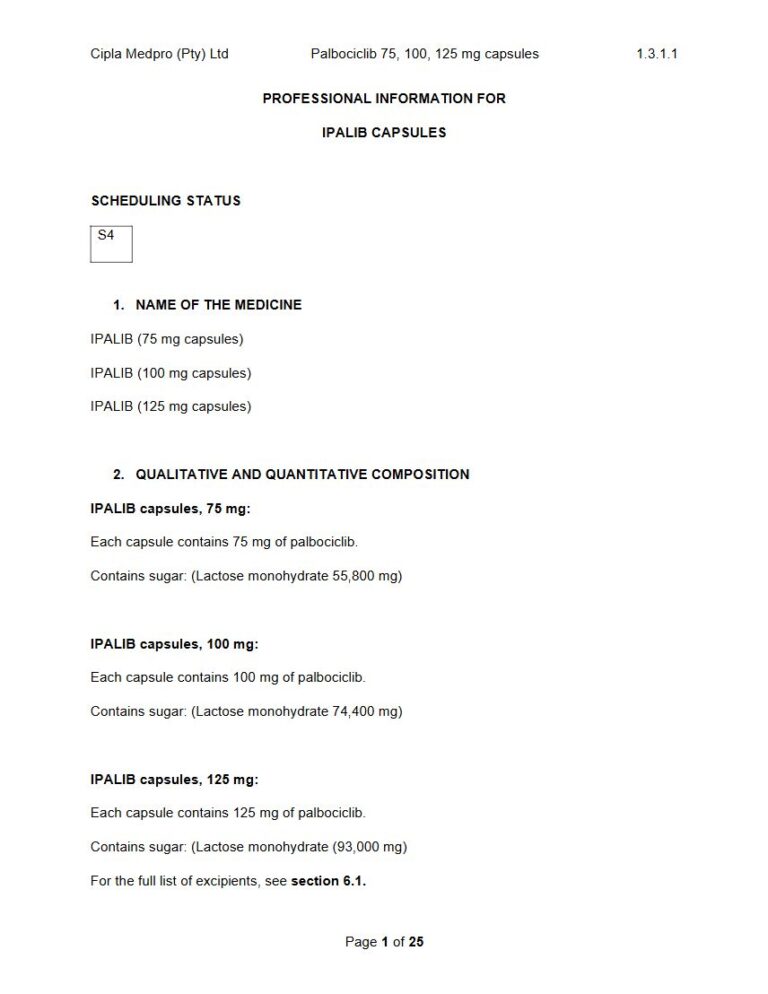
PDF Leaflet Revision Date: 28 February 2023
Clinical Summary
Quick overview from the medicine insert
Indication
Treatment of HR-positive, HER2-negative advanced or metastatic breast cancer.
Dosage (summary)
125 mg orally once daily with food for 21 days, followed by 7 days off.
Special Populations
- Elderly
- Hepatic impairment
- Renal impairment
Pregnancy & Breastfeeding
Can cause fetal harm; not recommended during breastfeeding.
Key Drug Interactions
- Strong CYP3A inhibitors
- Strong CYP3A inducers
Contraindications
- Hypersensitivity to palbociclib
- St. John's Wort
Common side effects
- Neutropenia
- Infections
- Fatigue
- Nausea
- Rash
Counselling Points
- Take with food
- Use contraception during treatment
- Report signs of infection
Serious warnings
- Severe ILD/pneumonitis
- Neutropenia monitoring required
Important Disclaimer
The Ipalib 75 Mg/100 Mg/125 Mg Capsules professional information leaflet below is the property of Cipla Medpro and is provided on Medinsert exactly as issued, with no.. alterations or editorial changes. We make every effort to keep content current by updating documents as soon as new versions become available. Medinsert serves as a trusted access point for healthcare professionals, but does not replace official sources or clinical judgement. For more details, please read our full disclaimer. read more>>
 Healthcare Professionals Only
This content is for registered healthcare professionals
Sign in or create a free account to read the full package insert.
Free for HPCSA-registered professionals. Powered by Medinsert.
Clinical Particulars
Section 4 of the official insert — extracted exactly as issued, no alterations
4.1. Therapeutic indications
IPALIB is indicated for the treatment of hormone receptor (HR)-positive, human epidermal growth factor receptor 2 (HER2)-negative advanced or metastatic breast cancer in combination:
- with letrozole as initial endocrine-based therapy in postmenopausal women
- with fulvestrant in women with disease progression who have received prior endocrine therapy.
4.2. Posology and method of administration
Treatment with IPALIB should be conducted by a medical practitioner experienced in the use of anticancer therapies.
Posology
The recommended starting dose of IPALIB is a 125 mg capsule taken orally once daily with food for 21 consecutive days followed by 7 days off treatment (Schedule 3/1) to comprise a complete cycle of 28 days.
When co-administered with IPALIB, the recommended dose of letrozole is 2,5 mg taken orally once daily continuously throughout the 28-day cycle. Please refer to the full prescribing information of letrozole.
When co-administered with IPALIB the recommended dose of fulvestrant is 500 mg administered intramuscularly on Days 1, 15, 29, and once monthly thereafter. Please refer to the Professional Information of fulvestrant.
Patients should be encouraged to take their dose at approximately the same time each day. Continue the treatment as long as the patient is deriving clinical benefit from therapy. If the patient vomits or misses a dose, an additional dose should not be taken. The next prescribed dose should be taken at the usual time. IPALIB capsules should be swallowed whole (do not chew, crush or open them prior to swallowing). No capsule should be ingested if it is broken, cracked, or otherwise not intact.
Prior to the start of, and throughout treatment with the combination IPALIB plus fulvestrant, pre/perimenopausal women should be treated with luteinizing hormone-releasing hormone (LHRH) agonists according to local clinical practice.
Dose modifications
Dose modification of IPALIB is recommended based on individual safety and tolerability. Management of some adverse reactions may require temporary dose interruptions/ cycle delays, and/or dose reductions, or permanent discontinuation as per dose reduction schedules provided in Tables 1, 2, and 3 (see sections 4.4 and 4.8).
Table 1. IPALIB recommended dose modifications for adverse reactions
| Dose level | Dose |
|---|---|
| Recommended dose | 125 mg/day |
| First dose reduction | 100 mg/day |
| Second dose reduction | 75 mg/day* |
*If further dose reduction below 75 mg/day is required, discontinue the treatment.
4.3. Contraindications
- Hypersensitivity to the active substance, palbociclib or to any of the excipients listed in section 6.1.
- Use of preparations containing St. John's Wort (see section 4.5).
4.4. Special warnings and precautions for use
Neutropenia
Decreased neutrophil counts have been observed in clinical studies with IPALIB. In patients receiving IPALIB in combination with letrozole (Study 1 and 2) or fulvestrant (Study 3), Grade 3 and Grade 4 decreased neutrophil counts were reported in 56,1 % and 10,6 % of patients, respectively.
The median time to first episode of any grade neutropenia was 15 days (12 - 700 days) and the median duration of Grade u2265 3 neutropenia was 7 days across 3 randomised clinical studies. Monitor complete blood count prior to starting IPALIB therapy and at the beginning of each cycle, as well as on Day 15 of the first 2 cycles, and as clinically indicated. For patients who experience a maximum of Grade 1 or 2 neutropenia in the first 6 cycles, monitor complete blood counts for subsequent cycles every 3 months, prior to the beginning of a cycle and as clinically indicated. Treatment interruption, dose reduction or delay in starting treatment cycles is recommended for patients who develop Grade 3 or 4 neutropenia (see section 4.2).
Pre/perimenopausal women
Ovarian ablation or suppression with an LHRH agonist is mandatory when pre/perimenopausal women are administered IPALIB in combination with an aromatase inhibitor, due to the mechanism of action of aromatase inhibitors. Palbociclib in combination with fulvestrant in pre/perimenopausal women has only been studied in combination with an LHRH agonist.
Critical visceral disease
The efficacy and safety of palbociclib have not been studied in patients with critical visceral disease (see section 5.1).
Haematological disorders
Dose interruption, dose reduction, or delay in starting treatment cycles is recommended for patients who develop Grade 3 or 4 neutropenia. Appropriate monitoring should be performed (see sections 4.2 and 4.8).
Interstitial lung disease/pneumonitis (ILD)
Severe, life-threatening, or fatal ILD and/or pneumonitis can occur in patients treated with cyclin-dependent kinase (CDK 4/6) inhibitors, including IPALIB when taken in combination with endocrine therapy. Across clinical trials (PALOMA-1, PALOMA-2, PALOMA-3), 1.4 % of IPALIB-treated patients had ILD/pneumonitis of any grade, 0,1 % had Grade 3, and no Grade 4 or fatal cases were reported. Additional cases of ILD/pneumonitis have been observed in the post-marketing setting, with fatalities reported (see section 4.8).
Monitor patients for pulmonary symptoms indicative of ILD/pneumonitis (e.g. hypoxia, cough, dyspnoea). In patients who have new or worsening respiratory symptoms and are suspected to have developed ILD/pneumonitis, interrupt IPALIB immediately and evaluate the patient. Permanently discontinue IPALIB in patients with severe ILD or pneumonitis (see section 4.2).
Infections
Since IPALIB has myelosuppressive properties, it may predispose patients to infections. Infections of any grade have been reported at a higher rate in patients treated with IPALIB in randomised clinical studies compared to patients treated in the respective comparator arm. Grade 3 and Grade 4 infections occurred respectively in 4,4 % and 0,7 % of patients treated with IPALIB in any combination (see section 4.8). Patients should be monitored for signs and symptoms of infection and treated as medically appropriate (see section 4.2). Medical practitioners should inform patients to promptly report any episodes of fever.
Hepatic impairment
Administer IPALIB with caution to patients with moderate or severe hepatic impairment, with close monitoring of signs of toxicity (see sections 4.2 and 5.2).
Renal impairment
Administer IPALIB with caution to patients with moderate or severe renal impairment, with close monitoring of signs of toxicity (see sections 4.2 and 5.2).
Concomitant treatment with inhibitors or inducers of CYP3A4
Strong inhibitors of CYP3A4 may lead to increased toxicity (see section 4.5). Concomitant use of strong CYP3A inhibitors during treatment with palbociclib should be avoided. Co-administration should only be considered after careful evaluation of the potential benefits and risks. If co-administration with a strong CYP3A inhibitor is unavoidable, reduce the IPALIB dose to 75 mg once daily. When the strong inhibitor is discontinued, increase the IPALIB dose (after 3 u2013 5 half u2013 lives of the inhibitor) to the dose used prior to the initiation of the strong CYP3A inhibitor (see section 4.5).
Concomitant use of palbociclib with strong CYP3A4 inducers should be avoided since coadministration of CYP3A inducers may lead to decreased palbociclib exposure and consequently a risk for lack of efficacy. No dose adjustments are required for co-administration of palbociclib with moderate CYP3A inducers (see section 4.5).
Women of childbearing potential or their partners
Women of childbearing potential or their male partners must use a highly effective method of contraception while taking IPALIB (see section 4.6).
Lactose Monohydrate
IPALIB contains lactose monohydrate. Patients with rare hereditary problems of galactose intolerance, the total lactase deficiency, or glucose-galactose malabsorption should not take this medicine. IPALIB may have an effect on the glycaemic control of patients with diabetes mellitus.
Sodium
This medicine contains less than 1 mmol (23 mg) sodium per capsule, that is to say essentially 'sodium-free'.
4.5. Interaction with other medicines and other forms of interaction
Palbociclib is primarily metabolised by CYP3A and sulphotransferase (SULT) enzyme SULT2A1. In vivo, palbociclib is a weak, time-dependent inhibitor of CYP3A.
Effects of other medicines on the pharmacokinetics of palbociclib
Effect of CYP3A inhibitors
Coadministration of multiple 200 mg doses of itraconazole with a single 125 mg palbociclib dose increased palbociclib total exposure (AUC inf) and the peak concentration (C max) by approximately 87 % and 34 %, respectively, relative to a single 125 mg palbociclib dose given alone. The concomitant use of strong CYP3A inhibitors including, but not limited to: amprenavir, boceprevir, clarithromycin, indinavir, itraconazole, ketoconazole, lopinavir/ritonavir, nefazodone, nelfinavir, posaconazole, saquinavir, telaprevir, telithromycin, voriconazole, and grapefruit or grapefruit juice, should be avoided (see sections 4.2 and 4.4). No dose adjustments are needed for mild and moderate CYP3A inhibitors.
Medicines that may decrease IPALIB plasma concentrations.
Effect of CYP3A inducers
Coadministration of multiple 600 mg doses of rifampicin with a single 125 mg palbociclib dose decreased palbociclib AUC inf and C max by 85 % and 70 %, respectively, relative to a single 125 mg palbociclib dose given alone. The concomitant use of strong CYP3A inducers including, but not limited to: carbamazepine, enzalutamide, felbamate, nevirapine, phenobarbital, phenytoin, primidone, rifabutin, rifampicin, rifapentine, and St. John's Wort should be avoided (see sections 4.3 and 4.4). Coadministration of multiple 400 mg daily doses of modafinil, a moderate CYP3A inducer, with a single 125 mg IPALIB dose decreased palbociclib AUC inf and C max by 32 % and 11 %, respectively, relative to a single 125 mg IPALIB dose given alone.
4.6. Fertility, pregnancy and lactation
Women of childbearing potential/Contraception
Females of childbearing potential who are receiving this medicine, or their male partners should use adequate contraceptive methods (e.g., double-barrier contraception) during therapy and for at least 3 weeks or 14 weeks after completing therapy for females and males, respectively.
Pregnancy
There are no adequate and well-controlled studies using IPALIB in pregnant women. Based on findings in animals and mechanism of action, IPALIB can cause foetal harm when administered to a pregnant woman. In animal studies, IPALIB was teratogenic and foetotoxic at maternally toxic doses.
Breastfeeding
It is unknown whether palbociclib is excreted in human milk as no studies have been conducted in humans or animals to assess the effect of palbociclib on milk production, its presence in breast milk, or its effects on the breast-fed child. Patients receiving IPALIB should not breast feed.
Fertility
No clinical data have been obtained on fertility in humans. Based on male reproductive organ findings (seminiferous tubule degeneration in testis, epididymal hypospermia, lower sperm motility and density, and decreased prostate secretion) in nonclinical safety studies, male fertility may be compromised by treatment with IPALIB. Thus, men may consider sperm preservation prior to beginning therapy with IPALIB.
4.7. Effects on ability to drive and use machines
IPALIB has minor influence on the ability to drive and use machines. However, IPALIB may cause fatigue and patients should exercise caution when driving or using machines.
4.8. Undesirable effects
Infections and infestations
Frequent: Infections b
Blood and lymphatic system disorders
Frequent: Neutropenia c (neutropenia, decreased neutrophil count), Leukopeniad (leukopenia, decreased white blood cell count), Anaemia e (anaemia, decreased haemoglobin, decreased haematocrit), Thrombocytopenia f (thrombocytopenia, decreased platelet count), Febrile neutropenia
Metabolism and nutrition disorders
Frequent: Decreased appetite
Nervous system disorders
Frequent: Dysgeusia
Eye disorders
Frequent: Vision blurred, Lacrimation increased, Dry eye
Respiratory, thoracic and mediastinal disorders
Frequent: Epistaxis
Gastrointestinal disorders
Frequent: Stomatitis g (aphthous stomatitis, cheilitis, glossitis, glossodynia, mouth ulceration, mucosal inflammation, oral pain, oropharyngeal discomfort, oropharyngeal pain, stomatitis), Nausea, Diarrhoea, Vomiting
Skin and subcutaneous tissue disorders
Frequent: Rash h (rash, maculo-papular rash, pruritic rash, erythematous rash, papular rash, dermatitis, acneiform dermatitis, toxic skin eruption), Alopecia, Dry skin
General disorders and administration site conditions
Frequent: Fatigue, Asthenia, Pyrexia
Investigations
Frequent: Increased alanine aminotransferase, increased aspartate aminotransferase
ALT=alanine aminotransferase; AST=aspartate aminotransferase; ILD=interstitial lung disease; N/n=number of patients; N/A=not applicable.
a Preferred Terms (PTs) are listed according to MedDRA 17.1.
b Infections includes all PTs that are part of the System Organ Class Infections and infestations.
c Neutropenia includes the following PTs: Neutropenia, Neutrophil count decreased.
d Leukopenia includes the following PTs: Leukopenia, White blood cell count decreased.
e Anaemia includes the following PTs: Anaemia, Haemoglobin decreased, Haematocrit decreased.
f Thrombocytopenia includes the following PTs: Thrombocytopenia, Platelet count decreased.
g Stomatitis includes the following PTs: Aphthous stomatitis, Cheilitis, Glossitis, Glossodynia, Mouth ulceration, Mucosal inflammation, Oral pain, Oropharyngeal discomfort, Oropharyngeal pain, Stomatitis.
h Rash includes the following PTs: Rash, Rash maculo-papular, Rash pruritic, Rash erythematous, Rash papular, Dermatitis, Dermatitis acneiform, Toxic skin eruption.
Post-marketing adverse events
Respiratory, thoracic and mediastinal disorders ILD/pneumonitis* Skin and subcutaneous tissue disorders Cutaneous lupus erythematosus * ILD/pneumonitis includes any reported PTs that are part of the Standardised MedDRA Query Interstitial Lung Disease (narrow)
Reporting of suspected adverse reactions
Reporting suspected adverse reactions after authorisation of the medicine is important. It allows continued monitoring of the benefit/risk balance of the medicine. Healthcare providers are asked to report any suspected adverse reactions to SAHPRA via the u201c6.04 Adverse Drug Reactions Reporting Formu201d, found online under SAHPRAu2019s publications: https://www.sahpra.org.za/Publications/Index/8 and to Cipla Medpro (Pty) Ltd at [email protected] or telephone 080 222 6662 (toll free).
4.9. Overdose
There is no antidote for IPALIB. In the event of a IPALIB overdose, both gastrointestinal (e.g., nausea, vomiting) and haematological (e.g., neutropenia) toxicity may occur and general supportive care should be provided.
