
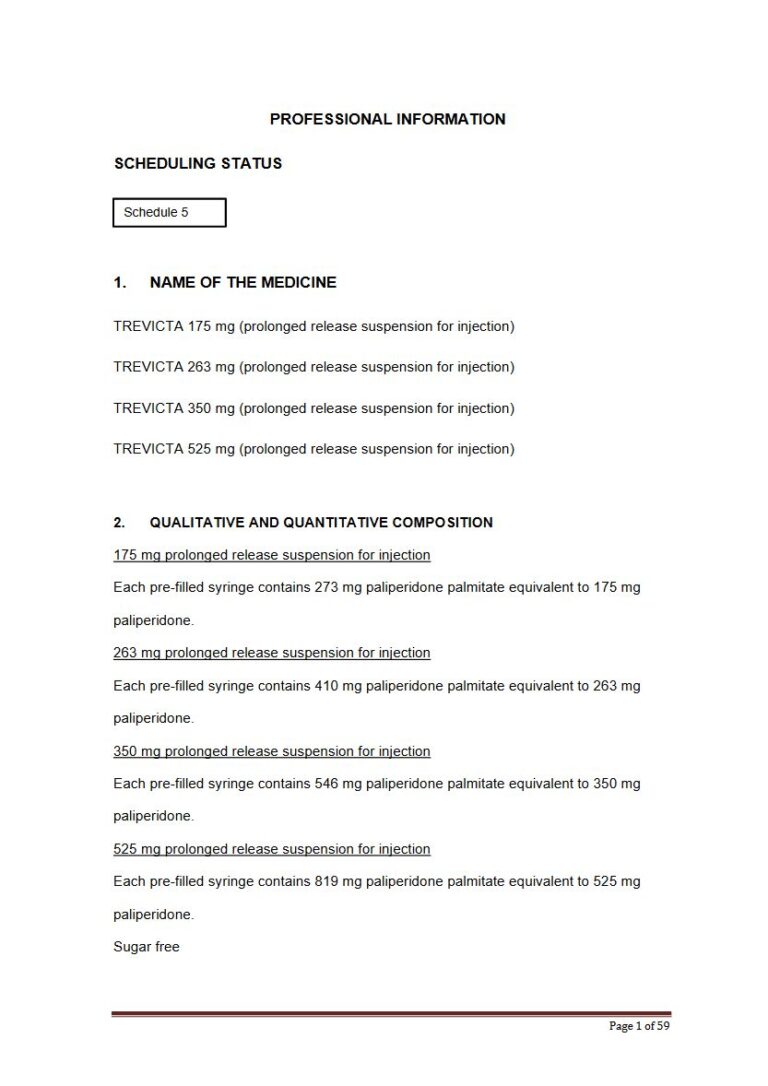
Trevicta 175 mg/263 mg/350 mg/525 mg Suspension
PDF Leaflet Revision Date: 16 January 2023
Clinical Summary
Quick overview from the medicine insert
Indication
Maintenance treatment of schizophrenia in stable adult patients.
Dosage (summary)
Administer 175-525 mg IM every 3 months after stabilization on 1-monthly paliperidone.
Special Populations
- Elderly
- Renal impairment
- Hepatic impairment
Pregnancy & Breastfeeding
Not recommended during pregnancy or breastfeeding due to potential risks to the newborn.
Key Drug Interactions
- QT prolonging agents
- Centrally acting medicines
- Dopamine agonists
Contraindications
- Hypersensitivity
- Moderate to severe renal impairment
- Parkinson's disease
- Dementia with Lewy Bodies
Common side effects
- Weight gain
- Upper respiratory tract infection
- Anxiety
- Headache
- Insomnia
Counselling Points
- Monitor for weight gain
- Avoid driving until effects are known
- Report signs of infection or hypersensitivity
Serious warnings
- Neuroleptic Malignant Syndrome
- Tardive dyskinesia
- Hyperglycaemia
- Orthostatic hypotension
Important Disclaimer
The Trevicta 175 mg/263 mg/350 mg/525 mg Suspension professional information leaflet below is the property of Janssen Pharmaceutica and is provided on Medinsert exactly as issued, with no.. alterations or editorial changes. We make every effort to keep content current by updating documents as soon as new versions become available. Medinsert serves as a trusted access point for healthcare professionals, but does not replace official sources or clinical judgement. For more details, please read our full disclaimer. read more>>
 Healthcare Professionals Only
This content is for registered healthcare professionals
Sign in or create a free account to read the full package insert.
Free for HPCSA-registered professionals. Powered by Medinsert.
Clinical Particulars
Section 4 of the official insert — extracted exactly as issued, no alterations
4.1 Therapeutic indications
TREVICTA, a 3-monthly injection, is indicated for the maintenance treatment of schizophrenia in adult patients who are clinically stable on a 1-monthly paliperidone palmitate prolonged release intramuscular injection formulation (preferably for 4 months or more) and who do not require dose adjustment (see section 5.1).
4.2 Posology and method of administration
Posology
Patients who are clinically stabilised on treatment with 1-monthly paliperidone palmitate prolonged release intramuscular (IM) injection formulation (preferably for four months or more) and do not require dose adjustment may be switched to TREVICTA.
TREVICTA should be initiated in place of the next scheduled dose of the 1-monthly paliperidone palmitate prolonged release intramuscular injection (u00b1 7 days). The TREVICTA dose should be based on the previous 1-monthly paliperidone palmitate prolonged release intramuscular injection dose using a 3.5-fold higher dose as shown in the following table:
TREVICTA doses for patients adequately treated with 1-monthly paliperidone palmitate prolonged release IM injection
If the last dose of the 1-monthly paliperidone palmitate prolonged release IM injection was
Initiate TREVICTA at the following dose
50 mg
175 mg
75 mg
263 mg
100 mg
350 mg
150 mg
525 mg
There is no equivalent dose of TREVICTA for the 25 mg dose of 1-monthly paliperidone palmitate prolonged release IM injection formulation which was not studied.
Following the initial TREVICTA dose, TREVICTA should be administered by intramuscular injection once every 3 months (u00b1 2 weeks, see also Missed dose section). TREVICTA is for maintenance treatment of patients that do not require 3 monthly dose adjustments. If frequent 3 monthly dose adjustments are required, patients should be reassessed as to the appropriateness of treatment with TREVICTA. However over time some patients may require up or down titration of the maintenance dose within the approved 3 monthly dose range of 175 - 525 mg. Due to the long acting properties of TREVICTA, the response of the patient to an adjusted dose may not be apparent for several months, therefore caution is advised when dose adjustments are to be made.
4.3 Contraindications
Hypersensitivity to the active substance, to risperidone or to any of the excipients listed in section 6.1.
Patients with moderate to severe renal impairment.
Parkinson's disease and dementia with Lewy Bodies.
4.4 Special warnings and precautions for use
Use in patients who are in an acutely agitated or severely psychotic state
TREVICTA should not be used to manage acutely agitated or severely psychotic states when immediate symptom control is warranted.
QT interval
Caution should be exercised when paliperidone is prescribed in patients with known cardiovascular disease or family history of QT prolongation, and in concomitant use with other medicines thought to prolong the QT interval.
Neuroleptic malignant syndrome
Neuroleptic Malignant Syndrome (NMS), characterised by hyperthermia, muscle rigidity, autonomic instability, altered consciousness, and elevated serum creatine phosphokinase levels has been reported to occur with paliperidone. Additional clinical signs may include myoglobinuria (rhabdomyolysis) and acute renal failure. If a patient develops signs or symptoms indicative of NMS, paliperidone should be discontinued. Consideration should be given to the long-acting nature of TREVICTA.
Tardive dyskinesia/extrapyramidal symptoms
Medicines with dopamine receptor antagonistic properties, such as TREVICTA have been associated with the induction of tardive dyskinesia characterised by rhythmical, involuntary movements, predominantly of the tongue and/or face. If signs and symptoms of tardive dyskinesia appear, the discontinuation of all antipsychotics, including paliperidone, should be considered. Consideration should be given to the long-acting nature of TREVICTA.
Caution is warranted in patients receiving both, psychostimulants (e.g., methylphenidate) and paliperidone concomitantly, as extrapyramidal symptoms could emerge when adjusting the dose of one or both medications. Gradual withdrawal of stimulant treatment is recommended (see section 4.5).
Leukopenia, neutropenia, and agranulocytosis
Events of leukopenia, neutropenia, and agranulocytosis have been reported with paliperidone. Patients with a history of a clinically significant low white blood cell count (WBC) or a medicine-induced leukopenia/neutropenia should be monitored during the first few months of therapy and discontinuation of TREVICTA should be considered at the first sign of a clinically significant decline in WBC in the absence of other causative factors. Patients with clinically significant neutropenia should be carefully monitored for fever or other symptoms or signs of infection and treated promptly if such symptoms or signs occur. Patients with severe neutropenia (absolute neutrophil count < 1 x 10 9 /L) should discontinue TREVICTA and have their WBC followed until recovery. Consideration should be given to the long-acting nature of TREVICTA.
Hypersensitivity reactions
Hypersensitivity reactions can occur even in patients who have previously tolerated oral risperidone or oral paliperidone (see section 4.8).
Hyperglycaemia and diabetes mellitus
Hyperglycaemia, diabetes mellitus, and exacerbation of pre-existing diabetes, including diabetic coma and ketoacidosis, have been reported with paliperidone. Appropriate clinical monitoring is advisable in accordance with utilised antipsychotic guidelines. Patients treated with TREVICTA should be monitored for symptoms of hyperglycaemia (such as polydipsia, polyuria, polyphagia, and weakness) and patients with diabetes mellitus should be monitored regularly for worsening of glucose control.
Weight gain
Significant weight gain has been reported with TREVICTA use. Weight should be monitored regularly.
Use in patients with prolactin-dependent tumours
Tissue culture studies suggest that cell growth in human breast tumours may be stimulated by prolactin. Although no clear association with the administration of antipsychotics has so far been demonstrated in clinical and epidemiological studies, caution is recommended in patients with a relevant medical history. Paliperidone should be used with caution in patients with a pre-existing tumour that may be prolactin-dependent.
Orthostatic hypotension
Paliperidone may induce orthostatic hypotension based on its alpha-adrenergic blocking activity. In the clinical trials of TREVICTA, 0.3% of subjects reported orthostatic hypotension related adverse reaction. TREVICTA should be used with caution in patients with known cardiovascular disease (e.g., heart failure, myocardial infarction or ischaemia, conduction abnormalities), cerebrovascular disease, or conditions that predispose the patient to hypotension (e.g., dehydration and hypovolemia).
Seizures
TREVICTA should be used cautiously in patients with a history of seizures or other conditions that potentially lower the seizure threshold.
Renal impairment
The plasma concentrations of paliperidone are increased in patients with renal impairment. For patients with mild renal impairment (creatinine clearance u2265 50 mL/min to < 80 mL/min), dose should be adjusted, and the patient stabilised using 1-monthly paliperidone palmitate injectable, then transitioned to TREVICTA. TREVICTA is not recommended in patients with moderate or severe renal impairment (creatinine clearance < 50 mL/min). (See sections 4.2 and 5.2).
Hepatic impairment
No data are available in patients with severe hepatic impairment (Child-Pugh class C). Caution is recommended if paliperidone is used in such patients.
Elderly patients with dementia
TREVICTA has not been studied in elderly patients with dementia. TREVICTA is not recommended to treat elderly patients with dementia due to increased risk of overall mortality and cerebrovascular adverse reactions. The experience from risperidone cited below is considered valid also for paliperidone.
Overall mortality
In a meta-analysis of 17 controlled clinical trials, elderly patients with dementia treated with other atypical antipsychotics, including risperidone, aripiprazole, olanzapine, and quetiapine had an increased risk of mortality compared to placebo. Among those treated with risperidone, the mortality was 4% compared with 3.1% for placebo.
Cerebrovascular adverse reactions
An approximately 3-fold increased risk of cerebrovascular adverse reactions has been seen in randomised placebo-controlled clinical trials in the dementia population with some atypical antipsychotics, including risperidone, aripiprazole, and olanzapine. The mechanism for this increased risk is not known.
Parkinsonu2019s disease and dementia with Lewy bodies
Caution is advised when prescribing TREVICTA to patients with Parkinsonu2019s disease or Dementia with Lewy Bodies (DLB) (See section 4.3) since both groups may be at increased risk of Neuroleptic Malignant Syndrome as well as having an increased sensitivity to antipsychotics. Manifestation of this increased sensitivity can include confusion, obtundation, postural instability with frequent falls, in addition to extrapyramidal symptoms.
Priapism
Antipsychotic medicines (including paliperidone) with alpha-adrenergic blocking effects have been reported to induce priapism. Patients should be informed to seek urgent medical care in case that priapism has not been resolved within 4 hours.
Body temperature regulation
Antipsychotic medicines may cause body temperature dysregulation with hypothermia and/or hyperthermia Appropriate care is advised when prescribing TREVICTA to patients who will be experiencing conditions which may contribute to an elevation in core body temperature, e.g., exercising strenuously, exposure to extreme heat, receiving concomitant medicinal products with anticholinergic activity or being subject to dehydration. Hyperthermia may occur with or without manifestations of NMS.
Venous thromboembolism
Cases of venous thromboembolism (VTE) have been reported with antipsychotic medicinal products. Since patients treated with antipsychotics often present with acquired risk factors for VTE, all possible risk factors for VTE should be identified before and during treatment with TREVICTA and preventative measures undertaken.
Antiemetic effect
An antiemetic effect was observed in preclinical studies with paliperidone. This effect, if it occurs in humans, may mask the signs and symptoms of overdosage with certain medicines or of conditions such as intestinal obstruction, Reyeu2019s syndrome and brain tumour.
Administration
Care must be taken to avoid inadvertent injection of TREVICTA into a blood vessel.
Intraoperative floppy iris syndrome
Intraoperative Floppy Iris Syndrome (IFIS) has been observed during cataract surgery in patients treated with medicines with alpha 1a-adrenergic antagonist effect, such as TREVICTA (see section 4.8). IFIS may increase the risk of eye complications during and after the operation. Current or past use of medicines with alpha 1a-adrenergic antagonist effect should be made known to the ophthalmic surgeon in advance of surgery. The potential benefit of stopping alpha 1 blocking therapy including antipsychotic therapy, prior to cataract surgery has not been established.
4.5 Interaction with other medicinal products and other forms of interaction
Caution is advised when prescribing TREVICTA with medicines known to prolong the QT interval, e.g., class IA antidysrhythmics (e.g., quinidine, disopyramide) and class III antidysrhythmics (e.g., amiodarone, sotalol), some antihistaminics, some antibiotics (e.g., fluoroquinolones), some other antipsychotics and some antimalarials (e.g., mefloquine). This list is indicative and not exhaustive.
Potential for TREVICTA to affect other medicines
Paliperidone is not expected to cause clinically important pharmacokinetic interactions with medicines that are metabolised by cytochrome P450 isozymes. Given the primary central nervous system (CNS) effects of paliperidone (see section 4.8), TREVICTA should be used with caution in combination with other centrally acting medicines, e.g., anxiolytics, most antipsychotics, hypnotics, opiates, etc. or alcohol. Paliperidone may antagonise the effect of levodopa and other dopamine agonists. If this combination is deemed necessary, particularly in end-stage Parkinsonu2019s disease, the lowest effective dose of each treatment should be prescribed. Because of its potential for inducing orthostatic hypotension (see section 4.4), an additive effect may be observed when TREVICTA is administered with other therapeutic agents that have this potential, e.g., other antipsychotics, tricyclics.
Caution is advised if paliperidone is combined with other with medicines products known to lower the seizure threshold (i.e., phenothiazines or butyrophenones, tricyclics or SSRIs, tramadol, mefloquine, etc.).
No interaction study between TREVICTA and lithium has been performed, however, a pharmacokinetic interaction is not likely to occur.
Potential for other medicines to affect TREVICTA
In vitro studies indicate that CYP2D6 and CYP3A4 may be minimally involved in paliperidone metabolism, but there are no indications in vitro nor in vivo that these isozymes play a significant role in the metabolism of paliperidone. Concomitant administration of oral paliperidone with paroxetine, a potent CYP2D6 inhibitor, showed no clinically significant effect on the pharmacokinetics of paliperidone. Co-administration of oral paliperidone prolonged release once daily with carbamazepine 200 mg twice daily caused a decrease of approximately 37% in the mean steady-state C max and AUC of paliperidone. This decrease is caused, to a substantial degree, by a 35% increase in renal clearance of paliperidone likely as a result of induction of renal P-gp by carbamazepine. A minor decrease in the amount of active substance excreted unchanged in the urine suggests that there was little effect on the CYP metabolism or bioavailability of paliperidone during carbamazepine co-administration. Larger decreases in plasma concentrations of paliperidone could occur with higher doses of carbamazepine. On initiation of carbamazepine, the dose of TREVICTA should be re-evaluated and increased if necessary. Conversely, on discontinuation of carbamazepine the dose of TREVICTA should be re-evaluated and decreased if necessary. Consideration should be given to the long-acting nature of TREVICTA.
Concomitant use of TREVICTA with risperidone or oral paliperidone
Since paliperidone is the major active metabolite of risperidone, TREVICTA should not be co-administered with risperidone or with oral paliperidone formulation. Safety data involving concomitant use of TREVICTA with other antipsychotics is limited.
Concomitant use of TREVICTA with psychostimulants
The combined use of psychostimulants (e.g. methylphenidate) with paliperidone can lead to extrapyramidal symptoms upon change of the doses of either or both treatments (see section 4.4).
4.6 Fertility, pregnancy and lactation
Pregnancy
There are no adequate data from the use of paliperidone during pregnancy. Intramuscularly injected paliperidone palmitate and orally administered paliperidone were not teratogenic in animal studies, but other types of reproductive toxicity were seen (see section 5.3). Neonates exposed to paliperidone during the third trimester of pregnancy are at risk of adverse reactions including extrapyramidal and/or withdrawal symptoms that may vary in severity and duration following delivery. There have been reports of agitation, hypertonia, hypotonia, tremor, somnolence, respiratory distress, or feeding disorder. Consequently, newborns should be monitored carefully. TREVICTA should not be used during pregnancy unless clearly necessary. Since paliperidone has been detected in plasma up to 18 months after a single dose of TREVICTA, consideration should be given to the long-acting nature of TREVICTA as maternal exposure to TREVICTA before and during pregnancy may lead to adverse reactions in the new-born baby.
Breastfeeding
Paliperidone is excreted in the breast milk to such an extent that effects on the breastfed infant are likely if therapeutic doses are administered to breastfeeding women. Since paliperidone has been detected in plasma up to 18 months after a single dose administration of TREVICTA, consideration should be given to the long-acting nature of TREVICTA as breastfed infants may be at risk even from TREVICTA administration long before breastfeeding. TREVICTA should not be used while breastfeeding.
Fertility
There were no relevant effects observed in the non-clinical studies.
4.7 Effects on ability to drive and use machines
TREVICTA may affect the ability to drive and use machines. Patients on treatment with TREVICTA should not drive and use machines until they know how treatment with TREVICTA affects them. Paliperidone can have nervous system and visual effects, such as sedation, somnolence, syncope, dizziness, agitation and blurred vision (see section 4.8).
4.8 Undesirable effects
Summary of the safety profile
The most frequently observed adverse reactions reported in u2265 5% of patients in two double-blind controlled clinical trials of TREVICTA were weight increased, upper respiratory tract infection, anxiety, headache, insomnia, and injection site reaction.
Table 1: Adverse drug reactions reported with paliperidone and/or risperidone by frequency category estimated from subjects who received at least one injection of TREVICTA (PP3M) in the PP3M clinical trials
The following terms and frequencies are applied: very common (u2265 1/10), common (u2265 1/100 to < 1/10), uncommon (u2265 1/1 000 to < 1/100), rare (u2265 1/10 000 to < 1/1 000), very rare (< 1/10 000), and not known (cannot be estimated from the available data).
System organ class Adverse Drug reaction Frequency Very Common Common Uncommon Rare Not Known a Infections and Infestations Upper respiratory tract infection Urinary tract infection, influenza. Pneumonia, bronchitis, respiratory tract infection, sinusitis, cystitis, ear infection, onychomycosis, cellulitis Eye infection, tonsillitis, acrodermatitis Subcutaneous abscess Blood and lymphatic system disorders neutropenia, white blood cell count decreased, anaemia Eosinophil count increased Immune System Disorders Hypersensitivity Anaphylactic reaction Endocrine Disorders Glucose urine present, Hyperprolactinaemia b Metabolism and nutrition disorders Weight increased Hyperglycaemia, weight decreased Hyperinsulinaemia, increased appetite, decreased appetite, blood triglycerides increased, blood cholesterol increased Polydipsia Anorexia Psychiatric disorders Insomnia c, depression, anxiety. Sleep disorder, agitation, libido decreased Blunted affect, nightmare Confusional state, anorgasmia, nervousness Nervous system disorders Parkinsonism d, akathisia d, sedation/somnolence, dizziness, tremor, headache Psychomotor hyperactivity, dystonia d, dizziness postural, disturbance in attention, dyskinesia d, hypoaesthesia Tardive dyskinesia, paraesthesia Neuroleptic malignant syndrome, cerebral ischaemia, unresponsive to stimuli, loss of consciousness, depressed level of consciousness, diabetic coma, convulsion c, syncope, balance disorder, coordination abnormal, dysarthria, head titubation Eye Disorders Vision blurred, conjunctivitis Lacrimation increased Glaucoma, eye movement disorder, eye rolling, photophobia, dry eye, ocular hyperaemia Ear and labyrinth disorders Vertigo Tinnitus Ear pain Cardiac disorders Tachycardia Atrioventricular block, conduction disorder, Electrocardiogram abnormal Sinus dysrhythmia electrocardiogram QT prolonged, postural orthostatic tachycardia syndrome, bradycardia, palpitations Vascular disorders Hypertension Hypotension, orthostatic hypotension. Ischaemia, flushing Respiratory, thoracic and mediastinal disorders Pharyngolaryngeal pain, cough Epistaxis, nasal congestion Dyspnoea, Hyperventilation, pneumonia aspiration, pulmonary congestion, respiratory tract congestion, rales, wheezing, dysphonia Gastrointestinal disorders Abdominal pain, vomiting, nausea, constipation, diarrhoea, dyspepsia, toothache Abdominal discomfort gastroenteritis, dry mouth, flatulence. Dysphagia, cheilitis Intestinal obstruction, swollen tongue, faecal incontinence, faecaloma Hepatobiliary disorders Transaminases increased. Gamma-glutamyl-transferase increased, hepatic enzyme increased. Skin and subcutaneous tissue disorders Pruritus, rash, eczema Erythema Drug eruption, urticaria, hyperkeratosis, dry skin, skin discolouration, acne, seborrhoeic dermatitis, dandruff Musculoskeletal and connective tissue disorders Musculoskeletal pain, back pain, arthralgia Blood creatine phosphokinase increased, muscle spasms, joint stiffness, muscular weakness Rhabdomyolysis, posture abnormal, joint swelling, neck pain Renal and urinary disorders Dysuria Pollakiuria Urinary incontinence Reproductive system Amenorrhoea, menstrual disorder c Erectile dysfunction, ejaculation Breast engorgement, breast and breast disorders disorder, gynaecomastia, galactorrhoea, sexual dysfunction, breast pain, breast discomfort. enlargement, vaginal discharge General disorders and administration site conditions Fatigue, injection-site reaction. Face oedema, oedema c, pyrexia, chest pain, chest discomfort, asthenia, malaise Body temperature increased, Body temperature decreased, chills, gait abnormal, thirst, drug withdrawal syndrome a The frequency of adverse reactions is qualified as u201cnot knownu201d because they were not observed in paliperidone palmitate 3-month injectable clinical trials. b Refer to u2018Hyperprolactinaemiau2019 below. c Insomnia includes: initial insomnia, middle insomnia; Convulsion includes: grand mal convulsion; Oedema includes: generalised oedema, oedema peripheral, pitting oedema Menstrual disorder includes: menstruation delayed, menstruation irregular, oligomenorrhoea. d Refer to u2018Extrapyramidal symptomsu2019 below.
Description of selected adverse reactions
Anaphylactic reaction
Rarely, cases of anaphylactic reaction after injection with 1-monthly paliperidone palmitate injectable have been reported during post-marketing experience in patients who have previously tolerated oral risperidone or oral paliperidone (see section 4.4).
Injection site reactions
In clinical trials of TREVICTA, 5.3% of subjects reported injection site related adverse reactions. Based on the investigatorsu2019 ratings, injection site reported reactions were absent or mild in u2265 95% of the assessments and included local pain, induration, swelling and erythema which decreased in intensity over time. None of these events led to discontinuation of treatment.
Extrapyramidal symptoms (EPS)
In the clinical trials of TREVICTA, akathisia, dyskinesia, dystonia, parkinsonism, and tremor were reported in 3.9%, 0.8%, 0.9%, 3.6%, and 1.4% of subjects, respectively. Extrapyramidal symptoms (EPS) included a pooled analysis of the following terms: parkinsonism (includes extrapyramidal disorder, extrapyramidal symptoms, on and off phenomenon, Parkinsonu2019s disease, parkinsonian crisis, salivary hypersecretion, musculoskeletal stiffness, parkinsonism, drooling, cogwheel rigidity, bradykinesia, hypokinesia, masked facies, muscle tightness, akinesia, nuchal rigidity, muscle rigidity, parkinsonian gait, glabellar reflex abnormal, and parkinsonian rest tremor), akathisia (includes akathisia, restlessness, hyperkinesia, and restless leg syndrome), dyskinesia (dyskinesia, chorea, movement disorder, muscle twitching, choreoathetosis, athetosis, and myoclonus), dystonia (includes dystonia, cervical spasm, emprosthotonus, oculogyric crisis, oromandibular dystonia, risus sardonicus, tetany, hypertonia, torticollis, muscle contractions involuntary, muscle contracture, blepharospasm, oculogyration, tongue paralysis, facial spasm, laryngospasm, myotonia, opisthotonus, oropharyngeal spasm, pleurothotonus, tongue spasm, and trismus), and tremor.
4.9 Overdose
Symptoms
In overdose, side effects can be precipitated and/or be of increased severity including those resulting from an exaggeration of paliperidoneu2019s known pharmacological effects, i.e., drowsiness and sedation, tachycardia and hypotension, QT prolongation, and extrapyramidal symptoms. Torsade de pointes and ventricular fibrillation have been reported in a patient in the setting of overdose with oral paliperidone. In the case of acute overdose, the possibility of multiple medicine involvement should be considered.
Management
Consideration should be given to the long-acting nature of TREVICTA and the long elimination half-life of paliperidone when assessing treatment needs and recovery. There is no specific antidote to paliperidone. Symptomatic and supportive measures should be employed. Establish and maintain a clear airway and ensure adequate oxygenation and ventilation. Cardiovascular monitoring should commence immediately and should include continuous electrocardiographic monitoring for possible dysrhythmias. Hypotension and circulatory collapse should be treated with appropriate measures such as intravenous fluid and/or sympathomimetic medicines. In case of severe extrapyramidal symptoms, anticholinergic medicines should be administered. Close supervision and monitoring should continue until the patient recovers.
