
Aspen Pantoprazole Injection
Clinical Summary
Quick overview from the medicine insert
Indication
Treatment of gastroesophageal reflux disease (GERD) and Zollinger-Ellison syndrome.
Dosage (summary)
40 mg administered intravenously once daily.
Onset of Action / Duration
Onset of action typically occurs within 1 to 2 hours, with a duration of effect lasting up to 24 hours.
Special Populations
- Elderly patients may require dose adjustment.
- Patients with hepatic impairment should use with caution.
- Patients with renal impairment do not require dose adjustment.
Pregnancy & Breastfeeding
Use during pregnancy only if the potential benefit justifies the potential risk to the fetus. Pantoprazole is excreted in breast milk; caution should be exercised when administered to nursing mothers.
Key Drug Interactions
- May reduce the absorption of drugs requiring an acidic pH for absorption (e.g., ketoconazole, atazanavir).
- Caution with concomitant use of warfarin, as it may increase the risk of bleeding.
Contraindications
- Hypersensitivity to pantoprazole or any component of the formulation.
- Severe hepatic impairment.
Common side effects
- Headache
- Diarrhea
- Nausea
- Abdominal pain
- Dizziness
Counselling Points
- Inform patients to report any signs of allergic reactions, such as rash or difficulty breathing.
- Advise patients to take the medication as prescribed and not to exceed the recommended dose.
- Encourage patients to maintain a healthy diet and lifestyle to support treatment.
Serious warnings
- Long-term use may lead to vitamin B12 deficiency.
- Risk of Clostridium difficile infection in the colon.
- May increase the risk of bone fractures in patients with osteoporosis.
Important Disclaimer
The Aspen Pantoprazole Injection professional information leaflet below is the property of Pharmacare and is provided on Medinsert exactly as issued, with no.. alterations or editorial changes. We make every effort to keep content current by updating documents as soon as new versions become available. Medinsert serves as a trusted access point for healthcare professionals, but does not replace official sources or clinical judgement. For more details, please read our full disclaimer. read more>>
 Healthcare Professionals Only
This content is for registered healthcare professionals
Sign in or create a free account to read the full package insert.
Free for HPCSA-registered professionals. Powered by Medinsert.
Clinical Particulars
Section 4 of the official insert — extracted exactly as issued, no alterations
4.1 Therapeutic indications
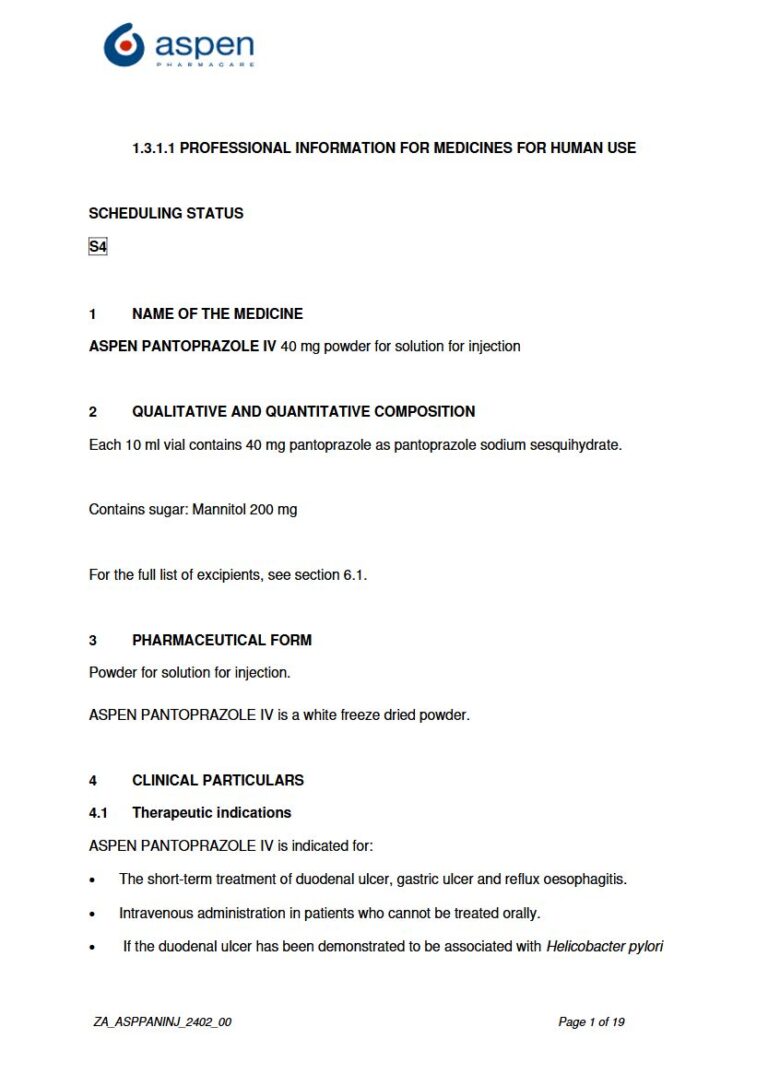
ASPEN PANTOPRAZOLE IV is indicated for:
- The short-term treatment of duodenal ulcer, gastric ulcer and reflux oesophagitis.
- Intravenous administration in patients who cannot be treated orally.
- If the duodenal ulcer has been demonstrated to be associated with Helicobacter pylori infections, ASPEN PANTOPRAZOLE IV used in combination with appropriate antibiotics may be useful.
- The treatment of Zollinger-Ellison Syndrome.
4.2 Posology and method of administration
Posology
The recommended dose is one vial (40 mg) of ASPEN PANTOPRAZOLE IV per day. ASPEN PANTOPRAZOLE IV is indicated for intravenous administration in patients who cannot be treated orally. A ready-to-use solution is prepared by injecting 10 ml of a 0,9 % sodium chloride solution into the vial containing the freeze dried powder. The solution may be administered directly or may be diluted further by mixing with 100 ml 0,9 % sodium chloride or 5 % glucose ONLY. The product should be administered intravenously over 2 to 15 minutes. After preparing the solution in 0,9 % sodium chloride and 5 % dextrose the solution must be used immediately and any unused portion discarded. ASPEN PANTOPRAZOLE IV may be used intravenously for up to 7 days. As soon as oral therapy is possible, treatment should be replaced with the same oral dose (of a suitable oral formulation of pantoprazole) in compliance with the approved dosage regimen as stated below.
Duodenal ulcer: The recommended dose is 40 mg pantoprazole daily. The total treatment with intravenous and oral pantoprazole should be 2 to 4 weeks. If the duodenal ulcer has been demonstrated to be associated with Helicobacter pylori infection, ASPEN PANTOPRAZOLE IV or an oral pantoprazole formulation used in combination with appropriate antibiotics may be useful.
Gastric ulcer: The recommended dose is 40 mg pantoprazole once daily. In the case of a suspected gastric ulcer, malignancy of the gastric ulcer should be excluded, as treatment could conceal the symptoms and may delay the diagnosis.
Reflux oesophagitis: The recommended dose is 40 mg pantoprazole once daily.
Zollinger-Ellison syndrome: For management of Zollinger-Ellison syndrome, the patient should start treatment with a daily dosage of 80 mg (2 vials) of ASPEN PANTOPRAZOLE IV. Thereafter, the dosage can be titrated up or down as needed using measurements of gastric acid secretion as a guide. With doses above 80 mg, the dosage should be divided and given twice daily. In case rapid acid control is required, a starting dose of 2 x 80 mg ASPEN PANTOPRAZOLE IV is sufficient to manage a decrease of acid output into the target range (< 10 mmol/h) within one hour in the majority of patients. Transition from ASPEN PANTOPRAZOLE IV to an oral formulation should be performed as soon as it is clinically justified.
Long-term treatment: Long-term treatment with ASPEN PANTOPRAZOLE IV is currently not indicated as there is insufficient clinical data.
Elderly patients: No dosage adjustment is needed in the elderly.
Impaired renal and liver function: No dosage adjustment is required in impaired renal function. A daily dose of 20 mg pantoprazole should not be exceeded in patients with mild to moderate severe liver impairment (see sections 4.4 and 5.2).
Paediatric population: Safety and efficacy in children have not been established (see section 4.3).
Method of administration: For intravenous administration.
4.3 Contraindications
ASPEN PANTOPRAZOLE IV is contraindicated in:
- Patients with hypersensitivity to pantoprazole or to any excipients in ASPEN PANTOPRAZOLE IV (see section 6.1).
- Safety and efficacy in children have not been established.
- Severe impaired liver function (see sections 4.2 and 4.4)
- Co-administration with atazanavir and nelfinavir (see section 4.5).
4.4 Special warnings and precautions for use
ASPEN PANTOPRAZOLE IV is for intravenous route only and must not be administered by any other route. ASPEN PANTOPRAZOLE IV is not indicated for mild gastrointestinal complaints such as nervous dyspepsia. Further investigation is to be considered if symptoms persist despite adequate treatment. The daily dose of 40 mg ASPEN PANTOPRAZOLE IV should not be exceeded in elderly patients or in those with impaired renal function.
Clostridium difficile-associated diarrhoea (CDAD): Published observational studies suggest that proton pump inhibitor (PPI) therapy, like ASPEN PANTOPRAZOLE IV, may be associated with an increased risk of Clostridium difficile-associated diarrhoea, especially in hospitalised patients. This diagnosis should be considered for diarrhoea that does not improve (see section 4.8).
Gastrointestinal infections caused by other bacteria: ASPEN PANTOPRAZOLE IV may be expected to increase the counts of bacteria normally present in the upper gastrointestinal tract. Treatment with pantoprazole 40 mg, as in ASPEN PANTOPRAZOLE IV, may lead to a slightly increased risk of gastrointestinal infections caused by bacteria such as Salmonella and Campylobacter.
Hepatic impairment: In patients with severe liver impairment, liver enzymes should be monitored regularly during treatment with ASPEN PANTOPRAZOLE IV, particularly during long-term use. In the case of a rise in the liver enzymes, ASPEN PANTOPRAZOLE IV should be discontinued.
Gastric malignancy: Symptomatic response to pantoprazole, as in ASPEN PANTOPRAZOLE IV, may mask the symptoms of gastric malignancy and may delay diagnosis. In the presence of any alarm symptom (e.g. significant unintentional weight loss, recurrent vomiting, dysphagia, haematemesis, anaemia or melaena) and when gastric ulcer is suspected or present, malignancy should be excluded. Further investigation is to be considered if symptoms persist despite adequate treatment.
Daily treatment with acid-blocking medicines including ASPEN PANTOPRAZOLE IV over a long period of time (e.g. longer than 3 years) may lead to malabsorption of cyanocobalamin caused by hypo- or achlorhydria. Cases of cyanocobalamin deficiency under acid-blocking therapy have been reported in the literature. This should be considered when respective clinical symptoms are observed.
Co-administration with HIV protease inhibitors: Co-administration of pantoprazole is not recommended with HIV protease inhibitors for which absorption is dependent on acidic intragastric pH such as atazanavir or nelfinavir, due to significant reduction in their bioavailability (see sections 4.3 and 4.5).
Hypomagnesaemia: Severe hypomagnesaemia has been reported in patients treated with PPIs such as ASPEN PANTOPRAZOLE IV for at least three months, and in most cases for a year. Serious manifestations of hypomagnesaemia such as fatigue, tetany, delirium, convulsions, dizziness and ventricular dysrhythmia can occur but they may begin insidiously and be overlooked. Hypomagnesaemia may lead to hypocalcaemia and/or hypokalaemia. In most affected patients, hypomagnesaemia (and hypomagnesaemia associated hypocalcaemia and/or hypokalaemia) improved after magnesium replacement and discontinuation of the PPI. For patients expected to be on prolonged treatment or who take ASPEN PANTOPRAZOLE IV with digoxin or medicines that may cause hypomagnesaemia (e.g. diuretics), medical practitioners should consider measuring magnesium levels before starting ASPEN PANTOPRAZOLE IV treatment and periodically during treatment.
Bone fractures: PPIs, such as ASPEN PANTOPRAZOLE IV, especially if used in high doses and over long durations (>1 year), may modestly increase the risk of hip, wrist and spine fracture, predominantly in the elderly or in presence of other recognised risk factors. Observational studies suggest that PPIs may increase the overall risk of fracture by 10 % to 40 %. Some of this increase may be due to other risk factors. Patients at risk of osteoporosis should receive care according to current clinical guidelines and they should have an adequate intake of vitamin D and calcium.
Subacute cutaneous lupus erythematosus (SCLE): PPIs, such as ASPEN PANTOPRAZOLE IV, are associated with cases of SCLE. If lesions occur, especially in sun-exposed areas of the skin, and if accompanied by arthralgia, the patient should seek medical help promptly and the medical practitioner should consider stopping ASPEN PANTOPRAZOLE IV. SCLE after previous treatment with a PPI may increase the risk of SCLE with other PPIs.
Interference with laboratory tests: Increased Chromogranin A (CgA) level may interfere with investigations for neuroendocrine tumours. To avoid this interference, ASPEN PANTOPRAZOLE IV treatment should be stopped for at least 5 days before CgA measurements (see section 5.1). If CgA and gastrin levels have not returned to reference range after initial measurement, measurements should be repeated 14 days after cessation of PPI treatment.
Increased risk of subclinical acute or chronic interstitial nephritis associated with proton pump inhibitors (PPIs) leading to chronic renal inflammation and reduced renal function: There is an increased risk of subclinical acute or chronic interstitial nephritis associated with proton pump inhibitors (PPIs) leading to chronic renal inflammation and reduced renal function. The preferred term to describe the histological findings of tubular injury being u201ctubulointerstitial nephritisu201d. Acute tubulointerstitial nephritis is characterised by an inflammatory reaction within the tubulointerstitial space of the kidney. Acute interstitial inflammatory reactions are associated with damage to the tubulointerstitium, leading to acute kidney injury. Tubulointerstitial nephritis may be medicine-related, infectious, systemic, autoimmune, genetic, and idiopathic with the most common cause being related to a medication or medicine exposure.
The risk of tubulointerstitial nephritis leading to chronic inflammation and reduced renal function associated with the use of proton pump inhibitors such as omeprazole, is a class effect.
Excipients: Patients with the rare hereditary condition of mannitol intolerance should not be administered ASPEN PANTOPRAZOLE IV.
4.5 Interaction with other medicines and other forms of interaction
pH-dependent medication: ASPEN PANTOPRAZOLE IV may reduce or increase the absorption of medicines whose bioavailability is pH-dependent, e.g. some azole antifungals such as ketoconazole, itraconazole, posaconazole and other medicines such as erlotinib.
HIV medicines: It has been shown that co-administration of atazanavir/ritonavir with omeprazole or atazanavir with lansoprazole resulted in a substantial reduction in the bioavailability of atazanavir. The absorption of atazanavir is pH-dependent. Therefore, ASPEN PANTOPRAZOLE IV must not be co-administered with atazanavir (see section 4.5).
Cytochrome P450 enzyme system: The active ingredient of ASPEN PANTOPRAZOLE IV is metabolised in the liver via the cytochrome P450 enzyme system. An interaction with other medicines or compounds which are metabolised using the same system cannot be excluded. No clinical significant interactions were however observed in specific tests with a number of such medicines or compounds, namely antipyrine, caffeine, carbamazepine, diazepam, diclofenac, digoxin, ethanol, glibenclamide, metoprolol, naproxen, nifedipine, phenytoin, piroxicam, theophylline, warfarin and oral contraceptives.
Anticoagulants: The response to anticoagulants such as warfarin, phenprocoumon and acenocoumarol may be affected by concomitant medicines. It is therefore recommended to monitor the patient with additional PT (prothrombin)/INR (International normalised ratio) determinations when ASPEN PANTOPRAZOLE IV is initiated, discontinued or given irregularly.
Other antacids: There were no interactions with concomitantly administered antacids.
Methotrexate: Concomitant use of PPIs, including ASPEN PANTOPRAZOLE IV with methotrexate (primarily at high dose), may elevate and prolong serum levels of methotrexate and/or its metabolite hydroxymethotrexate, possibly leading to methotrexate toxicities. Therefore, in settings where high-dose methotrexate is used, for example cancer and psoriasis, a temporary withdrawal of pantoprazole may need to be considered.
Antibiotics: Interaction studies have also been performed by concomitantly administering pantoprazole with the respective antibiotics (clarithromycin, metronidazole, amoxicillin). No clinically relevant interactions were found.
Medicines that inhibit or induce CYP2C19: Inhibitors of CYP2C19 such as fluvoxamine could increase the systemic exposure of pantoprazole, as in ASPEN PANTOPRAZOLE IV. A dose reduction may be considered for patients treated long-term with high doses of pantoprazole, or those with hepatic impairment. Enzyme inducers affecting CYP2C19 and CYP3A4 such as rifampicin and St Johnu00b4s wort (Hypericum perforatum) may reduce the plasma concentrations of PPIs that are metabolised through these enzyme systems.
4.6 Fertility, pregnancy and lactation
Safety and efficacy in pregnancy and lactation have not been established.
Pregnancy: Animal studies have shown reproductive toxicity. Data on pregnant women (between 300 to 1 000 pregnancy outcomes) indicate no malformative or foetal/neonatal toxicity. As a precautionary measure, the use of ASPEN PANTOPRAZOLE IV should be avoided during pregnancy.
Breastfeeding: Animal studies have shown excretion of pantoprazole in breast milk. There is insufficient information on the excretion of pantoprazole in human milk but excretion into human milk has been reported. A risk to the newborns/infants cannot be excluded.
Fertility: There was no evidence of impaired fertility following the administration of pantoprazole in animal studies.
4.7 Effects on ability to drive and use machines
ASPEN PANTOPRAZOLE IV will be administered in a hospital setting. ASPEN PANTOPRAZOLE IV has moderate influence on the ability to drive and use machines. Since adverse reactions such as blurred vision and dizziness have been reported in patients receiving ASPEN PANTOPRAZOLE IV, patients should not drive, use machinery or perform any tasks that require concentration, until they are certain that ASPEN PANTOPRAZOLE IV does not adversely affect their ability to do so (see section 4.8).
4.8 Undesirable effects
a) Summary of the safety profile: Approximately 5 % of patients can be expected to experience adverse drug reactions (ADRs). The most commonly reported ADR is injection site thrombophlebitis. Diarrhoea and headache occurred in approximately 1 % of patients.
b) Tabulated list of adverse reactions:
System organ class Frequent Less frequent Frequency unknown (cannot be estimated from the available data)
Infections and infestations Gastrointestinal infection Clostridium difficile associated diarrhoea (CDAD)
Blood and the lymphatic system disorders Leukopenia, thrombocytopenia, agranulocytosis, pancytopenia
Immune system disorders Anaphylactic reactions including anaphylactic shock
Metabolism and nutrition disorders Elevated triglycerides, elevated cholesterol, Hyponatraemia, hypomagnesaemia, hyperlipidaemias, weight changes hypocalcaemia 1 , hypokalaemia 1
Psychiatric disorders Mental depression, sleep disorders, disorientation Hallucination
Nervous system disorders Headache Dizziness Paraesthesia
Eye disorders Disturbances in vision or blurred vision Anterior ischaemic optic neuropathy
Vascular disorders Injection site thrombophlebitis and peripheral oedema
Gastrointestinal disorders Abdominal pain and discomfort, diarrhoea, constipation or flatulence, fundic gland polyps (benign) Nausea, vomiting, dry mouth, taste disorders Gastric glandular cysts, microscopic colitis
Hepatobiliary disorders Increased liver enzymes (transaminases, y-GT), severe hepatocellular damage leading to jaundice with or without hepatic failure increased bilirubin
Skin and subcutaneous tissue disorders Allergic reactions such as pruritus and skin rash, urticaria, angioedema, severe skin reactions such as Stevens Johnson syndrome, erythema multiforme, Lyell syndrome, photosensitivity, exanthema, eruption Subacute cutaneous lupus erythematosus, Drug reaction with eosinophilia and systemic symptoms (DRESS)
Musculoskeletal and connective tissue disorders Arthralgia, myalgia, fracture of the hip, wrist or spine Muscle spasm as a consequence of electrolyte disturbances
Renal and urinary disorders Interstitial nephritis (may lead to renal failure)
Reproductive system and breast disorders Gynaecomastia
General disorders and administrative site conditions asthenia, fatigue, malaise, increased body temperature
1. Hypocalcaemia and /or hypokalaemia may be related to the occurrence of hypomagnesaemia (see section 4.4)
Reporting of suspected adverse reactions: Reporting suspected adverse reactions after authorisation of the medicine is important. It allows continued monitoring of the benefit/risk balance of the medicine. Healthcare providers are asked to report any suspected adverse reactions to SAHPRA via the u201c6.04 Adverse Drug Reactions Reporting Formu201d, found online under SAHPRAu2019s publications: https://www.sahpra.org.za/Publications/Index/8 Aspen Pharmacare: E-mail: [email protected] Tel: 0800 118 088
4.9 Overdose
Symptoms: There are no known symptoms of overdosage in man.
Treatment: No specific therapeutic recommendation can be made in cases of overdosage. Treatment is symptomatic and supportive.
