
Pantoprazole Otc Mylan 20 mg MR tablet
PDF Leaflet Revision Date: 24 January 2023
Clinical Summary
Quick overview from the medicine insert
Indication
Treatment of gastric acid reflux symptoms such as heartburn and acid regurgitation.
Dosage (summary)
One 20 mg tablet daily in the morning; consult a doctor if no relief in 2 weeks.
Special Populations
- Elderly
- Renal impairment
- Hepatic impairment
Pregnancy & Breastfeeding
Safety in pregnancy and lactation not established; use with caution.
Key Drug Interactions
- Atazanavir
- NSAIDs
- Warfarin
- Methotrexate
Contraindications
- Hypersensitivity to pantoprazole
- Severe liver impairment
- Children
Common side effects
- Diarrhoea
- Headache
Counselling Points
- Take before or during breakfast
- Monitor for persistent symptoms
- Report any unusual skin reactions
Serious warnings
- Risk of interstitial nephritis
- Potential for gastric malignancy masking
- Hypomagnesaemia
Important Disclaimer
The Pantoprazole Otc Mylan 20 mg MR tablet professional information leaflet below is the property of Mylan and is provided on Medinsert exactly as issued, with no.. alterations or editorial changes. We make every effort to keep content current by updating documents as soon as new versions become available. Medinsert serves as a trusted access point for healthcare professionals, but does not replace official sources or clinical judgement. For more details, please read our full disclaimer. read more>>
 Healthcare Professionals Only
This content is for registered healthcare professionals
Sign in or create a free account to read the full package insert.
Free for HPCSA-registered professionals. Powered by Medinsert.
Clinical Particulars
Section 4 of the official insert — extracted exactly as issued, no alterations
4.1 Therapeutic indications
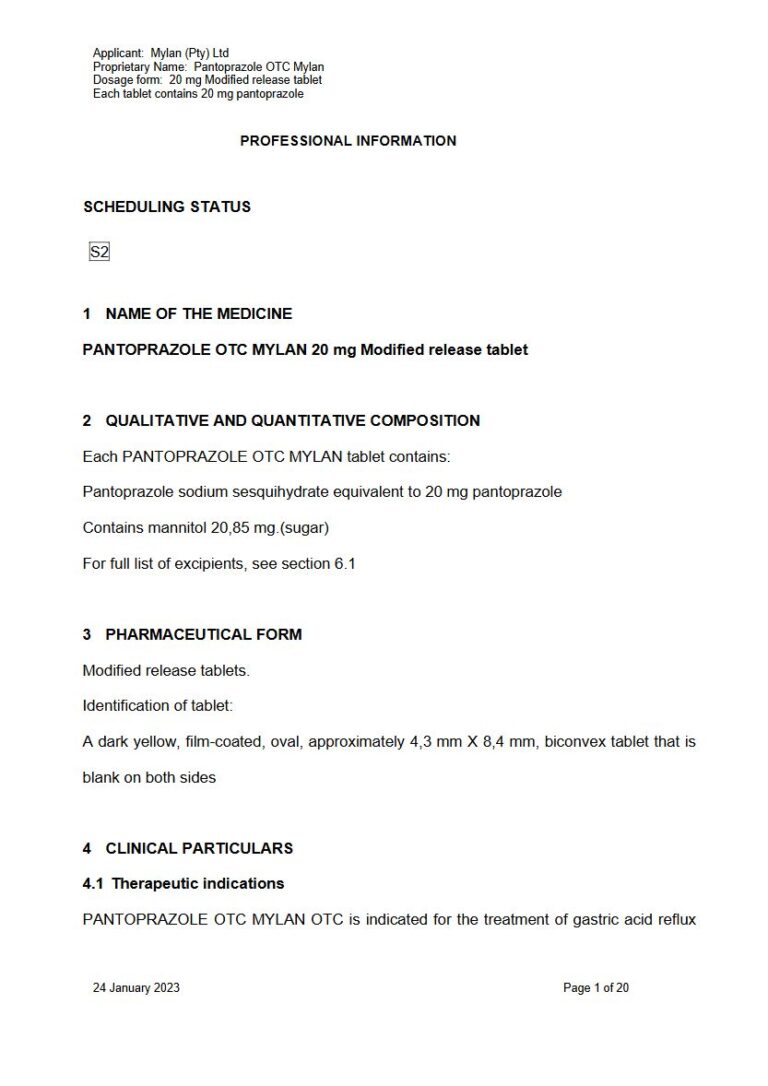
PANTOPRAZOLE OTC MYLAN OTC is indicated for the treatment of gastric acid reflux symptoms such as heartburn and acid regurgitation.
4.2 Posology and method of administration
Posology: The recommended once daily dose of PANTOPRAZOLE OTC MYLAN should be taken in the morning. The dose is one 20 mg PANTOPRAZOLE OTC MYLAN tablet per day. If no symptom relief is obtained within 2 weeks of continuous treatment the patient must be referred to the doctor. The treatment must not exceed 4 weeks without consulting a doctor.
Special populations: No dosage adjustment is necessary in the elderly or in those with impaired renal or liver function.
Method of administration: For oral use. PANTOPRAZOLE OTC MYLAN should be swallowed whole with a little water either before or during breakfast.
4.3 Contraindications
- Known hypersensitivity to pantoprazole or any of the excipients (see section 6.1).
- Safety and efficacy in children has not been established.
- Severely impaired liver function (see section 4.4).
- Co-administration with atazanavir (see section 4.5).
4.4 Special warnings and precautions for use
Hepatic impairment: In patients with mild and moderate liver impairment the liver enzymes should be monitored regularly during treatment with pantoprazole, particularly on long-term use. In the case of a rise of the liver enzymes the treatment should be discontinued. PANTOPRAZOLE OTC MYLAN is contraindicated in patients with severe liver impairment (see section 4.2).
PANTOPRAZOLE OTC MYLAN may increase the risk of subclinical acute or chronic interstitial nephritis associated with proton pump inhibitors (PPI) leading to chronic renal inflammation and reduced renal function (tubular injury being u201ctubulointerstitial nephritisu201d).
Co-administration with NSAIDs: The use of PANTOPRAZOLE OTC MYLAN as a preventive of gastroduodenal ulcers induced by non-selective non-steroidal anti-inflammatory drugs (NSAIDs) should be restricted to patients who require continued NSAID treatment and have an increased risk to develop gastrointestinal complications. The increased risk should be assessed according to individual risk factors, e.g. high age (>65 years), history of gastric or duodenal ulcer or upper gastrointestinal bleeding.
Gastric malignancy: Symptomatic response to PANTOPRAZOLE OTC MYLAN may mask the symptoms of gastric malignancy and may delay diagnosis. In the presence of any alarm symptom (e. g. significant unintentional weight loss, recurrent vomiting, dysphagia, haematemesis, anaemia or melaena) and when gastric ulcer is suspected or present, malignancy should be excluded. Further investigation is to be considered if symptoms persist despite adequate treatment.
Co-administration with HIV protease inhibitors: Co-administration of PANTOPRAZOLE OTC MYLAN is contraindicated with HIV protease inhibitors for which absorption is dependent on acidic intragastric pH such as atazanavir, due to significant reduction in their bioavailability (see section 4.5).
Influence on vitamin B12 absorption: PANTOPRAZOLE OTC MYLAN, may reduce the absorption of vitamin B12 (cyanocobalamin) due to hypo- or achlorhydria. This should be considered in patients with reduced body stores or risk factors for reduced vitamin B12 absorption on long-term therapy or if respective clinical symptoms are observed.
Long term treatment: In long-term treatment, especially when exceeding a treatment period of 1 year, patients should be kept under regular surveillance.
Gastrointestinal infections caused by bacteria: Treatment with PANTOPRAZOLE OTC MYLAN may lead to a slightly increased risk of gastrointestinal infections caused by bacteria such as Salmonella and Campylobacter or C. difficile. PANTOPRAZOLE OTC MYLAN, might be expected to increase the counts of bacteria normally present in the upper gastrointestinal tract.
Hypomagnesaemia: Severe hypomagnesaemia has been reported in patients treated with PPIs like PANTOPRAZOLE OTC MYLAN for at least three months, and in most cases for a year. Serious manifestations of hypomagnesaemia such as fatigue, tetany, delirium, convulsions, dizziness and ventricular dysrhythmia can occur, but they may begin insidiously and be overlooked. In most affected patients, hypomagnesaemia improved after magnesium replacement and discontinuation of the PPI. For patients expected to be on prolonged treatment or who take PPIs with digoxin or medicinal products that may cause hypomagnesaemia (e.g., diuretics), health care professionals should consider measuring magnesium levels before starting PPI treatment and periodically during treatment.
Bone fractures: Proton pump inhibitors as in PANTOPRAZOLE OTC MYLAN, especially if used in high doses and over long durations (> 1 year), may modestly increase the risk of hip, wrist and spine fracture, predominantly in the elderly or in presence of other recognised risk factors. Observational studies suggest that proton pump inhibitors may increase the overall risk of fracture by 10 - 40 %. Some of this increase may be due to other risk factors. Patients at risk of osteoporosis should receive care according to current clinical guidelines and they should have an adequate intake of vitamin D and calcium.
Subacute cutaneous lupus erythematosus (SCLE): Proton pump inhibitors as in PANTOPRAZOLE OTC MYLAN are associated with very infrequent cases of SCLE. If lesions occur, especially in sun-exposed areas of the skin, and if accompanied by arthralgia, the patient should seek medical help promptly and the health care professional should consider stopping PANTOPRAZOLE OTC MYLAN. SCLE after previous treatment with a proton pump inhibitor may increase the risk of SCLE with other proton pump inhibitors.
Interference with laboratory tests: Increased Chromogranin A (CgA) level may interfere with investigations for neuroendocrine tumours. To avoid this interference, PANTOPRAZOLE OTC MYLAN treatment should be stopped for at least 5 days before CgA measurements (see section 5.1). If CgA and gastrin levels have not returned to reference range after initial measurement, measurements should be repeated 14 days after cessation of proton pump inhibitor treatment.
Mannitol: PANTOPRAZOLE OTC MYLAN contains mannitol and may have a laxative effect.
4.5 Interaction with other medicines and other forms of interaction
Medicinal products with pH-dependent absorption pharmacokinetics: Because of profound and long lasting inhibition of gastric acid secretion, PANTOPRAZOLE OTC MYLAN may interfere with the absorption of other medicinal products where gastric pH is an important determinant of oral availability, e.g. some azole antifungals such as ketoconazole, itraconazole, posaconazole and other medicinal products such as erlotinib.
HIV protease inhibitors: Co-administration of PANTOPRAZOLE OTC MYLAN is contraindicated with HIV protease inhibitors for which absorption is dependent on acidic intragastric pH such as atazanavir due to significant reduction in their bioavailability (see section 4.4). If the combination of HIV protease inhibitors with a proton pump inhibitor is judged unavoidable, close clinical monitoring (e.g virus load) is recommended. A pantoprazole dose of 20 mg per day should not be exceeded. Dosage of the HIV protease inhibitor may need to be adjusted.
Warfarin: Co-administration of pantoprazole with warfarin did not affect the pharmacokinetics of warfarin or INR. However, there have been reports of increased INR and prothrombin time in patients receiving PPIs and warfarin concomitantly. Increases in INR and prothrombin time may lead to abnormal bleeding, and even death. Patients treated with pantoprazole and warfarin may need to be monitored for increase in INR and prothrombin time.
Methotrexate: Concomitant use of high dose methotrexate (e.g. 300 mg) and proton-pump inhibitors has been reported to increase methotrexate levels in some patients. Therefore, in settings where high-dose methotrexate is used, for example cancer and psoriasis, a temporary withdrawal of pantoprazole may need to be considered.
Other interactions studies: Pantoprazole is extensively metabolised in the liver via the cytochrome P450 enzyme system. The main metabolic pathway is demethylation by CYP2C19 and other metabolic pathways include oxidation by CYP3A4. Interaction studies with medicinal products also metabolised with these pathways, like carbamazepine, diazepam, glibenclamide, nifedipine, and an oral contraceptive containing levonorgestrel and ethinyl oestradiol did not reveal clinically significant interactions. An interaction of pantoprazole with other medicinal products or compounds, which are metabolised using the same enzyme system, cannot be excluded. Results from a range of interaction studies demonstrate that pantoprazole does not affect the metabolism of active substances metabolised by CYP1A2 (such as caffeine, theophylline), CYP2C9 (such as piroxicam, diclofenac, naproxen), CYP2D6 (such as metoprolol), CYP2E1 (such as ethanol) or does not interfere with p-glycoprotein related absorption of digoxin. There were no interactions with concomitantly administered antacids. Interaction studies have also been performed by concomitantly administering pantoprazole with the respective antibiotics (clarithromycin, metronidazole, amoxicillin). No clinically relevant interactions were found.
Medicinal products that inhibit or induce CYP2C19: Inhibitors of CYP2C19 such as fluvoxamine could increase the systemic exposure of pantoprazole. A dose reduction may be considered for patients treated long-term with high doses of PANTOPRAZOLE OTC MYLAN, or those with hepatic impairment. Enzyme inducers affecting CYP2C19 and CYP3A4 such as rifampicin and St Johnu00b4s wort (Hypericum perforatum) may reduce the plasma concentrations of PPIs that are metabolised through these enzyme systems.
4.6 Fertility, pregnancy and lactation
Pregnancy: Safety in pregnancy has not been established. A moderate amount of data on pregnant women indicate no malformative or foeto/neonatal toxicity of pantoprazole. Animal studies have shown reproductive toxicity (see section 5.3). As a precautionary measure, it is preferable to avoid the use of PANTOPRAZOLE OTC MYLAN during pregnancy.
Breast-Feeding: Safety in lactation has not been established. Animal studies have shown excretion of pantoprazole in breast milk. There is insufficient information on the excretion of pantoprazole in human milk but excretion into human milk has been reported. A risk to the newborns/infants cannot be excluded.
Fertility: There was no evidence of impaired fertility following the administration of pantoprazole in animal studies (see section 5.3).
4.7 Effects on ability to drive and use machines
PANTOPRAZOLE OTC MYLAN has adverse drug reactions such as dizziness and visual disturbances which may occur (see section 4.8). If affected, patients should not drive or operate machines.
4.8 Undesirable effects
a. Summary of the safety profile: Approximately 5 % of patients can be expected to experience adverse drug reactions (ADRs). The most frequent reported ADRs are diarrhoea and headache, both occurring in approximately 1 % of patients.
b. Tabulated summary of adverse reactions: The table below lists adverse reactions reported with pantoprazole according to system organ class, ranked under the following frequency classification: Frequent, Less frequent and Frequency unknown (for post-marketing experience). Within each frequency grouping, adverse reactions are presented in order of decreasing seriousness.
4.9 Overdose
Signs and symptoms: There are no known symptoms of overdose in man. Systemic exposure with up to 240 mg administered intravenously over 2 minutes were well tolerated. As pantoprazole is extensively protein bound, it is not readily dialysable.
Management of overdose: In the case of overdose with clinical signs of intoxication, apart from symptomatic and supportive treatment, no specific therapeutic recommendations can be made.
