
Parafengen Iv 1000 mg, 300 mg Solution for infusion
PDF Leaflet Revision Date: 15 August 2023
Clinical Summary
Quick overview from the medicine insert
Indication
Relief of mild to moderate pain and reduction of fever in adults via intravenous administration.
Dosage (summary)
100 ml IV infusion every 6 hours as needed, max 4 vials/day.
Special Populations
- Elderly
- Renal impairment
- Hepatic impairment
Pregnancy & Breastfeeding
Contraindicated in pregnancy and breastfeeding.
Key Drug Interactions
- Increased risk of GI bleeding with NSAIDs
- Enhanced effects of anticoagulants
- Reduced efficacy of ACE inhibitors
Contraindications
- Hypersensitivity to paracetamol or ibuprofen
- Severe renal or liver impairment
- Active alcoholism
- History of GI bleeding or ulcers
Common side effects
- Dizziness
- Nausea
- Vomiting
- Injection site pain
Counselling Points
- Do not exceed recommended dose.
- Monitor for signs of GI bleeding.
- Report any skin reactions immediately.
Serious warnings
- Risk of serious GI events
- Potential for liver damage in overdose
- Increased risk of cardiovascular events
Important Disclaimer
The Parafengen Iv 1000 mg, 300 mg Solution for infusion professional information leaflet below is the property of Litha Pharma and is provided on Medinsert exactly as issued, with no.. alterations or editorial changes. We make every effort to keep content current by updating documents as soon as new versions become available. Medinsert serves as a trusted access point for healthcare professionals, but does not replace official sources or clinical judgement. For more details, please read our full disclaimer. read more>>
 Healthcare Professionals Only
This content is for registered healthcare professionals
Sign in or create a free account to read the full package insert.
Free for HPCSA-registered professionals. Powered by Medinsert.
Clinical Particulars
Section 4 of the official insert — extracted exactly as issued, no alterations
4.1 Therapeutic indications
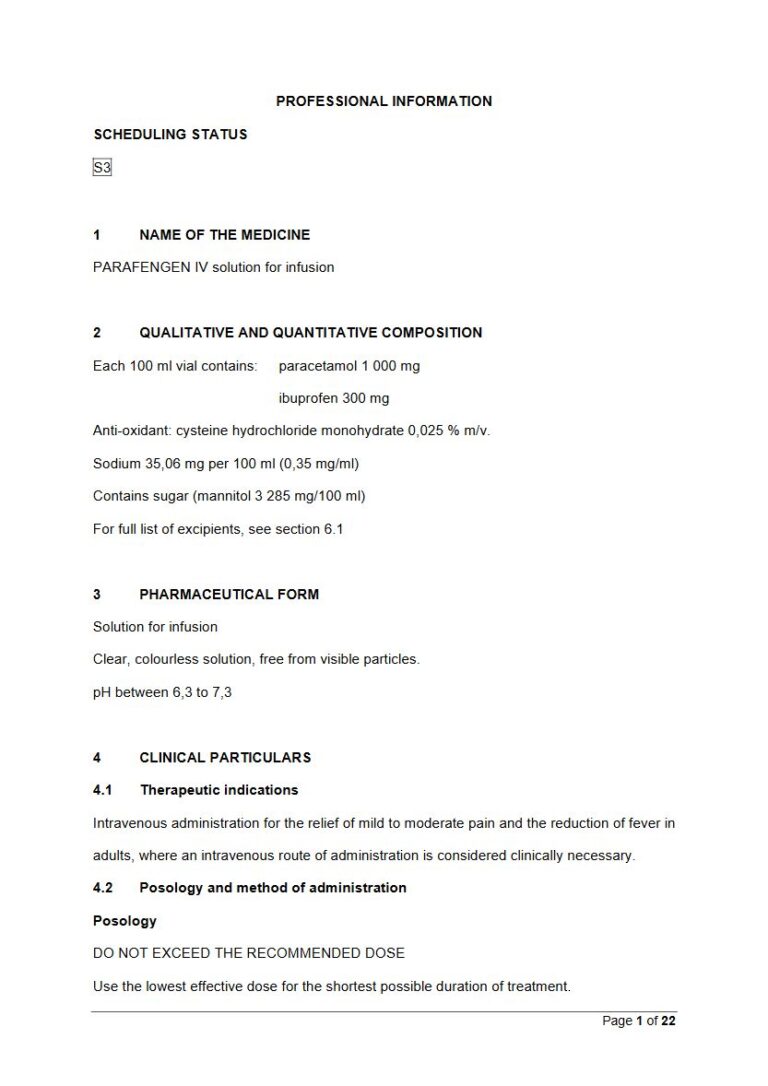
Intravenous administration for the relief of mild to moderate pain and the reduction of fever in adults, where an intravenous route of administration is considered clinically necessary.
4.2 Posology and method of administration
Posology
DO NOT EXCEED THE RECOMMENDED DOSE
Use the lowest effective dose for the shortest possible duration of treatment.
Adults
Administer one vial (100 ml) of PARAFENGEN IV as a 15-minute intravenous infusion, every 6 hours, as necessary. Do not exceed a total daily dose of 4 vials PARAFENGEN IV (totalling 4 000 mg (4 g) paracetamol and 1200 mg ibuprofen).
Special populations
Paediatric population
The safety and efficacy of PARAFENGEN IV in children under the age of 18 years have not been established.
Elderly
A clinical study of PARAFENGEN IV did not include sufficient numbers of subjects 65 years of age and over to determine whether they respond differently to younger subjects. Dose selection for an elderly patient should be cautious, usually starting at the low end of the dosing range, reflecting the greater frequency of decreased hepatic, renal, or cardiac function, and of concomitant disease or other medicine therapy. Elderly patients are at increased risk for serious GI adverse events (see section 4.4, Gastrointestinal effects).
Renal impairment
Caution is also recommended in patients with pre-existing renal disease. No information is available from controlled clinical studies regarding the use of PARAFENGEN IV in patients with advanced renal disease. If PARAFENGEN IV therapy must be initiated in patients with advanced renal disease, closely monitor the patientu2019s renal function. See section 4.3 and 4.4.
Hepatic impairment
PARAFENGEN IV should be used with caution in patients with mild to moderate hepatic impairment. The use of paracetamol at higher than recommended doses can lead to hepatotoxicity, hepatic failure and death. A patient with symptoms and/or signs suggesting liver dysfunction, or with abnormal liver test values, should be evaluated for evidence of the development of a more severe hepatic reaction while on therapy with ibuprofen. If clinical signs and symptoms consistent with liver disease develop, or if systemic manifestations occur (e.g., eosinophilia, rash, etc.), PARAFENGEN IV should be discontinued.
Adverse gastrointestinal events
To minimise the potential risk for an adverse GI event in patients treated with a NSAID, including ibuprofen as contained in PARAFENGEN IV, use the lowest effective dose for the shortest possible duration. Patients and healthcare professionals should remain alert for signs and symptoms of GI ulcerations and bleeding during PARAFENGEN IV therapy and promptly initiate additional evaluation and treatment if a serious GI event is suspected. This should include discontinuation of PARAFENGEN IV until a serious GI adverse event is ruled out. For high-risk patients, alternate therapies that do not involve NSAIDs should be considered.
Method of administration
PARAFENGEN IV should be administered as a 15-minute intravenous infusion. Visually inspect PARAFENGEN IV for particulate matter and discolouration prior to administration, whenever solution and container permit. If visibly opaque particles, discolouration or other foreign particulates are observed, the solution should not be used. PARAFENGEN IV should be used in one patient on one occasion only. It contains no antimicrobial preservative. Unused solution should be discarded. As for all solutions for infusion presented in glass vials, it should be remembered that close monitoring is needed notably at the end of the infusion, regardless of administration route. This monitoring at the end of the perfusion applies particularly for central route infusion, in order to avoid air embolism. It is recommended that for the administration of PARAFENGEN IV, a needle or giving set with a diameter equal to or below 0.8 mm should be used for solution sampling. In addition, it is recommended that the bung is pierced at the location specifically designed for needle introduction (where the thickness of the bung is the lowest). If these recommendations are not adhered to the likelihood of bung fragmentation or the bung being forced into the vial is increased. To facilitate administration, the label attached to the vials of PARAFENGEN IV allow for hanging.
4.3 Contraindications
- Hypersensitivity to paracetamol, ibuprofen, other NSAIDs or to any of the excipients (see section 6.1).
- Severe impaired kidney function, severe impaired liver function.
- Severe cardiovascular disease or heart failure.
- Patients with a history of gastrointestinal perforation, ulceration or bleeding (PUBs) related to previous NSAIDs, including PARAFENGEN IV. (See section 4.4).
- Patients with a history of asthma, urticaria, or other allergic-type reactions after taking aspirin or other NSAIDs. Severe, fatal anaphylactic-like reactions to NSAIDS have been reported in such patients. (See section 4.4).
- Treatment of peri-operative pain in the setting of coronary artery bypass graft (CABG) surgery (see section 4.4).
- Patients with active alcoholism as chronic excessive alcohol ingestion may predispose patients to hepatotoxicity (due to the paracetamol component).
- Patients with spinal cord injuries.
- Pregnancy or when planning to become pregnant (see section 4.6).
- Breastfeeding.
4.4 Special warnings and precautions for use
It is recommended to use a suitable oral analgesic treatment as soon as this administration route is possible. Paracetamol This product contains paracetamol which may be fatal in overdose. In the event of overdosage or suspected overdose and notwithstanding the fact that the person may be asymptomatic, the nearest doctor, hospital or Poison Centre must be contacted immediately.
PARAFENGEN IV should be used with caution in cases of:
- Glucose 6 Phosphate Dehydrogenase (G6PD) deficiency (may lead to haemolytic anaemia),
- anorexia, bulimia or cachexia; chronic malnutrition (low reserves of hepatic glutathione),
- dehydration, hypovolaemia (see section 4.2 and 5.2)
Maximum daily dose
The total dose of paracetamol should not exceed 4 g per day (see section 4.2). It is important to consider the contribution of all paracetamol-containing medicines, including non-prescription, oral or parenteral forms of the medicines to this total daily paracetamol dose prior to administering PARAFENGEN IV. If the daily dose of paracetamol from all sources exceeds the maximum, severe hepatic injury may occur (see section 4.9).
Hepatic injury
Patients with hepatic insufficiency, chronic alcoholism, chronic malnutrition or dehydration may be at a higher risk of liver damage following administration of PARAFENGEN IV.
Hypertension and heart failure
Caution is required in patients with a history of hypertension and/or heart failure as fluid retention and oedema have been reported in association with ibuprofen as contained in PARAFENGEN IV therapy. In view of the PARAFENGEN IVu2019s inherent potential to cause fluid retention, heart failure may be precipitated in some compromised patients. NSAIDs, including the ibuprofen in PARAFENGEN IV, can lead to onset of new hypertension or worsening of pre-existing hypertension, either of which may contribute to the increased incidence of cardiovascular events. Caution is required in patients with significant risk factors for cardiovascular events (e.g., hypertension, hyperlipidaemia, diabetes mellitus, smoking) and should only be treated with PARAFENGEN IV after careful consideration. To minimise the potential risk for an adverse cardiovascular event in patients treated with a NSAID, use the lowest effective dose for the shortest duration possible.
Monitor blood pressure closely during the initiation of NSAID treatment and throughout the course of therapy. Patients taking ACE inhibitors, thiazides, or loop diuretics may have an impaired response to these therapies when taking NSAIDS (see section 4.5).
Cardiovascular thrombotic events
All NSAIDS, including the ibuprofen in PARAFENGEN IV, have been associated with an increased risk of cardiovascular and thrombotic adverse events when taken long term. Clinical trials of several COX-2 selective and nonselective NSAIDs of up to three years duration have shown an increased risk of serious cardiovascular (CV) thrombotic events, myocardial infarction and stroke, which can be fatal. All NSAIDs, both COX-2 selective and nonselective, may have a similar risk. Patients with known CV disease or risk factors for CV disease may be at greater risk. To minimise the potential risk for an adverse CV event in patients treated with a NSAID, use the lowest effective dose for the shortest duration possible. Physicians and patients should remain alert for the development of such events, even in the absence of previous CV symptoms. Patients should be informed about the signs and/or symptoms of serious CV events and the steps to take if they occur.
There is no consistent evidence that concurrent use of aspirin mitigates the increased risk of serious cardiovascular thrombotic events associated with NSAID use. The concurrent use of aspirin and PARAFENGEN IV does increase the risk of serious gastrointestinal (GI) events.
Gastrointestinal bleeding, ulceration and perforation
When gastrointestinal bleeding or ulceration occurs in patients receiving PARAFENGEN IV, treatment with PARAFENGEN IV should be stopped. PARAFENGEN IV should be given with caution to patients with a history of gastrointestinal disease (e.g., ulcerative colitis, Crohnu2019s disease, hiatus hernia, gastroesophageal reflux disease, angiodysplasia) as the condition may be exacerbated. The elderly has an increased frequency of adverse reactions to NSAIDs including ibuprofen, as contained in PARAFENGEN IV, especially gastrointestinal perforation, ulceration and bleeding (PUBs) which may be fatal.
The risk of gastrointestinal perforation, ulceration or bleeding (PUBs) is higher with increasing doses of PARAFENGEN IV, in patients with a history of ulcers, and the elderly. Studies have shown that patients with a prior history of peptic ulcer disease and/or gastrointestinal bleeding and who use NSAIDs, have a greater than 10-fold higher risk for developing a gastrointestinal bleed than patients with neither of these risk factors. In addition to a past history of ulcer disease, pharmaco-epidemiological studies have identified several other co-therapies or co-morbid conditions that may increase the risk for gastrointestinal bleeding such as: treatment with corticosteroids, treatment with anticoagulants, longer duration of NSAID therapy, smoking, alcoholism, older age, and poor general health status.
Skin reactions
Serious skin reactions, some of them fatal, including exfoliative dermatitis, Stevens-Johnson syndrome, and toxic epidermal necrolysis have been reported (see section 4.8). PARAFENGEN IV should be discontinued at the first appearance of skin rash, mucosal lesions, or any other sign of hypersensitivity.
Pre-existing asthma
Patients with asthma may have aspirin-sensitive asthma. The use of aspirin in patients with aspirin-sensitive asthma has been associated with severe bronchospasm, which can be fatal. Since cross-reactivity between aspirin and NSAIDs, including ibuprofen as contained in PARAFENGEN IV, has been reported in such aspirin-sensitive patients, including bronchospasm, PARAFENGEN IV is contraindicated in patients with this form of aspirin sensitivity and should be used with caution in all patients with pre-existing asthma (see also section 4.3).
Ophthalmological effects
Blurred or diminished vision, scotomata, and changes in colour vision have been reported with oral ibuprofen. Discontinue PARAFENGEN IV if a patient develops such complaints and refer the patient for an ophthalmologic examination that includes central visual fields and colour vision testing.
Hepatic effects
Borderline elevations of one or more liver tests may occur in some patients taking NSAIDs, including the ibuprofen in PARAFENGEN IV. These laboratory abnormalities may progress, may remain unchanged, or may be transient with continuing therapy. Notable elevations of ALT or AST (approximately three or more times the upper limit of normal) have been reported in small numbers of patients in clinical trials with NSAIDs. In addition, rare cases of severe hepatic reactions have been reported, including jaundice, fulminant hepatitis, liver necrosis and hepatic failure, some with fatal outcomes. A patient with symptoms and/or signs suggesting liver dysfunction, or with abnormal liver test values, should be evaluated for evidence of the development of a more severe hepatic reaction while on therapy with PARAFENGEN IV. If clinical signs and symptoms consistent with liver disease develop, or if systemic manifestations occur (e.g., eosinophilia, rash, etc.), PARAFENGEN IV should be discontinued.
Renal effects
Long-term administration of NSAIDs like ibuprofen as contained in PARAFENGEN IV, has resulted in renal papillary necrosis and other renal injury. Renal toxicity has also been seen in patients in whom renal prostaglandins have a compensatory role in the maintenance of renal perfusion. In these patients, administration of PARAFENGEN IV may cause a dose-dependent reduction in renal prostaglandin formation and, secondarily, in renal blood flow, which may precipitate overt renal decompensation. Patients at greatest risk of this reaction are those with impaired renal function, heart failure, liver dysfunction, those taking diuretics, ACE inhibitors, or angiotensin receptor antagonists, and the elderly. Discontinuation of NSAID therapy is usually followed by recovery to the pre-treatment state. Caution is also recommended in patients with pre-existing renal disease. No information is available from controlled clinical studies regarding the use of PARAFENGEN IV in patients with advanced renal disease. If PARAFENGEN IV therapy must be initiated in patients with advanced renal disease, closely monitor the patientu2019s renal function.
Aseptic meningitis
Aseptic meningitis with fever and coma has been observed in patients on oral ibuprofen therapy. Although it is probably more likely to occur in patients with systemic lupus erythematosus and related connective tissue diseases, it has been reported in patients who do not have underlying chronic disease. If signs or symptoms of meningitis develop in a patient on PARAFENGEN IV, give consideration to whether or not the signs or symptoms are related to ibuprofen therapy.
Haematological effects
Anaemia may occur in patients receiving NSAIDs, including the ibuprofen in PARAFENGEN IV. This may be due to fluid retention, occult or gross gastrointestinal blood loss, or an incompletely described effect on erythropoiesis. In patients on long-term treatment with NSAIDs, including ibuprofen, check haemoglobin or haematocrit if they exhibit any signs or symptoms of anaemia or blood loss. NSAIDs inhibit platelet aggregation and have been shown to prolong bleeding time in some patients. Unlike aspirin, their effects on platelet function are less severe quantitatively, of shorter duration, and reversible. Carefully monitor patients who may be adversely affected by alterations in platelet function, such as those with coagulation disorders or patients receiving anticoagulants.
Masking inflammation and fever
The pharmacological activity of ibuprofen in PARAFENGEN IV in reducing fever and inflammation may diminish the utility of these diagnostic signs in detecting complications of presumed non-infectious, painful conditions.
Anaphylactoid reactions
As with other NSAIDs, anaphylactoid reactions may occur in patients without known prior exposure to ibuprofen. PARAFENGEN IV is contraindicated in patients with the aspirin triad. This symptom complex typically occurs in asthmatic patients who experience rhinitis with or without nasal polyps, or who exhibit severe, potentially fatal bronchospasm after taking aspirin or other NSAIDs (see also section 4.3).
Patients receiving spinal or epidural analgesia
As potential bleeding around the spinal cord has serious consequences, caution should be exercised when treating patients undergoing spinal and epidural analgesia.
Monitoring
Serious gastrointestinal tract ulcerations and bleeding can occur without warning symptoms therefore healthcare professionals should monitor for signs or symptoms of gastrointestinal bleeding. Patients on long-term treatment with NSAIDs should have full blood count (FBC) and chemistry profiles checked periodically. If clinical signs and symptoms consistent with liver or renal disease develop, systemic manifestations occur (e.g., eosinophilia, rash), or abnormal liver tests persist or worsen, discontinue PARAFENGEN IV.
Corticosteroid therapy
In order to avoid exacerbation of disease or adrenal insufficiency, patients who have been on prolonged corticosteroid therapy should have their therapy tapered slowly rather than discontinued abruptly when products containing ibuprofen are added to the treatment program.
Any special precaution necessary relating to excipients
PARAFENGEN IV contains 35,06 mg sodium per 100 ml. PARAFENGEN IV contains mannitol and may have a laxative effect.
4.5 Interaction with other medicines and other forms of interaction
PARAFENGEN IV should not be administered with other products containing paracetamol or NSAID. Concomitant use could result in an increase in side effects.
Paracetamol
Concurrent intake of the following medicines can influence the effect of paracetamol or paracetamol can affect their effect: cholestyramine, metoclopramide, domperidone and propantheline.
Busulfan
Busulfan is eliminated from the body via conjugation with glutathione. Concomitant use with paracetamol may result in reduced busulfan clearance.
Chloramphenicol
Paracetamol may increase chloramphenicol plasma concentrations.
Diflunisal
Concomitant diflunisal increases paracetamol plasma concentrations and this may increase hepatotoxicity.
Enzyme-inducing medicines
Caution should be paid to the concomitant intake of enzyme-inducing medicines. These substances include but are not limited to barbiturates, isoniazid, anticoagulants, zidovudine, amoxicillin and clavulanic acid, carbamazepine and ethanol. Induction of metabolism of paracetamol from enzyme inducers may result in an increased level of hepatotoxic metabolites.
Ibuprofen
Corticosteroids
Increased risk of gastrointestinal perforation, ulceration or bleeding (PUBs).
Anti-coagulants
PARAFENGEN IV may enhance the effects of anti-coagulants such as warfarin.
Anti-platelet medicines and selective serotonin reuptake inhibitors (SSRIs)
Increased risk of gastrointestinal bleeding.
Aminoglycosides
NSAIDs, including ibuprofen as contained in PARAFENGEN IV, may decrease the excretion of aminoglycosides.
Antidiabetic medicines
These medicines may interact with ibuprofen, as contained in PARAFENGEN IV.
Aspirin
When PARAFENGEN IV is administered with aspirin, ibuprofenu2019s protein binding is reduced, although the clearance of free ibuprofen is not altered. The clinical significance of this interaction is not known. Concomitant administration of PARAFENGEN IV and aspirin is not recommended because of the potential for increased adverse effects.
Cardiac glycosides
NSAIDs may exacerbate cardiac failure, reduce glomerular filtration rate and increase plasma cardiac glycoside levels. Care should therefore be taken in patients treated with cardiac glycosides.
Combination use of ACE inhibitors or angiotensin receptor antagonists, anti-inflammatory medicines and thiazide diuretics
NSAIDs, including ibuprofen as contained in PARAFENGEN IV may diminish the antihypertensive effect of ACE inhibitors. This interaction should be given consideration in patients taking NSAIDs concomitantly with ACE inhibitors. Ibuprofen, like other NSAIDs, can reduce the antihypertensive effect of ACE inhibitors and beta-blockers with possible loss of blood pressure control and can attenuate the natriuretic effects of thiazide diuretics and frusemide. Diuretics can also increase the risk of nephrotoxicity of NSAIDs. The combined use of the three classes of medicines, thiazides, an ACE inhibiting drug (ACE-inhibitor or angiotensin receptor antagonist) and an anti-inflammatory drug (NSAID or COX-2 inhibitor) all at the same time increases the risk of renal impairment (see section 4.4, Renal effects).
Ciclosporin or tacrolimus
Increased risk of nephrotoxicity when used with NSAIDs, including ibuprofen as contained in PARAFENGEN IV.
Diuretics
Clinical studies and post-marketing observations have shown that ibuprofen can reduce the natriuretic effects of furosemide and thiazides in some patients. This response has been attributed to inhibition of renal prostaglandin synthesis. During concomitant therapy with PARAFENGEN IV, observe patients closely for signs of renal failure, as well as to assure diuretic efficacy (see section 4.4).
Herbal extracts
Ginkgo biloba may potentiate the risk of bleeding with NSAIDs, including ibuprofen as contained in PARAFENGEN IV.
Lithium
PARAFENGEN IV should be avoided in patients taking lithium as NSAIDs have produced elevations of plasma lithium levels and a reduction in renal lithium clearance.
Methotrexate
NSAIDs, including ibuprofen as contained in PARAFENGEN IV, have been reported to competitively inhibit methotrexate accumulation in rabbit kidney slices. This indicates that NSAIDs may enhance the toxicity of methotrexate. Use caution when PARAFENGEN IV are administered concomitantly with methotrexate.
Mifepristone
PARAFENGEN IV should not be used for 8-12 days after mifepristone administration as NSAIDs can reduce the effect of mifepristone.
Quinolone antibiotics
Animal data indicate that NSAIDs, including ibuprofen as contained in PARAFENGEN IV, can increase the risk of convulsions associated with quinolone antibiotics. Patients taking PARAFENGEN IV and quinolones may have an increased risk of developing convulsions.
Zidovudine
Increased risk of haematological toxicity when NSAIDs, including ibuprofen as contained in PARAFENGEN IV are given with zidovudine. There is evidence of an increased risk of haemarthroses and haematoma in HIV (+) haemophiliacs receiving concurrent treatment with zidovudine and ibuprofen.
Paracetamol and ibuprofen
Phenytoin
Phenytoin administered concomitantly may result in decreased paracetamol effectiveness and an increased risk of hepatotoxicity. Patients receiving phenytoin therapy should avoid large and/or chronic doses of paracetamol. Patients should be monitored for evidence of hepatotoxicity. Phenytoin may also interact with ibuprofen.
Probenecid
Probenecid causes an almost 2-fold reduction in clearance of paracetamol by inhibiting its conjugation with glucuronic acid. A reduction of the paracetamol dose should be considered for concomitant treatment with probenecid. Probenecid may also interact with ibuprofen.
4.6 Fertility, pregnancy and lactation
Pregnancy
Use of NSAIDs, including ibuprofen in PARAFENGEN IV, during the third trimester of pregnancy increases the risk of premature closure of the fetal ductus arteriosus in utero and possibly, in persistent pulmonary hypertension of the new-born. The onset of labour may be delayed, and its duration increased. As there is insufficient information on the use of PARAFENGEN IV during pregnancy, its use during pregnancy or in patients planning to become pregnant is contraindicated (see section 4.3).
Labour and delivery
The effects of PARAFENGEN IV on labour and delivery in pregnant women are unknown but, based on the known pharmacology of ibuprofen, administration is not recommended as the onset of labour may be delayed and the duration increased with a greater bleeding tendency in both mother and child.
Breastfeeding
After oral administration, paracetamol is excreted into breast milk in small quantities. No undesirable effects on nursing infants have been reported. No signs of toxicity were observed in rat pups of dams that received IV propacetamol postpartum at maternal exposures (based on AUC) greater than twice those anticipated at the maximum clinical dose. It is not known whether ibuprofen and/or its metabolites are excreted in human milk. Because many medicines are excreted in milk and because of the potential for serious adverse reactions in nursing infants from IV ibuprofen, PARAFENGEN IV is contraindicated for use in nursing mothers (see section 4.3).
Fertility
The effects of PARAFENGEN IV on fertility are unknown. Intravenous paracetamol (administered as propacetamol) had no effect on fertility of rats at systemic exposure levels (based on AUC) greater than twice those anticipated at the maximum clinical dose. In rats, fertility was not affected by dietary administration of ibuprofen 20 mg/kg/day to males and females from prior to mating through organogenesis, or by oral administration to females at up to 180 mg/kg/day throughout gestation. In rabbits, oral administration of ibuprofen 60 mg/kg/day throughout gestation was associated with reduced implantations and live litter size, along with maternotoxicity; the no-effect dose was 20 mg/kg/day.
4.7 Effects on ability to drive and use machines
When driving vehicles or operating machinery it should be taken into account that drowsiness, dizziness, light-headedness, or blurred vision may occasionally occur when receiving PARAFENGEN IV (see section 4.8).
4.8 Undesirable effects
a. Summary of the safety profile
A clinical study with PARAFENGEN IV did not indicate any other undesirable effects other than those for equivalent doses of IV paracetamol alone or IV ibuprofen alone. The major safety issue with paracetamol is the risk of liver injury, especially in overdose situations and in alcoholics. The most commonly observed adverse events for ibuprofen are gastrointestinal in nature. The two major risks with non-steroidal anti-inflammatory drugs (NSAIDs), including ibuprofen as contained in PARAFENGEN IV are gastric bleeding and thromboembolic events.
b. Tabulated summary of adverse reactions
Adverse reactions have been ranked under headings of frequency using the following convention: Very common (u2265 1/10); common (u2265 1/100, < 1/10), frequency unknown (cannot be estimated from the available data).
MedDRA System Organ Class
Frequency
Side Effects
Nervous system disorders
Very common
Dizziness
Common
Somnolence, headache, hyperhydrosis
Cardiac disorders
Frequency unknown
Oedema, hypertension and cardiac failure
Gastrointestinal disorders
Very common
Nausea, vomiting.
Common
Constipation, peptic ulcers, perforation or gastrointestinal bleeding, sometimes fatal, diarrhoea, flatulence, dyspepsia, abdominal pain, melaena, haematemesis, ulcerative stomatitis, exacerbation of colitis and Crohnu2019s disease, gastritis.
Skin and subcutaneous tissue disorders
Common
Pruritus
Frequency unknown
Bullous reactions including Stevens Johnson syndrome and toxic epidermal necrolysis
General disorders and administrative site conditions
Very common
Injection site pain
Common
Injection site extravasation, decreased appetite
4.9 Overdose
Paracetamol
Prompt treatment is essential. In the event of an overdosage, consult a doctor immediately, or take the person directly to a hospital. A delay in starting treatment may mean that antidote is given too late to be effective. Evidence of liver damage is often delayed until after the time for effective treatment has lapsed. Susceptibility to paracetamol toxicity is increased in patients who have taken repeated high doses (greater than 5 -10 g/day) of paracetamol for several days, in chronic alcoholism, chronic liver disease, AIDS, malnutrition, and with the use of medicines that induce liver microsomal oxidation such as barbiturates, isoniazid, rifampicin, phenytoin and carbamazepine. Symptoms of paracetamol overdosage in the first 24 hours include pallor, nausea, vomiting, anorexia and possibly abdominal pain. Mild symptoms during the first two days of acute poisoning, do not reflect the potential seriousness of the overdosage. Liver damage may become apparent 12 to 48 hours, or later after ingestion, initially by elevation of the serum transaminase and lactic dehydrogenase activity, increased serum bilirubin concentration and prolongation of the prothrombin time. Liver damage may lead to encephalopathy, coma and death. Acute renal failure with acute tubular necrosis may develop even in the absence of severe liver damage. Abnormalities of glucose metabolism and metabolic acidosis may occur. Cardiac dysrhythmias have been reported.
Treatment for paracetamol overdosage
N-acetylcysteine should be administered to all cases of suspected overdose as soon as possible preferably within eight hours of overdosage, although treatment up to 36 hours after ingestion may still be of benefit, especially if more than 150 mg/kg of paracetamol was administered. An initial dose of 150 mg/kg N-acetylcysteine in 200 ml dextrose injection given intravenously over 15 minutes, followed by an infusion of 50 mg/kg in 500 ml dextrose injection over the next four hours, and then 100 mg/kg in 1 000 ml dextrose injection over the next sixteen hours. The volume of intravenous fluid should be modified for children. Although the oral formulation is not the treatment of choice, 140 mg/kg dissolved in water may be administered initially, followed by 70 mg/kg every four hours for seventeen doses. A plasma paracetamol level should be determined four hours after ingestion in all cases of suspected overdosage. Levels done before four hours may be misleading. Patients at risk of liver damage, and hence requiring continued treatment with N-acetylcysteine, can be identified according to their 4-hour plasma paracetamol level. The plasma paracetamol level can be plotted against time since ingestion in the nomogram below. The nomogram should be used only in relation to a single acute ingestion. Those whose plasma paracetamol levels are above the u201cnormal treatment line,u201d should continue N-acetylcysteine treatment with 100 mg/kg IV over sixteen hours repeatedly until recovery. Patients with increased susceptibility to liver damage as identified above, should continue treatment if concentrations are above the u201chigh risk treatment line.u201d Prothrombin index correlates best with survival.
Ibuprofen
The following signs and symptoms have occurred in individuals following an overdose of oral ibuprofen: abdominal pain, nausea, vomiting, drowsiness, dizziness, convulsion, and rarely, loss of consciousness.
Management
Treat patients with symptomatic and supportive care following an ibuprofen overdosage. There are no specific antidotes.
