
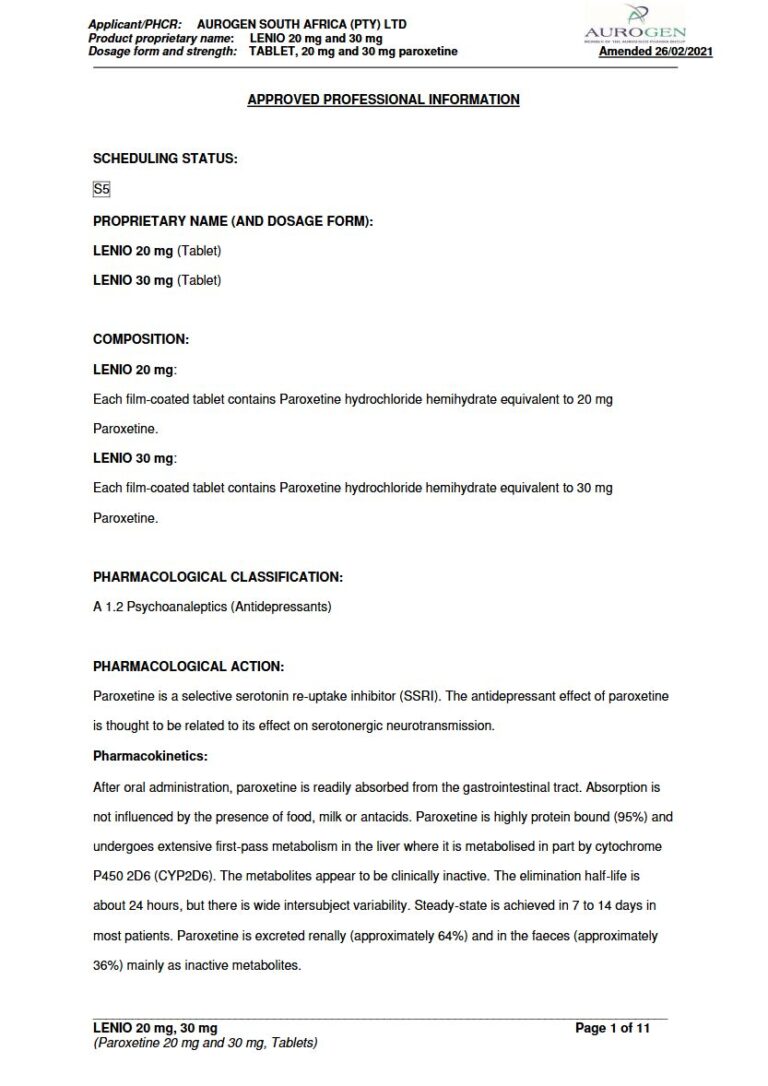
Lenio 20 mg and 30 mg TABLET
PDF Leaflet Revision Date: 26 February 2021
Clinical Summary
Quick overview from the medicine insert
Indication
Depression, OCD, Social phobia, Panic disorder.
Dosage (summary)
Starting at 20 mg daily, max 50 mg for depression; 40 mg daily for panic disorder; 40 mg daily for OCD; 20 mg daily for social phobia.
Onset of Action / Duration
Onset: 7-14 days, Duration: 24 hours
Special Populations
- Elderly
- Renal impairment
- Hepatic impairment
Pregnancy & Breastfeeding
Safety in pregnancy/lactation not established.
Key Drug Interactions
- MAO inhibitors
- Thioridazine
- Cimetidine
- Phenytoin
- Risperidone
- Lithium
- Warfarin
Contraindications
- Hypersensitivity to paroxetine
- MAO inhibitors
- Children under 18
- Co-administration with thioridazine
Common side effects
- Somnolence
- Insomnia
- Nausea
- Dizziness
- Sexual dysfunction
Counselling Points
- Take in the morning with food
- Do not abruptly discontinue
- Caution with driving and machinery
- Avoid alcohol
Serious warnings
- Risk of suicidal ideation in children and adolescents
- Monitor for worsening depression
- Caution in patients with epilepsy
Important Disclaimer
The Lenio 20 mg and 30 mg TABLET professional information leaflet below is the property of Aurogen South Africa and is provided on Medinsert exactly as issued, with no.. alterations or editorial changes. We make every effort to keep content current by updating documents as soon as new versions become available. Medinsert serves as a trusted access point for healthcare professionals, but does not replace official sources or clinical judgement. For more details, please read our full disclaimer. read more>>
 Healthcare Professionals Only
This content is for registered healthcare professionals
Sign in or create a free account to read the full package insert.
Free for HPCSA-registered professionals. Powered by Medinsert.
Clinical Particulars
Section 4 of the official insert — extracted exactly as issued, no alterations
4.1 Therapeutic indications
u2022 Depression
u2022 Obsessive Compulsive Disorder (OCD)
u2022 Social phobia
u2022 Panic disorder
4.2 Posology and method of administration
It is recommended that LENIO is administered in the morning with food. LENIO should be swallowed rather than chewed.
Depression: 20 mg daily. This dose can be increased gradually if needed by 10 mg increments to a maximum of 50 mg daily according to the patientu2019s response.
Panic Disorder: The recommended dose is 40 mg daily. The initial starting dose is 10 mg daily, which may be increased by 10 mg increments. The maximum dose is 60 mg daily. The low initial starting dose is recommended to minimise the potential worsening of panic symptoms when initiating treatment with LENIO.
Obsessive Compulsive Disorder: The recommended dose is 40 mg daily. The initial starting dose is 20 mg daily, which may be increased by 10 mg increments to a maximum of 60 mg daily.
Social Phobia: The recommended daily dose is 20 mg. This dose may be increased gradually if needed by 10 mg increments to a maximum of 60 mg according to the patientu2019s response.
Children: The safety and efficacy of LENIO in children under the age of 18 years have not been established. In children hostility, suicide ideation and self-harm may occur with LENIO.
Elderly: Elderly subjects may experience increased plasma concentrations with LENIO. Dosing should commence at the adult starting dose and may be increased gradually by 10 mg increments up to 40 mg daily.
Hepatic and renal impairment: Increased plasma concentrations of LENIO may occur in patients with severe renal impairment (creatinine clearance < 30 ml/min) or severe hepatic impairment. The dosage should therefore be restricted to the lower end of the dosage range.
4.3 Contraindications
u2022 Hypersensitivity to paroxetine or any of the ingredients of LENIO.
u2022 MAO Inhibitors: LENIO should not be used in combination with MAO inhibitors or within 2 weeks of terminating treatment with MAO inhibitors. MAO inhibitors should not be introduced within 2 weeks of cessation of therapy with LENIO.
u2022 Children under the age of 18 years (see u201cWARNINGS AND SPECIAL PRECAUTIONSu201d and u201cSIDE - EFFECTSu201d).
u2022 Co-administration with thioridazine.
4.4 Special warnings and precautions for use
Safety and efficacy in children under 18 years have not been established (see u201cCONTRA - INDICATIONSu201d and u201cSIDE - EFFECTSu201d). Patients with major depressive disorder, both adults and children, may experience worsening of their depression and or the emergence of suicidal ideation and behaviour, whether or not they are taking antidepressant medicines. This risk may persist until significant remission occurs. A causal role, however, for antidepressant medicines in inducing such behaviour has not been established. Patients being treated with LENIO should, nevertheless, be observed closely for clinical worsening and suicidality, especially at the beginning of a course of therapy, or at any time of dose changes, either increases or decreases. Because of the possibility of co-morbidity between major depressive disorder and other psychiatric and non-psychiatric disorders, the same precautions observed when treating patients with major depressive disorder should be observed when treating patients with other psychiatric and non-psychiatric disorders.
The following symptoms have been reported in patients being treated with antidepressants for major depressive disorder as well as for other indications, both psychiatric and non-psychiatric: anxiety, agitation, panic attacks, insomnia, irritability, hostility, aggressiveness, impulsivity, akathisia, hypomania, and mania. Although a causal link between the emergence of such symptoms and either the worsening of depression and/or the emergence of suicidal impulses has not been established, consideration should be given to changing the therapeutic regimen, including possibly discontinuing LENIO, in patients for whom such symptoms are severe, abrupt in onset, or were not part of the patientu2019s presenting symptoms. If the decision is made to discontinue treatment, the dose of LENIO should be tapered (see u201cWARNINGS AND SPECIAL PRECAUTIONSu201d and u201cDOSAGE AND DIRECTIONS FOR USEu201d). LENIO should be used with caution in:
u2022 patients with a history of mania.
u2022 patients already receiving neuroleptics, since symptoms suggestive of Neuroleptic Malignant Syndrome may occur with this combination.
u2022 patients concomitantly treated with medicines that give an increased risk for bleeding, and in patients with a known tendency for bleeding or those with predisposing conditions. Treatment with LENIO may cause skin and mucous membrane bleedings. Co-administration with risperidone may lead to increased toxicity thereof (see u201cINTERACTIONSu201d). Patients should be cautioned about their ability to drive a car and operate machinery. The concomitant use of LENIO and alcohol is not advised.
Special Precautions:
Cardiac Condition: Administration of LENIO to patients with a serious cardiovascular disorder such as (unstable) angina pectoris, poorly monitored cardiac decompensation, ventricular rhythm disorder and acute myocardial infarction, has not been studied and must therefore be avoided. If antidepressant medication is nevertheless indicated for such patients, LENIO should be administered with caution.
Epilepsy: LENIO should be used with caution in patients with epilepsy. Seizures may occur in patients treated with LENIO. LENIO should be discontinued in any patient who develops seizures. Electroconvulsive Therapy (ECT): Clinical experience of the concurrent administration of LENIO and electroconvulsive therapy is lacking. Hyponatraemia: Hyponatraemia, which is generally reversible on discontinuation of LENIO, may occur predominantly in the elderly. Glaucoma: LENIO may cause mydriasis and should be used with caution in patients with narrow angle glaucoma.
4.5 Interactions with other medicines
Cimetidine, a medicine metabolising inhibitor, can increase the bioavailability of LENIO, whereas the medicine metabolising inducer phenytoin can decrease it. When LENIO is to be co-administered with a known medicine metabolising enzyme inhibitor, consideration should be given to using doses at the lower end of the range. No initial dosage adjustment of LENIO is considered necessary when the medicine is to be co-administered with known medicine metabolising enzyme inducers. Any subsequent dosage adjustment should be guided by clinical effects (tolerability and efficacy). LENIO inhibits the specific hepatic cytochrome P450 isozyme CYP2D6 responsible for the metabolism of debrisoquine and sparteine. This may lead to enhanced plasma levels of those co-administered medicines which are metabolised by this isozyme.
Medicines metabolised by this isozyme include certain tricyclic antidepressants (e.g. nortriptyline, amitriptyline, imipramine and desipramine), phenothiazine neuroleptics (e.g. perphenazine and thioridazine), risperidone, Type 1c antiarrhythmics (e.g. propafenone) and metoprolol. Co-administration with risperidone may lead to increased toxicity thereof. Interaction between LENIO and monoamine oxidase (MAO) inhibitors (see u201cCONTRA - INDICATIONSu201d), and also between LENIO and tryptophan medication may occur, resulting in a u201cserotonin syndromeu201d. Concurrent administration of LENIO and lithium should be undertaken with caution. Lithium levels should be monitored. Co-administration of LENIO and phenytoin is associated with decreased plasma concentrations of paroxetine and increased adverse experiences (diarrhoea, indifference, imbalance, nervousness, ataxia and vertigo). No initial dosage adjustment of paroxetine is considered necessary when these agents are co-administered. Any subsequent adjustments should be guided by clinical effect. Co-administration of LENIO with anti-convulsants may be associated with an increased incidence of adverse events. Daily administration of LENIO may significantly increase the plasma levels of procyclidine; other anti-cholinergic medicines may be similarly affected. If anti-cholinergic effects are seen, the dose of procyclidine should be reduced. LENIO should be administered with great caution to patients receiving oral anticoagulants (see WARNINGS AND SPECIAL PRECAUTIONS). Co-administration of LENIO with warfarin may result in increased bleeding in the presence of unaltered prothrombin times.
4.6 Fertility, pregnancy and lactation
The safety of LENIO in pregnancy or lactation has not been established.
4.7 Effects on ability to drive and use machines
Patients should be cautioned about their ability to drive a car and operate machinery.
4.8 Undesirable effects
Definition of frequencies: rare (> 1/10 000, < 1/1 000) very rare ( 1/10) common (> 1/100, 1/1 000, < 1/100)
Blood and lymphatic system disorders: Uncommon: abnormal bleeding, predominantly of the skin and mucous membranes (mostly ecchymosis, but also in the gastrointestinal tract, central nervous system and eye).
Endocrine disorders: Very rare: syndrome of inappropriate anti-diuretic hormone secretion (SIADH).
Psychiatric disorders: Common: somnolence, insomnia. Uncommon: confusion, hallucinations. Rare: manic reactions.
Immune system disorders: Very rare: allergic reactions (including urticaria and angioedema).
Metabolism and nutrition disorders: Common: decreased appetite. Rare: hyponatraemia.
Nervous system disorders: Common: dizziness, tremor. Uncommon: extrapyramidal disorders. Rare: convulsions. Very rare: serotonin syndrome (symptoms may include agitation, confusion, diaphoresis, hallucinations, hyperreflexia, myoclonus, shivering, tachycardia and tremor). Extrapyramidal disorders may occur in patients using neuroleptic medication.
General disorders and administration site conditions: Common: asthenia. Very rare: peripheral oedema.
Eye disorders: Common: blurred vision. Very rare: acute glaucoma.
Respiratory, thoracic and mediastinal disorders: Common: yawning.
Renal and urinary disorders: Uncommon: urinary retention.
Reproductive system and breast disorders: Very common: sexual dysfunction. Rare: hyperprolactinaemia / galactorrhoea.
Gastrointestinal disorders: Very common: nausea. Common: constipation, diarrhoea, dry mouth.
Hepato-biliary disorders: Rare: elevation of hepatic enzymes. Very rare: hepatic events (such as hepatitis, sometimes associated with jaundice and/or liver failure). Elevation of hepatic enzymes may occur. Hepatic events, which may be fatal (such as hepatitis, sometimes associated with jaundice, and/or liver failure) may occur. Discontinuation of LENIO should be considered if there is prolonged elevation of liver function test results.
Skin and subcutaneous tissue disorders: Common: sweating. Uncommon: skin rashes. Very rare: photosensitivity reactions.
Symptoms seen on discontinuation of LENIO treatment: Common: Dizziness, sensory disturbances, sleep disturbances, anxiety, headache. Uncommon: Agitation, nausea, tremor, confusion, sweating, diarrhoea. Abrupt discontinuation of LENIO may lead to withdrawal symptoms such as dizziness, sensory disturbances, (including paraesthesia and electric shock sensations), sleep disturbances, insomnia, tremor, confusion, agitation or anxiety, headache, nervousness, vertigo, nausea and sweating. It is therefore advised that when LENIO treatment is no longer required, gradual discontinuation by dose tapering be carried out (see u201cDOSAGE AND DIRECTIONS FOR USEu201d and u201cWARNINGS AND SPECIAL PRECAUTIONSu201d).
4.9 Overdose
Symptoms of overdose: Vomiting, dilated pupils, fever, blood pressure changes, headache, involuntary muscle contractions, agitation, anxiety, tachycardia, coma, and ECG changes.
Treatment of overdose: Treatment is symptomatic and supportive. There is no specific antidote. To decrease absorption, the stomach should be emptied by gastric lavage or induction of emesis or both. This should be followed by administration of 20 to 30 g of activated charcoal every four to six hours during the first 24 hours after ingestion. Frequent monitoring of vital signs and careful observation is recommended.
