
Tiperabex 4 g; 0,5 g Powder for solution for infusion
PDF Leaflet Revision Date: 07.2024
Clinical Summary
Quick overview from the medicine insert
Indication
Treatment of systemic and local bacterial infections.
Dosage (summary)
Adults: 4 g/0.5 g every 8 hours; Neutropenic patients: every 6 hours.
Special Populations
- Elderly
- Renal impairment
Pregnancy & Breastfeeding
Not established; contraindicated in breastfeeding.
Key Drug Interactions
- Aminoglycosides
- Anticoagulants
- Methotrexate
- Vancomycin
Contraindications
- Hypersensitivity to piperacillin/tazobactam
- History of penicillin allergy
Common side effects
- Diarrhoea
- Nausea
- Headache
- Rash
Counselling Points
- Monitor for allergic reactions
- Report severe diarrhoea
- Avoid mixing with aminoglycosides
Serious warnings
- Severe hypersensitivity reactions
- Pseudomembranous colitis
- Hemophagocytic lymphohistiocytosis
Important Disclaimer
The Tiperabex 4 g; 0,5 g Powder for solution for infusion professional information leaflet below is the property of Abex Pharmaceutica and is provided on Medinsert exactly as issued, with no.. alterations or editorial changes. We make every effort to keep content current by updating documents as soon as new versions become available. Medinsert serves as a trusted access point for healthcare professionals, but does not replace official sources or clinical judgement. For more details, please read our full disclaimer. read more>>
 Healthcare Professionals Only
This content is for registered healthcare professionals
Sign in or create a free account to read the full package insert.
Free for HPCSA-registered professionals. Powered by Medinsert.
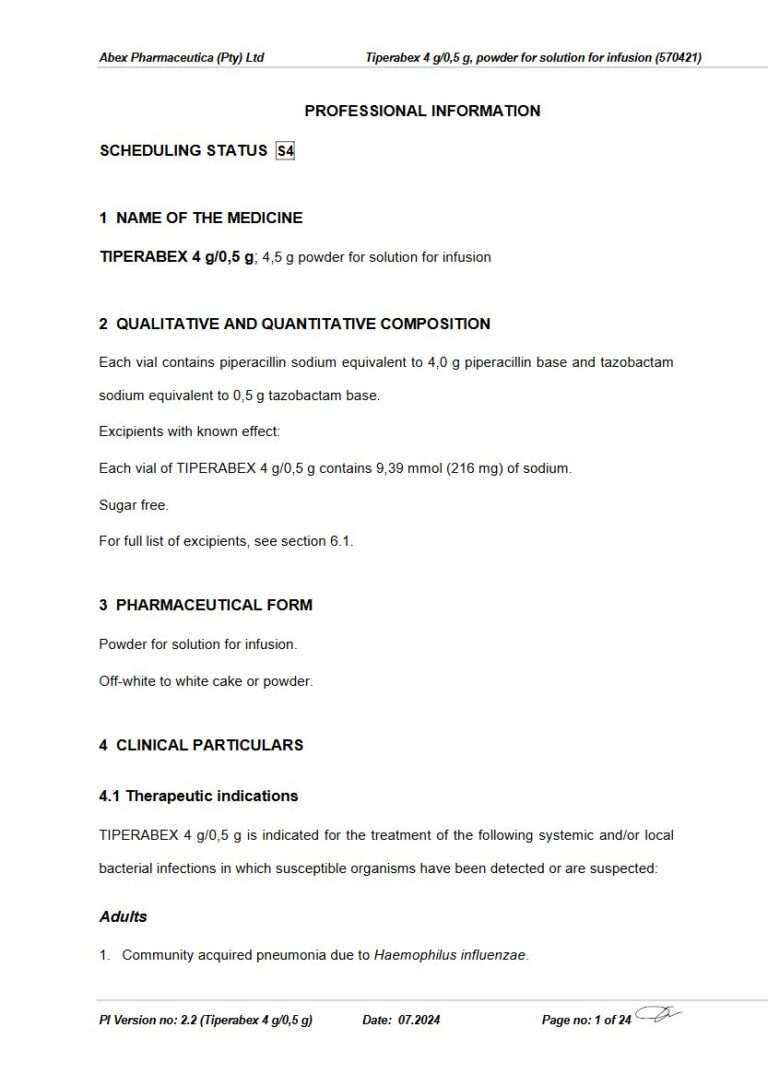
Clinical Particulars
Section 4 of the official insert — extracted exactly as issued, no alterations
4.1 Therapeutic indications
TIPERABEX 4 g/0,5 g is indicated for the treatment of the following systemic and/or local bacterial infections in which susceptible organisms have been detected or are suspected:
Adults
- Community acquired pneumonia due to Haemophilus influenzae.
- Intra-abdominal infections caused by piperacillin resistant beta-lactamase producing strains of Escherichia coli and Bacteroides fragilis.
- Skin and skin structure infections caused by piperacillin resistant beta-lactamase producing strains of Staphylococcus aureus.
- Gynaecologic infections including endometritis caused by piperacillin resistant beta-lactamase producing strains of E coli.
- TIPERABEX 4 g/0,5 g plus an aminoglycoside is indicated for bacterial infections in neutropenic patients.
Children
CHILDREN UNDER THE AGE OF 12 YEARS: TIPERABEX 4 g/0,5 g plus an aminoglycoside is indicated for bacterial infections in neutropenic patients.
CHILDREN 2 - 12 YEARS: In hospitalised children aged 2 to 12 years, TIPERABEX 4 g/0,5 g is indicated for the treatment of serious intra-abdominal infections, caused by E. coli or Bacteroides species. It has not been evaluated in this indication for paediatric patients below the age of 2 years. While TIPERABEX 4 g/0,5 g is indicated only for the conditions listed above, infections caused by piperacillin susceptible organisms are also amenable to TIPERABEX 4 g/0,5 g treatment due to its piperacillin content. Therefore, the treatment of mixed infections caused by piperacillin susceptible organisms and u00df-lactamase producing organisms susceptible to TIPERABEX 4 g/0,5 g should not require the addition of another antibiotic. TIPERABEX 4 g/0,5 g is useful in the treatment of mixed infections and in presumptive therapy prior to the availability of the results of sensitivity tests.
4.2 Posology and method of administration
Posology
The dose and frequency of TIPERABEX 4 g/0,5 g depends on the severity and localisation of the infection and expected pathogens.
Adults and adolescent patients 12 years and older
The usual dosage for adults and adolescents with normal renal function is 4 g/0,5 g TIPERABEX 4 g/0,5 g given every eight hours. For immunocompromised patients and neutropenic patients with infection, the dosage is 4 g/0,5 g TIPERABEX 4 g/0,5 g every 6 hours in combination with an aminoglycoside.
Neutropenic patients
In treating neutropenic patients, full therapeutic doses of TIPERABEX 4 g/0,5 g and an aminoglycoside should be used. The possibility of hypokalaemia should be kept in mind in patients who have low potassium reserves, and periodic electrolyte determinations should be made in these patients.
Duration of therapy
In acute infections, treatment with TIPERABEX 4 g/0,5 g should be for a minimum of five days and continued for forty-eight hours beyond resolution of clinical symptoms or the fever. The usual duration of treatment is 7 - 10 days.
Special populations
Elderly
TIPERABEX 4 g/0,5 g may be used at the same dose levels as adults except in cases of renal impairment (see below).
Renal Impairment
In patients with renal insufficiency, the intravenous dose should be adjusted to the degree of actual renal function impairment. The suggested daily doses are as follows (each patient must be monitored closely for signs of substance toxicity; medicine dose and interval should be adjusted accordingly):
INTRAVENOUS DOSAGE SCHEDULE FOR ADULTS WITH IMPAIRED RENAL FUNCTION
| Creatinine Clearance (ml/min) | Recommended Piperacillin / Tazobactam Dosage |
|---|---|
| 90 u2013 40 | 12 g/1,5 g / day in divided doses of 4 g/0,5 g every 8 hours or 3 g/0,375 g every 6 hours |
| 20 u2013 40 | 8 g/1,0 g / day in divided doses of 2 g/0,25 g every 6 hours |
| < 20 | 6 g/0,75 g / day in divided doses of 2 g/0,25 g every 8 hours |
For patients on haemodialysis, the maximum daily dose is 2 g/0,25 g every 8 hours. In addition, because haemodialysis removes 30 % - 40 % of piperacillin in 4 hours, one additional dose of 0,75 g TIPERABEX 4 g/0,5 g should be administered following each dialysis period. For patients with renal failure and hepatic insufficiency, measurement of serum levels of piperacillin / tazobactam will provide additional guidance for adjusting dosage.
Paediatric population
Use in children aged below 2 years
The safety and efficacy of TIPERABEX 4 g/0,5 g in children 0-2 years of age has not been established. No data from controlled clinical studies are available.
Children under the age of 12 years
TIPERABEX 4 g/0,5 g is only recommended for the treatment of children with neutropenia. For children weighing over 50 kg, follow the adult dosing guidance, including the aminoglycoside. For children with normal renal function and weighing less than 50 kg the dose should be adjusted to 90 mg/kg (80 mg piperacillin / 10 mg tazobactam) administered every 6 hours, in combination with an aminoglycoside.
Hospitalised children with intra-abdominal infection
For children aged 2 to 12 years, weighing up to 40 kg, and with normal renal function, the recommended dosage is 112,5 mg/kg (100 mg piperacillin / 12,5 mg tazobactam) every 8 hours. For children aged 2 to 12 years, weighing over 40 kg, and with normal renal function, follow the adult dose guidance, i.e., 4,5 g (4 g piperacillin / 0,5 g tazobactam) every 8 hours. The duration of therapy should be guided by the severity of the infection and the patientu2019s clinical and bacteriological progress. Therapy is recommended to be a minimum of 5 days and a maximum of 14 days, considering the dose administration should continue at least 48 hours after the resolution of clinical signs and symptoms.
Children aged 2 to 12 years with renal insufficiency
The pharmacokinetics of piperacillin / tazobactam have not been studied in paediatric patients with renal impairment. The following dosage adjustment for paediatric patients aged 2 to 12 years with renal impairment is recommended.
INTRAVENOUS DOSAGE SCHEDULE FOR CHILDREN AGED 2 - 12 YEARS WITH IMPAIRED RENAL FUNCTION
| Creatinine Clearance (ml/min) | Recommended Piperacillin / Tazobactam Dosage |
|---|---|
| > 50 | 112,5 mg/kg (100 mg/12,5 mg) every 8 hours |
| u2264 50 | 78,75 mg/kg (70 mg/8,75 mg) every 8 hours |
The intravenous dose should be adjusted to the degree of actual renal impairment. The dosage modification is only an approximation. Each patient must be monitored closely for signs of medicine toxicity. Medicine dose and interval should be adjusted accordingly.
Method of administration
TIPERABEX 4 g/0,5 g is administered by slow intravenous infusion (30 minutes). For instructions on reconstitution of the medicine before administration, see section 6.6.
4.3 Contraindications
TIPERABEX 4 g/0,5 g is contraindicated in:
- patients with known hypersensitivity to the piperacillin / tazobactam or to any of the excipients listed in section 6.1.
- patients with a history of allergic reactions to any of the penicillins and/or cephalosporins or u00df-lactamase inhibitors.
4.4 Special warnings and precautions for use
The selection of TIPERABEX 4 g/0,5 g to treat an individual patient should take into account the appropriateness of using a broad-spectrum semi-synthetic penicillin based on factors such as the severity of the infection and the prevalence of resistance to other suitable antibacterial medicines.
Before initiating therapy with TIPERABEX 4 g/0,5 g, careful inquiry should be made concerning previous hypersensitivity reactions to penicillins, other beta-lactam medicines (e.g., cephalosporin, monobactam or carbapenem) and other allergens. Serious and occasionally fatal hypersensitivity (anaphylactic/anaphylactoid [including shock]) reactions have been reported in patients receiving therapy with penicillins. These reactions are more likely to occur in persons with a history of penicillin hypersensitivity or sensitivity to multiple allergens.
TIPERABEX 4 g/0,5 g may cause severe cutaneous adverse reactions, such as Stevens-Johnson syndrome, toxic epidermal necrolysis, drug reaction with eosinophilia and systemic symptoms, and acute generalised exanthematous pustulosis (see section 4.8). If patients develop a skin rash they should be monitored closely and TIPERABEX 4 g/0,5 g discontinued if lesions progress.
If an allergic reaction occurs during therapy with TIPERABEX 4 g/0,5 g, the antibiotic should be discontinued. Serious hypersensitivity reactions require immediate emergency measures, with adrenaline, corticosteroids and antihistamines. An open airway must be maintained.
Hemophagocytic lymphohistiocytosis (HLH)
Cases of haemophagocytic lymphohistiocytosis (HLH) have been reported in patients treated with piperacillin / tazobactam, often following treatment longer than 10 days. HLH is a life-threatening syndrome of pathologic immune activation characterised by clinical signs and symptoms of an excessive systemic inflammation (e.g., fever, hepatosplenomegaly, hypertriglyceridaemia, hypofibrinogenaemia, high serum ferritin, cytopenias and haemophagocytosis). Patients who develop early manifestations of pathologic immune activation should be evaluated immediately. If diagnosis of HLH is established piperacillin / tazobactam treatment should be discontinued.
Pseudomembranous colitis has been reported with nearly all antibacterial medicines, including piperacillin. Antibiotic-induced pseudomembranous colitis may be manifested by severe, persistent diarrhoea which may be life-threatening. The onset of pseudomembranous colitis may occur during or after antibacterial treatment. In these cases, TIPERABEX 4 g/0,5 g should be discontinued. It is important to consider this diagnosis in patients who present with diarrhoea subsequent to the administration of antibacterial medicines. After the diagnosis of pseudomembranous colitis has been established, therapeutic measures should be initiated. Mild cases of pseudomembranous colitis usually respond to medicine discontinuation alone. In moderate to severe cases, consideration should be given to management with fluids and electrolytes, protein supplementation and treatment with an oral antibacterial medicine effective against C. difficile. In case of severe, persistent diarrhoea, the possibility of antibiotic-induced life-threatening pseudomembranous colitis must be taken into consideration. Therefore, TIPERABEX 4 g/0,5 g must be discontinued immediately in such cases and suitable therapy be initiated (e.g. oral teicoplanin or oral vancomycin). Preparations, which inhibit peristalsis, are contraindicated.
While TIPERABEX 4 g/0,5 g possesses the characteristic low toxicity of the penicillin group of antibiotics, periodic assessment of organ system functions including renal and hepatic during prolonged therapy is advisable.
Bleeding manifestations have occurred in some patients receiving u00df-lactam antibiotics. These reactions have sometimes been associated with abnormalities of coagulation tests such as clotting time, platelet aggregation and prothrombin time and are more likely to occur in patients with renal failure. If bleeding manifestations occur, the antibiotic should be discontinued, and appropriate therapy instituted.
Leukopenia and neutropenia may occur, especially during prolonged therapy; therefore, periodic assessment of haematopoietic function should be performed.
Neurological complications in the form of convulsions (seizures) may occur when high doses are administered, especially in patients with impaired renal function (see section 4.8).
The possibility of the emergence of resistant or non-susceptible organisms, including fungi, which might cause superinfections, should be kept in mind, particularly during prolonged treatment. If this occurs, appropriate measures should be taken.
This product contains 216 mg (9,39 mmol) of sodium per vial, which may increase a patientu2019s overall sodium intake. This is equivalent to 10,8 % of the WHO recommended daily intake of 2 g sodium for an adult. Periodic electrolyte determinations should be made in patients with low potassium reserves, and the possibility of hypokalaemia should be kept in mind with patients who have potentially low potassium reserves and who are receiving cytotoxic therapy or diuretics. Modest elevation of indices of liver function may be observed.
Renal impairment
Due to its potential nephrotoxicity (see section 4.8), TIPERABEX 4 g/0,5 g should be used with care in patients with renal impairment or in haemodialysis patients. Intravenous dosages and administration intervals should be adjusted to the degree of renal function impairment (see section 4.2). In a study where glomerular filtration rate (GFR) was examined after administration of frequently used antibiotics in critically ill patients, the use of piperacillin / tazobactam was associated with a lower rate of reversible GFR improvement. This analysis concluded that piperacillin / tazobactam was a cause of delayed renal recovery in these patients.
Combined use of TIPERABEX 4 g/0,5 g and vancomycin may be associated with an increased incidence of acute kidney injury (see section 4.5).
Patients over 65 years are not at an increased risk of developing adverse effects solely because of age. However, dosage should be adjusted in the presence of renal insufficiency.
4.5 Interaction with other medicines and other forms of interaction
Anticoagulants
During simultaneous administration of high doses of heparin, oral anticoagulants and other medicines that may affect the blood coagulation system and/or the thrombocyte function, the coagulation parameters should be tested more frequently and monitored regularly.
Aminoglycosides
Piperacillin either alone or with tazobactam did not significantly alter the pharmacokinetics of tobramycin in subjects with normal renal function and with mild or moderate renal impairment. The pharmacokinetics of piperacillin, tazobactam, and the M1 metabolite were also not significantly altered by tobramycin administration. Whenever TIPERABEX 4 g/0,5 g is used concurrently with another antibiotic, especially an aminoglycoside, the medicines must not be mixed in intravenous solutions or administered concurrently due to physical incompatibility. The inactivation of tobramycin and gentamicin by piperacillin has been demonstrated in patients with severe renal impairment. For information related to the administration of piperacillin / tazobactam with aminoglycosides please refer to sections 6.2 and 6.6.
Methotrexate
Piperacillin may reduce the excretion of methotrexate; therefore, serum levels of methotrexate should be monitored in patients to avoid medicine toxicity.
Non-depolarising muscle relaxants
Piperacillin, when given concomitantly with vecuronium has been implicated in the prolongation of the neuromuscular blockage of vecuronium. Due to their similar mechanism of action, it is expected that the neuromuscular blockade produced by any of the non-depolarizing muscle relaxants could be prolonged in the presence of piperacillin.
Probenecid
Concurrent administration of probenecid and TIPERABEX 4 g/0,5 g produces a longer half-life and lower renal clearance for both piperacillin and tazobactam; however, peak plasma concentrations of either substances are unaffected.
Vancomycin
Studies have detected an increased incidence of acute kidney injury in patients concomitantly administered piperacillin / tazobactam and vancomycin as compared to vancomycin alone (see section 4.4). Some of these studies have reported that the interaction is vancomycin dose dependent. No pharmacokinetic interactions have been noted between piperacillin / tazobactam and vancomycin.
4.6 Fertility, pregnancy and lactation
Pregnancy
Safety in pregnancy and lactation has not been established. Piperacillin and tazobactam cross the placenta.
Breastfeeding
Piperacillin is excreted in human milk. Women receiving TIPERABEX 4 g/0,5 g should not breastfeed their infants.
Fertility
A fertility study in rats showed no effect on fertility and mating after intraperitoneal administration of tazobactam or the combination piperacillin / tazobactam. No data on male and female fertility is available.
4.7 Effects on ability to drive and use machines
No studies on the effect on the ability to drive and use machines have been performed.
4.8 Undesirable effects
a. Summary of the safety profile
The most frequently reported adverse reaction is diarrhoea. Among the most serious adverse reactions were pseudo-membranous colitis and toxic epidermal necrolysis. Pancytopenia, anaphylactic shock and Stevens-Johnson syndrome have also been reported.
b. Tabulated list of adverse reactions
MedDRA System organ class: Frequencies Adverse reactions
Infections and Infestations
Frequent: Candida infections
Less frequent: Pseudomembranous colitis
Blood and lymphatic system disorders
Frequent: Thrombocytopenia, anaemia
Less frequent: Leukopenia, bleeding manifestations (including purpura, epistaxis), agranulocytosis
Frequency unknown: Pancytopenia, neutropenia, haemolytic anaemia, thrombocytosis, eosinophilia
Immune system disorders
Frequency unknown: Anaphylactic / anaphylactoid reaction (including anaphylactic / anaphylactoid shock), hypersensitivity reaction
Metabolism and nutrition disorders
Less frequent: Hypokalaemia
Psychiatric disorders
Frequent: Insomnia
Frequency unknown: Delirium
Nervous system disorders
Frequent: Headache
Less frequent: Seizure
Vascular disorders
Less frequent: Hypotension, phlebitis, thrombophlebitis, flushing
Respiratory, thoracic and mediastinal disorders
Less frequent: Epistaxis
Frequency unknown: Eosinophilic pneumonia
Gastrointestinal disorders
Frequent: Diarrhoea, nausea, vomiting, constipation, dyspepsia, abdominal pain
Less frequent: Pseudomembranous colitis, stomatitis
Hepatobiliary disorders
Frequency unknown: Hepatitis, jaundice
Skin and subcutaneous tissue disorders
Frequent: Rash, pruritus
Less frequent: Urticaria, erythema multiforme, rash maculo-papular
Frequency unknown: Bullous dermatitis, dermatitis exfoliative, Stevens-Johnson Syndrome, toxic epidermal necrolysis, drug reaction with eosinophilia and systemic symptoms (DRESS), acute generalised exanthematous pustulosis (AGEP), purpura
Musculoskeletal and connective tissue disorders
Less frequent: Arthralgia, myalgia
Renal and urinary disorders
Frequency unknown: Renal failure, tubulointerstitial nephritis
General disorders and administrative site conditions
Frequent: Pyrexia, injection site reaction
Less frequent: Chills
Investigations
Frequent: Alanine aminotransferase increased, protein total decreased, blood albumin decreased, Coombs direct test positive, blood creatinine increased, blood alkaline phosphatase increased, blood urea increased, activated partial thromboplastin time prolonged
Less frequent: Blood glucose decreased, blood bilirubin increased, prothrombin time prolonged
Frequency unknown: Bleeding time prolonged, gamma glutamyl transferase increased
Piperacillin therapy has been associated with an increased incidence of fever and rash in cystic fibrosis patients.
Beta-lactam antibiotic class effects
Beta-lactam antibiotics, including piperacillin tazobactam, may lead to manifestations of encephalopathy and convulsions (see section 4.4).
Reporting of suspected adverse reactions
Reporting suspected adverse reactions after authorisation of the medicine is important. It allows continued monitoring of the benefit/risk balance of the medicine. Health care providers are asked to report any suspected adverse reactions to SAHPRA via the Med Safety APP (Medsafety X SAHPRA) and eReporting platform (who-umc.org) found on SAHPRA website.
4.9 Overdose
The majority of events experienced during overdosage including nausea, vomiting and diarrhoea have also been reported with the usual recommended dosages. Patients may experience neuromuscular excitability or convulsions if higher than recommended doses are given intravenously (particularly in the presence of renal failure). Treatment should be supportive and symptomatic according to the patientu2019s clinical presentation. No specific antidote is known. Excessive serum concentrations of either piperacillin or tazobactam may be reduced by haemodialysis. In the event of an emergency, all required intensive medical measures are indicated as in the case of piperacillin. In case of motor excitability or convulsions, anticonvulsive medicines (e.g., diazepam or barbiturates) may be indicated. In case of severe, hyperallergic (anaphylactic) reactions, the usual countermeasures are to be initiated (antihistamines, corticosteroids, sympathomimetic medicines and, if required, oxygen and airway management).
