
Tuberculin Ppd Rt/23 2 Tu 0,1 ml Solution for injection.
PDF Leaflet Revision Date: 20 September 2023
Clinical Summary
Quick overview from the medicine insert
Indication
Diagnosis of Mycobacterium tuberculosis infection.
Dosage (summary)
0.1 ml intradermally.
Onset of Action / Duration
Onset: 48-72 hours, Duration: several days.
Special Populations
- Immunosuppressed
- HIV infected
- Pregnant women
Pregnancy & Breastfeeding
Safe for use during pregnancy and breastfeeding.
Key Drug Interactions
- Corticosteroids
- Live virus vaccines
Contraindications
- Hypersensitivity to tuberculin
- Severe local reaction to tuberculin
- Previous tuberculosis diagnosis
Common side effects
- Injection site pain
- Itching
- Irritation
- Fever
- Lymphadenopathy
Counselling Points
- Observe for allergic reactions for 20 mins post-injection
- Avoid subcutaneous or intramuscular injection
Serious warnings
- Risk of exaggerated reactions in active tuberculosis
- Anaphylaxis risk
Important Disclaimer
The Tuberculin Ppd Rt/23 2 Tu 0,1 ml Solution for injection. professional information leaflet below is the property of Kahma Biotech and is provided on Medinsert exactly as issued, with no.. alterations or editorial changes. We make every effort to keep content current by updating documents as soon as new versions become available. Medinsert serves as a trusted access point for healthcare professionals, but does not replace official sources or clinical judgement. For more details, please read our full disclaimer. read more>>
 Healthcare Professionals Only
This content is for registered healthcare professionals
Sign in or create a free account to read the full package insert.
Free for HPCSA-registered professionals. Powered by Medinsert.
Clinical Particulars
Section 4 of the official insert — extracted exactly as issued, no alterations
4.1 Therapeutic indications
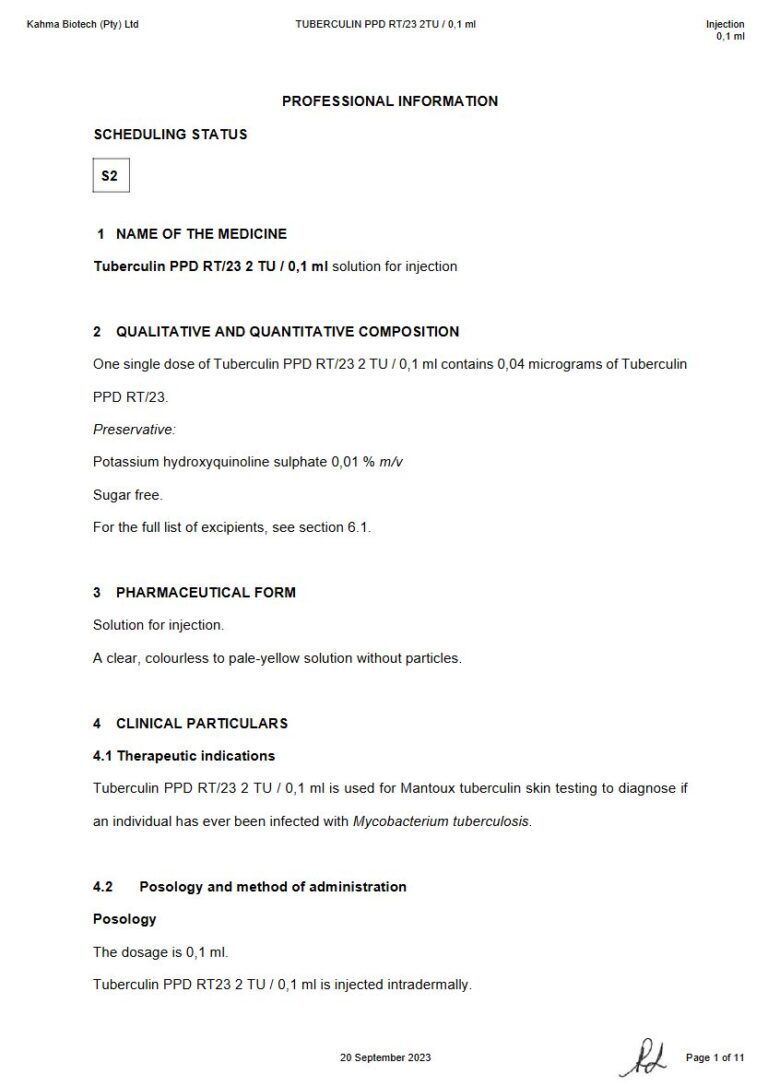
Tuberculin PPD RT/23 2 TU / 0,1 ml is used for Mantoux tuberculin skin testing to diagnose if an individual has ever been infected with Mycobacterium tuberculosis.
4.2 Posology and method of administration
Posology
The dosage is 0,1 ml. Tuberculin PPD RT23 2 TU / 0,1 ml is injected intradermally.
Method of administration
u2022 0,1 ml Tuberculin PPD RT/23 2 TU / 0,1 ml must be administered with a 1 ml graduated syringe fitted with a 25 or 26 gauge, short bevel needle.
u2022 The injection must be given intradermally in the middle third of the forearm. Administration near the wrist or the elbow joint may weaken the reaction.
u2022 The skin is slightly stretched and the needle point is held almost parallel with the skin surface, with the bevel upwards. The tip of the needle is inserted into the superficial layer of the dermis.
u2022 The needle must be visible through the epidermis during insertion. The needle should be visible through the epidermis during insertion. The 0,1 ml is slowly injected and a small blanched papule of 8 u2013 10 mm in diameter appears. This papule will disappear after approximately 10 minutes.
u2022 If no papule appears, the injection has been given too deep, and the skin test should be repeated on the other arm or on the same arm, at least 4 cm away from the first injection site (see section 4.4).
Evaluating the reaction
A skin test reaction is seen as a flat, uneven, slightly raised induration surrounded by an area of redness. The induration should be evaluated 48 u2013 72 hours after the injection. The induration should be evaluated 48u201372 hours after the injection. After approximately 72 hours the size of the induration is expected to diminish. Only the induration is assessed. The diameter of the induration is measured in millimetres transversely to the long axis of the forearm with a transparent, flexible plastic ruler. Recommendations for interpreting the Mantoux tuberculin skin test are shown in Table 1.
Table 1: Normal interpretation of the skin test result.
Diameter of induration in millimetres
Negative
Positive
Strongly positive
0 u2013 5 mm
6 u2013 14 mm
+15 mm
Interpretation
A positive reaction indicates an immune response for one or more of the following reasons:
u2022 Infection with Mycobacterium tuberculosis complex, including M. tuberculosis, M. bovis, M. africanum, M. microtii, or M. tuberculosis subsp. caprae.
u2022 Infection with non-tuberculous mycobacteria.
u2022 Previous BCG vaccination (BCG-vaccinated individuals normally become tuberculin-positive after 4 u2013 8 weeks). Reactions larger than 15 mm are unlikely to be due to previous BCG vaccination or exposure to environmental mycobacteria. The interpretation of the Mantoux tuberculin skin test can be influenced by factors mentioned under section 4.5. In countries where BCG vaccination is widely used and where Tuberculin PPD RT/23 2 TU / 0,1 ml is used as a post-vaccination test, it may be necessary to use an alternative interpretation with a larger diameter of the induration as a positive reaction. An induration measured to be close to the limit should be interpreted with caution and the results should be related to the clinical situation. Special caution should be taken in the interpretation of results measured to be close to the limit in individuals who are in close contact with patients with infectious TB, in the TB screening of immunosuppressed individuals including HIV infected children and adults, suspected TB infected infants; patients treated with immunosuppressants such as TNF-alpha inhibitors and in individuals with other risk factors such as children and adolescents, pregnant women, patients with diabetes mellitus or with other predisposing conditions.
Waning of tuberculin sensitivity
In most individuals, tuberculin sensitivity caused by infection with M. tuberculosis or related mycobacteria normally persists throughout life but may decrease or disappear gradually in some individuals. The tuberculin sensitivity frequently wanes within a few years in BCG-vaccinated individuals.
Booster effect
If tuberculin is administered to individuals whose tuberculin sensitivity has waned, the reaction to the skin test will be weak or absent. Retesting with tuberculin weeks or months later may result in an accentuation of the response, i.e. a booster effect. Repeated tuberculin skin testing will not induce a positive reaction in individuals who have no previous cellular immunity against the antigens in Tuberculin PPD RT/23 2 TU / 0,1 ml.
Repeated tuberculin skin testing
If the tuberculin skin test is likely to be repeated, e.g. in health care workers potentially exposed to tuberculosis infection, a two-step method is recommended. Individuals with a weak or an absent initial Mantoux tuberculin skin test should undergo a second tuberculin skin test 2 u2013 4 weeks after the first test. Skin test conversion in such individuals is defined as a reaction to the second test of more than 10 mm and an increase of at least 6 mm compared to the first test. Individuals with skin test conversion after the second test should be considered to be previously infected with Mycobacteria or may have been BCG vaccinated, whereas those with a negative reaction to the second test should be considered uninfected. It is important to emphasise that the predictive value of the skin test result and the expected risk of tuberculosis should be considered on an individual basis.
4.3 Contraindications
- Hypersensitivity (Type I) to Tuberculin PPD RT23 or to any of the excipients of Tuberculin PPD RT23 2 TU / 0,1 ml (see section 6.1)
- Individuals who have experienced a severe local reaction to tuberculin products. A severe local reaction may include vesicles and ulceration at the injection site and skin necrosis at the centre of a widespread tuberculin reaction. The necrosis will generally disappear after a few days.
- Individuals who have previously been diagnosed with tuberculosis or any other mycobacterial disease.
4.4 Special warnings and precautions for use
Exaggerated reactions may occur when used in persons with active tuberculosis. Although anaphylaxis is rare, facilities for its management should always be available during the Mantoux tuberculin skin test. Whenever possible skin tested individuals should be observed for allergic reactions for up to 20 minutes after administration. Avoid subcutaneous or intramuscular injection of Tuberculin PPD RT23 2 TU / 0,1 ml. If this occurs, a papule will not develop and the Mantoux tuberculin skin test should be repeated on the other arm or on the same arm, at least 4 cm away from the first injection site. Tuberculin PPD RT23 2 TU / 0,1 ml contains less than 1 mmol potassium (39 mg) and less than 1 mmol sodium (23 mg) per dose, i.e. essentially potassium- and sodium-free.
4.5 Interaction with other medicines and other forms of interaction
A variety of host-related factors such as age, nutrition, renal failure, diabetes, immunosuppression by medicines (e.g. corticosteroids), or disease, e.g. cancer, HIV infection or sarcoidosis can cause false-negative tuberculin reactions. Viral infections (particularly measles, mumps, mononucleosis, varicella and influenza) can lower the tuberculin reactivity for a few months. Previous BCG vaccination or recent infection with environmental non-tuberculous mycobacteria can result in cross-sensitisation and a false-positive reaction to a Mantoux tuberculin skin test. After vaccinations with vaccines containing live virus, e.g. vaccines against measles, mumps and rubella, a reduced reactivity may be observed. This decreased reactivity may result in false-negative reactions. Therefore, if Mantoux tuberculin skin testing cannot be done at the same time as measles, mumps and rubella immunisation, the test should be postponed for 4 u2013 6 weeks. Tuberculin PPD RT23 2 TU/0,1 ml can be safely administered simultaneously with all live and inactivated vaccines. Many patients co-infected with HIV and M. tuberculosis have anergy for tuberculin. In patients with severe tuberculosis (e.g. miliary tuberculosis) tuberculin reactivity may be suppressed.
4.6 Fertility, pregnancy and lactation
Pregnancy
Tuberculin PPD RT23 2 TU / 0,1 ml can be used during pregnancy.
Breastfeeding
Tuberculin PPD RT23 2 TU / 0,1 ml can be used during breastfeeding.
Fertility
No clinical or non-clinical data are available on the possible effects of Tuberculin PPD RT23 2 TU / 0,1 ml on male and female fertility.
4.7 Effects on ability to drive and use machines
Tuberculin PPD RT23 2 TU / 0,1 ml has no or negligible influence on the ability to drive and use machines.
4.8 Undesirable effects
a. Summary of the safety profile
The adverse events following administration of Tuberculin PPD RT23 2 TU/0,1 ml are generally mild and transient. The most common adverse reactions after administration of Tuberculin PPD RT23 2 TU/0,1 ml are pain, itching and irritation at the injection site. Individuals very sensitive to tuberculin may experience vesicles and necrosis at the injection site. The necrosis will usually disappear after a few days. Mild fever and enlargement of the lymph nodes may occur. There is an extensive clinical experience with Tuberculin PPD RT23 2 TU/0,1 ml and the safety profile is well known.
b. Tabulated summary of adverse reactions
The following convention was used for frequency grouping : Very common (u22651/10); common (u22651/100 to <1/10); uncommon (u22651/1 000 to <1/100); rare (u22651/10 000 to <1/1 000); very rare (<1/10 000); not known (cannot be estimated from the available data).
4.9 Overdose
See section 4.8. Treatment is symptomatic and supportive, but undesirable effects in relation to overdosage are not expected.
