
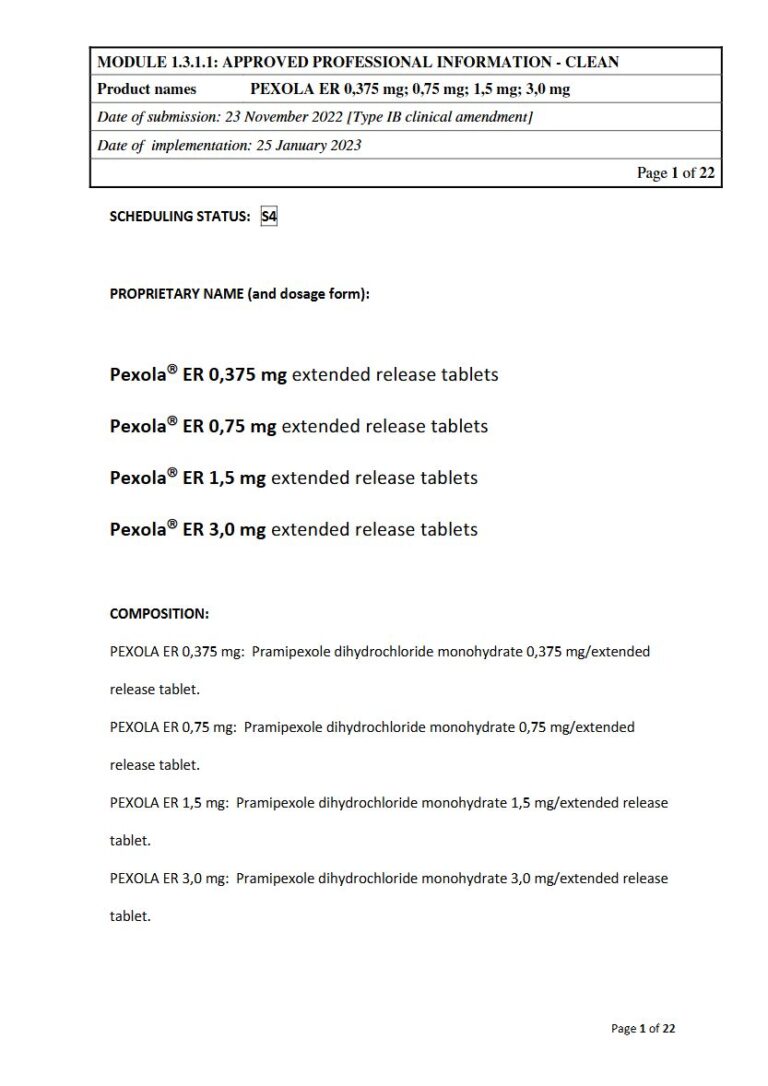
Pexola Er 0,375 mg; 0,75 mg; 1,5 mg; 3,0 mg XR tablets
PDF Leaflet Revision Date: 25 January 2023
Clinical Summary
Quick overview from the medicine insert
Indication
Treatment of idiopathic Parkinson's disease.
Dosage (summary)
Start at 0.375 mg daily, titrate weekly to max 4.5 mg.
Onset of Action / Duration
Onset: 6 hours, Duration: 8-12 hours
Special Populations
- Elderly
- Renal impairment
Pregnancy & Breastfeeding
Not recommended in pregnancy; inhibits lactation.
Key Drug Interactions
- Cimetidine
- Dopamine antagonists
- Alcohol and sedatives
Contraindications
- Hypersensitivity
- Renal impairment <50 mL/min
- Children <18 years
Common side effects
- Somnolence
- Nausea
- Dizziness
- Hallucinations
Counselling Points
- Avoid driving if drowsy
- Monitor for abnormal behaviors
- Taper off gradually
Serious warnings
- Risk of sudden sleep episodes
- Dopamine Dysregulation Syndrome
- Orthostatic hypotension
Important Disclaimer
The Pexola Er 0,375 mg; 0,75 mg; 1,5 mg; 3,0 mg XR tablets professional information leaflet below is the property of Ingelheim Pharmaceuticals and is provided on Medinsert exactly as issued, with no.. alterations or editorial changes. We make every effort to keep content current by updating documents as soon as new versions become available. Medinsert serves as a trusted access point for healthcare professionals, but does not replace official sources or clinical judgement. For more details, please read our full disclaimer. read more>>
 Healthcare Professionals Only
This content is for registered healthcare professionals
Sign in or create a free account to read the full package insert.
Free for HPCSA-registered professionals. Powered by Medinsert.
Clinical Particulars
Section 4 of the official insert — extracted exactly as issued, no alterations
4.1 Therapeutic indications
PEXOLA ER is indicated in the treatment of signs and symptoms of idiopathic Parkinsonu2019s disease. It may be used as monotherapy or in combination with levodopa.
4.2 Posology and method of administration
PEXOLA ER should be taken once daily at about the same time each day. PEXOLA ER should be swallowed whole with water, and must not be chewed, divided or crushed. PEXOLA ER may be taken with or without food.
When the intake of a dose is missed, PEXOLA ER may be taken up to 12 hours after the regularly scheduled time. After 12 hours, the missed dose should be left out and the next dose should be taken on the following day at the next regularly scheduled time.
Initial treatment: Dosages should be increased gradually from a starting dose of 0,375 mg per day and then increased every 7 days. Providing patients do not experience intolerable side effects, the dosage should be titrated to achieve a maximal therapeutic effect.
Ascending-Dose Schedule of PEXOLA ER extended release tablets
- Week 1: Total daily dose (mg) 0,375; Extended release tablets (mg) 0,375
- Week 2: Total daily dose (mg) 0,75; Extended release tablets (mg) 0,75
- Week 3: Total daily dose (mg) 1,50; Extended release tablets (mg) 1,50
If a further dose increase is necessary, the daily dose should be increased by 0,75 mg at weekly intervals up to a maximum dose of 4,5 mg per day. It should be noted that the incidence of somnolence is increased at doses higher than 1,5 mg/day (see WARNINGS).
Patients already taking pramipexole immediate release tablets may be switched to PEXOLA ER extended release tablets overnight, at the same daily dose.
Maintenance treatment: The individual maintenance dose ranges from 0,375 mg to a maximum of 4,5 mg per day. During dose escalation in pivotal studies, both in early and advanced Parkinsonu2019s disease, efficacy was observed starting at a daily dose of 1,5 mg. However doses lower than 1,5 mg per day can have adequate therapeutic benefit.
Treatment discontinuation: PEXOLA ER tablets should be tapered off at a rate of 0,75 mg per day until the daily dose has been reduced to 0,75 mg. Thereafter the dose should be reduced by 0,375 mg per day.
Dosing in patients with concomitant levodopa therapy: In patients with concomitant levodopa therapy it is recommended that the dosage of levodopa is reduced during both dose escalation and maintenance treatment with PEXOLA ER. This may be necessary in order to avoid excessive dopaminergic stimulation.
Dosing in patients with renal impairment: The elimination of pramipexole dihydrochloride monohydrate is dependent on renal function. The following dosage schedule is suggested for initiation of therapy: Patients with a creatinine clearance above 50 mL/min require no reduction in daily dose or dosing frequency. Inadequate data is available for the treatment of patients with a creatinine clearance below 50 mL/min with PEXOLA ER extended release tablets (See CONTRAINDICATIONS).
Dosing in patients with hepatic impairment: Dose reduction is not considered necessary in patients with hepatic impairment.
4.3 Contraindications
Hypersensitivity to pramipexole or any of the components of PEXOLA ER. Not recommended for use in children below 18 years of age. Moderate to severe renal impairment (creatinine clearance less than 50 mL/min).
4.4 Special warnings and precautions for use
Falling asleep during activities of daily living: Patients treated with PEXOLA ER have reported falling asleep while engaged in activities of daily living, including the operation of motor vehicles, which sometimes resulted in accidents. Although many of these patients reported somnolence while on PEXOLA ER, some perceived that they had no warning signs such as excessive drowsiness, and believed that they were alert immediately prior to the event. Some of these events have been reported as late as one year after the initiation of treatment.
Somnolence is a common occurrence in patients receiving PEXOLA ER at doses above 1,5 mg/day. Many clinical experts believe that falling asleep while engaged in activities of daily living always occurs in a setting of pre-existing somnolence, although patients may not give such a history. For this reason, prescribers should continually reassess patients for drowsiness or sleepiness, especially since some of the events occur well after the start of treatment. Prescribers should also be aware that patients may not acknowledge drowsiness or sleepiness until directly questioned about drowsiness or sleepiness during specific activities.
Before initiating treatment with PEXOLA ER, patients should be advised of the potential to develop drowsiness and specifically asked about factors that may increase the risk with PEXOLA ER such as concomitant sedating medications, the presence of sleep disorders, and concomitant medications that increase pramipexole plasma levels (e.g. cimetidine u2013 see INTERACTIONS). If a patient develops significant daytime sleepiness or episodes of falling asleep during activities that require active participation (e.g. conversations, eating, etc.), PEXOLA ER should ordinarily be discontinued. If a decision is made to continue PEXOLA ER, patients should be advised to not drive and to avoid other potentially dangerous activities.
While dose reduction clearly reduces the degree of somnolence, there is insufficient information to establish that dose reduction will eliminate episodes of falling asleep while engaged in activities of daily living.
Patients and caregivers should be aware of the fact that abnormal behaviour (reflecting symptoms of impulse control disorders and compulsive behaviours) such as binge eating, compulsive shopping, hypersexuality and pathological gambling have been reported in patients treated with dopaminergic medicines including PEXOLA ER. Dose reduction/tapered discontinuation should be considered.
Dopamine Dysregulation Syndrome (DDS): Dopamine dysregulation syndrome (DDS) has been observed in some patients during treatment with PEXOLA ER. This is an addictive disorder that results in the excessive use of this or other dopaminergic medicinal products. Before the start of treatment, patients and caregivers must be warned about the potential risk of developing DDS (see Side effects).
4.5 Interactions with other medicines
Carbidopa/levodopa: Carbidopa/levodopa did not influence the pharmacokinetics of PEXOLA ER in healthy volunteers (N=10). PEXOLA ER did not alter the extent of absorption (AUC) or the elimination of carbidopa/levodopa, although it caused an increase in levodopa Cmax by about 40 % and a decrease in Tmax from 2,5 to 0,5 hours.
Selegiline: In healthy volunteers (N=11), selegiline did not influence the pharmacokinetics of PEXOLA ER.
Amantadine: The interaction has not been examined, however, an interaction is possible via the same system of excretion in the kidney.
Cimetidine: Cimetidine, a known inhibitor of renal tubular secretion of organic bases via the cationic transport system, caused a 50 % increase in PEXOLA ER AUC and a 40 % increase in half-life (N=12).
Other medicines eliminated via renal secretion: Population pharmacokinetic analysis suggests that co-administration of medicines that are secreted by the cationic transport system (e.g. cimetidine, ranitidine, diltiazem, triamterene, verapamil, quinidine and quinine) decreases the clearance of PEXOLA ER by about 20 %, while those secreted by the anionic transport system (e.g. cephalosporins, penicillins, indomethacin, hydrochlorothiazide and chlorpropamide) are likely to have little effect on the clearance of PEXOLA ER.
CYP interactions: Inhibitors of cytochrome P450 enzymes would not be expected to affect PEXOLA ER elimination because PEXOLA ER is not appreciably metabolised by these enzymes in vivo or in vitro. PEXOLA ER does not inhibit CYP enzymes CYP1A2, CYP2C9, CYP2C19, CYP2E1 and CYP34A4. Inhibition of CYP2D6 was observed with an apparent Ki of 30 u03bcM, indicating that PEXOLA ER will not inhibit CYP enzymes at plasma concentrations observed following the highest recommended clinical dose (4,5 mg/day).
Dopamine antagonists: Since PEXOLA ER is a dopamine agonist, it is possible that dopamine antagonists, such as the neuroleptics (phenothiazines, butyrophenones, thioxanthenes) or metoclopramide, may diminish the effectiveness of PEXOLA ER.
Other anti-Parkinsonian medication: While increasing the dose of PEXOLA ER it is recommended that the dosage of levodopa is reduced and the dosage of other anti-Parkinsonian medication kept constant.
Alcohol and sedatives: Because of possible additive effects, caution should be advised when patients are taking other sedating medication or alcohol in combination with PEXOLA ER and when taking concomitant medication that increases plasma levels of pramipexole (e.g. cimetidine).
4.6 Fertility, pregnancy and lactation
Safety in pregnancy and lactation has not been shown. Patients should be advised to notify their medical practitioners if they become pregnant or intend to become pregnant during therapy. As PEXOLA ER treatment inhibits secretion of prolactin in humans inhibition of lactation is expected. Consequently, PEXOLA ER should not be used during breastfeeding.
4.7 Effects on ability to drive and use machines
Patients should be aware of the fact that hallucinations can occur and may adversely affect their ability to drive. Patients should be alerted to the potential sedating effects associated with PEXOLA ER, including somnolence and the possibility of falling asleep while engaged in activities of daily living. Since somnolence is a frequent adverse event with potentially serious consequences, patients should neither drive a car nor operate other complex machinery until they have gained sufficient experience with PEXOLA ER to gauge whether or not it affects their mental and/or motor performance adversely. Patients should be advised that if increased somnolence or episodes of falling asleep during activities of daily living (e.g. conversations, eating, etc.) are experienced at any time during treatment with PEXOLA ER, they should not drive or participate in potentially dangerous activities and should contact their medical practitioner.
4.8 Undesirable effects
Frequency classes: Derived from clinical trial data pertaining to the extended release formulation: Very common (u2265 1/10); common (u2265 1/100, < 1/10); uncommon (u2265 1/1 000, < 1/100); rare (u2265 1/10 000, < 1/1 000); very rare (< 1/10 000). Not known (cannot be estimated from available data).
Infections and infestations: Not known: Pneumonia.
Psychiatric disorders: Common: Abnormal behaviour (including symptoms of impulse control disorders and compulsions), insomnia, hallucinations. Uncommon: Libido disorders (increase or decrease), hypersexuality, compulsive shopping, pathological gambling, delusion, confusion, abnormal dreams, restlessness. Not known: Paranoia, binge eating, hyperphagia, dopamine dysregulation syndrome. Dopamine dysregulation syndrome (DDS) is an addictive disorder that has been observed in some patients treated with PEXOLA ER. Patients affected exhibit the compulsive abuse of dopaminergic medicinal products, using higher doses than are necessary for the adequate control of motor symptoms from Parkinsonu2019s disease. In some cases, this may result in severe dyskinesia (see also WARNINGS).
Nervous system disorders: Very common: Somnolence. Common: Headache, dizziness, dyskinesia. Uncommon: Falling asleep during activities of daily living/sudden onset of sleep (see WARNINGS), syncope. Not known: Amnesia, hyperkinesia.
Eye disorders: Common: Visual impairment including diplopia, vision blurred and visual acuity reduced.
Vascular disorders: Common: Hypotension.
Respiratory, thoracic and mediastinal disorders: Not known: Dyspnoea, hiccups.
Gastrointestinal disorders: Very common: Nausea. Common: Constipation, vomiting.
Skin and subcutaneous tissue disorders: Uncommon: Hypersensitivity, pruritus. Not known: Rash.
General disorders: Common: Peripheral oedema and fatigue.
Investigations: Common: Weight decrease including decreased appetite. Not known: Weight increase.
Post-marketing experience: The following adverse reactions have been identified during post-approval use of immediate-release pramipexole tablets, primarily in Parkinsonu2019s disease patients: Abnormal behaviour, abnormal dreams, accidents (including fall), blackouts, cardiac failure, compulsive shopping, fatigue, hallucinations (all kinds), headache, hypotension (including postural hypotension), increased eating (including binge eating, compulsive eating, and hyperphagia), libido disorders (including increased and decreased libido, and hypersexuality), pathological gambling, pruritus, syncope, vomiting and weight increase. In a pharmacoepidemiological study, pramipexole use was associated with an increased risk of cardiac failure compared with non-use of pramipexole.
4.9 Overdose
Symptoms: There is no clinical experience with massive overdosage. The expected adverse events should be related to the pharmacodynamic profile of a dopamine agonist including nausea, vomiting, hyperkinesia, hallucinations, agitation and hypotension.
Therapy: There is no established antidote for overdosage of a dopamine agonist. If signs of central nervous system stimulation are present, a neuroleptic agent may be indicated. Management of the overdose may require general supportive measures along with gastric lavage, intravenous fluids and electrocardiogram monitoring. Haemodialysis has not been shown to be helpful.
