
Pred Mild 1,2 mg/ml Sterile Eye Suspension
PDF Leaflet Revision Date: 30 March 2022
Clinical Summary
Quick overview from the medicine insert
Indication
Mild to moderate non-infectious allergic and inflammatory disorders of the eye.
Dosage (summary)
1-2 drops into the conjunctival sac 2-4 times daily; may increase to 2 drops hourly for the first 24-48 hours.
Pregnancy & Breastfeeding
Safety of prolonged use during pregnancy not substantiated.
Contraindications
- Acute purulent ocular infections
- Superficial herpes simplex
- Vaccinia
- Varicella
- Ocular tuberculosis
- Fungal diseases of the eye
- Sensitivity to any components
Common side effects
- Posterior subcapsular cataract formation
- Increased intraocular pressure
Counselling Points
- Shake container well before use.
- Do not discontinue therapy prematurely.
- Refer to an ophthalmologist if no response within 48 hours.
Serious warnings
- Regular ophthalmological examination required with prolonged use.
- Caution in patients with extensive ocular surface disease.
Important Disclaimer
The Pred Mild 1,2 mg/ml Sterile Eye Suspension professional information leaflet below is the property of AbbVie and is provided on Medinsert exactly as issued, with no.. alterations or editorial changes. We make every effort to keep content current by updating documents as soon as new versions become available. Medinsert serves as a trusted access point for healthcare professionals, but does not replace official sources or clinical judgement. For more details, please read our full disclaimer. read more>>
 Healthcare Professionals Only
This content is for registered healthcare professionals
Sign in or create a free account to read the full package insert.
Free for HPCSA-registered professionals. Powered by Medinsert.
Clinical Particulars
Section 4 of the official insert — extracted exactly as issued, no alterations
4.1 Therapeutic indications
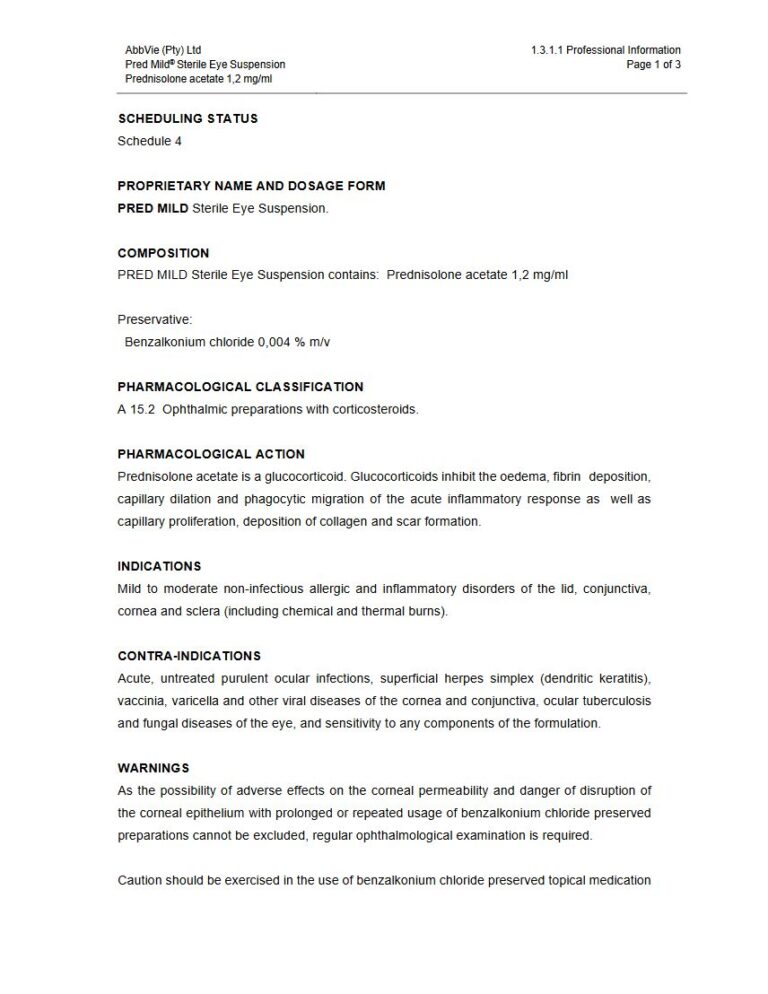
Mild to moderate non-infectious allergic and inflammatory disorders of the lid, conjunctiva, cornea and sclera (including chemical and thermal burns).
4.2 Posology and method of administration
1 to 2 drops instilled into the conjunctival sac two to four times daily. During the initial 24 to 48 hours the dosage may safely be increased to 2 drops every hour. Care should be taken not to discontinue therapy prematurely. Shake container well before using.
4.3 Contraindications
Acute, untreated purulent ocular infections, superficial herpes simplex (dendritic keratitis), vaccinia, varicella and other viral diseases of the cornea and conjunctiva, ocular tuberculosis and fungal diseases of the eye, and sensitivity to any components of the formulation.
4.4 Special warnings and precautions for use
As the possibility of adverse effects on the corneal permeability and danger of disruption of the corneal epithelium with prolonged or repeated usage of benzalkonium chloride preserved preparations cannot be excluded, regular ophthalmological examination is required. Caution should be exercised in the use of benzalkonium chloride preserved topical medication over an extended period in patients with extensive ocular surface disease.
4.5 Interactions with other medicines
None stated.
4.6 Fertility, pregnancy and lactation
Safety of intensive or protracted use of topical steroids during pregnancy has not been substantiated.
4.7 Effects on ability to drive and use machines
None stated.
4.8 Undesirable effects
Posterior subcapsular cataract formation has been reported after heavy or protracted use of the topical ophthalmic corticosteroids. Patients with histories of herpes simplex should be treated with caution. In those diseases causing thinning of the cornea, perforation has been reported with the use of topical steroids. Since PRED MILD contains no antimicrobial agent, if infection is present, appropriate measures must be taken to counteract the organism involved. Acute purulent infections of the eye may be masked or enhanced by the use of topical steroids. Use of steroid medication in the presence of stromal herpes simplex requires caution and should be followed by frequent mandatory slit-lamp microscopy. As fungal infections of the cornea have been reported coincidentally with long-term local steroid applications, fungal invasion may be suspected in any persistent corneal ulceration where a steroid has been used or is in use. Use of topical corticosteroids may cause increased intraocular pressure in certain individuals. This may result in damage to the optic nerve with defects in the visual fields. It is advisable that the intraocular pressure be checked frequently. Because of the possibility of inducing corneal abscess, fungal keratopathy of glaucoma, the patient should be referred to an ophthalmologist if the eye has not responded within 48 hours.
4.9 Overdose
Refer to u2018Side Effects and Special Precautionsu2019 listed above.
