
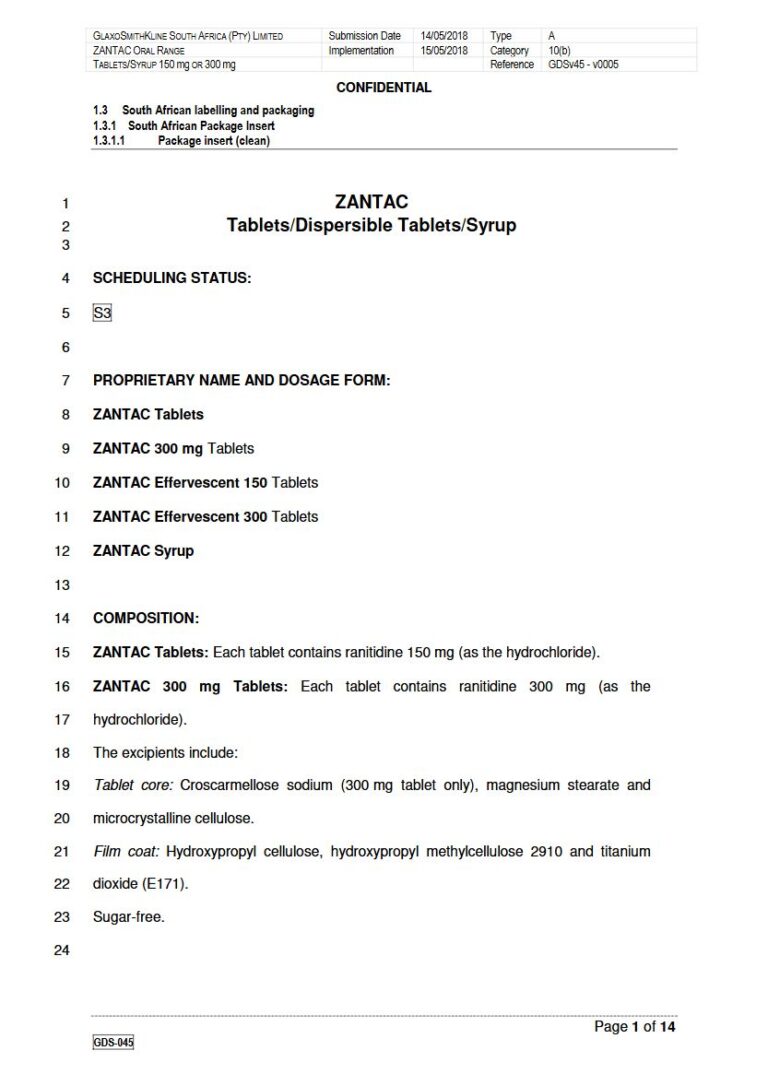
Zantac 150mg & 300mg Tablet
PDF Leaflet Revision Date: 30 September 2016
Clinical Summary
Quick overview from the medicine insert
Indication
Treatment of duodenal ulcers, gastric ulcers, reflux oesophagitis, and Zollinger-Ellison Syndrome.
Dosage (summary)
150 mg twice daily or 300 mg at bedtime; adjust for renal impairment.
Onset of Action / Duration
Onset: 1-3 hours, Duration: 6-12 hours
Special Populations
- Elderly
- Renal impairment
Pregnancy & Breastfeeding
Safety not established in pregnancy or lactation.
Key Drug Interactions
- Anticoagulants (e.g., warfarin)
- Procainamide
- Sucralfate
Contraindications
- Hypersensitivity to ranitidine
Common side effects
- Headache
- Dizziness
- Nausea
- Constipation
Counselling Points
- Take before meals or at bedtime.
- Avoid alcohol.
- Monitor for signs of allergic reactions.
Serious warnings
- Risk of masking gastric carcinoma
- Increased risk of pneumonia in certain populations
Important Disclaimer
The Zantac 150mg & 300mg Tablet professional information leaflet below is the property of Glaxosmithkline South Africa and is provided on Medinsert exactly as issued, with no.. alterations or editorial changes. We make every effort to keep content current by updating documents as soon as new versions become available. Medinsert serves as a trusted access point for healthcare professionals, but does not replace official sources or clinical judgement. For more details, please read our full disclaimer. read more>>
 Healthcare Professionals Only
This content is for registered healthcare professionals
Sign in or create a free account to read the full package insert.
Free for HPCSA-registered professionals. Powered by Medinsert.
Clinical Particulars
Section 4 of the official insert — extracted exactly as issued, no alterations
4.1 Therapeutic indications
ZANTAC is indicated for the treatment of duodenal ulcers; benign gastric ulcer; including prevention of duodenal ulceration associated with non-steroidal anti-inflammatory agents, reflux oesophagitis and Zollinger-Ellison Syndrome.
For duodenal ulcers associated with Helicobacter pylori infection, ZANTAC may be used in combination with appropriate antibiotics.
ZANTAC may also be used as premedication prior to anaesthesia in order to reduce the volume and acid content of gastric secretion, thereby minimising the consequence of the acid aspiration syndrome.
4.2 Posology and method of administration
ZANTAC Effervescent 150 or 300 tablets should be placed in half a glass of water (minimum 75 ml or 150 ml, respectively) and allowed to dissolve completely before swallowing.
ADULTS:
In Peptic Ulceration: The usual dosage is 150 mg twice daily, taken in the morning and before retiring, or a single bedtime dose of 300 mg. It is not necessary to time the dose in relation to meals. In most cases of duodenal ulcer and benign gastric ulcer, healing may occur in four weeks. Ulcers that do not heal within 4 weeks may require a further course of treatment. In ulcers following non-steroidal anti-inflammatory therapy or associated with continued non-steroidal anti-inflammatory agents, 8-12 weeks treatment may be necessary.
For the prevention of non-steroidal anti-inflammatory agent associated duodenal ulcers, ZANTAC 150 mg twice daily may be given concomitantly with non-steroidal anti-inflammatory agent therapy.
For duodenal ulcers associated with Helicobacter pylori infection, ZANTAC may be used in combination with appropriate antibiotics.
In Reflux Oesophagitis: To help in the management of reflux oesophagitis, the recommended course of treatment is 150 mg twice daily or 300 mg at bedtime for up to 8, or if necessary, 12 weeks. In patients with moderate to severe reflux oesophagitis, the dosage may be increased to 150 mg four times daily for up to 12 weeks. For the long-term management of reflux oesophagitis the recommended adult oral dose is 150 mg twice daily.
In Zollinger-Ellison Syndrome: In patients with very high gastric acid secretion (e.g. Zollinger-Ellison Syndrome) the starting dose is 150 mg three times daily and this may be increased as necessary, to within the range of 600 mg to 900 mg per day.
In Anaesthesia: For premedication prior to anaesthesia in order to reduce the volume and acid content of gastric secretion, a dose of 300 mg given at least 2 hours before induction is indicated to minimise the consequences of the acid aspiration syndrome. Alternatively, a dose of 150 mg given 12 hours prior, followed by a further 150 mg 2 hours prior to anaesthesia, is effective in suppressing gastric secretion.
Maintenance Treatment: For patients with peptic ulceration who have responded to short-term therapy, particularly those with a history of recurrent ulcer, extended maintenance treatment at a reduced dosage of 150 mg at bedtime is advised. Smoking is associated with a higher rate of ulcer relapse. Patients should be advised to stop smoking. In patients unable to stop smoking, a dose of 300 mg at night provides additional therapeutic benefit in these patients over the 150 mg dosage regimen.
Children: Experience with ZANTAC in children is limited and such use has not been fully evaluated in clinical studies.
Renal impairment: Ranitidine is excreted via the kidneys and so plasma levels of the medicine are increased and prolonged in patients with renal impairment (below a Cl Cr of 50 ml/min). Accordingly, it is recommended that the dose be reduced to 150 mg daily.
4.3 Contraindications
ZANTAC is contra-indicated in patients known to have hypersensitivity to any component of the preparation.
4.4 Special warnings and precautions for use
The possibility of malignancy should be excluded before commencement of therapy in patients with gastric ulcer, as treatment with ZANTAC may mask symptoms of gastric carcinoma.
ZANTAC should be avoided in patients with a history of acute porphyria.
Ranitidine is excreted via the kidneys and so plasma levels are increased and prolonged in patients with renal impairment (below a Cl Cr of 50 ml/min). Accordingly, it is recommended that the dose be reduced to 150 mg daily.
In patients such as the elderly, persons with chronic lung disease, diabetes or the immunocompromised, there may be an increased risk of developing community acquired pneumonia. A large epidemiological study showed an increased risk of developing community acquired pneumonia in current users of H2 receptor antagonists, such as ZANTAC, versus those who had stopped treatment, with an observed adjusted relative risk increase of 1,63 (95 % CI, 1,07-2,48).
Care should be taken to carry out periodic examinations of patients on prolonged maintenance treatment with ZANTAC as a safeguard against the occurrence of unforeseeable consequences of treatment.
Regular supervision of patients who are taking non-steroidal anti-inflammatory agents concomitantly with ZANTAC is recommended, especially if elderly.
Current evidence shows that ranitidine protects against NSAID-associated ulceration in the duodenum and not in the stomach.
ZANTAC Effervescent Tablets: As ZANTAC Effervescent 150 and 300 Tablets contain aspartame they should be used with caution in patients with phenylketonuria.
ZANTAC Effervescent 150 and 300 Tablets contain sodium (14,2 mmol/327 mg and 20,7 mmol/476 mg, respectively). Care should therefore be taken in treating patients in whom sodium restriction is indicated.
ZANTAC Syrup: ZANTAC syrup contains approximately 7,5 % m/v ethanol (alcohol), i.e. up to 405 mg per 5 ml spoonful. It is harmful for those suffering from alcoholism. It should be taken into account in pregnant or lactating women, high risk groups (those suffering from alcoholism, liver disease, epilepsy, brain injury or disease) and children (see DOSAGE AND DIRECTIONS FOR USE). It may modify or increase the effect of other medicines. ZANTAC syrup contains propyl- and butylhydroxybenzoate which may cause allergic reactions (possibly delayed).
Patients with the rare hereditary condition of sorbitol intolerance should not take ZANTAC Syrup.
4.5 Interactions with other medicines
Ranitidine has the potential to affect the absorption, metabolism or renal excretion of other medicines. The altered pharmacokinetics may necessitate dosage adjustment of the affected medicine or discontinuation of treatment.
Interactions occur by several mechanisms including:
- Inhibition of cytochrome P450-linked mixed function oxygenase system: ZANTAC at usual therapeutic doses does not potentiate the actions of medicines which are inactivated by this enzyme system such as diazepam, lidocaine (lignocaine), phenytoin, propranolol and theophylline. There have been reports of altered prothrombin time/INR with anticoagulants (e.g. warfarin). Due to the narrow therapeutic index, close monitoring of increased or decreased prothrombin time is recommended during concurrent treatment with ZANTAC.
- Competition for renal tubular secretion: Since ranitidine is partially eliminated by the cationic system, it may affect the clearance of other medicines eliminated by this route. High doses of ZANTAC (e.g. such as those used in the treatment of Zollinger-Ellison syndrome) may reduce the excretion of procainamide and N-acetylprocainamide resulting in increased plasma levels of these medicines.
- Alteration of gastric pH: The bioavailability of certain medicines may be affected. This can result in either an increase in absorption (e.g. triazolam, midazolam, glipizide) or a decrease in absorption (e.g. ketoconazole, itraconazole, atazanavir, delaviridine, gefitinib). There is no evidence of an interaction between ZANTAC, amoxicillin or metronidazole. If high doses (2 g) of sucralfate are co-administered with ZANTAC the absorption of the latter may be reduced. This effect is not seen if sucralfate is taken after an interval of 2 hours.
4.6 Fertility, pregnancy and lactation
Pregnancy: Safety in pregnancy has not been established.
Lactation: Safety in lactating women has not been established.
4.7 Effects on ability to drive and use machines
Not stated in the document.
4.8 Undesirable effects
Blood and Lymphatic System Disorders:
Less frequent: blood count changes (leucopenia, thrombocytopenia), agranulocytosis or pancytopenia, sometimes with marrow hypoplasia or marrow aplasia.
Immune System Disorders:
Less frequent: hypersensitivity reactions (urticaria, angioedema, fever, bronchospasm, hypotension and chest pain), anaphylactic shock. These reactions have been reported after a single dose.
Psychiatric Disorders:
Less frequent: reversible mental confusion, depression and hallucinations.
Nervous System Disorders:
Less frequent: headache (sometimes severe), dizziness and involuntary movement disorders.
Cardiac Disorders:
Less frequent: bradycardia and AV block.
Vascular Disorders:
Less frequent: vasculitis.
Gastrointestinal Disorders:
Less frequent: acute pancreatitis, constipation, diarrhoea, nausea and vomiting.
Hepatobiliary Disorders:
Less frequent: transient and reversible changes in liver function tests, hepatitis (hepatocellular, hepatocanalicular or mixed) with or without jaundice.
Skin and Subcutaneous Tissue Disorders:
Less frequent: skin rash, erythema multiforme, alopecia.
Musculoskeletal and Connective Tissue Disorders:
Less frequent: musculoskeletal symptoms such as arthralgia and myalgia.
Renal and Urinary Disorders:
Less frequent: acute interstitial nephritis.
Reproductive and Breast Disorders:
Less frequent: reversible impotence, breast symptoms (discomfort, pain and/or swelling), and breast conditions (such as gynaecomastia and galactorrhoea).
4.9 Overdose
See Side effects. Symptomatic and supportive therapy should be given as appropriate.
