
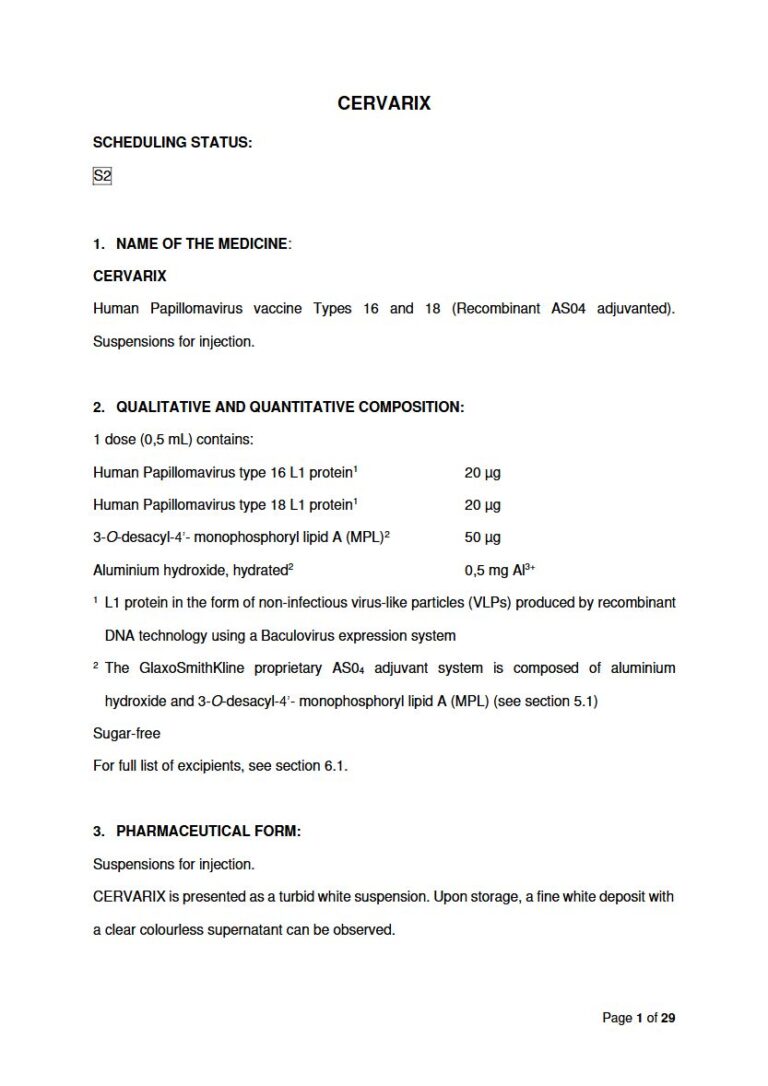
Cervarix 1 dose (0,5 mL) Suspensions for injection.
PDF Leaflet Revision Date: 24 November 2024
Clinical Summary
Quick overview from the medicine insert
Indication
Prevention of HPV-related cancers and lesions in individuals from 9 years of age.
Dosage (summary)
9-14 years: 2 doses (0.5 mL) at 0 and 5-13 months; 15 years and older: 3 doses (0.5 mL) at 0, 1, 6 months.
Special Populations
- Immunocompromised individuals
- Children < 9 years
Pregnancy & Breastfeeding
Postpone vaccination during pregnancy; use during breastfeeding only if benefits outweigh risks.
Key Drug Interactions
- Concomitant use with other vaccines
- Hormonal contraceptives
Contraindications
- Hypersensitivity to vaccine components
Common side effects
- Injection site pain
- Headache
- Fatigue
- Myalgia
- Fever
Counselling Points
- Inform about potential side effects
- Encourage regular cervical screening
- Discuss vaccination schedule
Serious warnings
- Risk of syncope
- Not for treatment of existing HPV lesions
- No protection against all HPV types
Important Disclaimer
The Cervarix 1 dose (0,5 mL) Suspensions for injection. professional information leaflet below is the property of Glaxosmithkline South Africa and is provided on Medinsert exactly as issued, with no.. alterations or editorial changes. We make every effort to keep content current by updating documents as soon as new versions become available. Medinsert serves as a trusted access point for healthcare professionals, but does not replace official sources or clinical judgement. For more details, please read our full disclaimer. read more>>
 Healthcare Professionals Only
This content is for registered healthcare professionals
Sign in or create a free account to read the full package insert.
Free for HPCSA-registered professionals. Powered by Medinsert.
Clinical Particulars
Section 4 of the official insert — extracted exactly as issued, no alterations
4.1 Therapeutic indications
CERVARIX is indicated from the age of 9 years for the prevention of persistent infection, premalignant anogenital lesions (cervical, vulvar, vaginal and anal) and cervical, vulvar, vaginal and anal cancers (squamous-cell carcinoma and adenocarcinoma) caused by oncogenic Human Papillomaviruses (HPV) (see section 5.1 and section 4.3).
4.2 Posology and method of administration
Posology: The vaccination schedule depends on the age of the subjects.
Age at the time of the first injection Immunization and schedule
- 9 to and including 14 years* Two doses each of 0,5 mL. The second dose given between 5 and 13 months after the first dose
- From 15 years and above Three doses each of 0,5 mL at 0, 1, 6 months**
* If the second vaccine dose is administered before the 5th month after the first dose, a third dose should always be administered.
**If flexibility in the vaccination schedule is necessary, the second dose can be administered between 1 month and 2,5 months after the first dose and the third dose between 5 and 12 months after the first dose. Although the necessity for a booster dose has not been established, an anamnestic response has been observed after the administration of a challenge dose (see section 5.1).
Paediatric population (children < 9 years of age): CERVARIX is not recommended for use in children below 9 years of age due to limited data on safety and immunogenicity in this age group.
Method of administration: CERVARIX is for intramuscular injection in the deltoid region (see section 4.3).
4.3 Contraindications
CERVARIX should not be administered to subjects with known hypersensitivity to any component of the vaccine (see section 2 and section 6.1).
4.4 Special warnings and precautions for use
Syncope (fainting) can occur following, or even before, any vaccination as a psychogenic response to the needle injection. It is important that procedures are in place to avoid injury from faints.
As with other vaccines, the administration of CERVARIX should be postponed in subjects suffering from acute severe febrile illness. However, the presence of a minor infection, such as a cold, should not result in the deferral of vaccination.
CERVARIX should under no circumstances be administered intravascularly or intradermally. No data are available on subcutaneous administration of CERVARIX.
As for other vaccines administered intramuscularly, CERVARIX should be given with caution to individuals with thrombocytopenia or any coagulation disorder since bleeding may occur following an intramuscular administration to these subjects.
As with any vaccine, a protective immune responses may not be elicited in all vaccinees. CERVARIX is a prophylactic vaccine. It is not intended to prevent progression of HPV-related lesions present at the time of vaccination. Vaccination is primary prevention and is not a substitute for regular cervical screening (secondary prevention) or for precautions against exposure to HPV and sexually transmitted diseases.
Except for asymptomatic human immunodeficiency virus (HIV) infected subjects for whom data are available (see section 5.1), there are no data on the use of CERVARIX in subjects with impaired immune responsiveness such as patients receiving immunosuppressive treatment. For these individuals an adequate immune response may not be elicited.
Duration of protection has not fully been established. Sustained protective efficacy has been observed for up to 9,4 years after the first dose. Long-term studies are ongoing to establish the duration of protection (see section 5.1).
It is good clinical practice to precede vaccination by a review of the medical history (especially with regard to previous vaccination and possible occurrence of undesirable events) and a clinical examination.
As with all injectable vaccines, appropriate medical treatment and supervision should always be readily available in case of a rare anaphylactic event following the administration of the vaccine.
HPV-16 and HPV-18 are not responsible for all cervical cancers (see section 5.1). Other oncogenic HPV types can also cause cervical cancer. HPV infections and related clinical outcomes due to these other types may not be prevented by vaccination. CERVARIX does not provide protection against all oncogenic HPV types (see section 5.1).
CERVARIX contains less than 1 mmol sodium (23 mg) per dose, that is to say essentially u2018sodium - freeu2019.
4.5 Interactions with other medicines and other forms of interaction
Use with other vaccines: CERVARIX can be given concomitantly with any of the following vaccines: reduced antigen diphtheria-tetanus-acellular pertussis vaccine (dTpa), inactivated poliovirus vaccine (IPV) and the combined dTpa-IPV vaccine; meningococcal serogroups A, C, W-135, Y tetanus toxoid conjugate vaccine (MenACWY-TT); hepatitis A (inactivated) vaccine (HepA), hepatitis B (rDNA) vaccine (HepB) and the combined HepA-HepB vaccine.
Administration of CERVARIX at the same time as Twinrix (combined HepA-HepB vaccine) has shown no clinically relevant interference in the antibody response to the HPV and hepatitis A antigens. Anti-HBs geometric mean antibody titers were lower on co-administration, but the clinical significance of this observation is not known since the seroprotection rates remain unaffected. The proportion of subjects reaching anti-HBs u2265 10 mIU/ml was 98,3 % for concomitant vaccination and 100 % for Twinrix alone.
If CERVARIX is to be given at the same time as another injectable vaccine, the vaccines should always be administered at different injection sites.
Use with hormonal contraceptive: In clinical efficacy studies, approximately 60 % of women who received CERVARIX used hormonal contraceptives. There is no evidence that the use of hormonal contraceptives has an impact on the efficacy of CERVARIX. As with other vaccines it may be expected that, in patients receiving immunosuppressive treatment, an adequate response may not be elicited.
4.6 Fertility, pregnancy and lactation
Pregnancy: The effect of CERVARIX on embryo-foetal, peri-natal and post-natal survival and development has been assessed in rats. Such animal studies do not indicate direct or indirect harmful effects with respect to fertility, pregnancy, embryonal/foetal development, parturition or post-natal development. Data in pregnant women collected as part of clinical trials, pregnancy registries and epidemiological studies do not suggest that vaccination with CERVARIX alters the risk of abnormal outcomes in neonates including birth defects. Data are insufficient to conclude whether or not vaccination with CERVARIX affects the risk of spontaneous abortion. Women who are pregnant or trying to become pregnant, are advised to postpone vaccination until completion of pregnancy.
Lactation: The effect on breastfed infants of the administration of CERVARIX to their mothers has not been evaluated in clinical studies. CERVARIX should only be used during breastfeeding when the possible advantages outweigh the possible risks. Serological data suggest a transfer of anti-HPV16 and anti-HPV18 antibodies via the milk during the lactation period in rats. However, it is unknown whether vaccine-induced antibodies are excreted in human breast milk.
4.7 Effect on ability to drive and use machines
No studies on the effects on the ability to drive or use machines have been performed.
4.8 Undesirable effects
Summary of the safety profile: In clinical studies a total of approximately 45 000 doses of CERVARIX were administered to approximately 16 000 female subjects aged 9-72 years and approximately 7 800 doses were administered to approximately 2 600 male subjects aged 10-18 years. These subjects were followed to assess the safety of the vaccine. The most common reaction observed after vaccine administration was injection site pain which occurred after 78 % of all doses. The majority of these reactions were of mild to moderate severity and were not long lasting.
Adverse reactions considered as being at least possibly related to vaccination have been categorised by frequency. Tabulated list of adverse events: Clinical trials: Frequencies are reported as:
- Very common (u2265 1/10)
- Common (u2265 1/100 to < 1/10)
- Uncommon (u2265 1/1 000 to < 1/100)
- Rare (u2265 1/10 000, < 1/1 000).
Table 1 Adverse events reported in clinical trials:
| System Organ Class | Frequency | Adverse reaction |
|---|---|---|
| Infections and infestations | Uncommon | upper respiratory tract infection |
| Blood and lymphatic system disorders | Uncommon | Lymphadenopathy |
| Nervous system disorders | Very common | Headache |
| Uncommon | Dizziness | |
| Gastrointestinal disorders | Common | Gastrointestinal symptoms including nausea, vomiting, diarrhoea and abdominal pain |
| Skin and subcutaneous tissue disorders | Common | Itching/pruritus, rash, urticaria |
| Musculoskeletal and connective tissue and bone disorders | Very common | Myalgia |
| Common | Arthralgia | |
| General disorders and administration site conditions | Very common | Injection site reactions including pain, redness, swelling; fatigue |
| Common | Fever (u2265 38 u00b0C) | |
| Uncommon | Other injection site reactions such as induration, local paraesthesia |
Post-marketing Data: As the following events were reported spontaneously, it is not possible to reliably estimate their frequency.
Immune system disorders: Unknown: allergic reactions (including anaphylactic and anaphylactoid reactions), angioedema
Nervous system disorders: Unknown: syncope or vasovagal responses to injection, sometimes accompanied by tonic-clonic movements.
Reporting of suspected adverse events: Reporting suspected adverse reactions after authorisation of the medicine is important. It allows continued monitoring of the benefit/risk balance of the medicine. Health care providers are asked to report any suspected adverse reactions to SAHPRA via the u201c6.04 Adverse Drug Reactions Reporting Formu201d, found online under SAHPRAu2019s publications: https://www.sahpra.org.za/Publications/Index/8.
4.9 Overdose
Insufficient data are available.
