
Betaferon Injection
Clinical Summary
Quick overview from the medicine insert
Indication
Treatment of relapsing forms of multiple sclerosis (MS) to reduce the frequency of clinical exacerbations.
Dosage (summary)
The recommended dose is 250 micrograms (0.5 mL) administered subcutaneously every other day.
Onset of Action / Duration
Initial effects may be observed within a few weeks, with maximum effects typically seen after several months of treatment.
Special Populations
- Elderly patients
- Patients with renal impairment
- Patients with hepatic impairment
Pregnancy & Breastfeeding
Use during pregnancy only if the potential benefit justifies the potential risk to the fetus. Caution is advised when administering to nursing mothers.
Key Drug Interactions
- Caution with other immunomodulatory therapies
- Potential interactions with live vaccines
Contraindications
- Hypersensitivity to recombinant interferon beta-1b or any excipients
- Severe depression or suicidal ideation
- Severe liver disease
Common side effects
- Flu-like symptoms (fever, chills, fatigue)
- Injection site reactions (redness, swelling, pain)
- Headache
- Nausea
- Depression
Counselling Points
- Instruct patients on proper injection technique and site rotation.
- Advise patients to report any signs of depression or mood changes.
- Encourage adherence to the dosing schedule for optimal efficacy.
Serious warnings
- Monitor for signs of liver dysfunction and hematologic abnormalities.
- Caution in patients with a history of seizures.
- May cause or exacerbate autoimmune disorders.
Important Disclaimer
The Betaferon Injection professional information leaflet below is the property of Bayer and is provided on Medinsert exactly as issued, with no.. alterations or editorial changes. We make every effort to keep content current by updating documents as soon as new versions become available. Medinsert serves as a trusted access point for healthcare professionals, but does not replace official sources or clinical judgement. For more details, please read our full disclaimer. read more>>
 Healthcare Professionals Only
This content is for registered healthcare professionals
Sign in or create a free account to read the full package insert.
Free for HPCSA-registered professionals. Powered by Medinsert.
Clinical Particulars
Section 4 of the official insert — extracted exactly as issued, no alterations
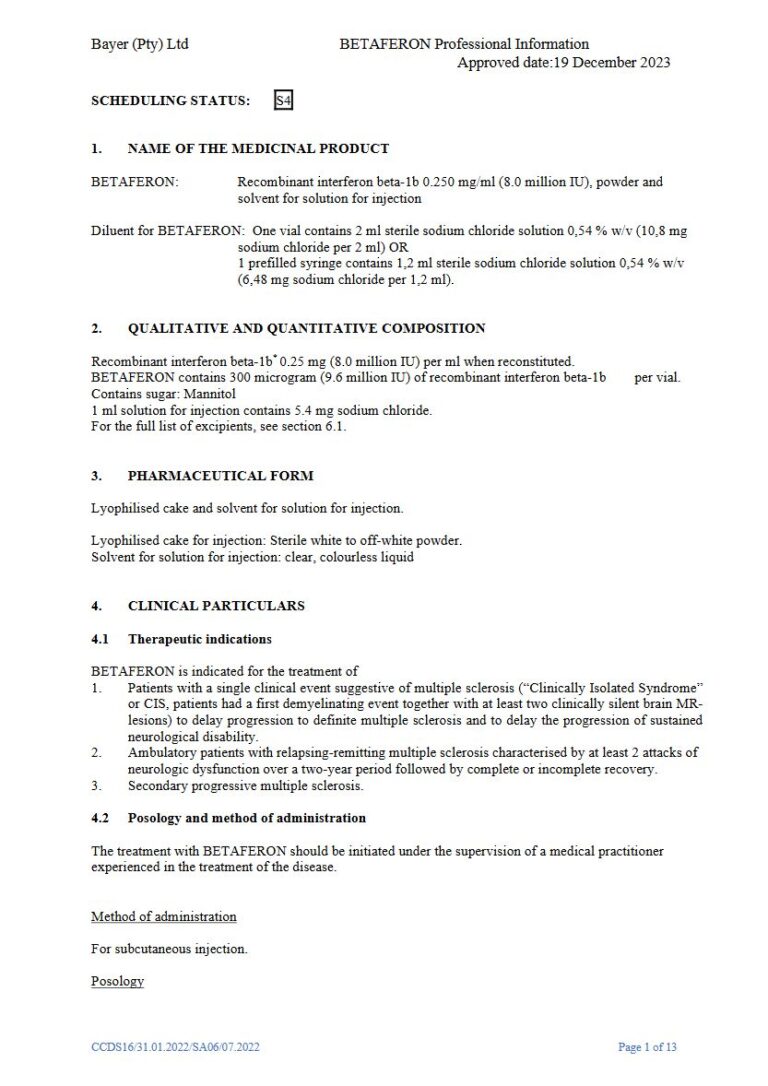
4.1 Therapeutic indications
BETAFERON is indicated for the treatment of
- Patients with a single clinical event suggestive of multiple sclerosis (u201cClinically Isolated Syndromeu201d or CIS, patients had a first demyelinating event together with at least two clinically silent brain MR- lesions ) to delay progression to definite multiple sclerosis and to delay the progression of sustained neurological disability.
- Ambulatory patients with relapsing-remitting multiple sclerosis characterised by at least 2 attacks of neurologic dysfunction over a two-year period followed by complete or incomplete recovery.
- Secondary progressive multiple sclerosis.
4.2 Posology and method of administration
The treatment with BETAFERON should be initiated under the supervision of a medical practitioner experienced in the treatment of the disease.
Method of administration
For subcutaneous injection.
Posology
Adults
Treatment with BETAFERON should be initiated under the supervision of a medical practitioner experienced in the treatment of the disease. The recommended dose of BETAFERON is 8 million IU (0,25 mg), contained in 1 ml of the reconstituted solution to be injected subcutaneously every other day. Generally, dose titration is recommended at the start of treatment. For this purpose, a special titration pack is available (see u201cPresentationu201d for details of the titration pack). Patients should be started at 0,0625 mg (0,25 ml) subcutaneously every other day and increased slowly to a dose of 0,25 mg (1,0 ml) every other day. The titration period may be adjusted according to individual tolerability.
In the study in patients with multiple sclerosis with a single clinical event, dosage was increased as shown in Table 1.
Table 1: Schedule for dose titration*
| treatment day | dose | volume |
|---|---|---|
| 1, 3, 5 | 0.0625 mg | 0.25 ml |
| 7, 9, 11 | 0.125 mg | 0.5 ml |
| 13, 15, 17 | 0.1875 mg | 0.75 ml |
| 19, 21, 23 et seq. | 0.250 mg | 1.0 ml |
* Titration scheme as used in the study in patients with multiple sclerosis with a single clinical event suggestive of multiple sclerosis. The titration period may be modified according to individual tolerability.
Duration of treatment: It is not known for how long the patient should be treated. Efficacy for a period of up to 3 years of treatment has been demonstrated in a controlled clinical trial. There are follow-up data under controlled clinical trial conditions for patients with relapsing-remitting multiple sclerosis for up to 5 years and for patients with secondary progressive multiple sclerosis for up to 3 years. For relapsing-remitting multiple sclerosis, the available data for up to 5 years suggest sustained treatment efficacy of BETAFERON over the whole time period. For secondary progressive multiple sclerosis efficacy for a period of two years with limited data for a period of up to 3 years of treatment has been demonstrated under controlled clinical trial conditions. In patients with a single clinical event suggestive of multiple sclerosis, efficacy has been demonstrated over a period of 5 years.
Children and adolescents: Efficacy and safety of BETAFERON were not investigated systematically in children and adolescents of less than 18 years of age. There is only limited information on the use of BETAFERON in children under 18 years of age and, therefore, BETAFERON should not be administered to this age group.
Instructions for use/handling:
BETAFERON vials and solvent vials:
- Reconstitution To reconstitute lyophilised interferon beta-1b for injection use a sterile syringe and needle to inject 1,2 ml of the supplied DILUENT FOR BETAFERON (sodium chloride solution 5,4 mg/ml (0,54 % w/v)) into the BETAFERON vial. Dissolve the powder completely without shaking.
- Inspection prior to use and preparation of the syringe Do not use cracked vials. Inspect the reconstituted product visually before use. The reconstituted product is colourless to light yellow and slightly opalescent to opalescent. Discard the product before use if it contains particulate matter or is discoloured. After reconstitution draw 1,0 ml from the vial into the syringe for the administration of 0,25 mg BETAFERON.
- Disposal Discard the product before use if it contains particulate matter or is discoloured. Discard any unused solution for injection.
4.3 Contraindications
Patients with a history of hypersensitivity, such as bronchospasm, anaphylaxis and urticaria; to natural or recombinant interferon beta or human albumin or to any of the excipients listed in section 6.1.
4.4 Special warnings and precautions for use
Immune system disorders The administration of cytokines to patients with a pre-existing monoclonal gammopathy has been associated with the development of systemic capillary leak syndrome with shock-like symptoms and fatal outcome.
Gastrointestinal disorders: Cases of pancreatitis were observed with BETAFERON use, frequently associated with hypertriglyceridaemia.
Nervous system disorders: Patients to be treated with BETAFERON should be informed that depressive disorders and suicidal ideation may be a side effect of the treatment and should report these symptoms immediately to the prescribing medical practitioner. In rare cases these symptoms may result in a suicide attempt. Patients exhibiting depression and suicidal ideation should be monitored closely and cessation of therapy should be considered. BETAFERON should be administered with caution to patients with previous or current depressive disorders or suicidal ideation.
BETAFERON contains human albumin. Based on effective donor screening and product manufacturing processes, it carries a remote risk for transmission of viral diseases. A theoretical risk for transmission of Creutzfeld-Jacob disease (CJD) is also considered remote. No cases of transmission of viral disease or CJD have ever been identified for albumin.
BETAFERON should be administered with caution to patients with a history of seizures.
Investigations/immunogenicity: There is a potential for immunogenicity (see section 4.8). The decision to continue or discontinue treatment should be based on all aspects of the patient's disease status rather than on neutralising activity status alone.
Hepato-biliary disorders: Elevations of serum transaminases, in most cases asymptomatic, mild and transient, occurred very commonly in patients treated with BETAFERON during clinical trials. Cases of severe hepatic injury, including hepatic failure, have been reported. The most severe events often occurred in patients exposed to other medicines or substances known to be associated with hepatotoxicity or in the presence of comorbid medical conditions (e.g. metastasising malignant disease, severe infection and sepsis, alcohol abuse). Patients should be monitored for signs of hepatic injury. The occurrence of elevations in serum transaminases should lead to close monitoring and investigation. Withdrawal of BETAFERON should be considered if the levels significantly increase or if they are associated with clinical symptoms such as jaundice. In the absence of clinical evidence for liver damage and after normalisation of liver enzymes, a reintroduction of therapy could be considered with appropriate follow-up of hepatic functions.
Cardiac disorders: BETAFERON should be used with caution in patients with pre-existing cardiac disease such as congestive heart failure, coronary artery disease or dysrhythmias. While there is no evidence of a direct cardiotoxic potential for BETAFERON, these patients should be monitored for worsening of their cardiac condition. This applies particularly during initiation of treatment with BETAFERON, where flu-like symptoms, commonly associated with beta interferons, exert cardiac stress through fever, chills and tachycardia. This may aggravate cardiac symptoms in patients with pre-existing significant cardiac disease. During the postmarketing period, reports have been received of worsening of cardiac status in patients with pre-existing significant cardiac disease, associated with the initiation of BETAFERON therapy. Cases of cardiomyopathy have been reported: if this occurs and a relationship to BETAFERON is suspected, treatment should be discontinued.
General disorders and administration site conditions: Serious hypersensitivity reactions such as acute bronchospasm, anaphylaxis and urticaria may occur. If reactions are severe, BETAFERON should be discontinued and appropriate medical intervention instituted. Other moderate to severe adverse experiences may require modifications of the BETAFERON dosage regimen or discontinuation. Injection site infection and injection site necrosis have been reported in patients using BETAFERON. Injection site necrosis can be extensive and may involve muscle fascia as well as fat and therefore can result in scar formation. Occasionally debridement and, less often, skin grafting are required and healing may take up to 6 months. If the patient experiences any break in the skin, which may be associated with swelling or drainage of fluid from the injection site, the patient should be advised to consult with their medical practitioner before continuing injections with BETAFERON. If the patient has multiple lesions, BETAFERON should be discontinued until healing has occurred. Patients with single lesions may continue on BETAFERON, provided the necrosis is not too extensive, as some patients have experienced healing of injection site necrosis whilst on BETAFERON. To minimise the risk of injection site infection and injection site necrosis, patients should be advised to:
- use an aseptic injection technique,
- rotate the injection sites with each dose.
The procedure for the self-administration by the patient should be reviewed periodically especially if injection site reactions have occurred.
Thrombotic microangiopathy (TMA) and Hemolytic anaemia Cases of thrombotic microangiopathy, manifested as thrombotic thrombocytopenic purpura (TTP) or haemolytic uraemic syndrome (HUS) have been reported including fatal cases with BETAFERON. Events were reported at various time points during treatment and may occur several weeks to several years after starting treatment with BETAFERON. Early clinical features include thrombocytopenia, new onset hypertension and impaired renal function. Laboratory findings suggestive of TMA include decreased platelet counts, increased serum lactate dehydrogenase (LDH) and schistocytes (erythrocyte fragmentation) on a blood film. Therefore if clinical features of TMA are observed further testing of blood platelet levels, serum LDH, blood films and renal function is recommended. If TMA is diagnosed prompt treatment with plasma exchange is required and immediate discontinuation of BETAFERON is recommended. Additionally, cases of hemolytic anemia (HA) not associated with TMA, including immune HA have been reported with BETAFERON. Life-threatening and fatal cases were reported. Cases have been reported several weeks to years after starting interferon beta products. If clinical symptoms and laboratory findings consistent with TMA and / or HA occur, and a relationship to BETAFERON is suspected, discontinue treatment and manage as clinically indicated.
Pulmonary Arterial Hypertension (PAH) Cases of pulmonary arterial hypertension (PAH) have been reported with BETAFERON. Patients developing suspicious symptoms (e.g dyspnoea, fatigue accompanied by shortness of breath) should be assessed for PAH.
Other: Caution should be exercised when administering BETAFERON to patients with myelosuppression, anaemia or thrombocytopenia; patients who develop neutropenia should be monitored closely for the development of fever or infection. Renal function should be monitored carefully when such patients receive BETAFERON therapy.
Laboratory tests: In addition to those laboratory tests normally required for monitoring patients with multiple sclerosis, complete blood and differential white blood cell counts, platelet counts, and blood chemistries, including liver function tests (e.g. AST (SGOT), ALT (SGPT) and gamma-GT), are recommended prior to initiation and at regular intervals following introduction of BETAFERON therapy, and then periodically thereafter in the absence of clinical symptoms. Thyroid function tests are recommended regularly in patients with a history of thyroid dysfunction or as clinically indicated. Patients with anaemia, thrombocytopenia, leukopenia (alone or in any combination) may require more intensive monitoring of complete blood cell counts, with differential and platelet counts.
4.5 Interaction with other medicinal products and other forms of interaction
No formal medicine interaction studies have been carried out with BETAFERON. The effect of BETAFERON on medicine metabolism in multiple sclerosis patients is unknown. Corticosteroid or ACTH treatment of relapses for periods of up to 28 days has been well tolerated in patients receiving BETAFERON. Due to the lack of clinical experience in multiple sclerosis patients, the use of BETAFERON together with immunomodulators other than corticosteroids or ACTH is not recommended. Interferons such as BETAFERON have been reported to reduce the activity of hepatic cytochrome P450- dependent enzymes. Caution should be exercised when BETAFERON is administered in combination with medicines that have a narrow therapeutic index and are largely dependent on the hepatic cytochrome P450 system for clearance, such as ketoconazole, itraconazole, macrolide antibiotics, etc. Caution should be exercised with any co-medication which has an effect on the haematopoietic system.
4.6 Fertility, pregnancy and lactation
Pregnancy: It is not known whether BETAFERON can cause foetal harm when administered to a pregnant woman or can affect human reproductive capacity. Spontaneous abortions have been reported in subjects with multiple sclerosis using BETAFERON in controlled clinical trials. BETAFERON in studies with rhesus monkeys has been proven embryotoxic, causing a dose-related increase in the rate of abortions. Therefore, BETAFERON is contra-indicated during pregnancy and women of childbearing potential should take appropriate contraceptive measures. If the patient becomes pregnant or plans to become pregnant while taking BETAFERON, she should be informed of the potential hazard and it should be recommended to discontinue therapy. If the patient plans to get pregnant, the benefits and possible risks of continuing BETAFERON therapy are recommended to be weighed. If the patient or becomes pregnant while taking Betaferon, the benefit and potential risks of continuing BETAFERON therapy, the individual disease severity and the potential detrimental effects that could occur if medication is stopped (e.g., on the individual disease activity) of drug discontinuation should be discussed with the patient.
Lactation: It is not known whether interferon beta-1b is excreted in human milk. Because of the potential for serious adverse reactions to BETAFERON if infants are being breastfed, BETAFERON should be discontinued.
Fertility: Reproduction studies with rhesus monkeys revealed maternal toxicity and an increased rate of abortions. No investigations on fertility have been conducted. BETAFERON is contra-indicated in pregnancy and lactation.
4.7 Effects on ability to drive and use machines
This has not been investigated. Central nervous system-related adverse events associated with the use of BETAFERON might influence the ability to drive and use machines in susceptible patients. Contains mannitol and may have a laxative effect.
4.8 Undesirable effects
Flu-like symptom complex (fever, chills, headache, myalgia, arthralgia, malaise, or sweating) occur frequently. The incidence rate of the symptoms decreased over time. Dose titration is recommended at the start of treatment in order to increase the tolerability to BETAFERON. Flu-like symptoms may also be reduced by administration of non-steroidal anti-inflammatory medicines.
Injection site reactions (e.g. redness, swelling, discolouration, inflammation, pain, hypersensitivity, infection necrosis, and non-specific reactions) occur frequently after administration of BETAFERON. The incidence rate of injection site reactions usually decreased over time. The incidence of injection site reactions may be reduced by the use of an autoinjector.
The most serious adverse reaction reported are thrombotic microangiopathy (TMA) and hemolytic anemia (HA). The frequencies of adverse reactions (ARs) reported with BETAFERON are summarised in the table below. Frequencies are defined as very common (u2265 1/10) and common (u2265 1/100 to < 1/10). The ADRs identified only during post-marketing surveillance, and for which a frequency could not be estimated, are listed under u201cnot knownu201d.
Table 2: Adverse reactions from clinical trials and from post-marketing experience.
| System Organ Class | Very common | Common | Frequency not known: |
|---|---|---|---|
| Blood and lymphatic system disorders | Lymphocyte count decreased (< 1500/mm 3 ) | X | |
| White blood cell count decreased (WBC) (< 3000/mm 3 ) | X | ||
| Absolute neutrophil count decreased (ANC) (< 500/mm 3 ) | X | ||
| Lymphadenopathy | X | ||
| Anemia, Thrombocytopenia | X | ||
| Leukopenia | X | ||
| Thrombotic Microangiopathy** | X | ||
| Hemolytic Anemia** | X | ||
| Immune system disorders | Anaphylactic reactions | X | |
| Capillary leak syndrome in preexisting monoclonal gammopathy | X | ||
| Endocrine disorders | Thyroid disorders, Hyperthyroidism, Hypothyroidism | X | |
| Metabolism and nutrition disorders | Blood triglycerides increased, Anorexia, Weight decrease, Weight increase | X | |
| Psychiatric disorders | Depression, Suicide attempt, Confusion, Anxiety, Emotional lability | X | |
| Nervous system disorders | Headache | X | |
| Insomnia | X | ||
| Incoordination | X | ||
| Convulsion, Dizziness | X | ||
| Cardiac disorders | Cardiomyopathy, Tachycardia, Palpitation | X | |
| Vascular disorders | Hypertension | X | |
| Vasodilatation | X | ||
| Respiratory, thoracic and mediastinal disorders | Dyspnoea | X | |
| Bronchospasm | X | ||
| Gastrointestinal disorders | Abdominal pain | X | |
| Nausea, Vomiting, Pancreatitis, Diarrhea | X | ||
| Hepatobiliary disorders | Alanine aminotransferase increased (ALT > 5 times baseline) | X | |
| Aspartate aminotransferase increased (AST > 5 times baseline) | X | ||
| Blood bilirubin increased, Gamma-glutamyltransferase increased, Hepatic injury (including hepatitis), Hepatic failure | X | ||
| Skin and subcutanoeus tissue disorders | Rash | X | |
| Skin disorder | Urticaria, Alopecia, Pruritus, Skin discoloration | X | |
| Musculosceletal, connective tissue and bone disorders | Myalgia | X | |
| Hypertonia | X | ||
| Arthralgia, Drug-induced lupus erythematosus | X | ||
| Renal and urinary disorders | Urinary urgency | X | |
| Reproductive system and breast disorders | Impotence | X | |
| Metrorrhagia | X | ||
| Menstrual disorder, Menorrhagia | X | ||
| General disorders and administration site conditions | Injection site reaction (various kindsu00b0) | X | |
| Flu-like symptoms (complex u00a7) | X | ||
| Pain | X | ||
| Fever | X | ||
| Chills | X | ||
| Peripheral oedema | X | ||
| Asthenia | X | ||
| Injection site necrosis | X | ||
| Chest pain | X | ||
| Malaise | X | ||
| Sweating | X |
** life-threatening and/or fatal cases have been reported.
u00d7 laboratory abnormality
a pre-menopausal women
b Men
o u201cInjection site reaction (various kinds)u201d comprises all adverse events occurring at the injection site (except injection site necrosis), i.e. the following terms: injection site atrophy, injection site oedema, injection site haemorrhage, injection site hypersensitivity, injection site infection, injection site inflammation, injection site mass, injection site pain, and injection site reaction.
u00a7 u201dFlu-like symptom complexu201d denotes flu syndrome and/or a combination of at least two AEs from fever, chills, myalgia, malaise, sweating.
Pulmonary arterial hypertension Cases of pulmonary arterial hypertension (PAH) have been reported with BETAFERON. Events were reported at various time points including up to several years after starting treatment with BETAFERON.
4.9 Overdose
Symptoms are expected to be as the side effects.
