
Stivarga 40 Mg Film-Coated Tablets
PDF Leaflet Revision Date: 01 June 2020
Clinical Summary
Quick overview from the medicine insert
Indication
Treatment of metastatic colorectal cancer, gastrointestinal stromal tumors, and hepatocellular carcinoma.
Dosage (summary)
160 mg orally once daily for 3 weeks, followed by 1 week off.
Special Populations
- Hepatic impairment
- Renal impairment
Pregnancy & Breastfeeding
Contraindicated in pregnancy and breastfeeding; may cause fetal harm.
Key Drug Interactions
- CYP3A4 inhibitors
- CYP3A4 inducers
- BCRP substrates
Contraindications
- Hypersensitivity to regorafenib
- Pregnancy
- Breastfeeding
- Gastrointestinal perforation
Common side effects
- Hand-foot skin reaction
- Fatigue
- Diarrhea
- Hypertension
- Infection
Counselling Points
- Take with a light meal
- Monitor for liver function abnormalities
- Use effective contraception during treatment
Serious warnings
- Severe liver injury
- Gastrointestinal perforation
- Myocardial ischemia
- Increased risk of hemorrhage
Important Disclaimer
The Stivarga 40 Mg Film-Coated Tablets professional information leaflet below is the property of Bayer and is provided on Medinsert exactly as issued, with no.. alterations or editorial changes. We make every effort to keep content current by updating documents as soon as new versions become available. Medinsert serves as a trusted access point for healthcare professionals, but does not replace official sources or clinical judgement. For more details, please read our full disclaimer. read more>>
 Healthcare Professionals Only
This content is for registered healthcare professionals
Sign in or create a free account to read the full package insert.
Free for HPCSA-registered professionals. Powered by Medinsert.
Clinical Particulars
Section 4 of the official insert — extracted exactly as issued, no alterations
4.1 Therapeutic indications
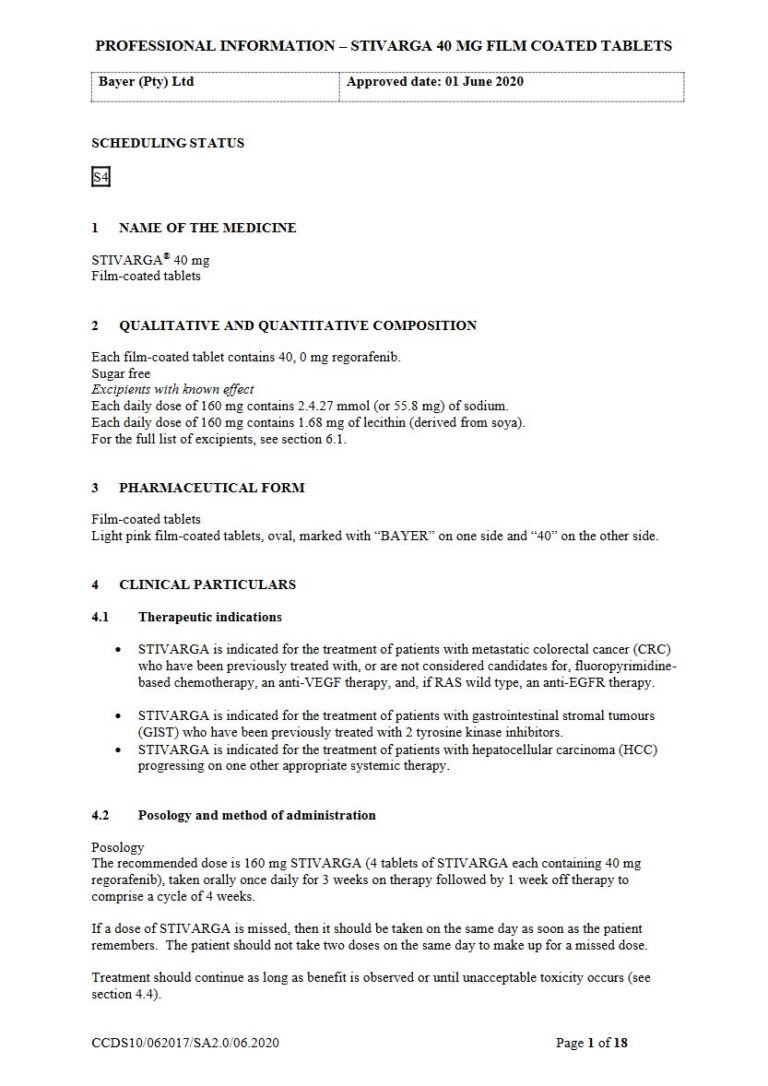
u2022 STIVARGA is indicated for the treatment of patients with metastatic colorectal cancer (CRC) who have been previously treated with, or are not considered candidates for, fluoropyrimidine-based chemotherapy, an anti-VEGF therapy, and, if RAS wild type, an anti-EGFR therapy.
u2022 STIVARGA is indicated for the treatment of patients with gastrointestinal stromal tumours (GIST) who have been previously treated with 2 tyrosine kinase inhibitors.
u2022 STIVARGA is indicated for the treatment of patients with hepatocellular carcinoma (HCC) progressing on one other appropriate systemic therapy.
4.2 Posology and method of administration
Posology
The recommended dose is 160 mg STIVARGA (4 tablets of STIVARGA each containing 40 mg regorafenib), taken orally once daily for 3 weeks on therapy followed by 1 week off therapy to comprise a cycle of 4 weeks. If a dose of STIVARGA is missed, then it should be taken on the same day as soon as the patient remembers. The patient should not take two doses on the same day to make up for a missed dose. Treatment should continue as long as benefit is observed or until unacceptable toxicity occurs (see section 4.4).
Dose modification
Dose interruptions and/or dose reductions may be required based on individual safety and tolerability. Dose modifications are to be applied in 40 mg (one tablet) steps. The lowest recommended daily dose is 80 mg. The maximum daily dose is 160 mg. For dose modifications and measures in case of hand-foot skin reaction (HFSR/palmar-plantar erythrodysesthesia syndrome) see Table 1 below.
Table 1: Recommended dose modifications and measures for HFSR.
Skin toxicity grade
Occurrence
Recommended dose modification and measures
Grade 1
Any
Maintain dose level and immediately institute supportive measures for symptomatic relief.
Grade 2
1st occurrence
Decrease dose by 40 mg (one tablet) and immediately institute supportive measures. If no improvement occurs despite dose reduction, interrupt therapy for a minimum of 7 days, until toxicity resolves to Grade 0 - 1. A dose re-escalation is permitted at the discretion of the treating medical practitioner.
No improvement within 7 days or 2nd occurrence
Interrupt therapy until toxicity resolves to Grade 0 - 1. When resuming treatment, decrease dose by 40 mg (one tablet). A dose re-escalation is permitted at the discretion of the treating medical practitioner.
3rd occurrence
Interrupt therapy until toxicity resolves to Grade 0 - 1. When resuming treatment, decrease dose by 40 mg (one tablet). A dose re-escalation is permitted at the discretion of the treating medical practitioner.
4th occurrence
Discontinue treatment.
Grade 3
1st occurrence
Institute supportive measures immediately. Interrupt therapy for a minimum of 7 days until toxicity resolves to Grade 0 - 1. When resuming treatment, decrease dose by 40 mg (one tablet). A dose re-escalation is permitted at the discretion of the treating medical practitioner.
2nd occurrence
Institute supportive measures immediately. Interrupt therapy for a minimum of 7 days until toxicity resolves to Grade 0 - 1. When resuming treatment, decrease dose by 40 mg (one tablet).
3rd occurrence
Discontinue treatment.
For recommended measures and dose modifications in case of worsening of liver function tests considered related to treatment with STIVARGA (see Table 2 below and section 4.4).
Table 2: Recommended measures and dose modifications in case of STIVARGA-related liver function test abnormalities.
Observed elevations of ALT and/or AST
Occurrence
Recommended measures and dose modification
u2264 5 times upper limit of normal (ULN) (maximum Grade 2)
Any occurrence
Continue STIVARGA treatment. Monitor liver function weekly until transaminases return to < 3 times ULN (Grade 1) or baseline.
> 5 times ULN to u2264 20 times ULN (Grade 3)
1st occurrence
Interrupt STIVARGA treatment. Monitor transaminases weekly until return to < 3 times ULN or baseline. Restart: If the potential benefit outweighs the risk of hepatotoxicity, re-initiate STIVARGA treatment, reduce dose by 40 mg (one tablet), and monitor liver function weekly for at least 4 weeks.
Re-occurrence
Discontinue treatment with STIVARGA permanently.
> 20 times ULN (Grade 4)
Any occurrence
Discontinue treatment with STIVARGA permanently.
> 3 times ULN (Grade 2 or higher) with concurrent bilirubin > 2 times ULN
Any occurrence
Discontinue treatment with STIVARGA permanently. Monitor liver function weekly until resolution or return to baseline. Exception: patients with Gilbertu2019s syndrome who develop elevated transaminases should be managed as per the above outlined recommendations for the respective observed elevation of ALT and/or AST.
Hepatic impairment
Regorafenib is eliminated mainly via the hepatic route. No clinically important differences in exposure were observed between patients with mild (Child-Pugh A) or moderate hepatic impairment (Child Pugh B) compared to patients with normal hepatic function. No dose adjustment is required in patients with mild or moderate hepatic impairment. Close monitoring of overall safety is recommended in these patients (see sections 4.4 and 5.2).
Stivarga is not recommended for use in patients with severe hepatic impairment (Child-Pugh C) as Stivarga has not been studied in this population.
Renal impairment
Available clinical data indicate similar exposure of regorafenib and its metabolites M-2 and M-5 in patients with mild, moderate or severe renal impairment compared to patients with normal renal function. No dose adjustment is required in patients with mild, moderate or severe renal impairment (see also section 5.2).
Ethnic differences: In clinical studies, no relevant differences in exposure or efficacy were observed between patients of different ethnic groups. No dose adjustment is necessary based on ethnicity. A higher incidence of hand foot skin reaction (HFSR), severe liver function test abnormalities and hepatic dysfunction was observed in Asian (in particular Japanese) patients treated with STIVARGA as compared with Caucasians. The Asian patients treated with STIVARGA in clinical studies were primarily from East Asia (~ 90%).
Method of administration
STIVARGA is for oral use. STIVARGA should be taken at the same time each day after a light meal. The tablets should be swallowed whole.
4.3 Contraindications
u2022 Hypersensitivity to regorafenib or any of the other ingredients of STIVARGA.
u2022 STIVARGA must not be used by pregnant women or by women who are breastfeeding their infants (see section 4.6).
u2022 Patients who develop gastrointestinal perforations or fistula while taking STIVARGA should permanently discontinue treatment with STIVARGA.
4.4 Special warnings and precautions for use
Hepatic effects
Abnormalities of liver function tests (alanine aminotransferase (ALT), aspartate aminotransferase (AST) and bilirubin) have been very commonly observed in patients treated with STIVARGA. Severe liver function test abnormalities (Grade 3 to 4) and hepatic dysfunction with clinical manifestations (including fatal outcomes) have been reported (see section 4.8). It is recommended to perform liver function tests (ALT, AST and bilirubin) before initiation of treatment with STIVARGA and monitor closely (at least every two weeks) during the first 2 months of treatment. Thereafter, periodic monitoring should be continued at least monthly and as clinically indicated. Regorafenib is a uridine diphosphate glucuronosyl transferase UGT1A1 inhibitor (see section 4.5). Indirect (unconjugated) hyperbilirubinemia may occur in patients with Gilbertu2019s syndrome. For patients with observed worsening of liver function tests considered related to treatment with STIVARGA (i.e. where no alternative cause is evident, such as post-hepatic cholestasis or disease progression), the dose modification and monitoring advice in the Table 2 must be followed (see section 4.5). Close monitoring of overall safety is recommended in patients with mild or moderate hepatic impairment (see sections 4.2 and 4.3). STIVARGA is not recommended for use in patients with severe hepatic impairment (Child-Pugh C) as STIVARGA has not been studied in this population and exposure might be increased in these patients.
Infections
STIVARGA has been associated with an increased incidence of infection events, some of which were fatal (see section 4.8). In cases of worsening infection events, interruption of STIVARGA treatment should be considered.
Haemorrhage
STIVARGA has been associated with an increased incidence of haemorrhagic events, some of which were fatal (see section 4.8). Blood counts and coagulation parameters should be monitored in patients with conditions predisposing to bleeding, and in those treated with anticoagulants or other concomitant medications that increase the risk of bleeding. In the event of severe bleeding necessitating urgent medical intervention, permanent discontinuation of STIVARGA should be considered.
Gastrointestinal perforation and fistula
Gastrointestinal perforation (including fatal outcomes) and fistulae have been reported in patients treated with STIVARGA (see section 4.8). STIVARGA should be discontinued in patients developing gastrointestinal perforation or fistula (see section 4.3).
Cardiac ischaemia and infarction
STIVARGA has been associated with an increased incidence of myocardial ischaemia and infarction (see section 4.8). Patients with a history of ischaemic heart disease should be monitored for clinical signs and symptoms of myocardial ischaemia. In patients who develop cardiac ischaemia and/or infarction, interruption of STIVARGA is recommended until resolution. The decision to re-initiate STIVARGA therapy should be based on careful consideration of the potential benefits and risks of the individual patient. STIVARGA should be permanently discontinued if there is no resolution.
Reversible posterior leukoencephalopathy syndrome
Reversible posterior leukoencephalopathy syndrome (RPLS) has been reported in association with STIVARGA treatment (see section 4.8). Signs and symptoms of RPLS include seizures, headache, altered mental status, visual disturbance or cortical blindness, with or without associated hypertension. A diagnosis of RPLS requires confirmation by brain imaging. In patients developing RPLS, discontinuation of STIVARGA, along with control of hypertension and supportive medical management of other symptoms is recommended. The safety of re-initiating STIVARGA therapy in patients previously experiencing RPLS is not known.
Arterial hypertension
STIVARGA has been associated with an increased incidence of arterial hypertension (see section 4.8). Blood pressure should be controlled prior to initiation of treatment with STIVARGA. It is recommended to monitor blood pressure and to treat hypertension in accordance with standard medical practice. In cases of severe or persistent hypertension despite adequate medical management, STIVARGA should be temporarily interrupted and/or the dose reduced at the discretion of the treating medical practitioner (see section 4.2 subsection u201cDose modificationu201d). In case of hypertensive crisis, STIVARGA should be discontinued.
Wound healing complications
No formal studies of the effect of STIVARGA on wound healing have been conducted. However, as medicines with anti-angiogenic properties may suppress or interfere with wound healing, temporary interruption of STIVARGA is recommended for precautionary reasons in patients undergoing major surgical procedures. There is limited clinical experience regarding the timing of re-initiation of therapy following major surgical intervention. Therefore, the decision to resume STIVARGA therapy following major surgical intervention should be based on clinical judgment of adequate wound healing.
Dermatological toxicity
Hand-foot skin reaction (HFSR/palmar-plantar erythrodysesthesia syndrome) and rash represent the most frequently observed dermatological adverse drug reactions with STIVARGA (see section 4.8). Measures for the prevention of HFSR include control of calluses and use of shoe cushions and gloves to prevent pressure stress to soles and palms. Management of HFSR may include the use of keratolytic creams (e.g. urea, salicylic acid, or alpha hydroxyl acid-based creams applied sparingly only on affected areas) and moisturising creams (applied liberally) for symptomatic relief. Dose reduction and/or temporary interruption of STIVARGA, or in severe or persistent cases, permanent discontinuation of STIVARGA should be considered (see section 4.2).
Biochemical and metabolic laboratory test abnormalities
STIVARGA has been associated with an increased incidence of electrolyte abnormalities (including hypophosphatemia, hypocalcaemia, hyponatraemia and hypokalaemia) and metabolic abnormalities (including increases in thyroid stimulating hormone, lipase and amylase). These abnormalities are generally of mild to moderate severity, not associated with clinical manifestations, and do not usually require dose interruptions or reductions. It is recommended to monitor biochemical and metabolic parameters during STIVARGA treatment and to institute appropriate replacement therapy according to standard clinical practice if required. Dose interruption or reduction, or permanent discontinuation of STIVARGA should be considered in case of persistent or recurrent significant abnormalities (see section 4.2).
Important information about some ingredients
STIVARGA contains 55.8 mg sodium per daily dose of 160 mg; equivalent to 3% of the WHO recommended maximum daily intake of 2 g sodium for an adult. Each daily dose of 160 mg contains 1.68 mg of lecithin (derived from soya).
Disease-specific precautions u2013 Hepatocellular carcinoma (HCC)
In the pivotal placebo-controlled phase III study, patients received prior therapy with sorafenib. There is insufficient data on patients who discontinued sorafenib therapy due to sorafenib-related toxicity or only tolerated a low dose (< 400 mg daily) of sorafenib. The tolerability of STIVARGA in these patients has not been established.
4.5 Interactions with other medicines
Inhibitors/inducers of CYP3A4
In vitro data indicate that regorafenib is metabolised by the cytochrome CYP3A4 and the uridine diphosphate glucuronosyl transferase UGT1A9. Administration of ketoconazole (400 mg for 18 days), a strong CYP3A4 inhibitor, with a single dose of regorafenib (160 mg on day 5) resulted in an increase in mean regorafenib exposure (AUC) of approximately 33 %, and a decrease in mean exposure to the active metabolites, M-2 (N-oxide) and M-5 (N-oxide and N-desmethyl), of approximately 90 %. It is recommended to avoid concomitant use of strong inhibitors of CYP3A4 activity (e.g. clarithromycin, grapefruit juice, itraconazole, ketoconazole, posaconazole, telithromycin and voriconazole) as their influence on the steady-state exposure of regorafenib and its metabolites (M-2 and M-5) has not been studied.
Administration of rifampin (600 mg for 9 days), a strong CYP3A4 inducer, with a single dose of regorafenib (160 mg on day 7) resulted in a reduction in mean regorafenib exposure (AUC) of approximately 50 %, a 3- to 4-fold increase in mean exposure of the active metabolite M-5, and no change in exposure of active metabolite M-2. Other strong inducers of CYP3A4 activity (e.g. phenytoin, carbamazepine, phenobarbital and St. Johnu2019s wort) may also increase metabolism of regorafenib. Since a reduction in plasma regorafenib concentrations may result in a decreased efficacy, strong inducers of CYP3A4 should be avoided, or selection of an alternate concomitant medicine, with no or minimal potential to induce CYP3A4 should be considered.
UGT1A1 and UGT1A9 substrates
In vitro data indicate that regorafenib as well as its active metabolite M-2 inhibits glucuronidation mediated by uridine diphosphate glucuronosyl transferases UGT1A1 and UGT1A9, whereas M-5 only inhibits UGT1A1 at concentrations which are achieved in vivo at steady state. Administration of regorafenib with a 5-day break prior to administration of irinotecan resulted in an increase of approximately 44 % in (AUC) to SN-38, a substrate of UGT1A1 and an active metabolite of irinotecan. An increase in mean exposure to irinotecan of approximately 28 % was also observed. This indicates that co-administration of regorafenib may increase systemic exposure to UGT1A1 and UGT1A9 substrates. The clinical significance of these findings is unknown.
BCRP and P-glycoprotein substrates
Administration of regorafenib (160 mg for 14 days) prior to administration of a single dose of rosuvastatin (5 mg), a breast cancer resistance protein (BCRP) substrate, resulted in a 3.8-fold increase in mean exposure (AUC) of rosuvastatin and a 4.6-fold increase in Cmax. This indicates that co-administration of regorafenib may increase the plasma concentrations of other concomitant BCRP substrates (e.g. methotrexate, fluvastatin, atorvastatin). Therefore, it is recommended to monitor patients closely for signs and symptoms of increased exposure to BCRP substrates.
CYP isoform-selective substrates
In vitro data indicate that regorafenib is a competitive inhibitor of the cytochromes CYP2C8, CYP2C9, CYP2B6 at concentrations which are achieved in vivo at steady state (peak plasma concentration of 8,1 micromolar). The in vitro inhibitory potency towards CYP3A4 and CYP2C19 was less pronounced. A clinical probe substrate study was performed to evaluate the effect of 14 days of dosing with 160 mg regorafenib on the pharmacokinetics of probe substrates of CYP2C8 (rosiglitazone), CYP2C9 (S-warfarin), CYP2C19 (omeprazole) and CYP3A4 (midazolam). Pharmacokinetic data indicate that regorafenib may be given concomitantly with substrates of CYP2C8, CYP2C9, CYP3A4, and CYP2C19 without a clinically meaningful drug interaction (see also section 4.4).
4.6 Fertility, pregnancy and lactation
Women of childbearing potential / Contraception in males and females
Women of childbearing potential must be informed that STIVARGA may cause foetal harm. Women and men of childbearing potential should ensure effective contraception during treatment and up to 8 weeks after completion of therapy.
Pregnancy
STIVARGA is contraindicated in pregnancy (see section 4.3). Based on its mechanism of action STIVARGA is suspected to cause foetal harm when administered during pregnancy. Animal studies have shown reproductive toxicity.
Breastfeeding
Breastfeeding must be discontinued during treatment with STIVARGA (see section 4.3). In rats, STIVARGA/regorafenib metabolites are excreted in milk. STIVARGA could harm infant growth and development.
Fertility
Results from animal studies indicate that STIVARGA can impair male and female fertility.
4.7 Effects on ability to drive and use machines
STIVARGA may cause tremor and fatigue that may impair the patientu2019s ability to drive or use machines.
4.8 Undesirable effects
a. Summary of the safety profile
The overall safety profile of STIVARGA is based on data from more than 4800 treated patients in clinical trials including placebo-controlled phase III data for 636 patients with metastatic colorectal cancer (CRC) 132 patients with gastrointestinal stromal tumours (GIST) and 374 patients with hepatocellular carcinoma (HCC). The most frequently observed adverse drug reactions (u2265 30 %) in patients receiving STIVARGA are pain, hand-foot skin reaction, asthenia/fatigue, diarrhoea, decreased appetite and food intake, hypertension and infection. The most serious adverse drug reactions in patients receiving STIVARGA are severe liver injury, haemorrhage, gastrointestinal perforation and infections.
b. Tabulated summary of adverse reactions
Table 3: Adverse drug reactions reported in clinical trials in patients treated with STIVARGA.
System Organ Class (MedDRA) Very common (u2265 1/10) Common (u2265 1/100 to < 1/10) Uncommon (u2265 1/1 000 to < 1/100) Rare (u2265 1/10 000 to < 1/1 000)
Infections and infestations Infection*
Neoplasms benign, malignant and unspecified (including cysts and polyps) Keratoacanthoma/ Squamous cell carcinoma of the skin
Blood and lymphatic system disorders Thrombo-cytopenia Anaemia Leucopenia
Immune system disorders Hypersensitivity reaction
Endocrine disorders Hypothyroidism
Metabolism and nutrition disorders Decreased appetite and food intake Hypokalemia Hypophosphatemia Hypocalcaemia Hyponatraemia Hypomagnesaemia Hyperuricaemia
Nervous system disorders Headache Tremor Reversible posterior leukoencephalopathy syndrome (RPLS)
Cardiac disorders Myocardial infarction Myocardial ischaemia
Vascular disorders Haemorrhage* Hypertension Hypertensive crisis
Respiratory, thoracic and mediastinal disorders Dysphonia
Gastrointestinal disorders Diarrhoea Stomatitis Vomiting Taste disorders Dry mouth Gastroesophageal Gastrointestinal perforation*
Hepatobiliary disorders Hyperbilirubinaemia Increase in transaminases Severe liver injury* #
Skin and subcutaneous tissue disorders Hand-foot skin reaction** Rash Alopecia Dry skin Exfoliative Rash Nail disorder Erythema Multiforme Stevens-Johnson syndrome Toxic epidermal necrolysis
Musculoskeletal and connective tissue disorders Muscle spasms
Renal and urinary disorders Proteinuria
General disorders and administration site conditions Asthenia/ fatigue Pain Fever Mucosal inflammation
Investigations Weight loss Increase in amylase Increase in lipase Abnormal International normalised ratio (INR)
* fatal cases have been reported ** palmar-plantar erythrodysesthesia syndrome in MedDRA terminology # according to drug-induced liver injury (DILI) criteria of the international DILI expert working group
c. Description of selected adverse reactions
Haemorrhage: In the placebo-controlled phase III trials, the overall incidence of haemorrhage was 18,2 % in patients treated with STIVARGA and 9, 5 % in patients receiving placebo. Most cases of bleeding events were mild to moderate in severity (Grades 1 and 2: 15,2 %), most notably epistaxis (6,1 %). Fatal outcome in patients treated with STIVARGA was uncommon (0,7 %), and included cerebral, the respiratory, gastrointestinal and genitourinary events.
Infection: In the placebo-controlled phase III trials, infections were more often observed in patients treated with STIVARGA as compared to patients receiving placebo (all grades: 31,6 % vs. 17,2%). Most infections in patients treated with STIVARGA were mild to moderate in severity (Grades 1 and 2: 23,0 %), and included urinary tract infections (5,7 %) nasopharyngitis (4,0 %), mucocutaneous and systemic fungal infections (3,3 %) as well as pneumonia (2,65 %). Fatal outcomes associated with infection were reported in 1, 0 % of patients treated with STIVARGA (1,0%) as compared to patients receiving placebo (0.3%) and were mainly respiratory events.
Hand-foot skin reaction: In the placebo-controlled phase III trials, hand-foot skin reaction (HFSR) was reported in patients treated with STIVARGA. The reported incidences were, 51,4 % CRC, 66,7 % GIST and 51,6 % HCC). Most cases of HFSR in patients treated with STIVARGA appeared during the first cycle of treatment and were mild to moderate in severity (Grades 1 and 2: 34,3 %, CRC, 44,7 %, GIST) and 39,3 % HCC). The incidence of Grade 3 HFSR was 17,1 % (CRC), 22,0 % (GIST) and 12,3% (HCC). A higher incidence of HFSR was observed in STIVARGA-treated Asian patients treated with STIVARGA (all grades: 74,8 % (CRC), 88,2 % (GIST) and 67,1 % HCC and Grade 3: 20,5 % (CRC), 23,5 % (GIST) and 13,5 % HCC).
Hypertension: In the placebo-controlled phase III trials, the overall incidence of hypertension was higher in patients treated with STIVARGA as compared to patients receiving placebo (29,6% CRC, 60,6% GIST and 31,0% HCC in patients treated with STIVARGA). Most cases of hypertension in patients treated with STIVARGA appeared during the first cycle of treatment and were mild to moderate in severity (Grades 1 and 2: 20, 9%, CRC, 31,8 %, GIST and 15,8 % HCC). The incidence of Grade 3 hypertension was 8,7 % (CRC), 28 % (GIST) and 15,2 % (HCC). One case of Grade 4 hypertension was reported in the GIST trial.
Severe liver injury: In most cases of severe liver injury, liver dysfunction had an onset within the first 2 months of therapy and was characterised by a hepatocellular pattern of injury with transaminase elevations >20 x ULN, followed by bilirubin increase. In clinical trials, a higher incidence of severe liver injury with fatal outcome was observed in Japanese patients (~1,5 %) treated with STIVARGA compared with non-Japanese patients (<0,1 %).
Laboratory test abnormalities: Treatment-emergent laboratory abnormalities observed in the placebo-controlled phase III trials are shown in Table 4 (see section 4.4).
Table 4: Treatment-emergent laboratory test abnormalities reported in placebo-controlled phase III trial in patients with metastatic CRC.
Treatment-emergent laboratory test abnormalities reported in placebo-controlled phase III trial in patients with metastatic CRC (CORRECT).
Laboratory Parameter, (in % of samples investigated) STIVARGA plus BSC u00a7 (N=500) Placebo plus BSC u00a7 (N=253) All Grades* Grade 3* Grade 4* All Grades* Grade 3* Grade 4*
Blood and lymphatic system disorders Haemoglobin decreased 78,5 4,7 0,6 66,3 2,8 0
Platelet count decreased 40,5 2,4 0,4 16,8 0,4 0
Neutrophil count decreased 2,8 0,6 0 0 0 0
Lymphocyte count decreased 54,1 9,3 0 34,4 3,2 0
Metabolism and nutrition disorders Calcium decreased 59,3 1,0 0,2 18,3 1,2 0
Potassium decreased 25,7 4,3 0 8,3 0,4 0
Phosphate decreased 57,4 30,5 0,6 11,1 3,6 0
Hepatobiliary disorders Bilirubin increased 44,6 9,6 2,6 17,1 5,2 3,2
AST increased 65,0 5,3 0,6 45,6 4,4 0,8
ALT increased 45,2 4,9 0,6 29,8 2,8 0,4
Renal and urinary disorders Proteinuria 83,6 1,8 0 61,0 0,8 0
Investigations INR increased*** 23,7 4,2 - 16,6 1,6 -
Lipase increased 46,0 9,4 2,0 18,7 2,8 1,6
Amylase increased 25,5 2,2 0,4 16,7 2,0 0,4
* Common Terminology Criteria for Adverse Events (CTCAE), Version 3. **International normalised ratio *** Common Terminology Criteria for Adverse Events (CTCAE), Version 4.0 - No Grade 4 denoted in Common Terminology Criteria for Adverse Events (CTCAE) Version 3.0
4.9 Overdose
The most frequently observed adverse reactions observed at high doses were dermatological events, dysphonia, diarrhoea, mucosal inflammation, dry mouth, decreased appetite, hypertension and fatigue. Overdosage is expected to exacerbate these adverse events. There is no specific antidote for STIVARGA overdose. In the event of suspected overdose, STIVARGA should be immediately withheld, best supportive care instituted by a medical professional and the patient should be observed until clinical stabilisation.
