
Abrysvo 120 μg Injection
Clinical Summary
Quick overview from the medicine insert
Indication
Prevention of respiratory syncytial virus (RSV) infection in high-risk infants and young children.
Dosage (summary)
Administer 120 μg as a single dose via intramuscular injection.
Onset of Action / Duration
Immunity develops within 2 to 4 weeks after vaccination.
Special Populations
- Infants under 6 months of age
- Children with underlying health conditions
- Immunocompromised patients
Pregnancy & Breastfeeding
Safety during pregnancy and lactation has not been established; use only if clearly needed.
Key Drug Interactions
- Immunosuppressive therapies may reduce vaccine efficacy.
- Concurrent administration with other vaccines should be evaluated.
Contraindications
- Severe allergic reaction to any component of the vaccine.
- History of anaphylaxis to previous RSV vaccines.
Common side effects
- Injection site reactions (pain, redness, swelling)
- Fever
- Fatigue
- Headache
- Nausea
Counselling Points
- Inform patients about the importance of vaccination in preventing RSV.
- Advise on potential side effects and when to seek medical attention.
- Encourage reporting of any adverse reactions post-vaccination.
Serious warnings
- Monitor for allergic reactions post-injection.
- Not intended for treatment of active RSV infection.
- Consult healthcare provider if symptoms persist or worsen.
Important Disclaimer
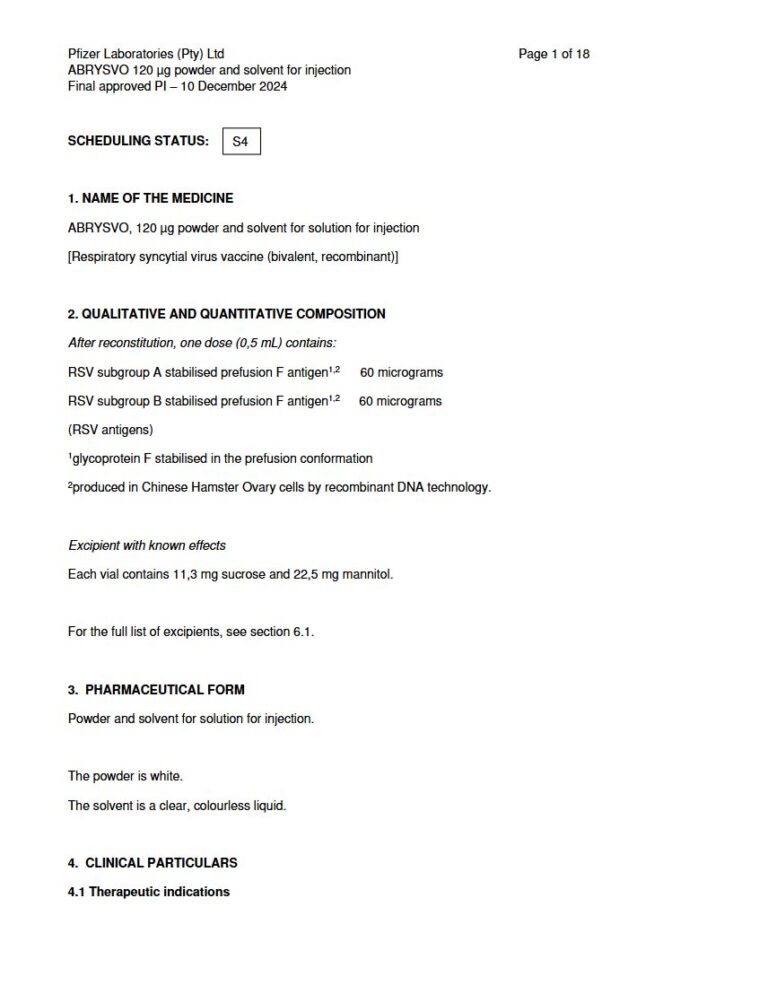
The Abrysvo 120 μg Injection professional information leaflet below is the property of Pfizer Laboratories and is provided on Medinsert exactly as issued, with no.. alterations or editorial changes. We make every effort to keep content current by updating documents as soon as new versions become available. Medinsert serves as a trusted access point for healthcare professionals, but does not replace official sources or clinical judgement. For more details, please read our full disclaimer. read more>>
 Healthcare Professionals Only
This content is for registered healthcare professionals
Sign in or create a free account to read the full package insert.
Free for HPCSA-registered professionals. Powered by Medinsert.
Clinical Particulars
Section 4 of the official insert — extracted exactly as issued, no alterations
4.1 Therapeutic indications
ABRYSVO is indicated for
- Passive protection against lower respiratory tract disease caused by respiratory syncytial virus (RSV) in infants from birth through 6 months of age following maternal immunisation during pregnancy. See sections 4.2 and 5.1.
- Active immunisation of individuals 60 years of age and older for the prevention of lower respiratory tract disease caused by RSV. The use of ABRYSVO should be in accordance with official recommendations.
4.2 Posology and method of administration
Posology
Pregnant individuals
A single dose of 0,5 mL should be administered between weeks 28 and 36 of gestation (see sections 4.4 and 5.1).
Individuals 60 years of age and older
A single dose of 0,5 mL should be administered.
Paediatric population
The safety and efficacy of ABRYSVO in children (from birth to less than 18 years of age) have not yet been established. Limited data are available in pregnant adolescents and their infants (see section 5.1).
Method of administration
ABRYSVO is for intramuscular injection into the deltoid region of the upper arm. ABRYSVO should not be mixed with any other vaccines or medicines. For instructions on reconstitution and handling of the medicine before administration, see section 6.6.
4.3 Contraindications
Hypersensitivity to RSV antigens or to any of the excipients of ABRYSVO listed in section 6.1.
4.4 Special warnings and precautions for use
Traceability
In order to improve the traceability of biological medicines, the name and the batch number of the administered medicine should be clearly recorded.
Hypersensitivity and anaphylaxis
Appropriate medical treatment and supervision should always be readily available in case of an anaphylactic event following the administration of the ABRYSVO.
Anxiety-related reactions
Anxiety-related reactions, including vasovagal reactions (syncope), hyperventilation or stress-related reactions may occur in association with vaccination as a psychogenic response to the needle injection. It is important that procedures are in place to avoid injury from fainting.
Concurrent illness
Vaccination should be postponed in individuals suffering from an acute febrile illness. However, the presence of a minor infection, such as a cold, should not result in the deferral of vaccination.
Thrombocytopenia and coagulation disorders
ABRYSVO should be given with caution to individuals with thrombocytopenia or any coagulation disorder since bleeding or bruising may occur following an intramuscular administration to these individuals.
Immunocompromised individuals
The efficacy and safety of the vaccine have not been assessed in immunocompromised individuals, including those receiving immunosuppressant therapy. The efficacy of ABRYSVO may be lower in immunosuppressed individuals.
Individuals less than 24 weeks of gestation
ABRYSVO has not been studied in pregnant individuals less than 24 weeks of gestation. Since protection of the infant against RSV depends on transfer of maternal antibodies across the placenta, ABRYSVO should be administered between weeks 28 and 36 of gestation (see sections 4.2 and 5.1).
Limitations of vaccine effectiveness
As with any vaccine, a protective immune response may not be elicited after vaccination.
Excipients
Sodium content
ABRYSVO contains less than 1 mmol sodium (23 mg) per dose, that is to say essentially u2018sodium free.u2019
4.5 Interaction with other medicines and other forms of interaction
ABRYSVO can be administered concomitantly with seasonal influenza vaccine (QIV, surface antigen, inactivated, adjuvanted). In a randomised study in adults 65 years of age and older, the criteria for non-inferiority of the immune responses in the co-administration versus the separate administration group were met. However, numerically lower RSV A and B neutralising titres and numerically lower influenza A and B haemagglutination inhibition titres were observed when ABRYSVO and inactivated adjuvanted seasonal influenza vaccine were co-administered than when they were administered separately. The clinical relevance of this finding is unknown.
A minimum interval of two weeks is recommended between administration of ABRYSVO and administration of a tetanus, diphtheria and acellular pertussis vaccine (Tdap). There were no safety concerns when ABRYSVO co-administered with Tdap in healthy non-pregnant women. Immune responses to RSV A, RSV B, diphtheria and tetanus on co-administration were non-inferior to those after separate administration. However, the immune responses to the pertussis components were lower on co-administration compared to separate administration and did not meet the criteria for non-inferiority. The clinical relevance of this finding is unknown.
4.6 Fertility, pregnancy and lactation
Pregnancy
Data on pregnant women (more than 4 000 exposed outcomes) indicate no malformative nor feto/neonatal toxicity. Results from animal studies with ABRYSVO do not indicate direct or indirect harmful effects with respect to reproductive toxicity (see section 5.3). In a phase 3 study (Study 1), maternal adverse events reported within 1 month after vaccination were similar in the ABRYSVO group (14 %) and the placebo group (13 %). No safety signals were detected in infants up to 24 months of age. The incidences of adverse events reported within 1 month after birth in infants were similar in the ABRYSVO group (37 %) and the placebo group (35 %). Major birth outcomes assessed in the ABRYSVO group compared to placebo included premature birth (201 (6 %) and 169 (5 %), respectively), low birth weight (181 (5 %) and 155 (4 %), respectively) and congenital anomalies (174 (5 %) and 203 (6 %), respectively).
Breastfeeding
It is unknown whether ABRYSVO are excreted in human milk. No adverse effects of ABRYSVO have been shown in breastfed newborns of vaccinated mothers.
Fertility
No human data on the effect of ABRYSVO on fertility are available. Animal studies do not indicate direct or indirect harmful effects with respect to female fertility (see section 5.3).
4.7 Effects on ability to drive and use machines
ABRYSVO has no or negligible influence on the ability to drive and use machines.
4.8 Undesirable effects
Summary of the safety profile
Pregnant individuals
In pregnant women at 24 - 36 weeks of gestation the most frequently reported adverse reactions were vaccination site pain (41 %), headache (31 %) and myalgia (27 %). The majority of local and systemic reactions in maternal participants were mild to moderate in severity and resolved within 2 - 3 days of onset.
Individuals 60 years of age and older
In individuals 60 years of age and older the most frequently reported adverse reaction was vaccination site pain (11 %). The majority of reactions were mild to moderate in severity and resolved within 1 - 2 days of onset.
Tabulated list of adverse reactions
The safety of administering a single dose of ABRYSVO to pregnant women at 24 - 36 weeks of gestation (n=3 682) and to individuals 60 years of age and older (n=18 575) was evaluated in phase 3 clinical trials. Adverse reactions are listed below by MedDRA body system organ class and the following frequency convention: Very common (u2265 1 / 10); common (u2265 1 / 100 to < 1 / 10); uncommon (u2265 1 / 1 000 to < 1 / 100; rare (u2265 1 / 10 000 to < 1 / 1 000); very rare (< 1 / 10 000); not known (cannot be estimated from the available data).
Within each frequency grouping, adverse reactions are presented in the order of decreasing seriousness.
Table 1. Adverse reactions following administration of ABRYSVO in pregnant individuals < 49 years
MedDRA system organ class Frequency Adverse reaction
Nervous system disorders Very common Headache
Musculoskeletal and connective tissue disorders Very common Myalgia
General disorders and administration site conditions Very common Vaccination site pain
Common Vaccination site redness
Table 2. Adverse reactions following administration of ABRYSVO in individuals > 60 years
MedDRA system organ class Frequency Adverse reaction
Immune system disorders Very rare Hypersensitivity
Nervous system disorders Rare a Guillain-Barru00e9 syndrome
General disorders and administration site conditions Very common Vaccination site pain
Common Vaccination site redness
Common Vaccination site redness
a In a study in individuals 60 years of age and older, one case of Guillain-Barru00e9 syndrome and one case of Miller Fisher syndrome were reported with onset of 7 and 8 days, respectively, after receiving ABRYSVO and assessed by the investigator as possibly related to the administered vaccine. Both cases had either confounding factors or an alternative aetiology. One additional case, with onset 8 months after receiving ABRYSVO, was assessed as not related to the administered vaccine by the investigator. One case of Guillain-Barru00e9 syndrome was reported in the placebo group 14 months after administration.
Reporting suspected adverse reactions after authorisation of the medicine is important. It allows continued monitoring of the benefit / risk balance of the medicine. Health care providers are requested to report any suspected adverse drug reactions to SAHPRA via the Med Safety APP (Medsafety X SAHPRA) and eReporting platform (who- umc.org) found on SAHPRA website.
Report any suspected adverse drug reactions associated with the use of the medicine directly to Pfizer via [email protected].
4.9 Overdose
Overdose with ABRYSVO, is unlikely due to its single dose presentation. There is no specific treatment for an overdose with ABRYSVO. In the event of an overdose, the individual should be monitored and provided with symptomatic treatment as appropriate.
