
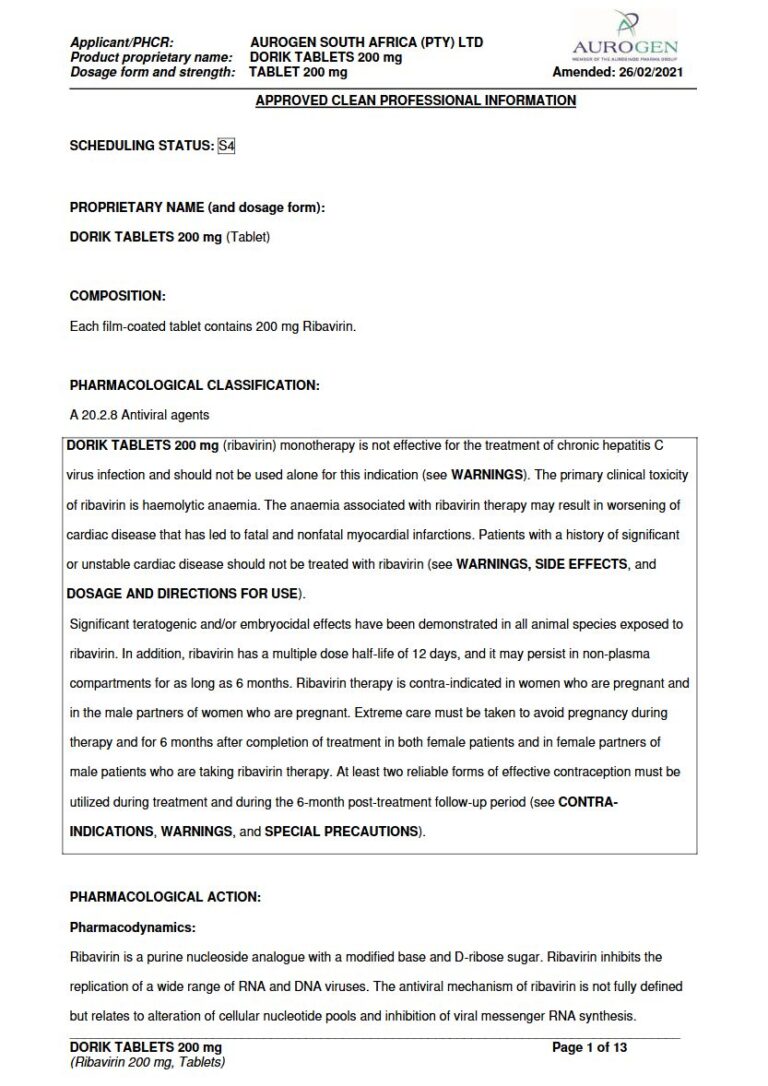
Dorik Tablets 200 mg TABLET
PDF Leaflet Revision Date: 26 February 2021
Clinical Summary
Quick overview from the medicine insert
Indication
Treatment of chronic hepatitis C in adults, in combination with peginterferons.
Dosage (summary)
1000 mg daily for <75 kg or 1200 mg for >75 kg, divided doses with food.
Special Populations
- Renal impairment
- Hepatic impairment
- Elderly patients (> 65 years)
Pregnancy & Breastfeeding
Contraindicated in pregnancy; requires effective contraception during and 6 months post-treatment.
Key Drug Interactions
- Antacids may decrease bioavailability
- Monitor HIV RNA levels with zidovudine or stavudine
Contraindications
- Pregnancy
- Severe renal impairment (C cr < 50 ml/min)
- Severe hepatic impairment
- Hypersensitivity
- Haemoglobinopathies
Common side effects
- Anaemia
- Depression
- Fatigue
- Nausea
- Palpitations
Counselling Points
- Use two forms of contraception
- Monitor for signs of anaemia
- Avoid pregnancy during and after treatment
Serious warnings
- Monotherapy not effective for hepatitis C
- Risk of severe anaemia
- Teratogenic effects
Important Disclaimer
The Dorik Tablets 200 mg TABLET professional information leaflet below is the property of Aurogen South Africa and is provided on Medinsert exactly as issued, with no.. alterations or editorial changes. We make every effort to keep content current by updating documents as soon as new versions become available. Medinsert serves as a trusted access point for healthcare professionals, but does not replace official sources or clinical judgement. For more details, please read our full disclaimer. read more>>
 Healthcare Professionals Only
This content is for registered healthcare professionals
Sign in or create a free account to read the full package insert.
Free for HPCSA-registered professionals. Powered by Medinsert.
Clinical Particulars
Section 4 of the official insert — extracted exactly as issued, no alterations
4.1 Therapeutic indications
DORIK TABLETS 200 mg, in combination with peginterferons, is indicated for the treatment of chronic hepatitis C. DORIK TABLETS 200 mg must not be used alone. DORIK TABLETS 200 mg is only indicated for the treatment of adult patients over the age of 18 years with chronic hepatitis C, who have elevated transaminases who are positive for serum HCV RNA and who have compensated liver disease.
4.2 Posology and method of administration
The daily dose of DORIK TABLETS 200 mg is to be administered orally in two divided doses, morning and evening, with food (see Table 1).
Table 1: DORIK TABLETS 200 mg Dosing Recommendations in combination with peginterferons
- Genotype 1, 4*
- < 75 kg = 1000 mg
- > 75 kg = 1200 mg
- Genotype 2, 3
- 800 mg (regardless of weight)
* sustained virologic response is highest in patients treated for 48 weeks with 1000 mg or 1200 mg of DORIK TABLETS 200 mg.
4.3 Contraindications
Please refer to the package insert of peginterferons alfa for contra-indications related to these products. In addition, DORIK TABLETS 200 mg is also contra-indicated in:
- Patients with hypersensitivity to the active substance or to any of the excipients
- Women who are pregnant or who intend to become pregnant
- Men whose female partners are pregnant
- Patients with haemoglobinopathies (e.g. thalassemia major or sickle-cell anaemia)
- Patients with autoimmune hepatitis
- Patients with moderate to severe hepatic impairment (Child-Pugh class B and C)
- Patients with moderate to severe renal impairment (C cr < 50 ml/min)
4.4 Special warnings and precautions for use
Monotherapy: DORIK TABLETS 200 mg must not be used alone as DORIK TABLETS 200 mg monotherapy is not effective for the treatment of chronic hepatitis C.
General: DORIK TABLETS 200 mg used in combination therapy should be administered under the guidance of a qualified physician and may lead to moderate to severe adverse experiences requiring dose reduction, temporary dose cessation or discontinuation of further therapy.
Pregnancy: DORIK TABLETS 200 mg must not be used in women who are pregnant or intend to become pregnant (see CONTRA-INDICATIONS). DORIK TABLETS 200 mg may cause birth defects and/or death of the exposed foetus. Extreme care must be taken to avoid pregnancy in female patients and in female partners of male patients. DORIK TABLETS 200 mg therapy must not be started unless a report of a negative pregnancy test has been obtained prior to the planned initiation of therapy.
Anaemia: The primary toxicity of DORIK TABLETS 200 mg is haemolytic anaemia (haemoglobin <10 g/dl). Anaemia associated with DORIK TABLETS 200 mg occurs approximately within 1 to 2 weeks of initiation or therapy. Because the initial drop in haemoglobin may be significant, it is advisable that haemoglobin or haematocrit be obtained pre-treatment and at week 2 and 4 of therapy or more frequently if clinically indicated. Patients should then be followed as clinically appropriate.
Although DORIK TABLETS 200 mg has no direct cardiovascular effects, anaemia associated with DORIK TABLETS 200 mg may result in deterioration of cardiac function, or exacerbation of the symptoms of coronary disease, or both. Thus, DORIK TABLETS 200 mg must be administered with caution to patients with pre-existing cardiac disease. Cardiac status must be assessed before start of therapy and monitored clinically during therapy; if any deterioration occurs, therapy should be stopped.
Hepatic decompensation: In patients who develop evidence of hepatic decompensation during treatment, DORIK TABLETS 200 mg should be discontinued. When the increase in ALT levels is progressive and clinically significant, despite dose reduction, or is accompanied by increased bilirubin, therapy should be discontinued.
Renal function: It is recommended that the renal function be evaluated in all patients prior to initiation of DORIK TABLETS 200 mg therapy. Substantial increases in DORIK TABLETS 200 mg plasma concentrations are seen at the recommended dosing regimen in patients with serum creatinine > 2 mg/dl or with creatinine clearance < 50 ml/minute. In these patients, DORIK TABLETS 200 mg is contra-indicated.
4.5 Interactions with other medicines
Interaction studies have been conducted with ribavirin, such as in DORIK TABLETS 200 mg in combination with peginterferons alfa and antacids. DORIK TABLETS 200 mg concentrations are similar when given alone or concomitantly with peginterferons alfa. Any potential for interactions may persist for up to 2 months (5 half-lives for DORIK TABLETS 200 mg) after cessation of DORIK TABLETS 200 mg therapy due to the long half-life.
Cytochrome P450 enzymes: Results of in-vitro studies with ribavirin such as in DORIK TABLETS 200 mg, using both human and rat liver microsome preparations indicated no cytochrome P450 enzyme-mediated metabolism of DORIK TABLETS 200 mg. DORIK TABLETS 200 mg does not inhibit cytochrome P450 enzymes. There is no evidence from toxicity studies that DORIK TABLETS 200 mg induces liver enzymes. Therefore, there is a minimal potential for P450 enzyme-based interactions.
Antacid: The bioavailability of DORIK 600 mg is decreased by co-administration with an antacid containing magnesium, aluminium and methicone; AUC tf decreases 14%. It is possible that the decreased bioavailability in this study was due to delayed transit of ribavirin or modified pH. This interaction is not considered to be clinically relevant.
Nucleoside analogues: Ribavirin was shown in-vitro to inhibit phosphorylation of zidovudine and stavudine. The clinical significance of these findings is unknown. However, these in-vitro findings raise the possibility that concurrent use of ribavirin with either zidovudine or stavudine might lead to increased HIV plasma viremia. Therefore, it is recommended that plasma HIV RNA levels be closely monitored in patients treated with DORIK TABLETS 200 mg concurrently with either of these two agents. If HIV RNA levels increase, the use of DORIK TABLETS 200 mg concomitantly with reverse transcriptase inhibitors must be reviewed.
4.6 Fertility, pregnancy and lactation
Pregnancy: DORIK TABLETS 200 mg must not be used by women who are pregnant or by men whose female partners are pregnant (see CONTRA-INDICATIONS and WARNINGS). Evaluation of experimental animal studies showed reproductive toxicity. Significant teratogenic and/or embryocidal potential have been demonstrated for DORIK TABLETS 200 mg in all animal species in which adequate studies have been conducted. Extreme care must be taken to avoid pregnancy in female patients. DORIK TABLETS 200 mg therapy must not be initiated until a report of a negative pregnancy test has been obtained immediately prior to initiation or therapy. Any birth control method can fail. Therefore, it is critically important that women of childbearing potential and their partners must use 2 forms of effective contraception simultaneously, during treatment and for 6 months after treatment has been concluded; routine monthly pregnancy tests must be performed during this time. If pregnancy does occur during treatment or within 6 months from stopping treatment the patient must be advised of the significant teratogenic risk of DORIK TABLETS 200 mg to the foetus.
Male patients and their female partners: Extreme care must be taken to avoid pregnancy in partners of male patients taking DORIK TABLETS 200 mg. DORIK TABLETS 200 mg accumulates intra-cellularly and is cleared from the body very slowly. In animal studies, ribavirin produced changes in sperm at doses below the clinical dose. It is unknown whether the DORIK TABLETS 200 mg that is contained in sperm will exert its known teratogenic effects upon fertilisation of the ova. Therefore, men must be instructed to use a condom to minimize delivery of DORIK TABLETS 200 mg to their partners. Male patients and their female partners of childbearing age must be counselled to use 2 forms of effective contraception during treatment with DORIK TABLETS 200 mg and for 6 months after treatment has been concluded.
Lactation: It is not known whether DORIK TABLETS 200 mg is excreted in human milk. Because of the potential for adverse reactions in nursing infants, a decision should be made either to discontinue nursing or not to initiate therapy.
4.7 Effects on ability to drive and use machines
DORIK TABLETS 200 mg alone has no or negligible influence on the ability to drive or operate machinery. Patients who develop fatigue, somnolence, or confusion during treatment must be cautioned to avoid driving or operating machinery.
4.8 Undesirable effects
Side effects: Blood and the lymphatic system disorders: Frequent: Anaemia, lymphadenopathy. Endocrine disorders: Frequent: Hyperthyroidism, hypothyroidism. Metabolism and nutritional disorders: Frequent: Anorexia, weight decrease. Psychiatric disorders: Frequent: Depression, irritability, concentration impairment, taste disturbance, mood alteration, insomnia, dizziness, memory impairment, paraesthesia, hypaesthesia, tremor, emotional disorders, nervousness, aggression, libido decrease, impotence, anxiety. Less frequent: Attempted suicide, substance overdose, vertigo, coma.
Eye disorders: Frequent: Blurred vision, xerophthalmia, eye inflammation, eye pain. Less frequent: Corneal ulcer. Cardiac disorders: Frequent: Palpitations. Less frequent: Endocarditis, arrhythmia, atrial fibrillation, pericarditis, angina pectoris. Vascular disorders: Less frequent: Cerebral haemorrhage. Respiratory, thoracic and mediastinal disorders: Frequent: Dyspnoea, sinus congestion, cough, chest tightness, upper respiratory tract infection, sore throat, rhinitis, nasopharyngitis, pulmonary congestion, dyspnoea exertional, epistaxis. Less frequent: Lower respiratory tract infection, interstitial pneumonitis, pulmonary embolism. Gastrointestinal disorders: Frequent: Abdominal pain, dyspepsia, vomiting, nausea, diarrhoea, gastritis, flatulence, dry mouth, mouth ulceration, gingival bleeding, gingivitis, cheilitis, constipation. Less frequent: Peptic ulcer, gastrointestinal bleeding. Hepato-biliary disorders: Less frequent: Hepatic dysfunction, fatty liver, cholangitis, malignant hepatic neoplasm, reversible pancreatic reaction, auto immune phenomena (e.g. idiopathic thrombocytopenic purpura). Skin and subcutaneous tissue disorders: Frequent: Pruritus, alopecia, dermatitis, dry skin, skin disorder, rash, eczema, psoriasis, urticaria, photosensitivity reaction, increased sweating, night sweats. Less frequent: Skin infection. Musculoskeletal, connective tissue and bone disorders: Frequent: Myalgia, muscle cramps, musculoskeletal pain, bone pain, back pain, neck pain, muscle weakness. Less frequent: Myositis. General disorders and administration site conditions: Frequent: Asthenia, rigors, chest pain, fatigue, headache, pyrexia, pain, injection site reaction, influenza-like illness, malaise, lethargy, shivering, hot flushes, weakness, weight decrease. Less frequent: Otitis externa, peripheral neuropathy.
4.9 Overdose
No cases of overdose have been reported with DORIK TABLETS 200 mg. Treatment should be supportive and symptomatic.
