
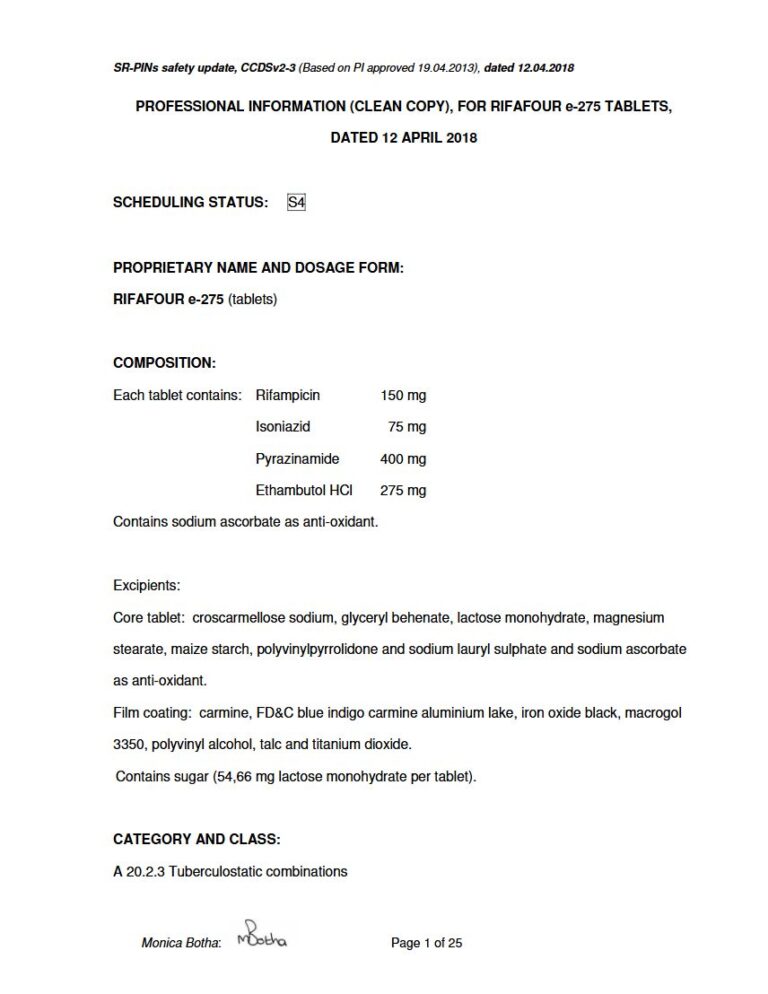
Rifafour E-275 150mg. 75mg. 400mg. 275mg Tablet
PDF Leaflet Revision Date: 12 April 2018
Clinical Summary
Quick overview from the medicine insert
Indication
Treatment of pulmonary and extrapulmonary tuberculosis.
Dosage (summary)
Adults: 2-5 tablets daily based on weight.
Special Populations
- Renal impairment
- Hepatic impairment
Pregnancy & Breastfeeding
Safety not established; excreted in breast milk.
Key Drug Interactions
- Saquinavir/ritonavir
- Ketoconazole
- Oral contraceptives
Contraindications
- Hypersensitivity to components
- Jaundice
- Active hepatic disease
- Optic neuritis
- Porphyria
- Children under 13
Common side effects
- Nausea
- Vomiting
- Hepatitis
- Visual disturbances
- Thrombocytopenia
Counselling Points
- Take with water 1 hour before or 2 hours after meals
- Avoid alcohol
- Report any signs of liver damage or visual changes
Serious warnings
- Hepatotoxicity risk
- Severe skin reactions
- Monitor liver function
Important Disclaimer
The Rifafour E-275 150mg. 75mg. 400mg. 275mg Tablet professional information leaflet below is the property of Sanofi-Aventis and is provided on Medinsert exactly as issued, with no.. alterations or editorial changes. We make every effort to keep content current by updating documents as soon as new versions become available. Medinsert serves as a trusted access point for healthcare professionals, but does not replace official sources or clinical judgement. For more details, please read our full disclaimer. read more>>
 Healthcare Professionals Only
This content is for registered healthcare professionals
Sign in or create a free account to read the full package insert.
Free for HPCSA-registered professionals. Powered by Medinsert.
Clinical Particulars
Section 4 of the official insert — extracted exactly as issued, no alterations
4.1 Therapeutic indications
Initial phase treatment of pulmonary and extrapulmonary tuberculosis in new adult patients and re-treatment of adult cases.
4.2 Posology and method of administration
Take RIFAFOUR e-275 tablets with a full glass of water 1 hour before, or 2 hours after a meal. However, if gastrointestinal irritation occurs, the tablets may be taken with food. If aluminium-containing antacids are taken, administer one hour after the tablet dose. The recommended treatment dosages, based on the patientu2019s body weight, given daily for the 2 month initial-phase treatment in adults and children over 13 years of age are as follows:
- 30 u2013 37 kg: 2 tablets
- 38 u2013 54 kg: 3 tablets
- 55 u2013 70 kg: 4 tablets
- 71 kg and over: 5 tablets
4.3 Contraindications
RIFAFOUR e-275 tablets are contraindicated in:
- patients with hypersensitivity to rifamycins, isoniazid, pyrazinamide, ethambutol or other chemically related medication or any of the components of the tablets
- the presence of jaundice or active hepatic disease
- patients with optic neuritis
- patients with porphyria
- children under 13 years of age.
RIFAFOUR e-275 is contraindicated when given concurrently with the combination of saquinavir/ritonavir (see INTERACTIONS).
4.4 Special warnings and precautions for use
RIFAFOUR e-275 tablets is a combination of four medicines, each of which has been associated with liver dysfunction.
Applies to rifampicin: Liver: Patients with impaired liver function should only be given rifampicin in cases of necessity and then with caution and under strict medical supervision. In these patients, careful monitoring of liver function, especially serum alanine aminotransferase (ALT) and serum aspartate aminotransferase (AST) should be carried out prior to therapy and then every 2 to 4 weeks during therapy. If signs of hepatocellular damage occur, rifampicin should be withdrawn.
In some cases, hyperbilirubinaemia resulting from competition between rifampicin and bilirubin for excretory pathways of the liver at cell level can occur in the early days of treatment. An isolated report showing a moderate rise in bilirubin and/or transaminase level is not in itself an indication for interrupting treatment; rather, the decision should be made after repeating the tests, noting the trends in the levels and considering them in conjunction with the patientu2019s clinical condition.
Immunological reactions/anaphylaxis: Because of the possibility of immunological reactions, including anaphylaxis (see SIDE EFFECTS), occurring with intermittent therapy (less than 2 to 3 times per week), patients should be closely monitored. Patients should be cautioned against interruption of dosage regimens since these reactions may occur.
Applies to isoniazid: Liver: Use of isoniazid should be carefully monitored in patients with current chronic liver disease or severe renal dysfunction. Severe and sometimes fatal hepatitis associated with isoniazid therapy may occur and may develop even after months of treatment. The risk of developing hepatitis is age related. Therefore, patients should be monitored for the prodromal symptoms of hepatitis, such as fatigue, weakness, malaise, anorexia, nausea or vomiting. If these symptoms appear or if signs suggestive of hepatic damage are detected isoniazid should be discontinued promptly since continued use of the medicine in these cases has been reported to cause a more severe form of liver damage.
Stevens-Johnson syndrome (SJS) and toxic epidermal necrolysis (TEN): Cases of severe cutaneous reactions including Stevens-Johnson syndrome (SJS) and toxic epidermal necrolysis (TEN), some with a fatal outcome, have been reported with the use of isoniazid (see SIDE EFFECTS). Patients should be advised of the signs and symptoms and monitored closely for skin reactions. If signs or symptoms of SJS or TEN (e.g. progressive skin rash often with blisters or mucosal lesions) develop, the patient should be advised to consult their doctor immediately. RIFAFOUR e-275 should be permanently discontinued if an alternative aetiology for the signs and symptoms cannot be established.
Applies to pyrazinamide: Gout: RIFAFOUR e-275 should be used with caution in patients with a history of gout. If hyperuricaemia accompanied by an acute gouty arthritis occurs, the patient should be transferred to a regimen not containing pyrazinamide.
Applies to rifampicin, isoniazid, pyrazinamide and ethambutol: Medicine reaction with eosinophilia and systemic symptoms (u201cDRESSu201d): Severe, systemic hypersensitivity reactions, including fatal cases, such as medicine reaction with eosinophilia and systemic symptoms (DRESS) syndrome have been observed during treatment with anti-tuberculosis therapy (see SIDE EFFECTS). It is important to note that early manifestations of hypersensitivity, such as fever, lymphadenopathy or biological abnormalities (including eosinophilia, liver abnormalities) may be present even though rash is not evident. If such signs or symptoms are present, the patient should be advised to consult their doctor immediately. RIFAFOUR e-275 should be discontinued if an alternative aetiology for the signs and symptoms cannot be established.
Special precautions: Applies to RIFAFOUR e-275 tablets: Monitoring: Adults treated for tuberculosis with RIFAFOUR e-275 should have baseline measurements of hepatic enzymes, bilirubin, serum creatinine, a complete blood count, and a platelet count (or estimate). Patients should be seen at least monthly during therapy and should be questioned specifically about symptoms associated with adverse reactions. All patients with abnormalities should have follow-up, including laboratory testing, if necessary. However, because there is a higher frequency of isoniazid-associated hepatitis with patients older than 35 years of age, liver function tests should be performed periodically in older persons. Other factors associated with an increased risk of hepatitis include daily use of alcohol, those who are slow acetylators and with chronic liver disease. Periodic eye examinations during treatment are suggested. Patients with visual defects: should visual disturbances occur during treatment, these must be reported immediately and RIFAFOUR e-275 discontinued pending visual evaluation. In the following cases, treatment with RIFAFOUR e-275 tablets should be stopped immediately and the patient evaluated: jaundice, rash and fever, elevated liver enzymes associated with the clinical signs of hepatitis, visual impairment. If liver damage is confirmed, the medicine should not be recommenced. Treatment should be discontinued permanently should thrombocytopenia, purpura, shock or renal failure occur.
Applies to rifampicin: Porphyria exacerbation: Reports have associated porphyria exacerbation with rifampicin administration as a result of induction of delta amino levulinic acid synthetase (see CONTRAINDICATIONS).
4.5 Interactions with other medicines
Applies to rifampicin and isoniazid: When RIFAFOUR e-275 is given concomitantly with the combination saquinavir/ritonavir, the potential for hepatotoxicity is increased. Therefore, concomitant use of RIFAFOUR e-275 with saquinavir/ritonavir is contraindicated (see CONTRAINDICATIONS).
Cytochrome P 450 enzyme interaction: Rifampicin is known to induce and isoniazid is known to inhibit certain cytochrome P 450 enzymes. Caution should be used when prescribing RIFAFOUR e-275 tablets with medicines metabolised by cytochrome P 450. To maintain optimum therapeutic blood levels, dosages of medicines metabolised by these enzymes may require adjustment when starting or stopping concomitantly administered RIFAFOUR e-275 tablets.
Applies to rifampicin: Enzyme induction: Rifampicin accelerates the metabolism of certain medicines by inducing microsomal enzymes, leading to decreases in plasma concentration of such medicines. Examples of medicines metabolised by cytochrome P 450 enzymes are: anticonvulsants (e.g. phenytoin), antidysrhythmics (e.g. disopyramide, flecainide, quinidine, propafenone, verapamil), antioestrogens (e.g. tamoxifen, toremifen), antipsychotics (e.g. haloperidol), oral anticoagulants (e.g. warfarin), antifungals (e.g. fluconazole, itraconazole, ketoconazole), antiretroviral medicines (e.g. atazanavir, lopinavir, nevirapine, zidovudine, saquinavir, indinavir, efavirenz), barbiturates (e.g. hexobarbitone), beta-blockers, benzodiazepines (e.g. diazepam), benzodiazepine-related medicines (e.g. zopiclone, zolpidem), calcium channel blockers (e.g. diltiazem, nifedipine, verapamil), chloramphenicol, cimetidine, clarithromycin, corticosteroids, cardiac glycosides (e.g. digoxin), clofibrate, systemic hormonal contraceptives, dapsone, doxycycline, oestrogens, fluoroquinolones (e.g. ciprofloxacin, levofloxacin), gestrinone, oral hypoglycaemic agents (sulfonylureas), immunosuppressive agents (e.g. azathioprine, ciclosporin, sirolimus, tacrolimus), irinotecan, levothyroxine, losartan, narcotic analgesics, methadone, phenytoin, praziquantel, progestins, quinine, riluzole, selective 5-HT3 receptor antagonists (e.g. ondansetron), statins metabolised by CYP3A4 (e.g. atorvastatin, simvastatin), sulfasalazine, telithromycin, theophylline, thiazolidinediones (e.g. pioglitazone), tricyclic antidepressants (e.g. amitriptyline, nortriptyline). It may be necessary to adjust the dosages of these medicines if they are given concurrently with rifampicin. The effectiveness of oestrogen-containing oral preparations is reduced. Patients using systemic hormonal contraceptives should be advised to change to non-hormonal methods of birth control during rifampicin therapy (see WARNINGS AND SPECIAL PRECAUTIONS).
Other interactions: When the two medicines were taken concomitantly, decreased concentrations of atovaquone and increased concentrations of rifampicin were observed. Rifampicin reduces serum atovaquone levels by about 50%, whereas atovaquone modestly raises serum rifampicin levels. Concurrent use of itraconazole, ketoconazole, voriconazole and rifampicin has resulted in decreased serum concentrations of both medicines. Concurrent use of rifampicin and enalapril has resulted in decreased concentrations of enalaprilat, the active metabolite of enalapril. Dosage adjustments should be made if indicated by the patient's clinical condition. Concomitant antacid administration may reduce the absorption of rifampicin. Daily doses of rifampicin should be given at least 1 hour before the ingestion of antacids. When rifampicin is given concomitantly with either halothane or isoniazid, the potential for hepatotoxicity is increased. The concomitant use of rifampicin and halothane should be avoided. Patients receiving both rifampicin and isoniazid should be monitored closely for hepatotoxicity. Concurrent use of alcohol, paracetamol and other hepatotoxic medication may increase the incidence of rifampicin-induced hepatotoxicity. Interference with laboratory and diagnostic tests: Therapeutic levels of rifampicin have been shown to inhibit standard microbiological assays for serum folate and vitamin B12. Thus, alternative assay methods should be considered. Transient elevation of serum bilirubin has also been observed. RIFAFOUR e-275 tablets may impair biliary excretion of contrast media used for visualisation of the gallbladder, due to competition for biliary excretion. Therefore, these tests should be performed before the morning dose of rifampicin.
4.6 Fertility, pregnancy and lactation
Safety in pregnancy has not been established. All agents of RIFAFOUR e-275 tablets are excreted in breast milk. Safety during lactation has not been established. Rifampicin has been reported to cross the placental barrier. When administered during the last weeks of pregnancy, rifampicin can cause post-natal haemorrhages in the mother and infant, for which treatment with vitamin K may be indicated.
4.7 Effects on ability to drive and use machines
RIFAFOUR e-275 may cause undesirable effects, e.g. vertigo, dizziness, psychotic reactions and visual disturbances, which may reduce the capacity for the completion of certain tasks (see SIDE EFFECTS). Patients should be informed of the potential for these undesirable effects that may occur and if they experience these symptoms, consideration should be given not to drive or operate machinery.
4.8 Undesirable effects
Side effects associated with rifampicin: Infections and infestations Frequency unknown: pseudomembranous colitis; a 12 hour u201cfluu201d syndrome, usually occurring after 3 to 6 months of intermittent treatment and usually with doses of 20 mg/kg or more, may present as fever, chills, bone pain and malaise, shortness of breath and wheezing. Blood and the lymphatic system disorders Frequent: thrombocytopenia with or without purpura is usually associated with intermittent regimens but is reversible if the medicine is discontinued as soon as purpura occurs. Less frequent: leucopenia Frequency unknown: disseminated intravascular coagulation, eosinophilia, agranulocytosis, haemolytic anaemia, haemolysis Immune system disorders Frequency unknown: anaphylactic reaction, lupus-like syndrome Endocrine disorders Frequency unknown: adrenal insufficiency in patients with compromised adrenal function Metabolism and nutritional disorders Frequency unknown: decreased appetite Psychiatric disorders Frequency unknown: psychotic disorder Nervous system disorders Frequency unknown: headache, dizziness, drowsiness, ataxia, numbness, confusion, generalised numbness; cerebral haemorrhage and fatalities have been reported when rifampicin administration has been continued or resumed after the appearance of purpura. Eye disorders Less frequent: eye irritation visual disturbances Frequency unknown: tear discolouration, blurred vision, soft contact lenses may be permanently stained (see WARNINGS AND SPECIAL PRECAUTIONS) Vascular disorders Frequency unknown: shock, flushing, vasculitis Respiratory, thoracic and mediastinal disorders Frequency unknown: dyspnoea, wheezing, discoloured sputum Gastrointestinal disorders Frequent: nausea, vomiting Less frequent: diarrhoea Frequency unknown: gastrointestinal disorder, abdominal discomfort, epigastric distress (which may be alleviated by administration with food), tooth discolouration (which may be permanent) Hepatobiliary disorders Frequency unknown: hepatitis and the prodromal symptoms of hepatitis may occur (nausea, vomiting, unusual tiredness/fatigue); hyperbilirubinaemia. Liver function should be monitored (see WARNINGS AND SPECIAL PRECAUTIONS) Skin and subcutaneous tissue disorders Frequency unknown: erythema multiforme including Stevens-Johnson syndrome and toxic epidermal necrolysis, medicine reaction with eosinophilia and systemic symptoms (DRESS) syndrome (see WARNINGS AND SPECIAL PRECAUTIONS); skin reaction, pruritus, pruritic rash, urticaria, erythema, allergic dermatitis, pemphigoid, sweat discolouration Musculoskeletal, connective tissue and bone disorders Frequency unknown: muscular weakness, myopathy, bone pain Renal and urinary disorders Frequency unknown: alterations in kidney function, acute kidney injury usually due to renal tubular necrosis or to tubulointerstitial nephritis, chromaturia Pregnancy, puerperium and perinatal conditions Frequency unknown: post-partum haemorrhage, fetal-maternal haemorrhage (see HUMAN REPRODUCTION) Reproductive system and breast disorders Frequency unknown: menstrual disorder Congenital, familial and genetic disorders Frequency unknown: porphyria exacerbation (see CONTRAINDICATIONS and WARNINGS AND SPECIAL PRECAUTIONS) General disorders and administration side conditions Frequent: pyrexia, chills Frequency unknown: oedema Investigations Frequent: increased blood bilirubin, increased aspartate aminotransferase (AST), increased alanine aminotransferase (ALT) (see WARNINGS AND SPECIAL PRECAUTIONS) Frequency unknown: decreased blood pressure, increased blood creatinine, increased hepatic enzyme (see WARNINGS AND SPECIAL PRECAUTIONS)
4.9 Overdose
There is limited overdose information involving rifampicin, isoniazid, pyrazinamide and ethambutol in combination. Symptoms: Rifampicin: Nausea, vomiting, abdominal pain, pruritus, headache and increasing lethargy will probably occur within a short time after acute ingestion; unconsciousness may occur when there is severe hepatic disease. Transient increases in liver enzymes and/or bilirubin may occur. Brownish-red or orange discolouration of the skin, urine, sweat, saliva, tears and faeces will occur and its intensity is proportional to the amount ingested. Facial or periorbital oedema has also been reported in paediatric patients. Hypotension, sinus tachycardia, ventricular dysrhythmias, seizures and cardiac arrest were reported in some fatal cases. Nonfatal acute overdoses in adults have been reported with doses ranging from 9 g to 12 g rifampicin. Fatal acute overdoses in adults have been reported with doses ranging from 14 g to 60 g. Nonfatal overdoses in paediatric patients ages 1 to 4 years old of 100 mg/kg for one or two doses have been reported.
Isoniazid: Isoniazid overdosage produces signs and symptoms within 30 minutes to 3 hours after ingestion. Nausea, vomiting, dizziness, slurring of speech, blurring of vision and visual hallucinations are among the early manifestations. With marked overdosage, respiratory distress and CNS depression, progressing rapidly from stupor to profound coma are to be expected, along with severe, intractable seizures. Severe metabolic acidosis, acetonuria and hyperglycaemia are typical laboratory findings.
Pyrazinamide: There is limited information related to pyrazinamide overdosage. Liver toxicity and hyperuricaemia may occur with overdosage.
Ethambutol: There is limited information related to ethambutol overdose. Loss of appetite, gastro-intestinal disturbances, fever, headache, dizziness, confusion and hallucinations may occur.
Management: In case of overdosage with RIFAFOUR e-275, gastric lavage should be performed as soon as possible. Following evacuation of the gastric contents, the installation of activated charcoal slurry into the stomach may help absorb any remaining medicine from the gastrointestinal tract. Anti-emetic medication may be required to control severe nausea and vomiting. Intensive support measures should be instituted, including airway patency and individual symptoms treated as they arise.
