
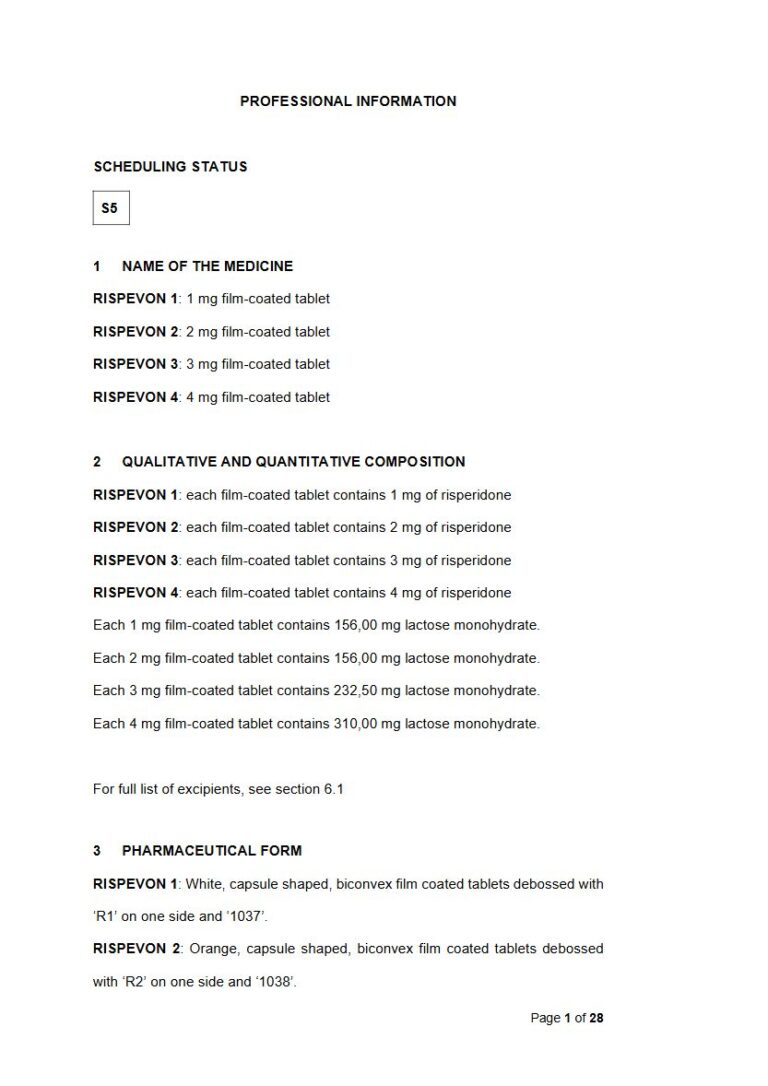
Rispevon 1 mg, 2 mg, 3 mg, 4 mg FC tablet
PDF Leaflet Revision Date: 8 February 2023
Clinical Summary
Quick overview from the medicine insert
Indication
Treatment of schizophrenia and related psychoses, behavioral disturbances in dementia, and disruptive behavior disorders in children.
Dosage (summary)
Adults: Start at 2 mg/day, increase to 4 mg/day on day 2; maintain 4-8 mg/day. Elderly: Start at 0.5 mg twice daily.
Special Populations
- Elderly
- Renal impairment
- Hepatic impairment
Pregnancy & Breastfeeding
Contraindicated in pregnancy and breastfeeding; may cause withdrawal symptoms in neonates.
Key Drug Interactions
- Caution with furosemide
- May antagonize levodopa
- Increased risk of QT prolongation with certain drugs
Contraindications
- Hypersensitivity to risperidone
- Pregnancy
- Lactation
- Parkinsonu2019s disease
- Children under 5 years
Common side effects
- Weight gain
- Hyperprolactinaemia
- Dizziness
- Sedation
- Extrapyramidal symptoms
Counselling Points
- Monitor for weight gain
- Avoid driving until effects are known
- Report any signs of hyperglycemia
Serious warnings
- Neuroleptic Malignant Syndrome
- Tardive dyskinesia
- Intraoperative Floppy Iris Syndrome
Important Disclaimer
The Rispevon 1 mg, 2 mg, 3 mg, 4 mg FC tablet professional information leaflet below is the property of Trinity Pharma and is provided on Medinsert exactly as issued, with no.. alterations or editorial changes. We make every effort to keep content current by updating documents as soon as new versions become available. Medinsert serves as a trusted access point for healthcare professionals, but does not replace official sources or clinical judgement. For more details, please read our full disclaimer. read more>>
 Healthcare Professionals Only
This content is for registered healthcare professionals
Sign in or create a free account to read the full package insert.
Free for HPCSA-registered professionals. Powered by Medinsert.
Clinical Particulars
Section 4 of the official insert — extracted exactly as issued, no alterations
4.1 Therapeutic indications
RISPEVON tablets are indicated for the treatment of:
- Acute and chronic schizophrenic psychoses and related psychosis in which positive symptoms and / or the negative symptoms are prominent. RISPEVON also alleviates affective symptoms associated with schizophrenia. In patients who have shown an initial treatment response, RISPEVON tablets are also effective in maintaining the clinical improvement.
- Behavioural disturbances in patients with dementia in whom symptoms such as aggressiveness, activity disturbances or psychotic symptoms are prominent.
- Conduct and other disruptive behaviour disorders in children (aged 5 - 12 years): with sub-average intellectual functioning or mental retardation in whom destructive behaviours are prominent.
4.2 Posology and method of administration
Posology
Schizophrenia: Switching from other antipsychotic medicines to RISPEVON: Gradual discontinuation of the previous treatment is recommended when medically appropriate, while RISPEVON therapy is initiated. Also, if medically appropriate, when switching patients from depot antipsychotics, initiate RISPEVON therapy in place of the next scheduled injection. The need for continuing existing anti-Parkinson medications should be re-evaluated periodically.
Adults: RISPEVON may be given once or twice daily. Patients should start RISPEVON tablets with a dose of 2 mg/day. The dosage may be increased on the second day to 4 mg/day. From then on, the dosage can be maintained unchanged, or further individualised, if needed. Most patients will benefit from daily doses of between 4 mg/day and 8 mg/day. Doses above 6 mg/day (when administered twice daily) were associated with more extrapyramidal symptoms and other adverse effects and are therefore not generally recommended. In some patients, particularly with first episode acute psychosis, a slower titration phase and a lower starting and maintenance dose may be appropriate. Doses above 10 mg/day have not been shown to be superior in efficacy to lower doses and may cause an increased incidence of side effects such as extrapyramidal symptoms. Dosages above 10 mg/day should only be considered if the benefits outweigh the risks. The maximum total daily dose is 16 mg/day. If additional sedation is required, a benzodiazepine may be added to RISPEVON tablets treatment.
Special populations
Renal- and liver diseased patients: Caution should be exercised with these groups of patients, as there is a lack of clinical experience in these patient populations. It is therefore recommended to halve both the starting dose and the subsequent dose increments.
Elderly patients: The recommended starting dose is 0,5 mg twice daily. This dosage can be individually adjusted with 0,5 mg twice daily with increments to 1 - 2 mg twice daily.
Paediatric population: The use of RISPEVON is not recommended for children under 15 years of age as efficacy and safety in children under the age of 15 years have not been demonstrated in schizophrenia. Behavioural disturbances in patients with dementia: A recommended starting dose is 0,25 mg twice daily. This dosage can be adjusted by increments of 0,25 mg twice daily as needed per individual but not more frequently than every other day, if needed. For most patients the optimum dose is 0,5 mg twice daily. Some patients, however, may benefit from doses up to 1 mg twice daily. A once-daily dosing regimen can be considered once patients have reached their target dose. The continued use of RISPEVON must be evaluated and justified on an ongoing basis.
Conduct and other disruptive behaviour disorders in children 5 - 12 years of age: Patients < 50 kg: A starting dose of 0,01 mg/kg once daily is recommended. This dosage can be individually adjusted by increments of 0,01 mg/kg once daily but not more frequently than every other day, if needed. The recommended maintenance dose is 0,02 u2013 0,04 mg/kg once daily. The mean dose is 0,03 mg/kg once daily. The continued use of RISPEVON must be evaluated and justified on an ongoing basis. Experience is lacking in children less than 5 years (see section 4.5).
Method of administration
Oral use. Can be taken with or without food.
4.3 Contraindications
- Hypersensitivity to risperidone or to any of the excipients (see section 6.1)
- Risperidone is contraindicated in pregnancy and for lactating mothers (see section 4.6)
- Parkinsonu2019s disease and Lewy Body Dementia (see section 4.4)
- Conduct and other disruptive behaviour disorders in children: Risperidone tablets are not indicated for children under 5 years as efficacy and safety in children under the age of 5 years have not been demonstrated.
4.4 Special warnings and precautions for use
Intraoperative Floppy Iris Syndrome (IFIS)
Intraoperative floppy iris syndrome may occur during cataract surgery in patients treated with medicines with u03b1 1 -adrenergic antagonist effect, including RISPEVON (see section 4.8). IFIS may increase the risk of eye complications during and after the operation. Current or past use of medicines with u03b11 -adrenergic antagonist effect, (including RISPEVON), should be made known to the ophthalmic surgeon in advance of surgery. The potential benefit of stopping RISPEVON therapy prior to cataract surgery has not been established and must be weighed against the risk of stopping the antipsychotic therapy.
Tardive dyskinesia
Tardive dyskinesia (TD), a syndrome consisting of potentially irreversible, involuntary dyskinetic movements may develop in patients treated with RISPEVON. Although this syndrome of TD appears to be most prevalent in the elderly, especially elderly females, it is impossible to predict at the onset of treatment which patients are likely to develop TD. It has been suggested that the occurrence of Parkinsonian side effects is a predictor for the development of TD. The risk of developing TD and the likelihood that it will become irreversible are believed to increase as the duration of treatment and the total cumulative dose of the antipsychotic administered to the patient increase. However, the syndrome can develop, although less commonly, after relatively brief periods of treatment at low doses. There is no known treatment for an established case of TD. The syndrome may remit partially or completely if the antipsychotic medicine treatment is withdrawn. RISPEVON treatment itself, however, may suppress the signs and symptoms of TD, thereby masking the underlying process. The effect of symptom suppression upon the long-term course of TD is unknown. In view of these considerations, RISPEVON should be prescribed in a manner that is most likely to minimise the risk of TD. RISPEVON should be reserved for patients who appear to be obtaining substantial benefit from the medicine. In such patients the smallest dose and the shortest duration of treatment should be sought. The benefit for continued treatment should be reassessed periodically. If signs and symptoms of TD appear in a patient on antipsychotics, RISPEVON discontinuation should be considered. However, some patients may require treatment despite the presence of this syndrome.
Neuroleptic Malignant Syndrome
Neuroleptic Malignant Syndrome (NMS) is a potentially fatal symptom complex that has been reported in association with the use of RISPEVON. Clinical manifestations of NMS are hyperthermia, muscle rigidity, altered mental status (including catatonic signs) and evidence of autonomic instability (irregular pulse or blood pressure, tachycardia, cardiac dysrhythmias and diaphoresis). Additional signs may include elevated creatine phosphokinase (CPK) levels, myoglobinuria (rhabdomyolysis) and acute renal failure. In arriving at a diagnosis, it is important to identify cases where the clinical presentation includes both serious medical illnesses (e.g. pneumonia, systemic infection, etc.) and untreated or inadequately treated extrapyramidal signs and symptoms (EPS). Other important considerations in the differential diagnosis include central anticholinergic toxicity, heat stroke, medicine fever and primary central nervous system pathology. The management of NMS should include: 1. Immediate discontinuation of all antipsychotic medicines and other medicines not essential to concurrent therapy; 2. Intensive symptomatic treatment and medical monitoring; and 3. Treatment of any concomitant serious medical problem for which specific treatments are available. There is no general agreement about specific pharmacological treatment regimens for uncomplicated NMS. If a patient requires antipsychotic medicine treatment after recovery from NMS, the potential reintroduction of medicine therapy should be carefully considered. The patient should be carefully monitored, since recurrences of NMS have been reported.
Reproductive system and breast disorders
A dose-dependent increase in plasma prolactin concentration may occur. Possible associated manifestations are galactorrhoea, gynaecomastia, disturbances of the menstrual cycle and amenorrhoea. Premenopausal women who develop secondary amenorrhoea of greater than six months duration should receive appropriate preventative therapy to avoid hypo-oestrogenic bone loss.
Concomitant use with furosemide
Caution is advised in patients treated with furosemide due to possible dehydration (see section 4.5). In placebo-controlled trials in elderly patients with dementia, there was a higher mortality in patients treated with furosemide and risperidone when compared to patients treated with risperidone alone. Dehydration was an overall risk for mortality and should be carefully avoided in these patients. Caution should be exercised, and the risks and benefits of this combination should be considered prior to the decision to use.
Hyperglycaemia and diabetes mellitus
Hyperglycaemia, in some cases extreme and associated with ketoacidosis and hyperosmolar coma or death, has been reported in patients treated with RISPEVON. Patients with an established diagnosis of diabetes mellitus who are started on RISPEVON should be monitored regularly for worsening of glucose control. Patients with risk factors for diabetes mellitus (e.g. obesity, family history of diabetes) who are starting treatment with RISPEVON should be monitored for symptoms of hyperglycaemia including polydipsia, polyuria, polyphagia and weakness. Patients who develop symptoms of hyperglycaemia during treatment with RISPEVON should undergo fasting blood glucose testing. In some cases, hyperglycaemia has resolved when RISPEVON was discontinued. However, some patients required continuation of anti-diabetic treatment despite discontinuation of RISPEVON. Hyperglycaemia and exacerbation of pre-existing diabetes mellitus have been reported during RISPEVON treatment.
Cerebrovascular adverse events
Cerebrovascular adverse events (CAE), including cerebrovascular accidents and transient ischaemic attacks, have been reported during treatment with RISPEVON. In placebo-controlled clinical trials in elderly patients with dementia, there was a higher incidence of cerebrovascular adverse events, including cerebrovascular accidents and transient ischaemic attacks, in patients treated with RISPEVON compared to patients receiving placebo (mean age 85 years; range 73 u2013 97 years).
Parkinsonu2019s disease and senile dementia
Prescribing RISPEVON to patients with Parkinsonu2019s disease or Dementia with Lewy Bodies (DLB) is not recommended, since both groups may be at risk of Neuroleptic Malignant Syndrome (NMS) as well as having an increased sensitivity to antipsychotic medicines such as RISPEVON (see CONTRAINDICATIONS). Manifestations of this increased sensitivity can include confusion, obtundation, and postural instability with frequent falls, in addition to extrapyramidal symptoms. In addition, in clinical trials, elderly patients treated with risperidone, as in RISPEVON, had a higher mortality than placebo treated elderly patients. Caution should be used when prescribing RISPEVON to patients with Parkinsonu2019s disease since, theoretically, it might cause a deterioration of the disease.
Concomitant medicine usage
The risk of using RISPEVON in combination with other medicines has not been systematically evaluated. Given the primary CNS depressive effects of RISPEVON, it should be used with caution in combination with alcohol and other centrally acting medicines. RISPEVON may antagonise the effect of levodopa and other dopamine agonists (see section 4.5).
Orthostatic hypotension
Due to the alpha-blocking activity of RISPEVON, (orthostatic) hypotension can occur, especially during the initial dose-titration period. RISPEVON should be used with caution in patients with known cardiovascular disease, and the dosage should be gradually titrated, as recommended. A dose reduction should be considered if hypotension occurs.
Seizures
Seizures have been reported after treatment with RISPEVON. Caution is recommended when treating patients with epilepsy, a history of seizures or other conditions that potentially lower the seizure threshold.
Renal or liver insufficiency
It is recommended to have both the starting dose and the subsequent dose increments in geriatric patients and patients with renal or liver insufficiency.
Benign pituitary adenomas
Benign pituitary adenomas have been reported during post-marketing surveillance. No causal association could be detected.
Weight gain
Significant weight gain may occur. Monitoring weight gain is advisable when RISPEVON is being used. Patients may be advised to refrain from excessive eating in view of the possibility of weight gain.
Antiemetic effect
An antiemetic effect may be observed during treatment with RISPEVON. This effect may mask the signs and symptoms of overdosage with certain medicines or of conditions such as intestinal obstruction, Reyeu2019s syndrome and brain tumour.
Body temperature regulation
Disruption of the bodyu2019s ability to reduce core body temperature may occur. Appropriate care is advised when prescribing RISPEVON to patients who will be experiencing conditions which may contribute to an elevation in core body temperature, e.g. exercising strenuously, exposure to extreme heat, receiving concomitant medication with anticholinergic activity, or being subject to dehydration.
Priapism
Medicines with alpha-adrenergic blocking effects such as RISPEVON, may induce priapism (see section 4.8).
QT interval
Caution should be exercised when RISPEVON is prescribed in patients with a history of cardiac dysrhythmias, congenital long QT syndrome and in concomitant use with medicines known to prolong the QT interval.
Excipients
The film coated tablets contain lactose. Patients with rare hereditary problems of galactose intolerance, total lactase deficiency or glucose-galactose malabsorption should not take this medicine.
4.5 Interactions with other medicines
Pharmacodynamic-related interactions
The risk of using RISPEVON in combination with other medicines has not been systematically evaluated. Central-acting medicines and alcohol RISPEVON should be used with caution in combination with alcohol and other centrally acting medicines, due to possible additive central nervous system depression.
Levodopa and dopamine agonists
Risperidone may antagonise the effect of levodopa and other dopamine agonists (bromocriptine and pergolide).
Medicines with hypotensive effects
RISPEVON may enhance the effects of anti-hypertensives.
Medicines known to prolong the QT interval
There may be an increased risk of QT prolongation when RISPEVON is given with other medicines that are known to cause this effect (e.g., quinidine, dysopiramide, procainamide, propafenone, amiodarone, sotalol), tricyclic antidepressants (i.e., amitriptyline), tetracyclic antidepressants (i.e., maprotiline), some antihistamines, other antipsychotics, some antimalarials (i.e., quinine and mefloquine), and with medicines causing electrolyte imbalance (hypokalaemia, hypomagnesaemia), bradycardia, or those which inhibit the hepatic metabolism of risperidone. This list is indicative and not exhaustive.
Psychostimulants
The combined use of psychostimulants (e.g. methylphenidate) with risperidone can lead to extrapyramidal symptoms upon change of either or both treatments.
Paliperidone
Concomitant use of oral RISPEVON with paliperidone is not recommended as paliperidone is the active metabolite of risperidone and the combination of the two may lead to additive active antipsychotic fraction exposure.
Pharmacokinetic-related interactions
Food does not affect the absorption of RISPEVON. When using concomitant medication, the corresponding label should be consulted for information on the route of metabolism and the possible need to adjust dosage. Risperidone is mainly metabolised through CYP2D6, and to a lesser extent through CYP3A4. Both risperidone and its active metabolite 9-hydroxy-risperidone are substrates of P-glycoprotein (P-gp). Substances that modify CYP2D6 activity, or substances strongly inhibiting or inducing CYP3A4 and/or P-gp activity, may influence the pharmacokinetics of the risperidone active antipsychotic fraction.
Clozapine: Chronic administration of clozapine may decrease the clearance of RISPEVON resulting in increased plasma levels.
Phenothiazines, tricyclic antidepressants and some beta-blockers may increase the plasma concentration of risperidone but not that of the antipsychotic fraction. Fluoxetine and paroxetine may increase the plasma concentration of risperidone but less so of the anti-psychotic fraction, and therefore dose adjustments may be necessary.
When RISPEVON is taken together with other highly protein-bound medicines (e.g. diazepam, warfarin, digitoxin, imipramine and, propranolol), there is no clinically relevant displacement of either medicine from the plasma proteins.
Lithium: C max and AUC of lithium were not significantly increased but T max of lithium was increased from 2,4 hours u2013 3,0 hours.
Cimetidine and ranitidine increased the bioavailability of risperidone, but only marginally that of the active antipsychotic fraction.
Venlafaxine: Risperidone AUC increased and risperidone clearance decreased, but no effect on 9-hydroxyu2013risperidone and the active moiety.
Valproate: T max of valproate increased from 1,3 hours to 2,0 hours.
Furosemide: In placebo-controlled trials in elderly patients with dementia, there was a higher mortality in patients treated with furosemide and risperidone, as in RISPEVON, when compared to patients treated with risperidone alone. Caution is advised in these patients. Dehydration was an overall risk for mortality and should be carefully avoided in these patients.
Topiramate: Modestly reduced the bioavailability of risperidone, but not that of the active antipsychotic fraction. Therefore, this interaction is unlikely to be of clinical significance. Amitriptyline does not affect the pharmacokinetics of risperidone or the active antipsychotic fraction. Cimetidine and ranitidine increased the bioavailability of risperidone, but only marginally that of the active antipsychotic fraction. Erythromycin, a CYP 3A4 inhibitor, does not change the pharmacokinetics of risperidone and the active antipsychotic fraction. The cholinesterase inhibitors, galantamine and donepezil, do not show a clinically relevant effect on the pharmacokinetics of risperidone and the active antipsychotic fraction.
Strong CYP2D6 inhibitors
Co-administration of RISPEVON with a strong CYP2D6 inhibitor may increase the plasma concentrations of risperidone, but less so of the active antipsychotic fraction. Higher doses of a strong CYP2D6 inhibitor may elevate concentrations of the risperidone active antipsychotic fraction (e.g., paroxetine, see below). It is expected that other CYP2D6 inhibitors, such as quinidine, may affect the plasma concentrations of risperidone in a similar way. When concomitant paroxetine, quinidine, or another strong CYP2D6 inhibitor, especially at higher doses, is initiated or discontinued, the physician should re-evaluate the dosing of RISPEVON.
CYP3A4 and/or P-gp inhibitors
Co-administration of RISPEVON with a strong CYP3A4 and/or P-gp inhibitor may substantially elevate plasma concentrations of the risperidone active antipsychotic fraction. When concomitant itraconazole or another strong CYP3A4 and/or P-gp inhibitor is initiated or discontinued, the physician should re-evaluate the dosing of RISPEVON.
CYP3A4 and/or P-gp inducers
Carbamazepine has been shown to decrease the plasma levels of the active antipsychotic fraction of RISPEVON. Similar effects may be observed with other hepatic enzyme inducers. On discontinuation of carbamazepine or other hepatic enzyme inducers the dosage of RISPEVON should be re-evaluated and, if necessary, decreased. When concomitant carbamazepine or another strong CYP3A4 and/or P-gp inducer is initiated or discontinued, the prescribing health care professional should re-evaluate the dosing of RISPEVON. CYP3A4 inducers exert their effect in a time-dependent manner and may take at least 2 weeks to reach maximal effect after introduction. Conversely, on discontinuation, CYP3A4 induction may take at least 2 weeks to decline.
Highly protein-bound medicines
When RISPEVON is taken together with highly protein-bound drugs, there is no clinically relevant displacement of either drug from the plasma proteins.
4.6 Fertility, pregnancy and lactation
Pregnancy
RISPEVON is contraindicated during pregnancy and lactation (see section 4.3). Reversible extrapyramidal symptoms, including hypertonia, hypotonia, jitteriness, tremor, muscle rigidity, twitching and convulsions, feeling disorder and withdrawals symptoms have been observed in neonates following post-marketing use of risperidone during the last trimester of pregnancy.
Breastfeeding
RISPEVON and 9-hydroxy-risperidone are excreted in human breast milk. Therefore, women receiving RISPEVON should not breastfeed.
4.7 Effects on ability to drive and use machines
RISPEVON may impair mental alertness. Patients should therefore be advised not to drive or operate machinery until their individual susceptibility is known.
4.8 Undesirable effects
MedDRA system organ class Frequency Adverse reactions Infections and infestations Frequent: Pneumonia, influenza, bronchitis, upper respiratory tract infection, sinusitis, urinary tract infection. Less frequent: Viral infection, ear infection, tonsillitis, cellulitis, otitis media, eye infection, localised infections, acarodermatitis, respiratory tract infection, cystitis, onychomycosis. Blood and lymphatic system disorders Less frequent: Anaemia, neutropenia, granulocytopenia, white blood cell count decreased, thrombocytopenia, haematocrit decreased, eosinophil count increased, agranulocytosis. Cardiac disorders Frequent: Tachycardia. Less frequent: Atrioventricular block, bundle branch block, sinus bradycardia, palpitations, atrial fibrillation, conduction disorder, electrocardiogram QT prolonged, bradycardia, abnormal electrocardiogram, sinus dysrhythmia. Immune system disorders Less frequent: Hypersensitivity, anaphylactic reaction, medicine hypersensitivity. Endocrine disorders Frequent Hyperprolactinaemia Less frequent Inappropriate antidiuretic hormone secretion, glucose urine present Metabolism and nutrition disorders Frequent: Weight increase, increased appetite, decreased appetite. Less frequent: Anorexia, polydipsia, diabetes mellitus, hyperglycaemia, weight decreased, blood cholesterol increase, water intoxication, hypoglycaemia, hyperinsulinaemia, blood triglycerides increase, diabetic ketoacidosis. Psychiatric disorders Frequent: Insomnia, anxiety, agitation, sleep disorder, depression. Less frequent: Confused state, decreased libido, listless, nervousness, anorgasmia, blunted effect, mania, nightmares, catatonia, somnambulism, sleep related eating disorder. Nervous system disorders Frequent: Parkinsonism, headache, akathisia, dizziness, tremor, dystonia, somnolence, sedation, lethargy, dyskinesia. Less frequent: Unresponsive to stimuli, loss of consciousness, syncope, depressed level of consciousness, cerebrovascular accident, transient ischaemic attack, dysarthria, disturbance in attention, hypersomnia, postural dizziness, balance disorder, tardive dyskinesia, speech disorder, abnormal coordination, hypoaesthesia, head intubation, neuroleptic malignant syndrome, diabetic coma, cerebrovascular disorders, cerebral ischaemia, movement disorder. Eye disorders Frequent: Blurred vision, conjunctivitis. Less frequent: Ocular hyperaemia, eye discharge, eye swelling, dry eye, increased lacrimation, photophobia, reduced visual acuity, eye movement disorder, eye rolling, eyelid margin crusting, floppy iris syndrome (intraoperative), glaucoma. Ear and labyrinth disorders Less frequent: Ear pain, tinnitus, vertigo. Vascular disorders Less frequent: Hypertension, hypotension, orthostatic hypotension, flushing, pulmonary embolism, venous thrombosis. Frequency unknown: Angioedema. Respiratory, thoracic and mediastinal disorders Frequent: Dyspnoea, epistaxis, cough, nasal congestion, pharyngolaryngeal pain. Less frequent: Wheezing, pneumonia aspiration, pulmonary congestion, respiratory disorders, rales, respiratory tract congestion, dysphonia, hyperventilation, sleep apnoea syndrome, respiratory disorder. Gastrointestinal disorders Frequent: Vomiting, diarrhoea, constipation, nausea, abdominal pain, dyspepsia, dry mouth, abdominal discomfort, toothache. Less frequent: Dysphagia, gastritis, faecal incontinence, faecaloma, lip swelling, cheilitis, gastroenteritis, flatulence, pancreatitis, intestinal obstruction, swollen tongue, cheilitis, ileus. Hepato - biliary disorders Less frequent Increase transaminases, increased gamma-glutamyltransferase, increased hepatic enzymes Skin and subcutaneous tissue disorders Frequent Rash, erythema Less frequent Skin lesions, skin disorders, pruritus, acne, skin discoloration, seborrheic dermatitis, dry skin, hyperkeratosis, dandruff Musculoskeletal and connective tissue disorders Frequent: Arthralgia, back pain, pain in extremities, muscle spasms, musculoskeletal pain. Less frequent: Muscular weakness, myalgia, neck pain, joint swelling, abnormal posture, joint stiffness, musculoskeletal chest pain, rhabdomyolysis, increased blood creatine phosphokinase. Renal and urinary disorders Frequent: Urinary incontinence, enuresis. Less frequent: Dysuria, pollakiuria, urinary retention. Pregnancy, puerperium and perinatal conditions Less Frequent Neonatal medicine withdrawal syndrome Reproductive system and breast disorders frequent: Amenorrhoea, sexual dysfunction, erectile dysfunction, ejaculation disorder, galactorrhoea, gynaecomastia, menstrual disorder, vaginal discharge, breast pain, breast discomfort, priapism, delayed menstruation, breast engorgement, breast enlargement, breast discharge. General disorders and administration site conditions Frequent: Pyrexia, fatigue, oedema, asthenia, chest pain. Less frequent: Face oedema, abnormal gait, feeling abnormal, sluggishness, influenza-like illness, thirst, chest discomfort, chills, medicine withdrawal syndrome, peripheral coldness, hypothermia, malaise. Investigations Frequent: Increased blood prolactin, increased weight. Less frequent: Abnormal electrocardiogram, increased blood glucose, increased transaminases, decreased white blood cell count, increased body temperature, increased eosinophil count, decreased haemoglobin, increased blood creatine phosphokinase, decreased body temperature. Injury, poisoning and procedural complications Frequent: Fall. Less frequent: Procedural pain. Reporting of suspected adverse reactions Reporting suspected adverse reactions after authorisation of the medicine is important. It allows continued monitoring of the benefit/risk balance of the medicine. Health care providers are asked to report any suspected adverse reactions to SAHPRA via the u201c6.04 Adverse Drug Reactions Reporting Formu201d, found online under SAHPRAu2019s publications: https://www.sahpra.org.za/Publications/Index/8
4.9 Overdose
Reported signs and symptoms have been those resulting from an exaggeration of the RISPEVON known pharmacological effects. Symptoms of acute overdosage include drowsiness, sedation, hypotension, tachycardia and extrapyramidal symptoms. In overdose, QT-prolongation have been reported.
In the case of acute overdosage, the possibility of multiple medicine involvement should be considered.
Treatment
Establish and maintain a clear airway and ensure adequate oxygenation and ventilation. Administration of activated charcoal together with a laxative should be considered. Cardiovascular monitoring should commence immediately and should include continuous electrocardiographic monitoring to detect possible dysrhythmias. Since there is no known antidote if accidental poisoning or overdosage is suspected, appropriate supportive measures should be instituted. Hypotension and circulatory collapse should be treated with appropriate measures such as intravenous fluids and/or sympathomimetic medicines. In case of severe extrapyramidal symptoms, anticholinergic medicines should be administered. Close medical supervision and monitoring should continue until the patient recovers.
