
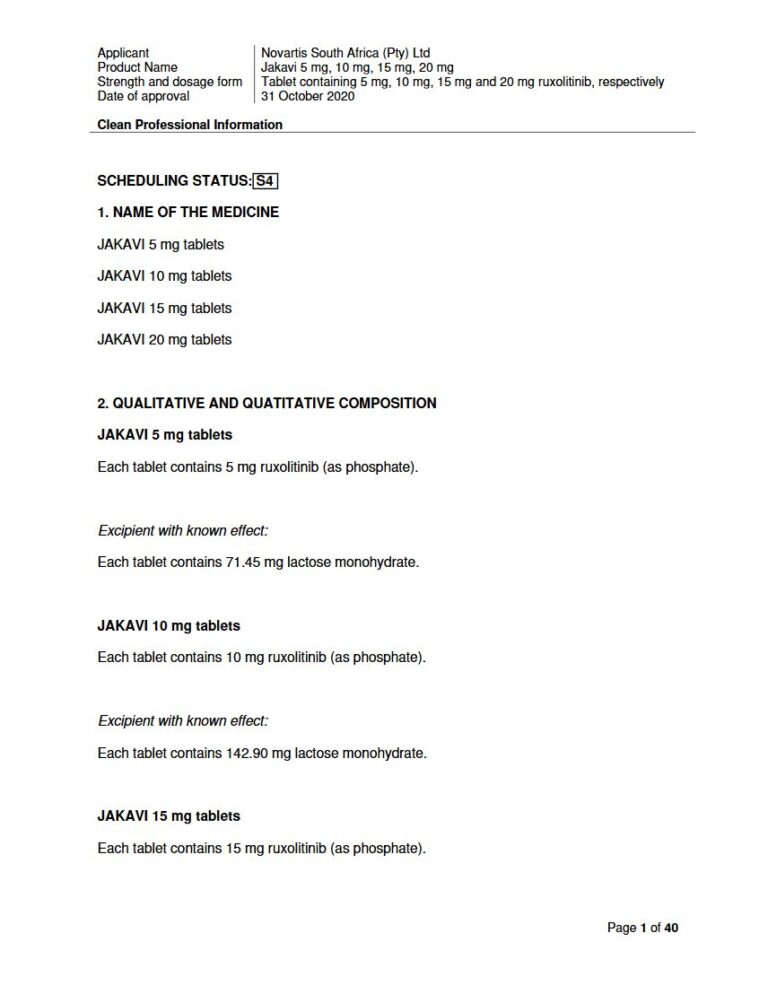
Jakavi 5 Mg/10 Mg/15 Mg/20 Mg Tablets
PDF Leaflet Revision Date: 31 October 2020
Clinical Summary
Quick overview from the medicine insert
Indication
Treatment of myelofibrosis and polycythaemia vera.
Dosage (summary)
Starting dose: 15 mg twice daily for MF; 10 mg twice daily for PV.
Special Populations
- Renal impairment
- Hepatic impairment
- Elderly patients
Pregnancy & Breastfeeding
Contraindicated in pregnancy and breastfeeding.
Key Drug Interactions
- Strong CYP3A4 inhibitors
- Dual CYP2C9 and CYP3A4 inhibitors
Contraindications
- Hypersensitivity
- Pregnancy
- Acute infections
- Severe hepatic impairment
- Severe renal impairment
- Active tuberculosis
Common side effects
- Thrombocytopenia
- Anaemia
- Dizziness
- Headache
Counselling Points
- Monitor blood counts regularly.
- Avoid live vaccines.
- Report signs of infection immediately.
Serious warnings
- Risk of serious infections
- Myelosuppression
- Progressive multifocal leukoencephalopathy
Important Disclaimer
The Jakavi 5 Mg/10 Mg/15 Mg/20 Mg Tablets professional information leaflet below is the property of Novartis South Africa and is provided on Medinsert exactly as issued, with no.. alterations or editorial changes. We make every effort to keep content current by updating documents as soon as new versions become available. Medinsert serves as a trusted access point for healthcare professionals, but does not replace official sources or clinical judgement. For more details, please read our full disclaimer. read more>>
 Healthcare Professionals Only
This content is for registered healthcare professionals
Sign in or create a free account to read the full package insert.
Free for HPCSA-registered professionals. Powered by Medinsert.
Clinical Particulars
Section 4 of the official insert — extracted exactly as issued, no alterations
4.1 Therapeutic Indications
Myelofibrosis (MF) JAKAVI is indicated for the treatment of disease related splenomegaly or symptoms in adult patients with primary myelofibrosis (also known as chronic idiopathic myelofibrosis), post polycythaemia vera myelofibrosis or post essential thrombocythaemia myelofibrosis.
Polycythaemia vera (PV) JAKAVI is indicated for the treatment of adult patients with polycythaemia vera who are resistant to or intolerant of hydroxyurea.
4.2 Posology and method of administration
JAKAVI treatment should only be initiated by a medical practitioner experienced in the administration of anti-cancer medicines.
A complete blood cell count, including a differential white blood cell count, must be performed before initiating therapy with JAKAVI. Complete blood count, including a differential white blood cell count, should be monitored every 2 - 4 weeks until JAKAVI doses are stabilised, and then as clinically indicated (see section 4.4).
Posology Starting dose The recommended starting dose of JAKAVI in MF is 15 mg twice daily for patients with a platelet count between 100,000/mm 3 and 200,000/mm 3 and 20 mg twice daily for patients with a platelet count of >200,000/mm 3 . The recommended starting dose of JAKAVI in PV is 10 mg given orally twice daily. There is limited information to recommend a starting dose for patients with platelet counts between 50,000/mm 3 and <100,000/mm 3 . The maximum recommended starting dose in these patients is 5 mg twice daily and the patients should be titrated cautiously.
Dose modifications Doses may be titrated based on safety and efficacy. Treatment should be discontinued for platelet counts less than 50,000/mm 3 or absolute neutrophil counts less than 500/mm 3 . In PV, treatment should also be interrupted when haemoglobin is below 8 g/dL. After recovery of blood counts above these levels, dosing may be re-started at 5 mg twice daily and gradually increased based on careful monitoring of complete blood cell count, including a differential white blood cell count. Dose reductions should be considered if the platelet count decreases below 100,000/mm 3 , with the goal of avoiding dose interruptions for thrombocytopenia. In PV, dose reductions should also be considered if haemoglobin decreases below 12 g/dL and is recommended if it decreases below 10 g/dL. If efficacy is considered insufficient and blood counts are adequate, doses may be increased by a maximum of 5 mg twice daily, up to the maximum dose of 25 mg twice daily. The starting dose should not be increased within the first four weeks of treatment and thereafter no more frequently than at 2 week intervals. The maximum dose of JAKAVI is 25 mg twice daily.
Dose adjustment with concomitant strong CYP3A4 inhibitors or fluconazole When JAKAVI is administered with strong CYP3A4 inhibitors or dual inhibitors of CYP2C9 and CYP3A4 enzymes (e.g. fluconazole) the unit dose of JAKAVI should be reduced by approximately 50 %, to be administered twice daily (see section 4.5). Avoid the concomitant use of JAKAVI with fluconazole doses greater than 200 mg daily.
More frequent monitoring (e.g. twice a week) of haematology parameters and of clinical signs and symptoms of JAKAVI related adverse drug reactions is recommended while on strong CYP3A4 inhibitors or dual inhibitors of CYP2C9 and CYP3A4 enzymes.
Special populations Renal impairment No specific dose adjustment is needed in patients with mild or moderate renal impairment. In patients with severe renal impairment (creatinine clearance less than 30 ml/min) the recommended starting dose based on platelet count for MF patients should be reduced by approximately 50 % to be administered twice daily. The recommended starting dose for PV patients with severe renal impairment is 5 mg twice daily. Patients should be carefully monitored with regard to safety and efficacy during JAKAVI treatment. There are limited data to determine the best dosing options for patients with end stage renal disease (ESRD) on haemodialysis. Pharmacokinetic/pharmacodynamic simulations based on available data in this population suggest that the starting dose for MF patients with ESRD on haemodialysis is a single dose of 15-20 mg or two doses of 10 mg given 12 hours apart, to be administered post-dialysis and only on the day of haemodialysis. A single dose of 15 mg is recommended for MF patients with platelet count between 100,000/mm 3 and 200,000/mm 3 . A single dose of 20 mg or two doses of 10 mg given 12 hours apart is recommended for MF patients with platelet count of >200,000/mm 3 . Subsequent doses (single administration or two doses of 10 mg given 12 hours apart) should be administered only on haemodialysis days following each dialysis session. The recommended starting dose for PV patients with ESRD on haemodialysis is a single dose of 10 mg or two doses of 5 mg given 12 hours apart, to be administered post-dialysis and only on the day of haemodialysis. These dose recommendations are based on simulations and any dose modification in ESRD should be followed by careful monitoring of safety and efficacy in individual patients. No data is available for dosing patients who are undergoing peritoneal dialysis or continuous venovenous haemofiltration (see section 5.2).
Hepatic impairment In patients with any hepatic impairment the recommended starting dose based on platelet count should be reduced by approximately 50 % to be administered twice daily. Subsequent doses should be adjusted based on careful monitoring of safety and efficacy. Patients diagnosed with hepatic impairment while receiving JAKAVI should have complete blood counts, including a differential white blood cell count, monitored at least every one to two weeks for the first 6 weeks after initiation of therapy with JAKAVI and as clinically indicated thereafter once their liver function and blood counts have been stabilised. The JAKAVI dose can be titrated to reduce the risk of cytopenia.
Elderly patients (u226565 years) No additional dose adjustments are recommended for elderly patients.
Paediatric population The safety and efficacy of JAKAVI in children and adolescents aged up to 18 years have not been established. No data are available (see section 5.1).
Treatment discontinuation Treatment may be continued as long as the benefit risk remains positive. However, the treatment should be discontinued after 6 months if there has been no reduction in spleen size or improvement in symptoms since initiation of therapy. It is recommended that, for patients who have demonstrated some degree of clinical improvement, JAKAVI therapy can be discontinued if they sustain an increase in their spleen length of 40% compared with baseline size (roughly equivalent to a 25% increase in spleen volume) and no longer have tangible improvement in disease related symptoms.
Method of administration JAKAVI is to be taken orally, with or without food. If a dose is missed, the patient should not take an additional dose, but should take the next usual prescribed dose.
4.3 Contraindications
- Hypersensitivity to the active substance or to any of the excipients listed in section 6.1.
- Pregnancy and lactation.
- Acute phase of serious infections
- Acute hepatitis B infection or a history of hepatitis B infection not well controlled with appropriate treatment
- Haemoglobin u22648g/dl
- Platelet count u226450,000 mm 3
- Total neutrophil count u2264500 mm 3
- Active or latent/dormant pulmonary or extrapulmonary tuberculosis
- HIV infection
- Presence of a basal cell and/or squamous cell carcinoma
- Vaccination with a live attenuated bacterial or viral vaccine
- Concomitant use with cytoreductive therapies or haematopoietic growth factors
4.4 Special warnings and precautions for use
Infections, haematological abnormalities and malignancies listed in the contraindication section must first be treated until cured/resolved, improved, well controlled, reversed or in case of haematological abnormalities, improved with values outside the contraindication domain, before therapy with JAKAVI can be initiated. If an infection, haematological abnormality or malignancy cannot be cured/resolved, improved, well controlled, reversed or in case of haematological abnormalities, improved with values outside the contraindication domain, those conditions remain contraindications to initiation of therapy with JAKAVI and other appropriate treatment options for treatment of the patient should be considered.
Myelosuppression Treatment with JAKAVI can cause haematological adverse drug reactions, including thrombocytopenia, anaemia and neutropenia. A complete blood count, including a differential white blood cell count, must be performed before initiating therapy with JAKAVI. Treatment should be discontinued in patients with platelet count less than 50,000/mm 3 or absolute neutrophil count less than 500/mm 3 (see section 4.2). (see section 4.3) It has been observed that patients with low platelet counts (<200,000/mm 3 ) at the start of therapy are more likely to develop thrombocytopenia during treatment. Thrombocytopenia is generally reversible and is usually managed by reducing the dose or temporarily withholding JAKAVI (see sections 4.2 and 4.8). However, platelet transfusions may be required as clinically indicated. Patients developing anaemia may require blood transfusions. Dose modifications or interruption for patients developing anaemia may also be considered. Patients with a haemoglobin level below 10.0 g/dl at the beginning of the treatment have a higher risk of developing a haemoglobin level below 8.0 g/dl during treatment compared to patients with a higher baseline haemoglobin level (79.3 % versus 30.1 %). More frequent monitoring of haematology parameters and of clinical signs and symptoms of JAKAVI related adverse drug reactions is recommended for patients with baseline haemoglobin below 10.0 g/dl. Neutropenia (absolute neutrophil count <500) was generally reversible and was managed by temporarily withholding JAKAVI (see sections 4.2 and 4.8). Complete blood counts should be monitored as clinically indicated and dose adjusted as required (see sections 4.2 and 4.8).
Infections Serious bacterial, mycobacterial, fungal, viral and other opportunistic infections have occurred in patients treated with JAKAVI. Patients should be assessed for the risk of developing serious infections. Medical practitioners should carefully observe patients receiving JAKAVI for signs and symptoms of infections and initiate appropriate treatment promptly. Treatment with JAKAVI should not be started until active serious infections have resolved. (See section 4.3) Tuberculosis has been reported in patients receiving JAKAVI. Before starting treatment, patients should be evaluated for active and inactive (u201clatentu201d) tuberculosis, as per local recommendations. This can include medical history, possible previous contact with tuberculosis, and/or appropriate screening such as lung x-ray, tuberculin test and/or interferon-gamma release assay, as applicable. Prescribers are reminded of the risk of false negative tuberculin skin test results, especially in patients who are severely ill or immunocompromised. (See section 4.3)
Hepatitis B reactivation and/or Hepatitis B viral load (HBV-DNA titre) increases, with and without associated elevations in alanine aminotransferase and aspartate aminotransferase, have been reported in patients with chronic HBV infections taking JAKAVI. The effect of JAKAVI on viral replication in patients with chronic HBV infection is unknown. Patients should be screened for hepatitis B infection before initiating treatment with JAKAVI. Patients with chronic HBV infection should be treated and monitored according to clinical guidelines. (see section 4.3)
Herpes zoster Medical practitioners should educate patients about early signs and symptoms of herpes zoster, including extra cutaneous herpes zoster infections, advising that treatment should be sought as early as possible.
Progressive multifocal leukoencephalopathy Progressive multifocal leukoencephalopathy (PML) has been reported with JAKAVI treatment. Medical practitioners should be particularly alert to symptoms suggestive of PML that patients may not notice (e.g., cognitive, neurological or psychiatric symptoms or signs). Patients should be monitored for any of these new or worsening symptoms or signs, and if such symptoms/signs occur, referral to a neurologist and appropriate diagnostic measures for PML should be considered. If PML is suspected, further dosing must be suspended until PML has been excluded.
Non-melanoma skin cancer Non-melanoma skin cancers (NMSCs), including basal cell, squamous cell, and Merkel cell carcinoma, have been reported in patients treated with ruxolitinib. Most of these patients had histories of extended treatment with hydroxyurea and prior NMSC or pre-malignant skin lesions. A causal relationship to ruxolitinib has not been established. Periodic skin examination is recommended for patients who are at increased risk for skin cancer. (see section 4.3)
Lipid abnormalities/elevations Treatment with JAKAVI has been associated with increases in lipid parameters including total cholesterol, high-density lipoprotein (HDL) cholesterol, low-density lipoprotein (LDL) cholesterol, and triglycerides. Lipid monitoring and treatment of dyslipidaemia according to clinical guidelines is recommended.
4.5 Interactions with other medicines
Interaction studies have only been performed in adults. JAKAVI (ruxolitinib) is eliminated through metabolism catalysed by CYP3A4 and CYP2C9. Thus, medicines inhibiting these enzymes can give rise to an increased ruxolitinib exposure.
Interactions resulting in dose reduction of JAKAVI CYP3A4 inhibitors Strong CYP3A4 inhibitors (such as, but not limited to, boceprevir, clarithromycin, indinavir, itraconazole, ketoconazole, lopinavir/ritonavir, ritonavir, mibefradil, nefazodone, nelfinavir, posaconazole, saquinavir, telaprevir, telithromycin, voriconazole) In healthy subjects co-administration of JAKAVI (10 mg single dose) with a strong CYP3A4 inhibitor, ketoconazole, resulted in ruxolitinib C max and AUC that were higher by 33 % and 91 %, respectively, than with JAKAVI alone. The half-life was prolonged from 3.7 to 6.0 hours with concurrent ketoconazole administration. When administering JAKAVI with strong CYP3A4 inhibitors the unit dose of JAKAVI should be reduced by approximately 50 %, to be administered twice daily. Patients should be closely monitored (e.g. twice weekly) for cytopenias and dose titrated based on safety and efficacy (see section 4.2).
Dual CYP2C9 and CYP3A4 inhibitors In healthy subjects receiving fluconazole, a dual CYP2C9 and CYP3A4 inhibitor, as a single 400 mg dose followed by 200 mg once daily for seven days, there was a 232% increase in the AUC of ruxolitinib 50 % dose reduction should be considered when using medicines which are dual inhibitors of CYP2C9 and CYP3A4 enzymes (e.g. fluconazole). Avoid the concomitant use of JAKAVI with fluconazole doses greater than 200 mg daily.
Enzyme inducers CYP3A4 inducers (such as, but not limited to, avasimibe, carbamazepine, phenobarbitone, phenytoin, rifabutin, rifampin (rifampicin), St.Johnu2019s wort (Hypericum perforatum)) Patients should be closely monitored and the dose titrated based on safety and efficacy (see section 4.2). In healthy subjects given ruxolitinib (50 mg single dose) following the potent CYP3A4 inducer rifampicin (600 mg daily dose for 10 days), ruxolitinib AUC was 70 % lower than after administration of ruxolitinib alone. The exposure of ruxolitinib active metabolites was unchanged. Overall, the ruxolitinib pharmacodynamic activity was similar, suggesting the CYP3A4 induction resulted in minimal effect on the pharmacodynamics. However, this could be related to the high ruxolitinib dose resulting in pharmacodynamic effects near E max . It is possible that in the individual patient, an increase of the JAKAVI dose is needed when initiating treatment with a strong enzyme inducer.
Other interactions to be considered affecting JAKAVI Mild or moderate CYP3A4 inhibitors (such as, but not limited to, ciprofloxacin, erythromycin, amprenavir, atazanavir, diltiazem, cimetidine) In healthy subjects co-administration of ruxolitinib (10 mg single dose) with erythromycin 500 mg twice daily for four days resulted in ruxolitinib C max and AUC that were higher by 8 % and 27 %, respectively, than with ruxolitinib alone. No dose adjustment is recommended when JAKAVI is co-administered with mild or moderate CYP3A4 inhibitors (e.g. erythromycin). However, patients should be closely monitored for cytopenias when initiating therapy with a moderate CYP3A4 inhibitor.
Effects of JAKAVI on other medicines Substances transported by P-glycoprotein or other transporters JAKAVI may inhibit P-glycoprotein and breast cancer resistance protein (BCRP) in the intestine. This may result in increased systemic exposure of substrates of these transporters, such as dabigatran etexilate, ciclosporin, rosuvastatin and potentially digoxin. Therapeutic drug monitoring (TDM) or clinical monitoring of the affected substance is advised. It is possible that the potential inhibition of P-gp and BCRP in the intestine can be minimised if the time between administrations is kept apart as long as possible.
Haematopoietic growth factors The concurrent use of haematopoietic growth factors and JAKAVI has not been studied. It is not known whether the Janus Associated Kinase (JAK) inhibition by JAKAVI reduces the efficacy of the haematopoietic growth factors or whether the haematopoietic growth factors affect the efficacy of JAKAVI (see section 4.4).
Cytoreductive therapies The concomitant use of cytoreductive therapies and JAKAVI has not been studied. The safety and efficacy of this co-administration is not known (see section 4.4).
Midazolam A study in healthy subjects indicated that ruxolitinib did not inhibit the metabolism of the oral CYP3A4 substrate midazolam. Therefore, no increase in exposure of CYP3A4 substrates is anticipated when combining them with ruxolitinib.
Oral contraceptives containing ethinyl-oestradiol and levonorgestrel Another study in healthy subjects indicated that ruxolitinib does not affect the pharmacokinetics of an oral contraceptive containing ethinylestradiol and levonorgestrel. Therefore, it is not anticipated that the contraceptive efficacy of this combination will be compromised by co-administration of JAKAVI.
4.6 Fertility, pregnancy and lactation
Pregnancy JAKAVI is contraindicated in pregnancy. Ruxolitinib was embryotoxic and foetotoxic in animal studies (increases in post-implantation loss and reduced foetal weights) (see section 4.3).
Women of childbearing potential/ Contraception in males and females Women of child bearing potential should use effective contraception during the treatment with JAKAVI. Pregnancy should be excluded before initiation of treatment with JAKAVI. Pregnancy tests should be performed at regular intervals during treatment to exclude pregnancy.
Breastfeeding Women on treatment with JAKAVI should not breastfeed their babies (see section 4.3). In lactating rats, ruxolitinib and/or its metabolites are excreted into the milk with a concentration that was 13-fold higher than the maternal plasma concentration. It is not known whether JAKAVI is excreted in human breastmilk.
Fertility There are no human data on the effect of JAKAVI on fertility. In animal studies, no effect on fertility was observed.
4.7 Effects on ability to drive and use machines
JAKAVI may influence the ability to drive and use machines. Patients should first ascertain how treatment of JAKAVI is affecting their mental and/or physical abilities to perform or execute tasks or activities requiring mental alertness, judgement and/or sound coordination and vision. Adverse events such as dizziness, bleeding, anaemia, headache, infections and hypertension may influence their ability to drive and operate machines. JAKAVI has no or negligible sedating effect. However, patients who experience dizziness after the intake of JAKAVI should refrain from driving or using machines.
4.8 Undesirable effects
Summary of safety profile The safety assessment was based on a total of 982 patients (with MF or PV) receiving JAKAVI in phase 2 and 3 studies. Myelofibrosis In the randomised period of the two pivotal studies, COMFORT-I and COMFORT-II, the median duration of exposure to JAKAVI was 10.8 months (range 0.3 to 23.5 months). The majority of patients (68.4 %) were treated for at least 9 months. Of 301 patients, 111 (36.9 %) had a baseline platelet count of between 100,000/mm 3 and 200,000/mm 3 and 190 (63.1 %) had a baseline platelet count of >200,000/mm 3 . In these clinical studies, discontinuation due to adverse events, regardless of causality, was observed in 11.3 % of patients. The most frequently reported adverse drug reactions were thrombocytopenia and anaemia.
Haematological adverse drug reactions (any Common Terminology Criteria for Adverse Events [CTCAE] grade) included anaemia (82.4 %), thrombocytopenia (69.8 %), neutropenia (16.6 %) and bruising and/or haematoma (21.3%). Anaemia, thrombocytopenia and neutropenia are dose-related effects. The two most frequent non-haematological adverse drug reactions were dizziness (15.3 %) and headache (14.0 %). The three most frequent non-haematological laboratory abnormalities were raised alanine aminotransferase (27.2 %), raised aspartate aminotransferase (19.9 %) and hypercholesterolaemia (16.9 %). In phase 3 clinical studies in MF, neither CTCAE grade 3 or 4 hypercholesterolaemia, raised aspartate aminotransferase nor CTCAE grade 4 raised alanine aminotransferase were observed.
Long-term safety: Long term safety data from two pivotal phase 3 studies assessed 457 patients with MF who were treated with ruxolitinib, including patients initially randomised to ruxolitinib (n=301; exposure 0.3 u2013 68.1 months, median exposure 33.4 months) and patients who received ruxolitinib after crossing over from control treatments (n=156; exposure: 0.5 u2013 59.8 months, median exposure 25.0 months). The cumulative frequency of adverse events in these studies increased proportionally to the increase in the follow-up time. With these updated data, therapy discontinuation due to adverse events was observed in 27.4 % of patients treated with ruxolitinib.
Polycythaemia vera The safety of JAKAVI was assessed in 184 patients with PV in two open-label, randomised, controlled studies, the phase 3 RESPONSE study and the phase 3b RESPONSE 2 study. The adverse drug reactions listed below reflect the randomised study period (up to week 32 for RESPONSE and up to week 28 for RESPONSE 2) with equivalent exposure to ruxolitinib and Best Available Therapy (BAT). The median duration of exposure to JAKAVI during the randomised study periods was 7.85 months (range 0.03 to 7.85 months). Discontinuation due to adverse events, regardless of causality, was observed in 2.2 % of patients. Haematological adverse reactions (any CTCAE grade) included anaemia (40.8 %) and thrombocytopenia (16.8 %). Anaemia or thrombocytopenia CTCAE grade 3 and 4 were reported in respectively 1.1 % or 3.3 %. The three most frequent non-haematological adverse reactions were dizziness (9.2 %), constipation (8.7 %) and hypertension (6.5 %). The three most frequent non-haematological laboratory abnormalities (any CTCAE grade) identified as adverse reactions were raised aspartate aminotransferase (26.1%), raised alanine aminotransferase (22.3%) and hypercholesterolaemia (20.7%). These were all CTCAE grade 1 and 2 with the exception of one CTCAE grade 3 raised alanine aminotransferase event.
Long-term safety was evaluated using data from two phase 3 studies including data from patients initially randomised to ruxolitinib (n=184; exposure 0.03 to 43.5 months, median exposure 18.9 months) and patients who received ruxolitinib after crossing over from control treatments (n=149; exposure: 0.2 to 33.5 months, median exposure 12.0 months): With longer exposure, the cumulative frequency of adverse events increased but no new safety findings emerged. When adjusted for exposure, the adverse events rates were generally comparable with those observed during the comparative periods of the randomised studies.
Tabulated summary of adverse reactions In the clinical study programme, the severity of adverse drug reactions was assessed based on the CTCAE, defining grade 1 = mild, grade 2 = moderate, grade 3 = severe and grade 4=life threatening. Adverse drug reactions from clinical studies (Table 1) are listed by MedDRA system organ class. Within each system organ class, the adverse drug reactions are ranked by frequency, with the most frequent reactions first. In addition, the corresponding frequency category for each adverse drug reaction is based on the following convention: very common (u22651/10); common (u22651/100 to <1/10); uncommon (u22651/1,000 to <1/100); rare (u22651/10,000 to <1/1,000); very rare (<1/10,000).
4.9 Overdose
In overdose, side effects can be precipitated and/or be of increased severity. There is no known antidote for overdoses with JAKAVI. Single doses up to 200 mg have been given with acceptable acute tolerability. Higher than recommended repeat doses are associated with increased myelosuppression including leukopenia, anaemia and thrombocytopenia. Appropriate symptomatic and supportive treatment should be given. Haemodialysis is not expected to enhance the elimination of JAKAVI (ruxolitinib).
