
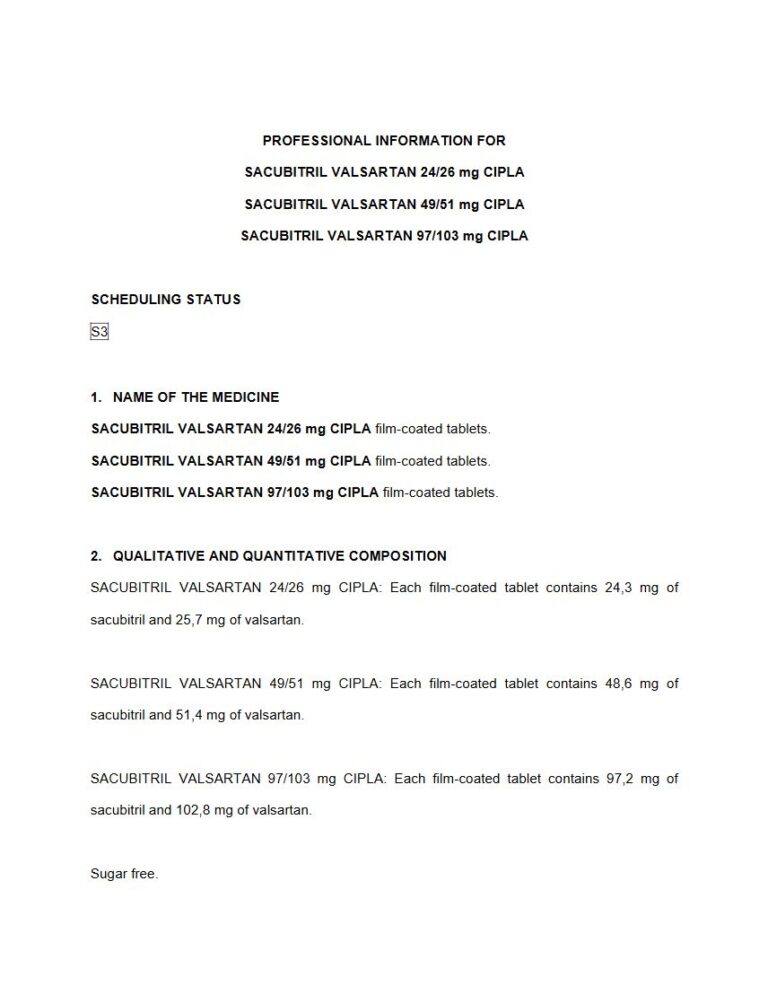
Sacubitril Valsartan 36 Mg/51 Mg/103 Mg Tablets
PDF Leaflet Revision Date: 19 September 2023
Clinical Summary
Quick overview from the medicine insert
Indication
Treatment of symptomatic heart failure in adults with systolic dysfunction.
Dosage (summary)
Starting dose: 24/26 mg twice daily; target dose: 97/103 mg twice daily.
Special Populations
- Elderly
- Renal impairment
- Hepatic impairment
Pregnancy & Breastfeeding
Contraindicated in pregnancy and breastfeeding.
Key Drug Interactions
- ACE inhibitors
- Aliskiren
- Potassium-sparing diuretics
Contraindications
- Hypersensitivity
- Severe renal impairment
- Severe hepatic impairment
- History of angioedema
- Bilateral renal artery stenosis
Common side effects
- Hypotension
- Hyperkalaemia
- Dizziness
- Fatigue
Counselling Points
- Monitor blood pressure regularly.
- Report any signs of angioedema immediately.
- Avoid potassium supplements.
Serious warnings
- Risk of angioedema
- Monitor renal function
- Avoid dual RAAS blockade
Important Disclaimer
The Sacubitril Valsartan 36 Mg/51 Mg/103 Mg Tablets professional information leaflet below is the property of Cipla Medpro and is provided on Medinsert exactly as issued, with no.. alterations or editorial changes. We make every effort to keep content current by updating documents as soon as new versions become available. Medinsert serves as a trusted access point for healthcare professionals, but does not replace official sources or clinical judgement. For more details, please read our full disclaimer. read more>>
 Healthcare Professionals Only
This content is for registered healthcare professionals
Sign in or create a free account to read the full package insert.
Free for HPCSA-registered professionals. Powered by Medinsert.
Clinical Particulars
Section 4 of the official insert — extracted exactly as issued, no alterations
4.1 Therapeutic indications
SACUBITRIL VALSARTAN CIPLA is indicated in adult patients as second line treatment, replacing ACE inhibitors or ARBu2019s for treatment of symptomatic heart failure (NYHA class II - IV) in patients with systolic dysfunction. SACUBITRIL VALSARTAN CIPLA is administered as combination therapy with other appropriate heart failure therapies.
4.2 Posology and method of administration
Posology
The target dose is one (1) tablet of SACUBITRIL VALSARTAN 97/103 mg CIPLA twice daily.
The recommended starting dose is one (1) tablet of SACUBITRIL VALSARTAN 24/26 mg CIPLA twice daily for patients currently taking low doses of ACE inhibitors or ARBu2019s. Dose up titration by doubling the dose every 3 - 4 weeks is recommended until the target dose of one (1) tablet of SACUBITRIL VALSARTAN 97/103 mg CIPLA twice daily is achieved as tolerated by the patient. Each dose increment should be preceded by clinical observation for hypotension and laboratory evaluation of serum potassium and renal function. To avoid hypotension, the recommended starting dose in patients previously using a high dose of ACE inhibitor or ARB is one (1) tablet of SACUBITRIL VALSARTAN 49/51 mg CIPLA twice daily. SACUBITRIL VALSARTAN CIPLA must not be started for at least 36 hours after discontinuing ACE inhibitor therapy due to the potential risk of angioedema when used concomitantly with an ACE inhibitor (see sections 4.3, 4.4, and 4.5). If patients experience tolerability issues (systolic blood pressure [SBP] u2264 95 mmHg, symptomatic hypotension, hyperkalaemia, renal dysfunction), adjustment of concomitant medicines, down-titration or discontinuation of SACUBITRIL VALSARTAN CIPLA is recommended (see section 4.4).
Special populations
Elderly
Patients over the age of 65 years may have impaired renal function, therefore a lower starting dose in line with the renal function is recommended.
Renal impairment
SACUBITRIL VALSARTAN CIPLA is contraindicated in patients with severe renal function impairment (see section 4.3).
Hepatic impairment
No dose adjustment of SACUBITRIL VALSARTAN CIPLA is required in patients with mild to moderate hepatic impairment (Child-Pugh A and B classification). No studies have been conducted in patients with severe hepatic impairment (Child-Pugh C classification). Therefore, use of SACUBITRIL VALSARTAN CIPLA in these patients is contraindicated (see section 4.3).
Paediatric patients
The safety and efficacy of SACUBITRIL VALSARTAN CIPLA in children and adolescents below 18 years have not been established. No data are available.
Method of administration
SACUBITRIL VALSARTAN CIPLA is administered orally. SACUBITRIL VALSARTAN CIPLA may be administered with or without food (see section 5.2). The tablets must be swallowed with a glass of water.
4.3 Contraindications
SACUBITRIL VALSARTAN CIPLA is contraindicated:
u2022 In patients who are hypersensitive to sacubitril, valsartan or any other ingredient of SACUBITRIL VALSARTAN CIPLA (see section 6.1).
u2022 In concomitant use with ACE inhibitors (see section 4.4 and 4.5). SACUBITRIL VALSARTAN CIPLA must not be administered for at least 36 hours after discontinuing ACE inhibitor therapy.
u2022 In patients with a known history of angioedema related to previous ACE inhibitor or ARB therapy (see section 4.4). These patients must never be given these medicines again.
u2022 In patients with hereditary or idiopathic angioedema (see section 4.4).
u2022 In patients with hypertrophic obstructive cardiomyopathy (HOCM).
u2022 In patients with bilateral renal artery stenosis.
u2022 In patients with renal artery stenosis in patients with a single kidney.
u2022 In patients with aortic valve stenosis.
u2022 In concomitant therapy with potassium sparing diuretics such as spironolactone, triamterene, amiloride (see section 4.5).
u2022 In patients with porphyria.
u2022 In patients on lithium therapy. Concomitant administration of SACUBITRIL VALSARTAN CIPLA may lead to toxic blood concentrations of lithium (see section 4.5).
u2022 In concomitant use with renin antagonists such as aliskiren-containing medicines in patients with diabetes mellitus or in patients with renal impairment (eGFR < 60 mL/min/1,73 m2) (see section 4.4 and 4.5).
u2022 In pregnancy and lactation (see section 4.6).
u2022 In patients with severe renal function impairment (creatinine clearance less than 30 mL/min).
u2022 In patients with severe hepatic impairment, biliary cirrhosis and cholestasis (see section 4.2).
u2022 Concomitant use of fluoroquinolones and ACE inhibitors/angiotensin receptor blockers is contraindicated in patients with moderate to severe renal impairment (creatine clearance u2264 30 mL/min) and in elderly patients.
4.4 Special warnings and precautions for use
Should a woman become pregnant while taking SACUBITRIL VALSARTAN CIPLA, the treatment should be stopped promptly and switched to a different antihypertensive medicine, see sections 4.3 and 4.8.
Dual blockage of the Renin-Angiotensin Aldosterone System (RAAS)
SACUBITRIL VALSARTAN CIPLA must not be administered with an ACE inhibitor or another ARB due to an increased risk of angioedema (see section 4.3). SACUBITRIL VALSARTAN CIPLA must not be initiated until 36 hours after taking the last dose of ACE inhibitor therapy. If treatment with SACUBITRIL VALSARTAN CIPLA is stopped, ACE inhibitor therapy must not be initiated until 36 hours after the last dose of SACUBITRIL VALSARTAN CIPLA (see section 4.2, 4.3 and 4.5).
SACUBITRIL VALSARTAN CIPLA should not be used concomitantly with direct renin inhibitors such as aliskiren (see section 4.5). SACUBITRIL VALSARTAN CIPLA with aliskiren-containing medicines is contraindicated in patients with diabetes mellitus or in patients with renal impairment (eGFR < 60 mL/min/1,73 m2) (see section 4.3 and 4.5).
Hypotension
Cases of symptomatic hypotension have been reported commonly in patients treated with SACUBITRIL VALSARTAN CIPLA. If hypotension occurs, dose adjustment of diuretics, concomitant antihypertensive medicines and treatment of other causes of hypotension (e.g. hypovolemia) should be considered. Symptomatic hypotension is more likely to occur if the patient has been volume depleted, e.g. by diuretic therapy, dietary salt restriction, diarrhoea or vomiting. Sodium and/or volume depletion should be corrected before starting treatment with SACUBITRIL VALSARTAN CIPLA. If hypotension persists despite the measures taken, the dosage of SACUBITRIL VALSARTAN CIPLA should be reduced or the product should be discontinued (see section 4.2). Treatment should not be initiated unless SBP u2265 100 mmHg.
Impaired renal function
Evaluation of patients with heart failure should always include assessment of renal function. Patients with mild and moderate renal impairment are more at risk of developing hypotension (see section 4.2). There is limited experience in patients with severe renal impairment (estimated GFR < 30 mL/min/1,73 m2) and these patients may be at greater risk of hypotension (see section 4.3). The use of SACUBITRIL VALSARTAN CIPLA may be associated with decreased renal function. The risk may be further increased by dehydration or concomitant use of non-steroidal inflammatory medicines (NSAIDs) (see section 4.5). Down titration or discontinuation of SACUBITRIL VALSARTAN CIPLA should be considered in patients who develop a clinically significant decrease in renal function.
Hyperkalaemia
The use of SACUBITRIL VALSARTAN CIPLA is associated with an increased risk of hyperkalaemia although hypokalaemia may also occur (see section 4.8). If clinically significant hyperkalaemia occurs, measures such as reducing dietary potassium or adjusting the dose of concomitant medications should be considered or temporary down-titration or discontinuation is recommended. Monitoring of serum potassium is recommended especially in patients with risk factors such as diabetes mellitus, hypoaldosteronism or receiving a high potassium diet or on mineralocorticoid antagonists (see section 4.2). Treatment should not be initiated if the serum potassium level is > 5,4 mmol/L. Medications known to raise potassium levels (e.g. potassium sparing diuretics, potassium supplements) should not be used with SACUBITRIL VALSARTAN CIPLA.
Angioedema
Angioedema has been reported in patients treated with SACUBITRIL VALSARTAN CIPLA. If angioedema occurs, SACUBITRIL VALSARTAN CIPLA should be immediately discontinued and appropriate therapy and monitoring should be provided until complete and sustained resolution of signs and symptoms has occurred. SACUBITRIL VALSARTAN CIPLA must not be re-administered. Angioedema associated with laryngeal oedema may be fatal. Where there is involvement of the tongue, glottis or larynx likely to cause airway obstruction, appropriate therapy, e.g. adrenaline solution 1 mg/1 mL (0, 3 u2013 0, 5 mL), and/or measures necessary to ensure a patent airway, should be promptly administered. Patients with prior angioedema were not studied (see section 4.3). As they may be at high risk for angioedema, caution is recommended if SACUBITRIL VALSARTAN CIPLA is used in these patients. SACUBITRIL VALSARTAN CIPLA is contraindicated in patients with a known history of angioedema related to previous ACE inhibitor or ARB therapy or with hereditary or idiopathic angioedema (see section 4.3). Black patients have an increased susceptibility to develop angioedema (see section 4.8).
Patients with renal artery stenosis
SACUBITRIL VALSARTAN CIPLA is contraindicated in patients with renal artery stenosis with one kidney (see section 4.3).
Patients with NYHA functional classification IV
Caution should be exercised when initiating SACUBITRIL VALSARTAN CIPLA in patients with NYHA functional classification IV due to limited clinical experience in this population.
B-type natriuretic peptide (BNP)
BNP is not a suitable biomarker of heart failure in patients treated with SACUBITRIL VALSARTAN CIPLA because it is a neprilysin substrate (see section 5.1).
Patients with hepatic impairment
There is limited clinical experience in patients with moderate hepatic impairment (Child-Pugh B classification) or with AST/ALT values more than twice the upper limit of the normal range. In these patients, exposure may be increased and safety is not established. Caution is therefore recommended when using it in these patients (see section 4.2 and 5.2). SACUBITRIL VALSARTAN CIPLA is contraindicated in patients with severe hepatic impairment, biliary cirrhosis and cholestasis (Child-Pugh C classification) (see section 4.3).
Fluoroquinolones and ACE inhibitors/angiotensin receptor blockers
Concomitant use of fluoroquinolones and ACE inhibitors/angiotensin receptor blockers may precipitate acute kidney injury in patients, especially those with moderate to severe renal impairment and elderly patients (see section 4.3). Renal function should be assessed before initiating treatment and monitored during treatment with fluoroquinolones or ACE inhibitors/angiotensin receptor blockers, whether used separately and/or concomitantly.
4.5 Interaction with other medicines and other forms of interaction
Interactions resulting in contraindications
ACE inhibitors
The concomitant use of SACUBITRIL VALSARTAN CIPLA with ACE inhibitors and ARBs is contraindicated, as the concomitant inhibition of neprilysin (NEP) and ACE may increase the risk of angioedema. SACUBITRIL VALSARTAN CIPLA must not be started until 36 hours after taking the last dose of ACE inhibitor or ARB therapy. ACE inhibitor therapy must not be started until 36 hours after the last dose of SACUBITRIL VALSARTAN CIPLA (see section 4.2 and 4.3).
Aliskiren
The concomitant use of SACUBITRIL VALSARTAN CIPLA with aliskiren is contraindicated (see section 4.3).
Interactions resulting in concomitant use not being recommended
SACUBITRIL VALSARTAN CIPLA contains valsartan, and therefore should not be co-administered with another ARB-containing medicine (see section 4.4).
Interactions requiring precautions
Statins
In vitro data indicate that sacubitril inhibits OATP1B1 and OATP1B3 transporters. SACUBITRIL VALSARTAN CIPLA may therefore increase the systemic exposure of OATP1B1 and OATP1B3 substrates such as statins. Co-administration of SACUBITRIL VALSARTAN CIPLA increased the C max of atorvastatin and its metabolites by up to 2-fold and AUC by up to 1,3-fold. Therefore, caution should be exercised when co-administering SACUBITRIL VALSARTAN CIPLA with statins as the adverse effects of statins are dose/exposure related.
Sildenafil
Addition of a single dose of sildenafil to SACUBITRIL VALSARTAN CIPLA at steady state in patients with hypertension was associated with greater blood pressure reduction compared to administration of SACUBITRIL VALSARTAN CIPLA alone. Therefore, caution should be exercised when sildenafil or another PDE5 inhibitor is initiated in patients treated with SACUBITRIL VALSARTAN CIPLA.
Potassium
Concomitant use of potassium-sparing diuretics (e.g. triamterene, amiloride), mineralocorticoid antagonists (e.g. spironolactone, eplerenone), potassium supplements, salt substitutes containing potassium may lead to increases in serum potassium, and to increased serum creatinine. Other medicines (such as heparin) may also lead to increases in serum creatinine. Monitoring of serum potassium is recommended if SACUBITRIL VALSARTAN CIPLA is co-administered with these medicines (see section 4.4).
Non-steroidal Anti-inflammatory drugs (NSAIDs) including selective cyclooxygenase-2 (COX-2) inhibitors
In elderly patients, volume-depleted patients (including those on diuretic therapy), or patients with compromised renal function, concomitant use of SACUBITRIL VALSARTAN CIPLA and NSAIDs may lead to an increased risk of worsening of renal function and increase in blood pressure. Therefore, monitoring of renal function is recommended when initiating or modifying treatment in patients on SACUBITRIL VALSARTAN CIPLA who are taking NSAIDs concomitantly (see section 4.4).
Lithium
Reversible increases in serum lithium concentrations and toxicity have been reported during concomitant administration of lithium with ACE inhibitors or angiotensin II receptor antagonists (see section 4.3). Therefore, this combination is contraindicated (see section 4.3). If diuretic is also used, the risk of lithium toxicity may be increased further.
Furosemide
Co-administration of SACUBITRIL VALSARTAN CIPLA and furosemide had no effect on the pharmacokinetics of SACUBITRIL VALSARTAN CIPLA but reduced C max and AUC of furosemide by 50 % and 28 %, respectively. While there was no relevant change in urine volume, the urinary excretion of sodium was reduced within 4 hours and 24 hours after co-administration.
Nitrates
There was no interaction between SACUBITRIL VALSARTAN CIPLA and intravenously administered nitroglycerin with regards to blood pressure reduction. Co-administration of nitroglycerin and SACUBITRIL VALSARTAN CIPLA was associated with a treatment difference of 5 bpm in heart rate compared to the administration of nitroglycerine alone. A similar effect on the heart rate may occur when SACUBITRIL VALSARTAN CIPLA is co-administered with sublingual, oral or transdermal nitrates. In general, no dose adjustment is required.
OATP and MRP2 transporters
The active metabolites of sacubitril (LBQ657) and valsartan are OATP1B1, OATP1B3, OAT1 and OAT3 substrates; valsartan is also a MRP2 substrate. Therefore, co-administration of SACUBITRIL VALSARTAN CIPLA with inhibitors of OATP1B1, OATP1B3, OAT3 (e.g. rifampicin, ciclosporin), OAT1 (e.g. tenofovir, cidofovir) or MRP2 (e.g. ritonavir) may increase the systemic exposure LBQ657 or valsartan. Appropriate care should be exercised when initiating or ending concomitant treatment with such medicines.
Metformin
Co-administration of SACUBITRIL VALSARTAN CIPLA with metformin reduced both C max and AUC of metformin by 23 %. The clinical relevance of these findings is unknown. Therefore, when initiating therapy with SACUBITRIL VALSARTAN CIPLA in patients receiving metformin, the clinical status of the patient should be evaluated.
Fluoroquinolones and ACE inhibitors/angiotensin receptor blockers
Concomitant use of fluoroquinolones and ACE inhibitors/angiotensin receptor blockers may precipitate acute kidney injury. The mechanism of the possible interaction between the different classes of medicines, over and above different mechanisms of kidney damage, is the unknown (see section 4.3).
No significant interaction
No clinically meaningful interaction was observed when SACUBITRIL VALSARTAN CIPLA was co-administered with digoxin, warfarin, hydrochlorothiazide, amlodipine, omeprazole, carvedilol or a combination of levonorgestrel/ethinyl estradiol. No interaction is expected with atenolol, indomethacin, glyburide or cimetidine.
CYP450 interactions
In vitro metabolism studies indicate that the potential for CYP450 based interactions is low since there is a limited metabolism of SACUBITRIL VALSARTAN CIPLA via the CYP450 enzymes. SACUBITRIL VALSARTAN CIPLA does not induce or inhibit CYP450 enzymes.
4.6 Fertility, pregnancy and lactation
Women of child-bearing potential/Contraception in males and females
Women of childbearing potential should ensure effective contraception.
Pregnancy
SACUBITRIL VALSARTAN CIPLA is contraindicated in pregnancy (see section 4.3). There are no data from the use of SACUBITRIL VALSARTAN CIPLA in pregnant women. When pregnancy is planned or confirmed, SACUBITRIL VALSARTAN CIPLA should be discontinued. Medicines affecting the renin angiotensin system, such as SACUBITRIL VALSARTAN CIPLA, can cause embryonal toxicity, foetal and neonatal morbidity and mortality when administered to pregnant women.
Breastfeeding
It is not known whether SACUBITRIL VALSARTAN CIPLA is excreted in human milk. Because of the potential risk for adverse reactions in breastfed new-borns/infants, it is contraindicated during breastfeeding (see section 4.3).
Fertility
There are no available data on the effect of SACUBITRIL VALSARTAN CIPLA on human fertility.
4.7 Effects on ability to drive and use machines
SACUBITRIL VALSARTAN CIPLA has a minor influence on the ability to drive and use machines. When driving vehicles or operating machines it should be taken into account that occasionally dizziness or fatigue may occur.
4.8 Undesirable effects
a) Summary of safety profile
The safety of sacubitril / valsartan in patients with chronic heart failure was evaluated in a reported study, in which patients were treated twice daily with sacubitril 97 mg / valsartan 103 mg. Patients received treatment for up to 4,3 years, with a median duration of exposure of 24 months; 3 271 patients were treated for more than one year. Discontinuation of therapy due to an adverse event occurred in 450 (10,71 %) of sacubitril / valsartan treated patients. The events most frequently associated with dosage adjustment or treatment interruption were hypotension, hyperkalaemia and renal impairment.
b) Tabulated summary of adverse reactions
Table 1 List of adverse reactions
MedDRA system organ Class Frequency Side effects
Blood and lymphatic system disorders Frequent Anaemia.
Immune system disorders Less frequent Hypersensitivity, angioedema.
Metabolism and nutrition disorders Frequent Hyperkalaemia, hypokalaemia, hypoglycaemia.
Nervous system disorders Frequent Dizziness, headache, syncope. Less frequent Postural dizziness.
Ear and labyrinth Frequent Vertigo.
Vascular disorders Frequent Hypotension, orthostatic hypotension, syncope.
Respiratory, thoracic and mediastinal disorders Frequent Cough.
Gastrointestinal disorders Frequent Diarrhoea, nausea, gastritis.
Skin and subcutaneous tissue disorders Less frequent Pruritus, rash
Renal and urinary disorders Frequent Renal impairment, renal failure (renal failure, acute renal failure).
General disorders and administration site conditions Frequent Fatigue, asthenia.
4.9 Overdose
Hypotension is the most likely symptom of overdose due to the blood pressure lowering effects of SACUBITRIL VALSARTAN CIPLA. Symptomatic treatment should be provided. SACUBITRIL VALSARTAN CIPLA is unlikely to be removed by haemodialysis due to high protein binding (see section 5.2).
