
Covid–19 Vaccine Lhc 4,0 μg Injection
PDF Leaflet Revision Date: 24 May 2022
Clinical Summary
Quick overview from the medicine insert
Indication
Active immunisation to prevent COVID-19 in individuals 18 years and older.
Dosage (summary)
Two doses of 0.5 mL each, administered 21-28 days apart.
Special Populations
- Immunocompromised
- Chronic diseases
- Blood disorders
Pregnancy & Breastfeeding
Use in pregnancy only if benefits outweigh risks; unknown if excreted in breast milk.
Key Drug Interactions
- No interaction studies performed
- Do not mix with other vaccines
Contraindications
- Hypersensitivity to components
- Serious chronic disease
- Acute fever
Common side effects
- Pain at injection site
- Transient fever
- Fatigue
- Diarrhoea
Counselling Points
- Shake well before use
- Do not use if abnormalities are present
- Report adverse reactions
Serious warnings
- Monitor for allergic reactions for 30 mins
- Do not use if frozen
Important Disclaimer
The Covid–19 Vaccine Lhc 4,0 μg Injection professional information leaflet below is the property of Lhc Pharmaceuticals and is provided on Medinsert exactly as issued, with no.. alterations or editorial changes. We make every effort to keep content current by updating documents as soon as new versions become available. Medinsert serves as a trusted access point for healthcare professionals, but does not replace official sources or clinical judgement. For more details, please read our full disclaimer. read more>>
 Healthcare Professionals Only
This content is for registered healthcare professionals
Sign in or create a free account to read the full package insert.
Free for HPCSA-registered professionals. Powered by Medinsert.
Clinical Particulars
Section 4 of the official insert — extracted exactly as issued, no alterations
4.1 Therapeutic indications
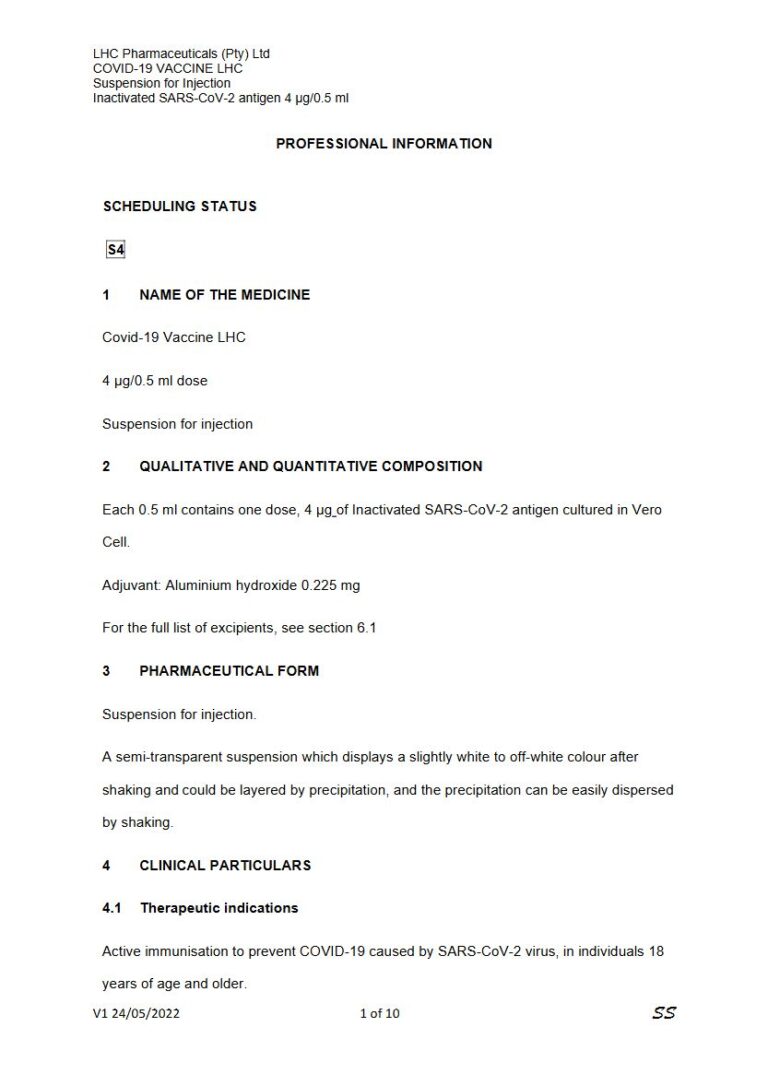
Active immunisation to prevent COVID-19 caused by SARS-CoV-2 virus, in individuals 18 years of age and older.
4.2 Posology and method of administration
Posology:
Individuals 18 years of age and older
Two doses are administered by a healthcare professional into the deltoid muscle at an interval of 21-28 days, each dose is 0.5 mL and contains 4 u03bcg/dose
Paediatric population
The safety and efficacy of Covid-19 Vaccine LHC in children have not yet been established.
Method of Administration: The Covid-19 Vaccine LHC is administered intramuscularly into the deltoid muscle. The vaccine should be thoroughly shaken before use. Do not allow disinfectant to come into contact with the vaccine when the protective cap is removed. The vaccine should be used immediately after opening. Do not use if any abnormalities are observed such as visible particles, damaged label, beyond expiry date or cracks in the syringe or vial are present.
4.3 Contraindications
(1) Individuals who are hypersensitive to any component (active or excipients) of this product, or those who have had allergic reactions with this vaccine before.
(2) Individuals who have serious chronic disease or history of hypersensitivity.
(3) Vaccination should be postponed if individuals have fever or during the acute phase of disease.
4.4 Special warnings and precautions for use
Intravenous injection is strictly prohibited. The effect of freeze thaw cycles has not been established. Do not use the vaccine if it has been frozen as its antigenicity will have been compromised. Medicines and equipment should be available for emergency treatment in the event of an occasional severe allergic reaction. The vaccinee should be watched for at least 30 minutes after vaccination. This vaccine should be used with caution in the following circumstances:
- (1) Individuals who have blood disorders such as decrease in platelets (thrombocytopenia) or clotting disorders because of the risk of bleeding which may occur during intramuscular administration of the vaccine.
- (2) Individuals who are taking immunosuppressants, in such cases it is recommended to postpone vaccination until the end of the treatment to make sure the subject is well protected.
- (3) Individuals who have chronic immune deficiency, may be vaccinated even though the underlying disease may cause a limited immune response.
- (4) Uncontrolled epilepsy and other progressive neurological disorders.
Like all vaccines, this product may not have 100% preventive effect for the vaccinee.
4.5 Interaction with other medicines and other forms of interaction
No interaction studies have been performed. Concomitant administration with other vaccines has not been studied. Do not mix Covid-19 Vaccine LHC with other vaccines/products in the same syringe.
4.6 Fertility, pregnancy and lactation
Pregnancy
There is no experience with use of the Covid-19 Vaccine LHC in pregnant women. Animal studies do not indicate direct or indirect harmful effects with respect to pregnancy, embryo/foetal development, parturition or post-natal development (see section 5.3). Administration of the Covid-19 Vaccine LHC in pregnancy should only be considered when the potential benefits outweigh any potential risks for the mother and foetus.
Breast-feeding
It is unknown whether the Covid-19 Vaccine LHC is excreted in human milk.
Fertility
Animal studies do not indicate direct or indirect harmful effects with respect to reproductive toxicity (see section 5.3)
4.7 Effects on ability to drive and use machines
Covid-19 Vaccine LHC has no or negligible influence on the ability to drive and use machines. However, some of the adverse reactions mentioned under section 4.8 may temporarily affect the ability to drive or use machines.
4.8 Undesirable effects
Systemic adverse reactions are mainly fever and diarrhoea, and local adverse reactions are mainly pain followed by swelling. All the adverse events occurred within 7 days of vaccination. The occurrence rate for ADRs can be presented as:
Very common (u2265 1/10), Common (u2265 1/100 to < 1/10), Uncommon (u2265 1/1,000 to < 1/100), Rare (u2265 1/10,000 to < 1/1,000), Very rare (< 1/10,000),
- (1) Very common: Pain at the injection site;
- (2) Common: Transient fever, fatigue, headache, diarrhoea; redness, swelling, itching, and hardening at the injection site;
- (3) Uncommon: Skin rash at the injection site; nausea and vomiting, itching at the non-injection site, muscle pain, arthralgia, drowsiness, dizziness.
- (4) No vaccine-related serious adverse reaction have been observed.
Participants were monitored after each vaccination for 30 minutes for immediate reactions. Solicited injection site and systemic reactions were recorded in a diary card for 7 consecutive days after each vaccination. Participants were monitored for 28 days for unsolicited adverse events and for 12 months post-vaccination for visits to an emergency room, unexpected visits to an office physician, and serious adverse events. Unsolicited adverse event information was obtained either by telephone interview or at an interim clinic visit. The most frequently reported solicited injection site and systemic reactions within 7 days following vaccination in adults aged 18 years and elder were injection site pain. Fever, fatigue, headache, and diarrhoea were also common.
4.9 Overdose
In overdose, side effects can be precipitated and/or be of increased severity. In the event of overdose, monitoring of vital functions and possible symptomatic treatment is recommended.
