
Ozempic 0.25-0.5 mg and 1 mg Solution for injection (injection).
PDF Leaflet Revision Date: 14 December 2021
Clinical Summary
Quick overview from the medicine insert
Indication
Treatment of adults with insufficiently controlled type 2 diabetes mellitus.
Dosage (summary)
Starting dose 0.25 mg once weekly, increase to 0.5 mg after 4 weeks, then to 1 mg if needed.
Special Populations
- Elderly
- Renal impairment
- Hepatic impairment
Pregnancy & Breastfeeding
Contraindicated in pregnancy and lactation; effective contraception advised.
Key Drug Interactions
- Sulfonylureas
- Insulin
Contraindications
- Hypersensitivity to semaglutide
- Personal or family history of MTC
- MEN 2
Common side effects
- Nausea
- Diarrhoea
- Vomiting
- Hypoglycaemia
Counselling Points
- Monitor for signs of thyroid tumours
- Avoid hypoglycaemia when driving
- Inject subcutaneously only
Serious warnings
- Risk of thyroid C-cell tumours
- Acute pancreatitis
- Diabetic retinopathy complications
Important Disclaimer
The Ozempic 0.25-0.5 mg and 1 mg Solution for injection (injection). professional information leaflet below is the property of Novo Nordisk and is provided on Medinsert exactly as issued, with no.. alterations or editorial changes. We make every effort to keep content current by updating documents as soon as new versions become available. Medinsert serves as a trusted access point for healthcare professionals, but does not replace official sources or clinical judgement. For more details, please read our full disclaimer. read more>>
 Healthcare Professionals Only
This content is for registered healthcare professionals
Sign in or create a free account to read the full package insert.
Free for HPCSA-registered professionals. Powered by Medinsert.
Clinical Particulars
Section 4 of the official insert — extracted exactly as issued, no alterations
4.1 Therapeutic indications
Ozempic is indicated:
- for the treatment of adults with insufficiently controlled type 2 diabetes mellitus as an adjunct to diet and exercise
- as monotherapy when metformin is considered inappropriate due to intolerance or contraindications.
- as combination therapy with oral anti-diabetic medicines (metformin, thiazoledinediones, sulphonylurea), basal insulin with or without metformin and pre-mix insulin.
- to reduce the risk of major adverse cardiovascular events (cardiovascular death, non-fatal myocardial infarction or non-fatal stroke) in adults with type 2 diabetes mellitus and established cardiovascular disease.
4.2 Posology and method of administration
Dosage
Ozempic starting dose is 0,25 mg once weekly. After 4 weeks, the dose should be increased to 0,5 mg once weekly. After at least 4 weeks with a dose of 0,5 mg once weekly, the dose can be increased to 1 mg once weekly to further improve glycaemic control.
Ozempic dose 0,25 mg is not a therapeutic dose.
Ozempic can be used as monotherapy or as combination therapy with one or more antidiabetic medicines. See section 4.1 Therapeutic indications for further information.
When Ozempic is added to existing metformin and/or thiazolidinedione therapy, the current dose of metformin and/or thiazolidinedione can be continued unchanged.
When Ozempic is added to existing sodium-glucose cotransporter 2 (SGLT2) inhibitor therapy, the current dose of SGLT2 inhibitor can be continued unchanged.
When Ozempic is added to existing therapy of a sulfonylurea or insulin, a reduction in the dose of sulfonylurea or insulin should be considered to reduce the risk of hypoglycaemia (see 4.4 Special warnings and precautions for use).
The use of Ozempic does not require blood glucose self-monitoring. Self-monitoring should be performed when Ozempic is used together with metformin, sulfonylurea or insulin in order to allow adjustment of the dose of these medicines.
Special populations
Elderly (u2265 65 years old): No dose adjustment is required based on age.
Gender and Ethnicity: No dose adjustment is required based on gender, age, race or ethnicity.
Patients with renal impairment: No dose adjustment is required for patients with renal impairment. Experience with the use of Ozempic in patients with end-stage renal impairment is limited. Caution should be exercised when treating these patients with Ozempic.
Patients with hepatic impairment: No dose adjustment is required for patients with hepatic impairment. Experience with the use of Ozempic in patients with severe hepatic impairment is limited. Caution should be exercised when treating these patients with Ozempic.
Children and adolescents: Safety and efficacy of Ozempic in children and adolescents below 18 years have not been studied.
Method of administration
Ozempic is to be administered once weekly at any time of the day, with or without meals. Ozempic is to be injected subcutaneously in the abdomen, in the thigh or in the upper arm. The injection site can be changed without dose adjustment. Ozempic should not be administered intravenously or intramuscularly.
The day of weekly administration can be changed if necessary as long as the time between two doses is at least 2 days (> 48 hours).
Missed dose
If a dose is missed, it should be administered as soon as possible and within 5 days after the missed dose. If more than 5 days have passed, the missed dose should be skipped, and the next dose should be administered on the regularly scheduled day. In each case, patients can then resume their regular once weekly dosing schedule.
4.3 Contraindications
- Hypersensitivity to semaglutide or to any of the excipients listed under 2 QUALITATIVE AND QUANTITATIVE COMPOSITION.
- A personal or family history of medullary thyroid carcinoma (MTC) or in patients with Multiple Endocrine Neoplasia syndrome type 2 (MEN 2) (see 4.4 Special warnings and precautions for use.
- Pregnancy and lactation. Women who may become pregnant should use effective contraception while taking Ozempic (see 4.6 Fertility, pregnancy and lactation).
4.4 Special warnings and precautions for use
Ozempic should not be used in patients with type 1 diabetes mellitus or for the treatment of diabetic ketoacidosis. Ozempic is not a substitute for insulin.
Gastrointestinal effects
Ozempic may be associated with gastrointestinal adverse reactions. This should be considered when treating patients with impaired renal function as nausea, vomiting, and diarrhoea, may cause dehydration which could cause a deterioration of renal function.
Acute pancreatitis
Acute pancreatitis has been observed with the use of Ozempic. Patients should be informed of the characteristic symptoms of acute pancreatitis. If pancreatitis is suspected, Ozempic should be discontinued; if confirmed, Ozempic should not be restarted. Caution should be exercised in patients with a history of pancreatitis. In the absence of other signs and symptoms of acute pancreatitis, elevations in pancreatic enzymes alone are not predictive of acute pancreatitis.
Hypoglycaemia
Patients treated with Ozempic in combination with a sulfonylurea or insulin may have an increased risk of hypoglycaemia. The risk of hypoglycaemia can be lowered by reducing the dose of sulfonylurea or insulin when initiating treatment with Ozempic.
Diabetic retinopathy
Rapid improvement in glucose control has been associated with a temporary worsening of diabetic retinopathy. Long-term glycaemic control decreases the risk of diabetic retinopathy. Patients with a history of diabetic retinopathy should be monitored for worsening and treated according to clinical guidelines.
Heart failure
There is no therapeutic experience in patients with congestive heart failure New York Heart Association (NYHA) class IV.
Risk of Thyroid C-cell Tumours
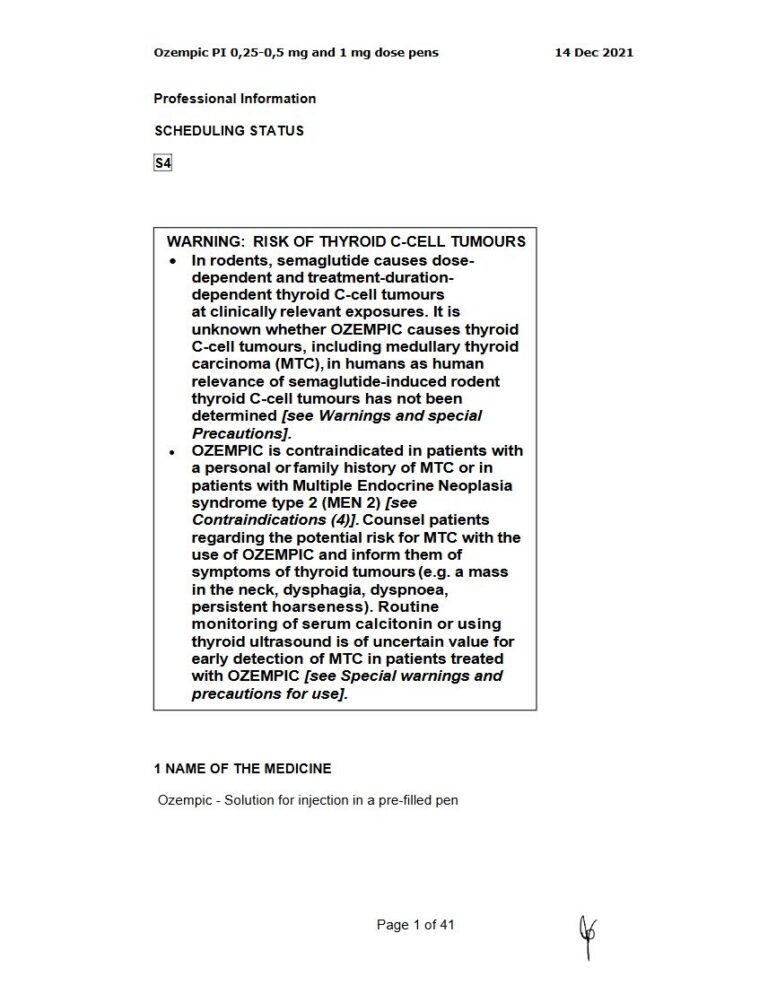
In mice and rats, semaglutide caused a dose dependent and treatment-duration-dependent increase in the incidence of thyroid C-cell tumours (adenomas and carcinomas) after lifetime exposure at clinically relevant plasma exposures. It is unknown whether Ozempic causes thyroid C-cell tumours, including medullary thyroid carcinoma (MTC), in humans as human relevance of semaglutide-induced rodent thyroid C-cell tumours has not been determined.
Cases of MTC in patients treated with liraglutide, another GLP-1 receptor agonist have been reported in the post marketing period; the data in these reports are insufficient to establish or exclude a causal relationship between MTC and GLP-1 receptor agonist use in humans. Ozempic is contraindicated in patients with a personal or family history of MTC or in patients with MEN 2. Counsel patients regarding the potential risk for MTC with the use of Ozempic and inform them of symptoms of thyroid tumours e.g. mass in the neck, dysphagia, dyspnoea, persistent hoarseness). Significantly elevated serum calcitonin value may indicate MTC and patients with MTC usually have calcitonin values >50 ng/L. If serum calcitonin is measured and found to be elevated, the patient should be further evaluated. Patients with thyroid nodules noted on physical examination or neck imaging should also be further evaluated.
Hypersensitivity
Serious hypersensitivity reactions (e.g. anaphylaxis, angioedema) have been reported with GLP-1 receptor agonists such as Ozempic. If hypersensitivity reactions occur, discontinue use of Ozempic; treat promptly per standard of care and monitor until signs and symptoms resolve. Do not use in patients with a previous hypersensitivity to Ozempic (see 4.3 Contraindications).
Effects on ability to drive and use machines
When it is used in combination with a sulfonylurea or insulin, patients should be advised to take precautions to avoid hypoglycaemia while driving and using machines.
4.5 Interaction with other medicines and other forms of interaction
In vitro studies have shown very low potential for Ozempic to inhibit or induce CYP enzymes, and to inhibit drug transporters. The delay of gastric emptying with Ozempic may influence the absorption of concomitantly administered oral medicines. The potential effect of Ozempic on the absorption of co-administered oral medicines was studied in trials at Ozempic 1 mg steady state exposure. No clinically relevant interaction with Ozempic was observed based on the evaluated medicines. Therefore, no dose adjustment is required when co-administered with Ozempic.
4.6 Fertility, pregnancy and lactation
Ozempic is contraindicated during pregnancy and lactation (see 4.3 Contraindications).
Pregnancy
Studies in animals have shown reproductive toxicity. Semaglutide should not be used during pregnancy. The safety of Ozempic in pregnant women has not been established. Semaglutide should be discontinued at least 2 months before a planned pregnancy due to the long half-life.
Women who may become pregnant should use effective contraception while taking Ozempic and for 2 months after stopping the medicine.
Lactation
It is unknown whether semaglutide is excreted in human milk. In lactating rats, semaglutide was excreted in milk. Women on treatment with Ozempic should not breastfeed their infants.
4.7 Effects on ability to drive and use machines
When it is used in combination with a sulfonylurea or insulin, patients should be advised to take precautions to avoid hypoglycaemia while driving and using machines.
4.8 Undesirable effects
Summary of safety profile
In 8 phase 3a trials, 4,792 patients were exposed to Ozempic alone or in combination with other glucose lowering medicines. The duration of the treatment ranged from 30 weeks to 2 years. The most frequently reported adverse reactions in clinical trials were gastrointestinal disorders, including nausea, diarrhoea and vomiting.
Tabulated list of adverse reactions
Table 1 lists adverse reactions identified in phase 3a trials in patients with type 2 diabetes (further described in section Description of selected adverse reactions). The frequencies of the adverse reactions are based on a pool of the phase 3a trials excluding the cardiovascular outcomes trial. The reactions are listed below by system organ class and absolute frequency. Frequencies are defined as: very common: (u22651/10); common: (u22651/100 to <1/10); uncommon (u22651/1,000 to <1/100); rare: (u22651/10,000 to <1/1,000); and very rare: (<1/10,000).
Table 1: Side effects from controlled phase 3a trials
MedDRA system organ class
Very common
Common
Uncommon
Rare
Immune - system disorders
Hypersensitivity
Anaphylactic reaction
Metabolism and nutrition disorders
Hypoglycaemia when used with insulin or sulfonylurea
Hypoglycaemia when used with other OADs
Decreased appetite
Nervous system disorders
Dizziness
Dysgeusia
Eye disorders
Diabetic retinopathy complications
Cardiac disorders
Increased heart rate
Gastrointestinal disorders
Nausea
Diarrhoea
Vomiting
Abdominal pain
Abdominal distension
Constipation
Dyspepsia
Gastritis
Gastro-oesophageal reflux disease
Eructation
Flatulence
Acute pancreatitis
Hepatobiliary disorders
Cholelithiasis
General disorders and administration site conditions
Fatigue
Injection site reactions
Investigations
Increased lipase
Increased amylase
Weight decreased
Hypoglycaemia defined as severe (requiring the assistance of another person) or symptomatic in combination with a blood glucose <3.1 mmol/L
Diabetic retinopathy complications is a composite of: need for retinal photocoagulation, need for treatment with intravitreal agents, vitreous haemorrhage, onset of diabetes-related blindness. Frequency based on cardiovascular outcomes trial.
Grouped term covering adverse events related to hypersensitivity such as rash and urticaria.
4.9 Overdose
There is no specific antidote for overdose with Ozempic. In the event of overdose, appropriate supportive treatment should be initiated according to the patientu2019s clinical signs and symptoms. A prolonged period of observation and treatment for these symptoms may be necessary, taking into account the long half-life of Ozempic of approximately 1 week.
