
Aurolift TabletS
Clinical Summary
Quick overview from the medicine insert
Indication
Major depressive disorder, obsessive-compulsive disorder, panic disorder, social anxiety disorder, and post-traumatic stress disorder.
Dosage (summary)
Initial dose is typically 50 mg once daily, may be adjusted based on clinical response, with a maximum dose of 200 mg per day.
Onset of Action / Duration
Therapeutic effects may take 1 to 2 weeks to become noticeable, with full effects often taking several weeks.
Special Populations
- Elderly patients
- Patients with hepatic impairment
- Patients with renal impairment
Pregnancy & Breastfeeding
Use during pregnancy only if the potential benefit justifies the potential risk to the fetus. Sertraline is excreted in breast milk; caution is advised when administered to nursing mothers.
Key Drug Interactions
- Monoamine oxidase inhibitors (MAOIs)
- Other serotonergic agents (e.g., triptans, tramadol)
- Warfarin
- NSAIDs
- Alcohol
Contraindications
- Hypersensitivity to sertraline or any of its components
- Concurrent use with MAOIs
Common side effects
- Nausea
- Diarrhea
- Insomnia
- Dry mouth
- Sexual dysfunction
- Dizziness
Counselling Points
- Take the medication at the same time each day.
- Do not discontinue abruptly without consulting a healthcare provider.
- Report any worsening of mood or suicidal thoughts immediately.
- Avoid alcohol while taking this medication.
Serious warnings
- Increased risk of suicidal thoughts and behavior in children, adolescents, and young adults.
- Serotonin syndrome risk, especially when combined with other serotonergic drugs.
- May cause drowsiness; caution when driving or operating machinery.
Important Disclaimer
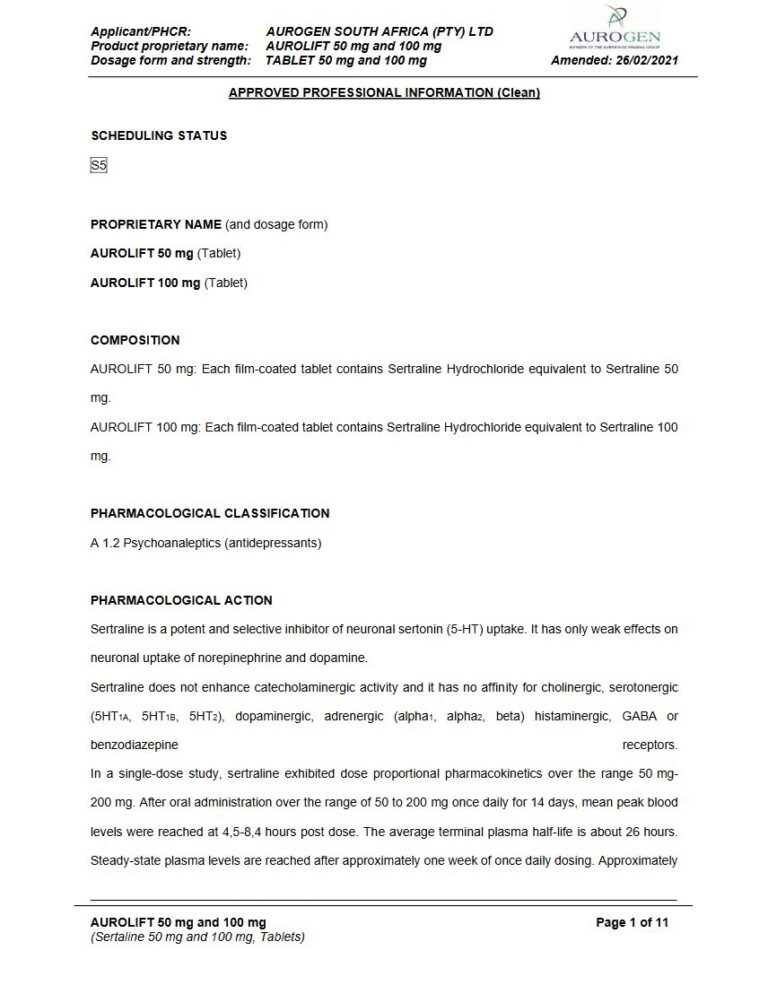
The Aurolift TabletS professional information leaflet below is the property of Aurogen South Africa and is provided on Medinsert exactly as issued, with no.. alterations or editorial changes. We make every effort to keep content current by updating documents as soon as new versions become available. Medinsert serves as a trusted access point for healthcare professionals, but does not replace official sources or clinical judgement. For more details, please read our full disclaimer. read more>>
 Healthcare Professionals Only
This content is for registered healthcare professionals
Sign in or create a free account to read the full package insert.
Free for HPCSA-registered professionals. Powered by Medinsert.
Clinical Particulars
Section 4 of the official insert — extracted exactly as issued, no alterations
4.1 Therapeutic indications
AUROLIFT is indicated for the treatment of major depressive disorders such as single episodes and recurrent depression. AUROLIFT is also indicated for the treatment of obsessive compulsive disorder (OCD). AUROLIFT is also indicated for the treatment of panic disorder, with or without agoraphobia.
4.2 Posology and method of administration
AUROLIFT tablets should be given as a single daily dose with or without food.
Depression
The starting dose is 50 mg daily and the usual therapeutic dose in depression is 50 mg daily. In difficult to treat patients, the dose may be titrated up in 50 mg increments at 2 weekly intervals, to 150 mg - 200 mg.
Obsessive-Compulsive Disorder
The minimum effective dose in OCD is also 50 mg daily and increases above 100 mg daily does not have any additional benefit. Full activity is usually seen after 2 - 4 weeks and even longer in OCD. Effect may however be seen within 7 days.
Panic Disorder
For panic disorder, the minimum recommended effective dose of sertraline is 50 mg/day. However, therapy for panic disorder should commence at 25 mg/day, increasing to 50 mg/day after one week. This dosage regimen has been demonstrated to reduce the frequency of early treatment emergent side effects characteristic of panic disorder.
Use in the elderly
No special precautions are required. The usual adult dosage is recommended.
Use in children
The use of AUROLIFT in children is not recommended as safety and efficacy have not been established.
Use in hepatic and renal impairment
see u201cWarnings - Use in patients with concomitant illnessu201d.
4.3 Contraindications
AUROLIFT is contra-indicated in patients with known hypersensitivity to sertraline. The concomitant use of AUROLIFT with a monoamine oxidase inhibitor (MAOI) is contra-indicated - see u201cWarningsu201d. Use in hepatic or renal insufficiency - see u201cWarnings - Use in patients with concomitant illnessu201d.
4.4 Special warnings and precautions for use
Activation of mania/hypomania
Activation of mania/hypomania may occur in patients with Major Affective Disorder treated with other marketed antidepressants and antiobsessional agents.
Weight loss
Significant weight loss may be an undesirable result of treatment with sertraline for some patients.
Seizure
AUROLIFT should be avoided in patients with unstable epilepsy and patients with controlled epilepsy should be carefully monitored. AUROLIFT should be discontinued in any patient who develops seizures.
Suicide
The possibility of a suicide attempt is inherent in depression and may persist until significant remission occurs. Close supervision of high risk patients should accompany initial drug therapy.
Prescriptions for AUROLIFT should be written for the smallest quantity of tablets consistent with good patient management, in order to reduce the risk of overdose.
Electroconvulsive therapy
There are no clinical studies establishing the risks or benefits of combined use of ECT and AUROLIFT.
Driving/Use of machinery
Clinical pharmacology studies have shown that sertraline has no effect on psychomotor performance. However patients should be cautioned accordingly when driving a car or operating machinery.
Use in patients with concomitant illness
Caution is advisable in using AUROLIFT in patients with diseases or conditions that could affect metabolism or hemodynamic responses.
Liver impairment
As might be predicted from its primary site of metabolism, liver impairment can affect the elimination of sertraline. The use of sertraline in patients with liver disease must be approached with caution. If AUROLIFT is administered to patients with liver disease, a lower or less frequent dose should be considered.
Renal impairment
AUROLIFT should be used with care in these patients. The dose of AUROLIFT may have to be reduced in patients with impaired renal function.
4.5 Interactions with other medicines
Monoamine oxidase inhibitors
Cases of serious reactions, sometimes fatal, have been reported in patients receiving AUROLIFT in combination with a MAOI, including the selective MAOI, selegiline, and the reversible MAOI, moclobemide. Some cases presented with features resembling neuroleptic malignant syndrome. Symptoms of a drug interaction between a SSRI and a MAOI include: hyperthermia, rigidity, myoclonus, autonomic instability with possible rapid fluctuations of vital signs, mental status changes that include confusion, irritability, and extreme agitation progressing to delirium and coma. Therefore, AUROLIFT should not be used in combination with a MAOI or within 14 days of discontinuing treatment with a MAOI. Similarly, at least 14 days should elapse after discontinuing sertraline treatment and starting a MAOI.
CNS depressants and alcohol
The concomitant use of AUROLIFT and alcohol in depressed patients is not recommended.
Protein bound medicines
In vitro protein binding studies performed with radiolabeled u00b3H - sertraline showed that sertraline is highly bound to serum proteins (98%) in the range of 20 to 500 ng/mL. However, at up to 300 and 200 ng/mL concentrations, respectively, sertraline and N - desmethylsertraline did not alter the plasma protein binding of two other highly protein bound medicines, viz. warfarin and propranolol. However in three formal interaction studies with diazepam, tolbutamide and warfarin respectively, sertraline was not shown to have significant effects on the protein binding of the substrate. (see also Other Interactions).
Serotonergic agents
Co-administration of AUROLIFT with other agents which enhance serotonergic neurotransmission, such as tryptophan or fenfluramine, should be avoided due to the potential for pharmacodynamic interaction.
Switching from other antidepressants or antiobsessional agents
There is limited controlled experience regarding the optimal timing of switching from other antidepressants or antiobsessional agents to AUROLIFT. Care and prudent medical judgement should be exercised when switching, particularly from long-acting agents such as fluoxetine. The duration of washout period which should intervene before switching from one selective serotonin reuptake inhibitor (SSRI) to another has not been established.
Other interactions
Co-administration of AUROLIFT (sertraline 200 mg daily) with diazepam or tolbutamide resulted in small, statistically significant changes in some pharmacokinetic parameters. Co-administration with cimetidine caused a substantial decrease in sertraline clearance. The clinical significance of these changes is unknown.
Warfarin
Co-administration of sertraline 200 mg daily with warfarin resulted in a small but statistically significant increase in prothrombin time. Accordingly prothrombin time should be carefully monitored when AUROLIFT therapy is initiated or stopped.
No interactions reported with the following: AUROLIFT has no effect on the beta-adrenergic blocking ability of atenolol. No interaction of sertraline 200 mg daily was observed with glibenclamide or digoxin.
Lithium
In placebo-controlled trials in normal volunteers, the combined administration of lithium and AUROLIFT did not alter lithium pharmacokinetics. It is recommended that plasma lithium levels be monitored following initiation of AUROLIFT therapy, so that appropriate adjustments to the lithium dose may be made if necessary. Co-administration with lithium may lead to a higher incidence of 5HT-associated side effects, resulting in an increase in tremor relative to placebo, indicating a possible pharmacodynamic interaction. Therefore, caution is recommended when co-administering sertraline with medications such as lithium, which may act via serotonergic mechanisms.
Medicines metabolised by cytochrome P450 (CYP) 2D6
There is variability among antidepressants in the extent of clinically important inhibition of the drug metabolising isoenzyme CYP 2D6 and, in formal interaction studies, chronic dosing with sertraline 50 mg daily showed minimal elevation of steady state desipramine plasma levels (a marker of CYP 2D6 isoenzyme activity).
Medicines metabolised by other CYP enzymes
In vivo interaction studies have demonstrated that chronic administration of AUROLIFT 200 mg daily does not inhibit the CYP 3A3/4 mediated 6-beta hydroxylation of endogenous cortisol or the metabolism of carbamazepine or terfenadine. The apparent lack of clinically significant effects of the chronic administration of AUROLIFT 200 mg daily on plasma concentrations of tolbutamide, phenytoin and warfarin suggests that AUROLIFT is not a clinically relevant inhibitor of CYP 2C9. The apparent lack of clinically significant effects of the chronic administration of AUROLIFT 200 mg daily on plasma concentrations of diazepam suggests that AUROLIFT is not a clinically relevant inhibitor of CYP 2C19. In vitro studies indicate that AUROLIFT has little or no potential to inhibit CYP 1A2.
4.6 Fertility, pregnancy and lactation
Safety during pregnancy and lactation has not been established. AUROLIFT should be used in pregnancy and during lactation only if the perceived benefits outweigh the risks. Women of child-bearing potential should employ an adequate method of contraception if taking AUROLIFT.
4.7 Effects on ability to drive and use machines
Clinical pharmacology studies have shown that sertraline has no effect on psychomotor performance. However patients should be cautioned accordingly when driving a car or operating machinery.
4.8 Undesirable effects
Side Effects:
Gastrointestinal disorders: Common: Constipation, diarrhoea, nausea, vomiting, dyspepsia, flatulence, anorexia, abdominal pain, appetite increased, dry mouth, taste perversion.
Nervous system disorders: Common: Headache, paresthesia, hypoesthesia, twitching, hypertonia, tremor; dizziness, insomnia, somnolence, convulsions.
Cardiac disorders: Palpitations.
Skin and subcutaneous tissue disorders: Rash, erythema multiforme.
General disorders: Fatigue, increased sweating, hot flushes, fever, back pain.
Metabolism and nutrition disorders: Thirst.
Musculoskeletal, connective tissue and bone disorders: Myalgia, arthralgia, movement disorders (such as gait abnormalities).
Psychiatric disorders: Agitation, nervousness, anxiety, yawning, impaired concentration, psychosis, depressive symptoms, hallucinations, aggressive reaction, agitation.
Renal and urinary disorders: Micturition frequency, micturition disorder, urinary retention.
Hepato-biliary disorders: Pancreatitis and serious liver events (including hepatitis, jaundice and liver failure).
Reproductive system and breast disorders: Menstrual Symptoms, female sexual dysfunction, sexual dysfunction (primarily ejaculatory delay in males).
Respiratory, thoracic and mediastinal disorders: Rhinitis, pharyngitis.
Eye disorders: Vision abnormal.
Ear and labyrinth disorders: Tinnitus.
Investigations: Asymptomatic elevations of serum transaminases (SGOT and SGPT) have been reported infrequently (approximately 0.8%) in association with AUROLIFT therapy. There have been rare reports of altered platelet function and/or abnormal clinical laboratory results in patients taking AUROLIFT. Hyponatraemia, possibly due to inappropriate antidiuretic hormone secretion, has been associated with the use of antidepressants, particularly in the elderly.
4.9 Overdose
Serious sequelae have not been reported following overdoses of sertraline alone of up to 6 g. Although there have been no deaths reported when sertraline was taken alone, deaths involving overdoses of sertraline in combination with other medicines and/or alcohol have been reported. Therefore, any overdose should be treated aggressively. No specific therapy is recommended and there are no specific antidotes to sertraline. Establish and maintain an airway, ensure adequate oxygenation and ventilation. Activated charcoal, which may be used with sorbitol, a cathartic, may be as, or more, effective than emesis or lavage, and should be considered in treating overdosage. Monitoring of cardiac and vital signs is recommended, along with general symptomatic and supportive measures. Due to the large volume of distribution of sertraline, forced diuresis, dialysis, hemoperfusion, and exchange transfusion are unlikely to be of benefit.
