
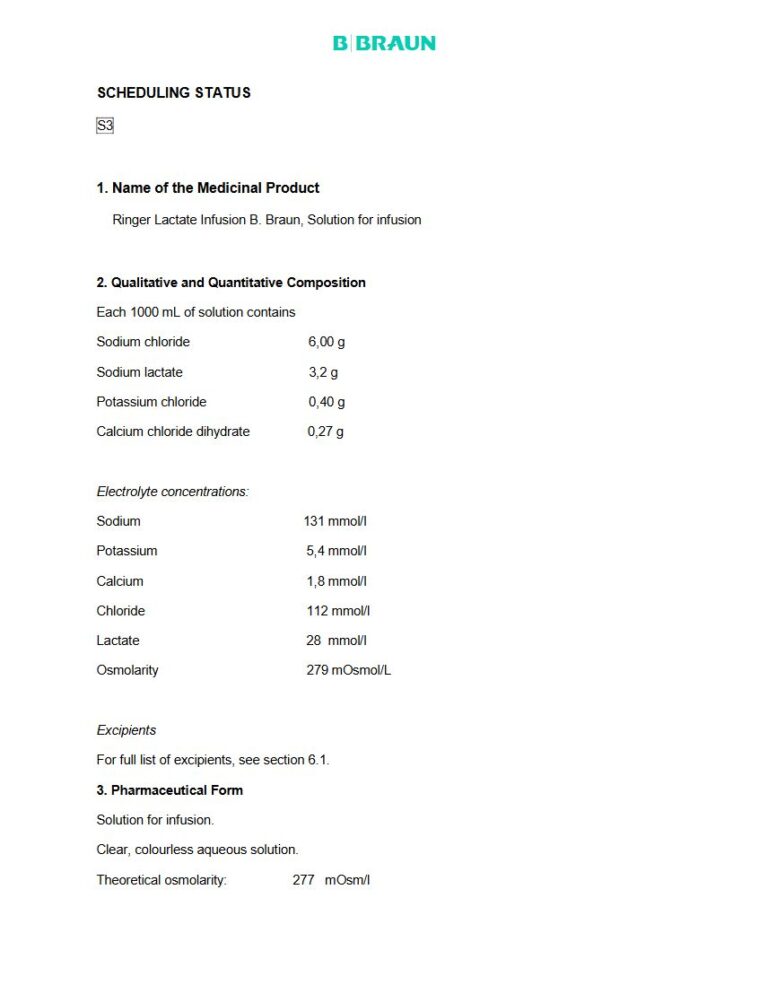
Ringer Lactate Infusion B. Braun 1000 mL Solution for infusion
PDF Leaflet Revision Date: 28 May 2021
Clinical Summary
Quick overview from the medicine insert
Indication
For reduced plasma volume due to burns, trauma, severe diarrhoea, and surgery.
Dosage (summary)
Infuse as prescribed, considering central venous pressure and blood pressure.
Special Populations
- Renal impairment
- Hepatic impairment
Pregnancy & Breastfeeding
Use with caution; lactate metabolism may be impaired in hypoxia or hepatic insufficiency.
Key Drug Interactions
- Corticosteroids may cause sodium retention
- Potassium-sparing diuretics may increase potassium levels
- Calcium may enhance digitalis effects
Contraindications
- Renal insufficiency
- Crush syndrome
- Severe hemolytic reactions
- Adrenocortical insufficiency
- Hyperkalaemia
- Hypernatraemia
Common side effects
- Electrolyte imbalances
- Oedema
- Nausea
Counselling Points
- Monitor serum electrolytes
- Administer cautiously in patients with renal or cardiac issues
- Do not mix with incompatible solutions
Serious warnings
- Risk of acute hyponatraemia
- Caution in cardiac or renal failure
- Avoid rapid correction of chronic hyponatraemia
Important Disclaimer
The Ringer Lactate Infusion B. Braun 1000 mL Solution for infusion professional information leaflet below is the property of B Braun Medical and is provided on Medinsert exactly as issued, with no.. alterations or editorial changes. We make every effort to keep content current by updating documents as soon as new versions become available. Medinsert serves as a trusted access point for healthcare professionals, but does not replace official sources or clinical judgement. For more details, please read our full disclaimer. read more>>
 Healthcare Professionals Only
This content is for registered healthcare professionals
Sign in or create a free account to read the full package insert.
Free for HPCSA-registered professionals. Powered by Medinsert.
Clinical Particulars
Section 4 of the official insert — extracted exactly as issued, no alterations
4.1. Therapeutic indications
Reduced plasma volume resulting from burns, trauma, severe diarrhoea and surgery. Reduced blood volumes resulting from haemorrhage.
4.2 Posology and method of administration
Infuse as prescribed, taking into consideration central venous pressure and blood pressure.
4.3. Contraindications
- Renal insufficiency (see also section 4.4)
- The crush syndrome
- Severe hemolytoic reactions
- Adrenocortical insufficiency
- Hyperkalaemia (see also section 4.4)
- Early postoperative oliguria, except when gastrointestinal drainage is being done
- Hypernatraemia (see also section 4.4)
4.4. Special warnings and precautions for use
This solution should only be administered with particular caution in the following conditions:
- hypertonic dehydration
- hyperkalaemia
- hypernatraemia
- hyperchloraemia
- hypercalcaemia
- hepatic insufficiency
High volume infusions must only be used under specific monitoring in patients with cardiac, renal or pulmonary failure lung or brain oedema, and in patients with non-osmotic vasopressin release (including SIADH), due to the risk of hospital-acquired hyponatraemia (see below).
Hyponatraemia Patients with non-osmotic vasopressin release (e.g. in acute illness, pain, post-operative stress, infections, burns, and CNS diseases), patients with heart-, liver- and kidney diseases and patients exposed to vasopressin agonists (see section 4.5) are at particular risk of acute hyponatraemia upon infusion of hypotonic fluids. Acute hyponatraemia can lead to acute hyponatraemic encephalopathy (cerebral oedema) characterized by headache, nausea, seizures, lethargy and vomiting. Patients with cerebral oedema are at particular risk of severe, irreversible and life-threatening brain injury. Children, women in the fertile age and patients with reduced cerebral compliance (e.g. meningitis, intracranial bleeding, cerebral contusion and brain oedema) are at particular risk of the severe and life-threatening brain swelling caused by acute hyponatraemia. Lactate utilisation may be impaired in the presence of hypoxia or hepatic insufficiency. Ringer Lactate Infusion B. Braun contains an amount of potassium that is similar to that of the physiological concentration of potassium in human blood. Nevertheless it is not suitable for the treatment of patients with severe potassium deficiency. As the solution contains metabolisable ions (e.g. lactate) it may cause metabolic alkalosis. Therefore the solution has to be administered with caution in patients with metabolic alkalosis. Solutions containing sodium chloride should be administered with caution to patients with cardiac insufficiency, peripheral oedema or extracellular hyper hydration, hypertension, impaired renal function, present or imminent eclampsia, aldosteronism or other conditions or treatment (e. g. corticoids/steroids) associated with sodium retention (see also section 4.5).
Solutions containing potassium salts should be administered with caution to patients with cardiac disease, conditions predisposing to hyperkalaemia such as renal or adrenocortical insufficiency, acute dehydration, or extensive tissue destruction as occurs with severe burns. Because of the presence of calcium: Care should be taken to prevent extravasation during intravenous infusion. The solution should be given cautiously to patients with impaired renal function or diseases associated with elevated vitamin D concentrations such as sarcoidosis. Thus administration of calcium containing solutions should be avoided in patients with nephroliths or with a history of nephroliths. In case of concomitant blood transfusion, the solution must not be administered via the same infusion set. Patients with chronic hyponatraemia: Too rapid correction of serum sodium levels must be avoided in patients with chronic hyponatraemia as rapid increases of serum sodium levels may in rare cases lead to osmotic adverse effects, e.g. the osmotic demyelinisation syndrome. Paediatric patients: The solution should be administered only with special care to newborns younger than 3 months. Use as vehicle solution: Please note: If this solution is used as vehicle solution the safety information of the additive provided by the respective manufacturer has to be taken into account. Clinical monitoring should include checks of serum electrolyte levels, acid-base balance and water balance. Serum lactate should be monitored carefully and if lactate accumulates during infusion, the dosage and infusion rate should be reduced or administration of the solution should eventually be discontinued. Only for polyethylene bottles and plastic bags: In case of pressure infusion, which may be necessary in vital emergencies, all air must be removed from the plastic container and the infusion set before the solution is administered.
4.5 Interaction with other medicinal products and other forms of interaction
Administration of Ringer Lactate Infusion B. Braun in accordance with the recommended indications and contraindications does not increase the plasma concentrations of the electrolytes contained in it. In case there is a rise of any electrolyteu2019s concentration due to other reasons the following interactions should be considered.
Related to sodium: Corticoids/steroids and carbenoxolone may be associated with the retention of sodium and water (with oedema and hypertension).
Related to potassium: Suxamethonium, potassium-sparing diuretics (amilorid, spironolactone, triamteren, alone or in association), ACE inhibitors (e.g. captopril, enalapril), Angiotensin II receptor antagonists (e.g. valsartan, losartan), tacrolimus, cyclosporine may increase the concentration of potassium in the plasma and lead to potentially fatal hyperkalaemia notably in case of renal failure increasing the hyperkalaemic effect.
Related to calcium: Digitalis glycosides (cardiac glycosides) may undergo enhancement of their effects during hypercalcaemia and lead to serious or fatal cardiac arrhythmia. Thiazid-diuretics and Vitamin D administered simultaneously with calcium may induce hypercalcaemia. If bisphosphonates, fluorides, several fluorchinolones and tetracyclines are administered simultaneously with calcium containing solutions the bioavailability (reduced absorption) of above named medicinal products may be reduced.
Related to lactate: The administration of bicarbonate or bicarbonate precursor like lactate leads to alkalinisation of the urine with increased renal clearance of acidic drugs (e.g. salicylic acid). The half-life of basic medicinal products u2013 especially sympathomimetics (e.g. ephedrine, pseudoephedrine) and stimulants (e.g. dexamphetaminesulphate, fenfluramine hydrochloride) will be prolonged if lactate containing solutions are administered simultaneously. Drugs leading to an increased vasopressin effect: The below listed drugs increase the vasopressin effect, leading to reduced renal electrolyte free water excretion and may increase the risk of hospital acquired hyponatraemia following inappropriately balanced treatment with i.v. fluids (see sections 4.2, 4.4 and 4.8). Drugs stimulating vasopressin release include: Chlorpropamide, clofibrate, carbamazepine, vincristine, selective serotonin reuptake inhibitors, 3.4-methylenedioxy-N, methamphetamine, ifosfamide, antipsychotics, narcotics. Drugs potentiating vasopressin action include: Chlorpropamide, NSAIDs, cyclophosphamide. Vasopressin analogues include: Desmopressin, oxytocin, vasopressin, terlipressin. Other medicinal products increasing the risk of hyponatraemia also include diuretics in general and antiepileptics such as oxcarbazepine.
4.9 Overdose
Symptoms: Overdose may result in hyperhydration with increased skin tension, venous congestion, oedema - possibly also lung or brain oedema -, electrolyte and acid-base imbalances as well as serum hyperosmolarity.
Treatment: Cessation of infusion, administration of diuretics with continuous monitoring of serum electrolytes, correction of electrolyte and acid-base imbalances. In severe cases of overdose dialysis may be necessary.
