
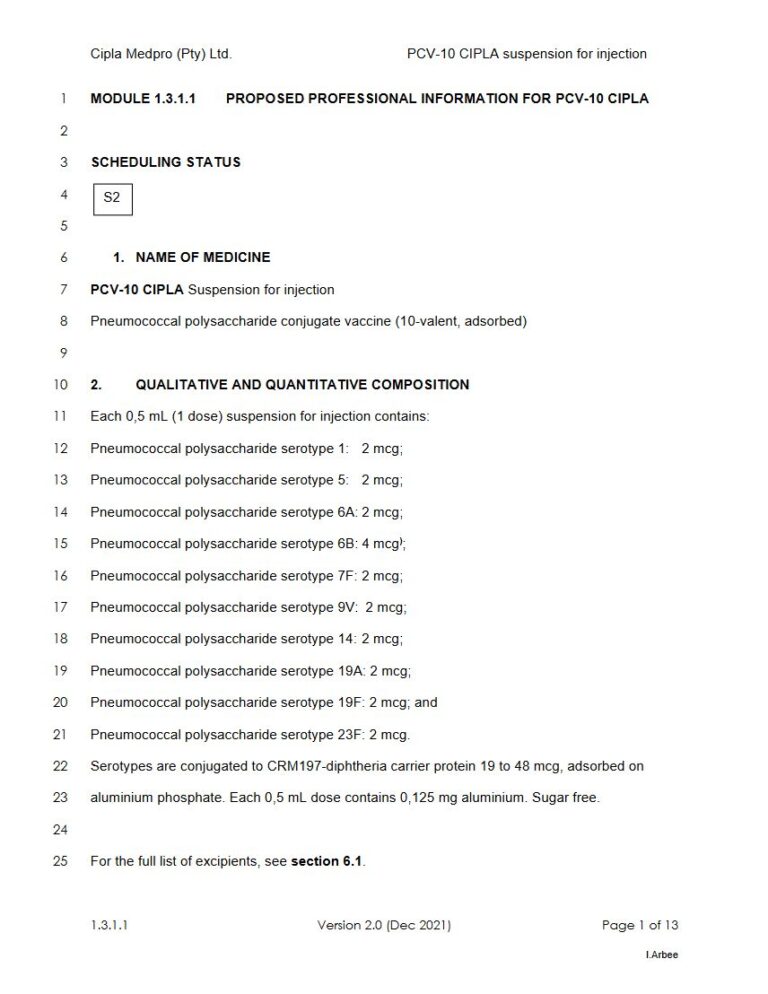
Pcv-10 Cipla 2,0 μg, 4,0 μg SUSPENSION FOR INJECTION
PDF Leaflet Revision Date: December 2021
Clinical Summary
Quick overview from the medicine insert
Indication
Active immunization against invasive disease caused by Streptococcus pneumoniae in infants and toddlers.
Dosage (summary)
Administered intramuscularly as a three-dose series starting at 6 weeks of age.
Special Populations
- Premature infants
- Children with HIV
- Children with splenic dysfunction
Pregnancy & Breastfeeding
No data available on safety during pregnancy and breastfeeding.
Key Drug Interactions
- Can be co-administered with other vaccines
Contraindications
- Hypersensitivity to any component of the vaccine
Common side effects
- Tenderness at injection site
- Fever
- Irritability
Counselling Points
- Shake well before use
- Inspect for foreign particles before administration
- Monitor for allergic reactions
Serious warnings
- Anaphylaxis risk; adrenaline must be available during vaccination
Important Disclaimer
The Pcv-10 Cipla 2,0 μg, 4,0 μg SUSPENSION FOR INJECTION professional information leaflet below is the property of Cipla Medpro and is provided on Medinsert exactly as issued, with no.. alterations or editorial changes. We make every effort to keep content current by updating documents as soon as new versions become available. Medinsert serves as a trusted access point for healthcare professionals, but does not replace official sources or clinical judgement. For more details, please read our full disclaimer. read more>>
 Healthcare Professionals Only
This content is for registered healthcare professionals
Sign in or create a free account to read the full package insert.
Free for HPCSA-registered professionals. Powered by Medinsert.
Clinical Particulars
Section 4 of the official insert — extracted exactly as issued, no alterations
4.1. Therapeutic indications
Active immunisation against invasive disease, pneumonia and acute otitis media caused by Streptococcus pneumoniae serotypes 1, 5, 6A, 6B, 7F, 9V, 14, 19A, 19F and 23F in infants and toddlers from 6 weeks up to 2 years of age. The use of vaccine should be determined on the basis of relevant recommendations and take into consideration the disease impact by age and regional epidemiology.
4.2. Posology and method of administration
PCV - 10 CIPLA is given intramuscularly, with care to avoid injection into or near nerves and blood vessels. PCV - 10 CIPLA is a suspension containing an adjuvant, it must be shaken vigorously immediately prior to use to obtain a homogenous, whitish turbid suspension in the vaccine container.
PCV - 10 CIPLA should be visually inspected for any foreign particulate matter and/or variation of physical aspect prior to administration. In event of either being observed, discard the vaccine.
Vaccination schedule:
- PCV - 10 CIPLA is to be administered as a three-dose primary series at dosing schedule from six weeks of age. A booster dose is to be administered at 9 u2013 10 or 12 u2013 15 months of age. The minimum interval between doses should be 4 weeks. If a booster dose is given, it should be at least 6 months after the last primary dose.
Table 1: Vaccination schedule for infants and toddlers
Dosage schedules
- Dose 1: 6 weeks
- Dose 2: 10 weeks
- Dose 3: 14 weeks
- Dose 4: 9 to 10 months or 12 to 15 months
For children who are beyond the age of routine infant schedule, the following schedule is proposed:
The catch-up schedule, for children aged 7 to 24 months who have not received PCV - 10 CIPLA is as follows:
Table 2: Vaccination schedule for unvaccinated children aged 7 to 24 months of age
Dosage schedules
- Total number of 0.5 mL doses: 7 to 11 months: 3 doses; 12 to 24 months: 2 doses.
Method of administration:
PCV - 10 CIPLA should be given by intramuscular injection. The preferred sites are anterolateral aspect of the thigh in infants or the deltoid muscle of the upper arm in young children. The vaccine should not be injected in the gluteal area. Do not administer PCV - 10 CIPLA intravascularly. The vaccine should not be injected intradermally, subcutaneously or intravenously, since the safety and immunogenicity of these routes have not been evaluated.
4.3. Contraindications
Hypersensitivity to any component of the vaccine, including diphtheria toxoid.
4.4. Special warnings and precautions for use
Appropriate medical treatment and supervision must always be readily available in case of a rare anaphylactic event following the administration of the vaccine. Hydrocortisone and antihistaminics should also be available in addition to supportive measures such as oxygen inhalation and IV fluids.
ADRENALINE INJECTION (1:1000) MUST BE IMMEDIATELY AVAILABLE SHOULD AN ACUTE ANAPHYLACTIC REACTION OCCUR DUE TO ANY COMPONENT OF THE VACCINE. The mainstay in the treatment of severe anaphylaxis is the prompt use of adrenaline, which can be lifesaving. It should be used at the first suspicion of anaphylaxis.
Special care should be taken to ensure that the injection does not enter a blood vessel (see section 4.2). It is extremely important when the parent, guardian returns for the next dose in the series, the parent and guardian should be questioned concerning occurrence of any symptoms and/or signs of an adverse reaction after the previous dose.
Minor illnesses, such as mild respiratory infection, with or without low grade fever, are not generally contraindications to vaccination. The decision to administer or delay vaccination because of a current or recent febrile illness depends largely on the severity of the symptoms and their aetiology. The administration of PCV - 10 CIPLA should be postponed in subjects suffering from acute severe febrile illness. As with any intramuscular injection, PCV - 10 CIPLA should be given with caution to infants or children with thrombocytopenia or any coagulation disorder, or to those receiving anticoagulant therapy. PCV - 10 CIPLA is not intended to be used for treatment of active infection. As with any vaccine, PCV - 10 CIPLA may not protect all individuals receiving the vaccine from pneumococcal disease.
Safety and immunogenicity data on PCV - 10 CIPLA are not available for children in specific groups at higher risk for invasive pneumococcal disease (e.g., children with congenital or acquired splenic dysfunction, HIV infection, malignancy, nephrotic syndrome). Children in these groups may have reduced antibody response to active immunisation due to impaired immune responsiveness. Limited data have demonstrated that other pneumococcal conjugate vaccines induce an immune response in children with HIV, sickle cell disease, and children born prematurely with a safety profile similar to that observed in non-high-risk groups. The use of PCV - 10 CIPLA in high-risk groups should be considered on an individual basis.
Apnoea in premature infants: Based on experience with use of other pneumococcal conjugate vaccines, the potential risk of apnoea and the need for respiratory monitoring for 48 u2013 72 hours should be considered when administering the primary immunisation series to very premature infants (born u2264 28 weeks of gestation) and particularly for those with a previous history of respiratory immaturity. As the benefit of vaccination is high in this group of infants, vaccination with PCV - 10 CIPLA should not be withheld or delayed.
4.5. Interactions with other medicines and other forms of interaction
PCV - 10 CIPLA can be given with any of the following vaccine antigens, either as monovalent or combination vaccines: diphtheria, tetanus, whole-cell pertussis, Haemophilus influenzae type b, inactivated or oral poliomyelitis, rotavirus, yellow fever, hepatitis B, measles and rubella. Clinical studies demonstrated that the immune responses and the safety profiles of the administered vaccines were unaffected. Studies with other pneumococcal conjugate vaccines co-administered with mumps, varicella, meningococcal ACWY, and rotavirus vaccines have demonstrated that the immune responses of the other pneumococcal conjugate vaccines and the co-administered vaccines were unaffected. In clinical trials, when other pneumococcal conjugate vaccines were given concomitantly but at a different site/route, with rotavirus vaccine or hepatitis A vaccine, no change in the safety profiles for these infants was observed. Different injectable vaccines should always be given at different injection sites. Till date PCV - 10 CIPLA clinical studies have been conducted in India and The Gambia in toddlers and infants. In the Gambia Phase I/II study, there was no evidence that administration of PCV - 10 CIPLA interfered with the immune response to any component of co-administered pentavalent vaccine. In the Gambia Phase 3 study, non-inferiority of the immune responses induced by EPI vaccines between treatment groups was demonstrated for all EPI vaccines co-administered during the 3-dose primary vaccination series (6 weeks, 10 weeks and 14 weeks) u2013 namely, whole-cell pentavalent vaccine (DTwP-HepB-Hib) oral polio vaccine, inactivated polio vaccine, and oral rotavirus vaccine. Standard EPI vaccines based on the Gambian EPI schedule (measles-rubella vaccine and yellow fever virus vaccine) were co-administered with the booster dose of study vaccine. Non-inferiority of the immune responses was demonstrated for these co-administered EPI vaccines. While there are no known published data on co-administration of other pneumococcal conjugate vaccine with yellow fever virus vaccine, the high sero-response rate to yellow fever in the PCV - 10 CIPLA group indicates PCV - 10 CIPLA does not interfere with the immune response to yellow fever virus vaccine.
4.6. Fertility, pregnancy and lactation
There are no data on pregnancy and breastfeeding.
4.7. Effects on ability to drive and use machines
Data on u201cEffects on ability to drive and use machinesu201d are not available.
4.8. Undesirable effects
Summary of safety profile: Safety assessment of PCV - 10 CIPLA was based on clinical trials involving the administration of 5416 doses to 1828 healthy children as primary immunisation. Furthermore, 428 children received a booster dose of PCV - 10 CIPLA following a primary vaccination course. PCV - 10 CIPLA was administered concomitantly with recommended childhood vaccines, as appropriate.
Safety was also assessed in 57 previously unvaccinated children during the second year of life; all children received 2 doses of vaccine. PCV - 10 CIPLA has also been used for booster vaccination in 56 children who received another pneumococcal conjugate vaccine for the primary course. The vast majority of the reactions observed following vaccination were of mild or moderate severity and were of short duration. In the largest study in infants, the most common adverse reactions observed after primary vaccination were tenderness at the injection site, fever and irritability, which were reported for approximately 49%, 52% and 32% of all infants, respectively. No increase in the incidence or severity was observed following subsequent doses of the primary vaccination course. Following booster vaccination, the most common adverse reaction was tenderness at the injection site, which was reported for approximately 8% of all infants. The Indian Phase 3 licensure study in infants similarly showed tenderness at the injection site, fever and irritability as the most common adverse reactions observed after primary vaccination, with no change in the incidence or severity observed following subsequent doses of the primary vaccination course. Majority of the solicited AEs were of mild to moderate intensity and resolved completely.
The injection site and systemic reactions following catch-up vaccination or booster during the second year of life were similar to those reported after primary vaccination. In all studies, the incidence and severity of local and general adverse reactions reported within 7 days of vaccination were similar to those after vaccination with the licensed comparator PCV.
List of adverse reactions:
Adverse reactions (i.e. events considered as related to vaccination) have been categorised by frequency for all age groups. Frequencies are reported as:
- Very common (u2265 1/10 vaccinees)
- Common (u2265 1/100 vaccinees but < 1/10 vaccinees)
- Uncommon (u22651/1000 vaccinees but < 1/100 vaccinees)
- Rare (u22651/10000 vaccinees but < 1/1000 vaccinees)
Infections and infestation:
Very common: upper respiratory tract infection.
Immune system disorders:
Frequency not known: anaphylaxis (see section 4.4)
Metabolism and nutrition disorders:
Common: decreased appetite.
Psychiatric disorders:
Very common: irritability.
Nervous system disorders:
Common: drowsiness.
Gastrointestinal disorders:
Uncommon: diarrhoea.
General disorders and administration site conditions:
Very common: pain, fever > 37.5 u00b0C.
Common: erythema, swelling/induration.
Uncommon: fever > 39 u00b0C.
Skin and subcutaneous tissue disorders:
Common: rash.
Reporting of suspected adverse reactions: If you get side effects, talk to your doctor, pharmacist or nurse. You can also report side effects to SAHPRA via the u201c6.04 Adverse Drug Reaction Reporting Formu201d, found online under SAHPRAu2019s publications: https://www.sahpra.org.za/Publications/Index/8. By reporting side effects, you can help provide more information on the safety of PCV - 10 CIPLA. You may also report any suspected side effects (to Cipla Medpro (Pty) Ltd) by e-mail: [email protected] or telephone: 080 222 6662 (toll free).
4.9. Overdose
In overdose, side effects can be precipitated and/or be of increased severity. (see section 4.8)
