
Migrex 50 50 mg Tablet
PDF Leaflet Revision Date: 18 January 2022
Clinical Summary
Quick overview from the medicine insert
Indication
Acute relief of migraine attacks.
Dosage (summary)
Initial dose 50 mg, may increase to 100 mg; max 300 mg in 24 hours.
Onset of Action / Duration
Onset: 30 mins, Duration: Not specified
Special Populations
- Hepatic impairment
- Renal impairment
Pregnancy & Breastfeeding
Safety in pregnancy not established; excreted in breast milk.
Key Drug Interactions
- Ergotamine
- MAOIs
- SSRIs
- SNRIs
Contraindications
- Hypersensitivity to sumatriptan
- Ischaemic heart disease
- Severe hypertension
- CVA or TIA history
- Severe hepatic impairment
Common side effects
- Dizziness
- Drowsiness
- Nausea
- Chest pain
- Flushing
Counselling Points
- Take at onset of migraine
- Do not exceed recommended dose
- Avoid in uncontrolled hypertension
- Monitor for allergic reactions
Serious warnings
- Risk of ischaemic heart disease
- Serotonin syndrome risk
- Caution in patients with cardiovascular risk factors
Important Disclaimer
The Migrex 50 50 mg Tablet professional information leaflet below is the property of Sandoz Sa 1 and is provided on Medinsert exactly as issued, with no.. alterations or editorial changes. We make every effort to keep content current by updating documents as soon as new versions become available. Medinsert serves as a trusted access point for healthcare professionals, but does not replace official sources or clinical judgement. For more details, please read our full disclaimer. read more>>
 Healthcare Professionals Only
This content is for registered healthcare professionals
Sign in or create a free account to read the full package insert.
Free for HPCSA-registered professionals. Powered by Medinsert.
Clinical Particulars
Section 4 of the official insert — extracted exactly as issued, no alterations
4.1 Therapeutic indications
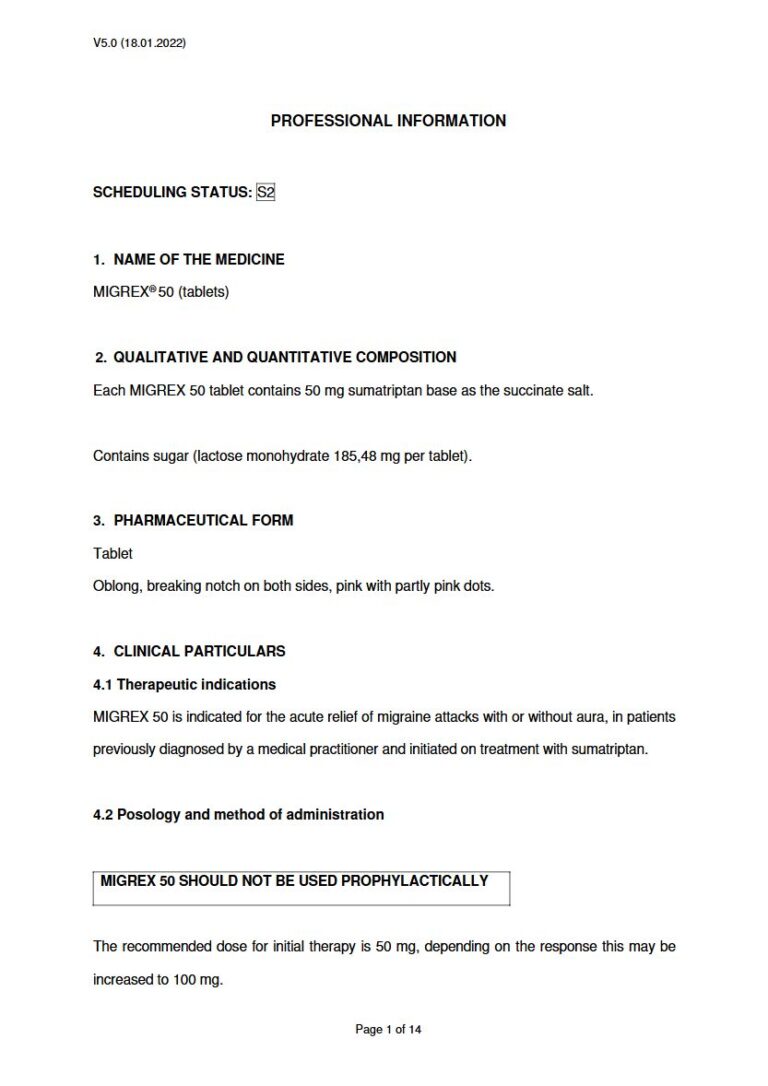
MIGREX 50 is indicated for the acute relief of migraine attacks with or without aura, in patients previously diagnosed by a medical practitioner and initiated on treatment with sumatriptan.
4.2 Posology and method of administration
MIGREX 50 SHOULD NOT BE USED PROPHYLACTICALLY. The recommended dose for initial therapy is 50 mg, depending on the response this may be increased to 100 mg.
If symptoms recur, a further dose may be given at any time in the next 24 hours provided not more than 300 mg (6 x 50 mg tablets) are taken in any 24-hour period and that each dose is separated by at least two hours. A second dose has not proven to provide relief if the first dose did not have a beneficial effect on the migraine.
The tablet should be swallowed whole with water. The dose of MIGREX 50 should be reduced in patients with impaired liver function. It is recommended that MIGREX 50 be administered as early as possible after the onset of migraine; however, it is equally effective at whatever stage of the attack it is given.
4.3 Contraindications
- MIGREX 50 is contraindicated in patients with hypersensitivity to sumatriptan or to any of the excipients listed in section 6.1.
- MIGREX 50 should not be used in patients who have had ischaemic cerebrovascular disease, myocardial infarction or have ischaemic heart disease, coronary vasospasm (Prinzmetal's angina), peripheral vascular disease or patients who have symptoms or signs consistent with ischaemic heart disease.
- Sumatriptan should not be administered to patients with a history of cerebrovascular accident (CVA) or transient ischaemic attack (TIA).
- MIGREX 50 is contraindicated in patients with moderate and severe hypertension and mild uncontrolled hypertension.
- The concomitant use of MIGREX 50 and ergotamine containing preparations or derivatives of ergotamine (including methysergide) or any triptan / 5-hydroxytryptamine 1 (5-HT 1) receptor agonist is contraindicated (see section 4.5).
- Concurrent administration of Monoamine Oxidase Inhibitors (MAOIs) or use within two weeks of discontinuation of MAOI therapy is contraindicated.
- MIGREX 50 should not be administered to patients with severe hepatic impairment.
- MIGREX 50 is not indicated for use in the management of hemiplegic, basilar or ophthalmoplegic migraine.
- Patients with known hypersensitivity to sulphonamides may exhibit an allergic reaction following administration of MIGREX 50. Reactions may range from cutaneous hypersensitivity to anaphylaxis. Caution should be exercised before using MIGREX 50 in these patients.
4.4 Special warnings and precautions for use
MIGREX 50 should only be used where there is a clear diagnosis of migraine. Sumatriptan is not indicated for use in the management of hemiplegic, basilar or ophthalmoplegic migraine. Following administration of MIGREX 50, patients with known hypersensitivity to sulphonamides can experience an allergic reaction. Hypersensitivity reactions may range from cutaneous hypersensitivity to anaphylaxis. Evidence of cross-sensitivity is limited, however, caution should be exercised before using sumatriptan in these patients.
Following administration, the use of MIGREX 50 can be associated with transient symptoms, including chest pain and chest tightness, which may be intense and involve the throat (see section 4.8). Where such symptoms are thought to indicate ischaemic heart disease, no further dose of MIGREX 50 should be given and appropriate evaluation should be carried out. The recommended dose of MIGREX 50 should not be exceeded.
Before treating headaches in patients not previously diagnosed as migraineurs, and in migraineurs who present with atypical symptoms, care should be taken to exclude other potentially serious neurological conditions. It should be noted that migraineurs may be at risk of certain cerebrovascular events (e.g. cerebrovascular accident, transient ischaemic attack).
MIGREX 50 should not be given to patients with risk factors for ischaemic heart disease, including those patients who are heavy smokers or users of nicotine substitution therapies without prior evaluation for underlying cardiovascular disease (see section 4.3). Such patients include postmenopausal women, males over 40 years of age and patients with risk factors for coronary artery disease. However, these evaluations may not identify every patient who has cardiac disease. Serious cardiac events have occurred in patients without underlying cardiovascular disease (see section 4.8).
MIGREX 50 should be administered with caution to patients with mild controlled hypertension as transient increases in blood pressure and peripheral vascular resistance have been observed in a small proportion of patients (see section 4.3).
There have been rare post-marketing reports describing patients with serotonin syndrome (including altered mental status, autonomic instability and neuromuscular abnormalities) following the use of a selective serotonin reuptake inhibitor (SSRI) and sumatriptan. Serotonin syndrome has been reported following concomitant treatment with triptans and serotonin noradrenaline reuptake inhibitors (SNRIs). If concomitant treatment with MIGREX 50 and a Selective Serotonin Reuptake Inhibitor (SSRI) / Serotonin Noradrenaline Reuptake Inhibitors (SNRI) is clinically warranted, appropriate observation of the patient is advised (see section 4.5).
Sumatriptan should be administered with caution to patients with conditions which may affect significantly the absorption, metabolism or excretion of medicines, e.g. impaired hepatic (Child Pugh grade A or B; see section 5.2) or renal function (see section 5.2). A 50 mg dose should be considered in patients with hepatic impairment.
MIGREX 50 should be used with caution in patients with a history of epilepsy or structural brain lesions which lower their seizure threshold, as seizures have been reported in association with sumatriptan (see section 4.8).
Undesirable effects may be more common during concomitant use of triptans and herbal preparations containing St. Johnu2019s Wort (Hypericum perforatum). Prolonged use of any type of painkiller for headaches can make them worse. If this situation is experienced or suspected, medical advice should be obtained and treatment should be discontinued. The diagnosis of medication overuse headache (MOH) should be suspected in patients who have frequent or daily headaches despite (or because of) the regular use of headache medications.
Contains lactose which may have an effect on the glycaemic control of patients with diabetes mellitus. Patients with the rare hereditary problems of galactose intolerance, total lactase deficiency or glucose-galactose malabsorption should not take MIGREX 50.
Children (under 18 years of age) and patients over 65 years: The safety and effectiveness of MIGREX 50 in children (under 18 years of age) and patients over 65 years has not yet been established.
4.5 Interaction with other medicines and other forms of interaction
There are limited data on an interaction with preparations containing ergotamine or another triptan/5-HT 1 receptor agonist. The increased risk of coronary vasospasm is a theoretical possibility and concomitant administration is contraindicated (see section 4.3).
The period of time that should elapse between the use of MIGREX 50 and ergotamine-containing preparations or another triptan/5-HT 1 receptor agonist is not known. This will also depend on the doses and types of products used. Since these effects may be additive, 24 hours should pass before MIGREX 50 can be administered following an ergotamine preparation or another triptan/5-HT 1 receptor agonist. Conversely, it is advised to wait at least 6 hours following use of MIGREX 50 before administering an ergotamine containing product and at least 24 hours before administering another triptan/5-HT 1 receptor agonist.
There is no evidence of interactions with flunarizine, propranolol, dihydroergotamine, pizotifen or alcohol. An interaction may occur between MIGREX 50 and monoamine oxidase inhibitors (MAOIs) and concomitant administration is contraindicated (see section 4.3).
There have been rare post-marketing reports describing patients with serotonin syndrome (including altered mental status, autonomic instability and neuromuscular abnormalities) following the use of SSRIs and MIGREX 50. Serotonin syndrome has also been reported following concomitant treatment with triptans and SNRIs (see section 4.4).
4.6 Fertility, pregnancy and lactation
Pregnancy: Safety in pregnancy has not been established.
Breastfeeding: It has been demonstrated that following subcutaneous administration MIGREX 50 is excreted into breast milk. Infant exposure can be minimised by avoiding breastfeeding your baby for 12 hours after treatment, during which time any breast milk expressed should be discarded.
4.7 Effects on ability to drive and use machines
No studies on the effects on the ability to drive and use machines have been performed. Drowsiness may occur as a result of migraine or treatment with MIGREX 50. This may influence the ability to drive and to operate machinery.
4.8 Undesirable effects
Immune system disorders
Frequency not known: Hypersensitivity reactions ranging from cutaneous hypersensitivity to anaphylaxis.
Psychiatric disorders
Frequency not known: Anxiety
Nervous system disorders
Frequent: Dizziness, drowsiness, sensory disturbance including paraesthesia and hypoaesthesia.
Frequency not known: Seizures, although some have occurred in patients with either a history of seizures or concurrent conditions predisposing to seizures. There are also reports in patients where no such predisposing factors are apparent. Tremor, dystonia, nystagmus, scotoma.
Eye disorders
Frequency not known: Flickering, diplopia, reduced vision, loss of vision including reports of permanent defects. However, visual disorders may also occur during a migraine attack itself.
Cardiac disorders
Frequency not known: Angina, flushing, transient increases in blood pressure, peripheral vascular resistance, bradycardia, hypotension, palpitations, tachycardia, coronary artery vasospasm. In extremely rare cases, serious coronary events have been reported which have included cardiac arrhythmias, transient ischaemic ECG changes or myocardial infarction. Thus, MIGREX 50 should not be given to patients in whom unrecognised cardiac disease is likely without a prior evaluation for underlying cardiovascular disease. These patients include males over 40 years of age, postmenopausal women and patients with risk factors for coronary disease. If any symptoms that are consistent with ischaemic heart disease occur, appropriate evaluation must be performed.
Vascular disorders
Frequent: Transient increases in blood pressure arising soon after treatment, flushing
Frequency not known: Hypotension, Raynaudu2019s phenomenon
Respiratory, thoracic and mediastinal disorders
Frequent: Dyspnoea
Gastrointestinal disorders
Frequent: Nausea and vomiting occurred in some patients but it is unclear if this is related to sumatriptan or the underlying condition.
Frequency not known: Ischaemic colitis, diarrhoea, dysphagia.
Hepato-biliary disorders
Frequency not known: Disturbances in liver function tests have been observed. MIGREX 50 should also be administered with caution to patients with diseases which may alter the absorption, metabolism or excretion of medicines, such as impaired hepatic function. Lower doses should be considered in patients with hepatic impairment.
Skin and subcutaneous tissue disorders
Frequency not known: Hyperhidrosis
Musculoskeletal and connective tissue disorders
Frequent: Sensations of heaviness (usually transient and may be intense and can affect any part of the body including the chest and throat), myalgia.
Frequency not known: Neck stiffness, arthralgia
General disorders and administration site conditions
Frequent: Pain, sensations of tingling, heat or cold, pressure or tightness (these events are usually transient and may be intense and can affect any part of the body including the chest and throat), dizziness and feelings of weakness, fatigue and drowsiness (both events are mostly mild to moderate in intensity and transient).
Frequency not known: Pain trauma activated, pain inflammation activated, heaviness.
Investigations
Less frequent: Minor disturbances in liver function tests have occasionally been observed.
Reporting of suspected adverse reactions: Reporting suspected adverse reactions after authorisation of the medicine is important. It allows continued monitoring of the benefit/risk balance of the medicine. Healthcare providers are asked to report any suspected adverse reactions to SAHPRA via the u201c6.04 Adverse Drug Reactions Reporting Formu201d, found online under SAHPRAu2019s publications: https://www.sahpra.org.za/Publications/Index/8.
Suspected adverse reactions can also be reported directly to the HCR via [email protected].
4.9 Overdose
Doses in excess of 400 mg orally were not associated with side effects other than those mentioned. If overdosage occurs, the patient should be monitored for at least ten hours and standard supportive treatment applied as required. It is unknown what effect haemodialysis or peritoneal dialysis has on the plasma concentrations of MIGREX 50.
