
Surogran 50 Mg/100 Mg Tablets
PDF Leaflet Revision Date: 26 February 2021
Clinical Summary
Quick overview from the medicine insert
Indication
Acute relief of migraine attacks with or without aura.
Dosage (summary)
Initial dose 50 mg, may increase to 100 mg; max 3 x 100 mg or 6 x 50 mg in 24 hours.
Onset of Action / Duration
Onset: 30 mins, Duration: 6-8 hours
Special Populations
- Hepatic impairment
- Elderly
- Children under 18
Pregnancy & Breastfeeding
Safety in pregnancy and lactation not established.
Key Drug Interactions
- Ergotamine
- MAOIs
- SSRIs
Contraindications
- Hypersensitivity to components
- Myocardial infarction
- Ischaemic heart disease
- Uncontrolled hypertension
- Severe hepatic impairment
Common side effects
- Chest pain
- Nausea
- Dizziness
- Fatigue
- Drowsiness
Counselling Points
- Use only for diagnosed migraine
- Avoid operating machinery if drowsy
- Monitor for cardiovascular symptoms
Serious warnings
- Risk of allergic reactions
- Transient chest symptoms may mimic angina
- Caution in cardiovascular disease
Important Disclaimer
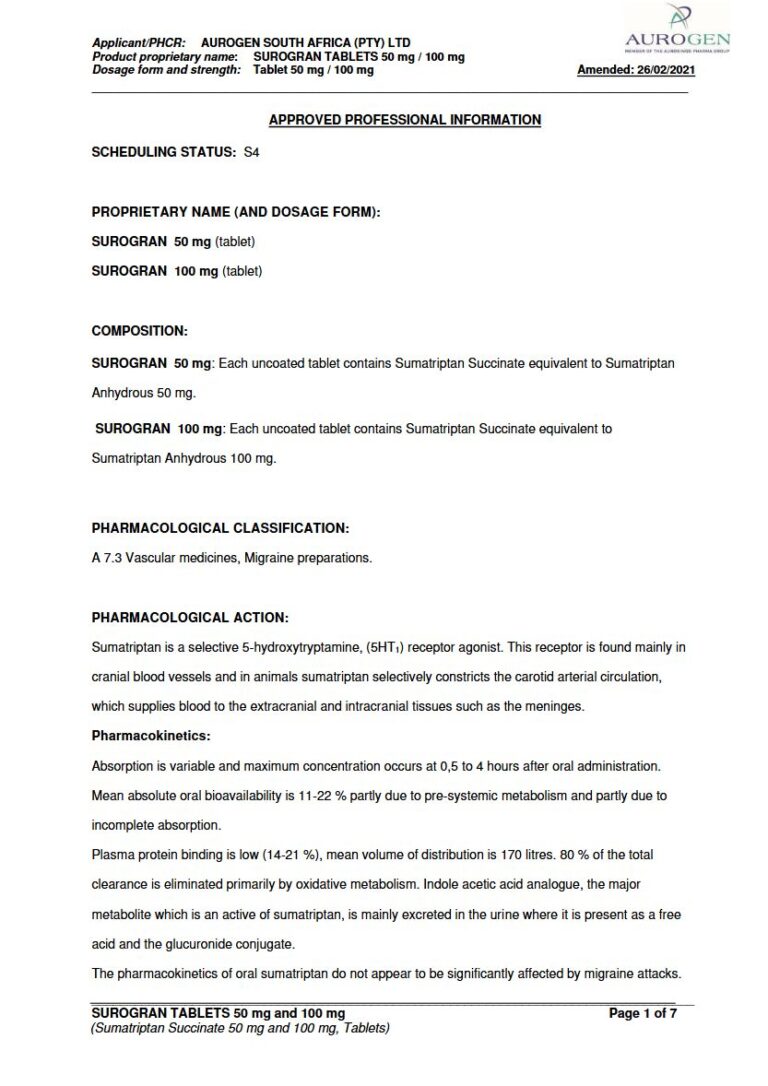
The Surogran 50 Mg/100 Mg Tablets professional information leaflet below is the property of Aurogen South Africa and is provided on Medinsert exactly as issued, with no.. alterations or editorial changes. We make every effort to keep content current by updating documents as soon as new versions become available. Medinsert serves as a trusted access point for healthcare professionals, but does not replace official sources or clinical judgement. For more details, please read our full disclaimer. read more>>
 Healthcare Professionals Only
This content is for registered healthcare professionals
Sign in or create a free account to read the full package insert.
Free for HPCSA-registered professionals. Powered by Medinsert.
Clinical Particulars
Section 4 of the official insert — extracted exactly as issued, no alterations
4.1 Therapeutic indications
SUROGRAN is indicated for the acute relief of migraine attacks with or without aura.
4.2 Posology and method of administration
SUROGRAN is indicated for the acute intermittent treatment of migraine. SUROGRAN SHOULD NOT BE USED PROPHYLACTICALLY.
Tablets: The recommended dose for initial therapy is 50 mg, depending on response this may be increased to 100 mg. If symptoms recur, a further dose may be given at any time in the next 24 hours provided not more than 3 x 100 mg tablets or 6 x 50 mg tablets are taken in any 24 hour period and that each dose is separated by at least two hours. A second dose has not proven to provide relief if the first dose did not have a beneficial effect on the migraine. The tablet should be swallowed whole with water. The dose of SUROGRAN should be reduced in patients with impaired liver function. It is recommended that SUROGRAN be administered as early as possible after the onset of migraine however it is equally effective at whatever stage of the attack it is given.
4.3 Contraindications
SUROGRAN is contra-indicated in patients with hypersensitivity to any component of the preparation. Following administration of SUROGRAN patients with known hypersensitivity to sulphonamides can experience an allergic reaction. Hypersensitivity reactions may range from cutaneous hypersensitivity to anaphylaxis. SUROGRAN should not be used in patients who have had a myocardial infarction, ischaemic heart disease, Prinzmetalu2019s angina/coronary vasospasm or ischaemic cerebro-vascular disease. SUROGRAN is not recommended in patients with uncontrolled hypertension. The concomitant use of SUROGRAN and ergotamine containing preparations is contra-indicated. Concurrent administration of monoamine oxidase inhibitors or use within two weeks of discontinuation of MAOI therapy is contra-indicated. SUROGRAN should not be administered to patients with severe hepatic impairment. SUROGRAN is not indicated for use in the management of hemiplegic, basilar or ophthalmoplegic migraine.
4.4 Special warnings and precautions for use
Following administration of SUROGRAN patients with known hypersensitivity to sulphonamides can experience an allergic reaction. Hypersensitivity reactions may range from cutaneous hypersensitivity to anaphylaxis. The use of SUROGRAN can be associated with transient symptoms, including chest pain and chest tightness, which may be intense and involve the throat. Although these symptoms can mimic angina pectoris, they are only in exceptional circumstances the result of myocardial ischaemia/coronary vasospasm. The recommended dose of SUROGRAN should not be exceeded. Drowsiness may occur as a result of migraine or its treatment with SUROGRAN. Caution is advised in patients performing skilled tasks, e.g. operating machinery or driving. SUROGRAN should only be used where there is clear diagnosis of migraine. Before treating headaches in patients not previously diagnosed as migraineurs, and in migraineurs who present with atypical symptoms, care should be taken to exclude other potentially serious neurological conditions. It should be noted that migraineurs may be at risk of certain cerebrovascular events (e.g. CVA, TIA). SUROGRAN should not be given to patients in whom unrecognised cardiac disease is likely without a prior evaluation for underlying cardiovascular disease. Such patients include postmenopausal women, males over 40 years of age and patients with risk factors for coronary artery disease. However, these evaluations may not identify every patient who has cardiac disease. Serious cardiac events have occurred in patients without underlying cardiovascular disease. SUROGRAN should be administered with caution to patients with controlled hypertension as increases in blood pressure and peripheral vascular resistance have been observed. If concomitant treatment with SUROGRAN and a selective serotonin reuptake inhibitor (SSRI) is clinically warranted, appropriate observation of the patient is advised as there is a risk of serotonin syndrome (see u201cInteractionsu201d). SUROGRAN should be used with caution in patients with a history of epilepsy or structural brain lesions, which lower their convulsion threshold. Children (under 18 years of age) and patients aged more than 65 years: The safety and effectiveness of SUROGRAN in children (under 18 years of age) and patients over 65 years has not yet been established.
4.5 Interactions with other medicines
Prolonged vasospastic reactions have been reported with ergotamine. Since these effects may be additive, 24 hours should pass before SUROGRAN can be administered following an ergotamine preparation. Conversely, ergotamine containing preparations should not be taken until 6 hours having passed following SUROGRAN administration. There is no evidence of interactions with flunarizine, propranolol, dihydroergotamine, pizotifen or alcohol. An interaction may occur between SUROGRAN and MAOIu2019s and concomitant administration is contraindicated. Rarely an interaction may occur between SUROGRAN and SSRIs.
4.6 Fertility, pregnancy and lactation
Safety in pregnancy and lactation has not been established.
4.7 Effects on ability to drive and use machines
Drowsiness may occur as a result of migraine or its treatment with SUROGRAN. Caution is advised in patients performing skilled tasks, e.g. operating machinery or driving.
4.8 Undesirable effects
Side-effects which have been reported include the following: Cardiac Disorders Less frequent: chest-pain, sensations of tingling, heaviness, heat, pressure or tightness. These symptoms are usually transient and may be intense and can affect any part of the body including the throat and chest. In extremely rare cases serious coronary events have been reported which have included cardiac arrhythmias, transient ischaemic ECG changes or myocardial infarction. Thus SUROGRAN should not be given to patients in whom unrecognised cardiac disease is likely without a prior evaluation for underlying cardiovascular disease. These patients include males over 40 years of age, postmenopausal women and patients with risk factors for coronary disease. If any symptoms that are consistent with ischaemic heart disease occur, appropriate evaluation must be performed. The following side effects have been reported and frequencies are unknown: Transient increases in blood pressure, peripheral vascular resistance, bradycardia, hypotension, palpitations and tachycardia. Gastrointestinal Disorders: Frequent: Nausea and vomiting occurred in some patients but the relationship to SUROGRAN is not clear. The following side effects have been reported and frequencies are unknown: Disturbances in liver function tests have been observed. SUROGRAN should also be administered with caution to patients with diseases which may alter the absorption, metabolism or excretion of drugs, such as impaired hepatic function. Lower doses should be considered in patients with hepatic impairment. Nervous System Disorders: Less frequent: Seizures. SUROGRAN should be used with caution in patients with a history of epilepsy or structural brain lesions which lower their convulsion threshold. Vascular Disorders: Less frequent: Flushing. General Disorders: Less frequent: Dizziness, feelings of weakness, fatigue and drowsiness.
4.9 Overdose
The patient should be monitored for at least ten hours and supportive treatment applied as required in the case of overdosage. It is unknown what effect haemodialysis or peritoneal dialysis has on the plasma concentrations of SUROGRAN.
