
Metalyse 40 mg/50 mg Solution
PDF Leaflet Revision Date: 3 September 2025
Clinical Summary
Quick overview from the medicine insert
Indication
Thrombolytic treatment of acute myocardial infarction.
Dosage (summary)
Administer based on body weight, max 10,000 units (50 mg).
Special Populations
- Elderly > 80 years
- Children < 18 years
Pregnancy & Breastfeeding
Limited data; caution advised during lactation.
Key Drug Interactions
- Anticoagulants may increase bleeding risk
- Incompatible with dextrose solution
Contraindications
- Hypersensitivity to tenecteplase
- Severe bleeding disorders
- Hepatic dysfunction
- Recent major surgery
Common side effects
- Haemorrhage
- Gingival bleeding
- Injection site bleeding
Counselling Points
- Report any signs of bleeding
- Avoid unnecessary invasive procedures during treatment
Serious warnings
- Risk of serious bleeding
- Requires experienced physician supervision
Important Disclaimer
The Metalyse 40 mg/50 mg Solution professional information leaflet below is the property of Ingelheim Pharmaceuticals and is provided on Medinsert exactly as issued, with no.. alterations or editorial changes. We make every effort to keep content current by updating documents as soon as new versions become available. Medinsert serves as a trusted access point for healthcare professionals, but does not replace official sources or clinical judgement. For more details, please read our full disclaimer. read more>>
 Healthcare Professionals Only
This content is for registered healthcare professionals
Sign in or create a free account to read the full package insert.
Free for HPCSA-registered professionals. Powered by Medinsert.
Clinical Particulars
Section 4 of the official insert — extracted exactly as issued, no alterations
4.1 Therapeutic indications
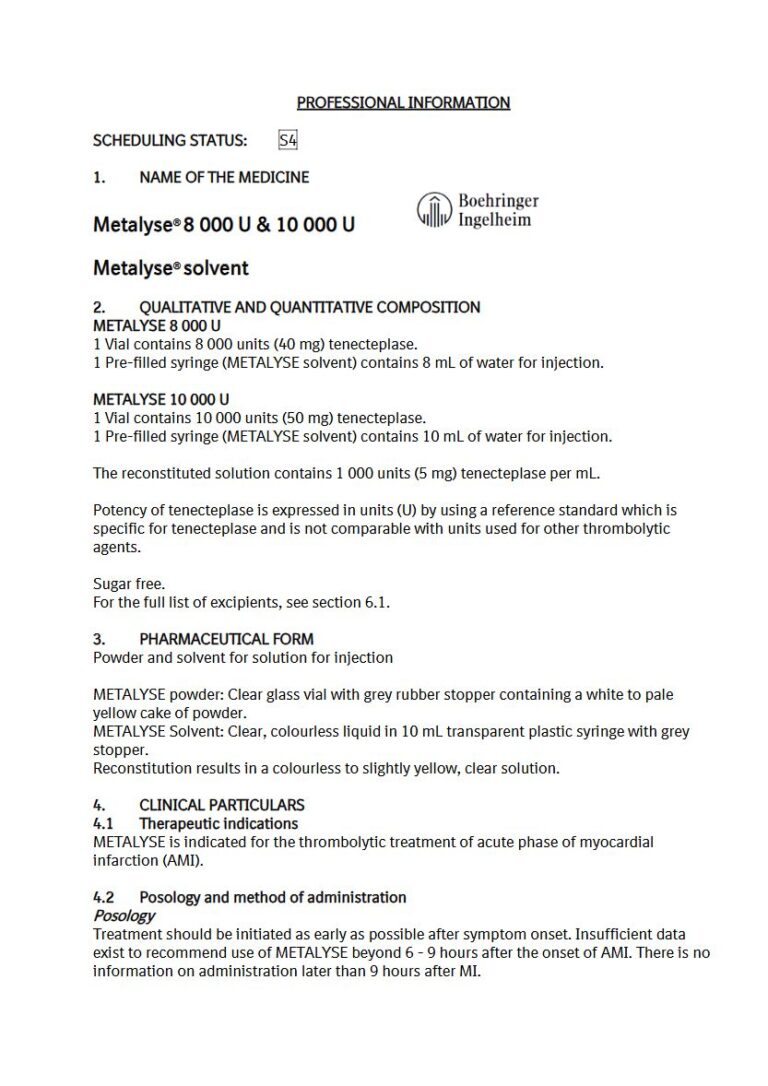
METALYSE is indicated for the thrombolytic treatment of acute phase of myocardial infarction (AMI).
4.2 Posology and method of administration
Posology
Treatment should be initiated as early as possible after symptom onset. Insufficient data exist to recommend use of METALYSE beyond 6 - 9 hours after the onset of AMI. There is no information on administration later than 9 hours after MI.
METALYSE should be administered on the basis of body weight, with a maximum dose of 10 000 units (50 mg tenecteplase). The volume required to administer the correct dose can be calculated from the following table:
Patientu2019s body weight category (kg)
Corresponding volume of reconstituted solution (mL)
Tenecteplase (U)
Tenecteplase (mg)
- < 60 6 6 000 7 000 8 000 9 000 10 000 30 35 40 45 50
- > 60 to < 70 7
- > 70 to < 80 8
- > 80 to < 90 9
- > 90 10
The reconstituted solution should be administered intravenously and is for immediate use. The dose required should be administered as a single intravenous bolus over 5 to 10 seconds. Adjunct therapy
Antithrombotic adjunctive therapy is recommended according to the current international guidelines for the management of patients with ST-elevation myocardial infarction. For coronary intervention please refer to section 4.4.
4.3 Contraindications
- Patients with known hypersensitivity to the active substance tenecteplase, gentamicin (a trace residue from the manufacturing process) or to any of the excipients
- Previous treatment with Tenecteplase
- Subjects > 80 years of age or < 18 years of age
- Pregnancy and lactation (see section 4.6, subsection u201clactationu201d)
- Thrombolytic therapy is associated with a risk of bleeding, therefore, METALYSE is contraindicated in the following situations:
- Hepatic dysfunction, including hepatic failure, cirrhosis, portal hypertension (oesophageal varices) and active hepatitis. METALYSE is metabolised by the liver and no studies in patients with impaired liver function are available at present
- Manifest or recent severe or dangerous bleeding disorder either at present or within the last 6 months
- Patients receiving effective oral anticoagulant treatment, e.g. vitamin K antagonists with international normalised ratio (INR) > 1,3 (see section 4.4, subsection u201cBleedingu201d)
- Any history of central nervous system damage (i.e. neoplasm, aneurysm, intracranial or spinal surgery)
- Haemorrhagic stroke or stroke of unknown origin at any time
- Known haemorrhagic diathesis
- Severe uncontrolled arterial hypertension
- Major surgery, biopsy of a parenchymal organ, or significant trauma within the past 2 months (this includes any trauma associated with the current AMI)
- Recent trauma to the head or cranium
- Active ulcerative gastrointestinal disease
- Known arterial aneurysm and/or arterial/venous malformation
- Neoplasm with increased bleeding risk
- Parturition within the previous 3 days
- Cardiogenic shock
- Bacterial endocarditis, pericarditis
- Acute pancreatitis.
4.4 Special warnings and precautions for use
The decision to treat a patient with acute myocardial infarction with METALYSE should only be made by a doctor experienced in the use of thrombolytic treatment. This does not preclude the pre-hospital use of METALYSE. When METALYSE is administered standard resuscitation equipment and medication must be available in all circumstances.
Traceability
In order to improve traceability of biological medicinal products, the trade name and the batch number of the administered product should be clearly recorded in the patient file.
Bleeding
Bleeding can occur. The most frequent adverse events associated with the use of METALYSE are haemorrhage at the injection site, and occasionally genitourinary and gingival bleeding. Intracranial haemorrhage (ICH) has been observed. The concomitant use of unfractionated heparin anticoagulation may contribute to bleeding. As fibrin is lysed during METALYSE therapy, bleeding from recent puncture sites may occur. Therefore, thrombolytic therapy requires careful attention to all possible bleeding sites (including those following catheter insertions, arterial and venous puncture, cutdown and needle puncture). The use of rigid catheters, intramuscular injections and non-essential handling of the patient should be avoided during treatment with METALYSE. Should serious bleeding occur, in particular cerebral haemorrhage, concomitant heparin administration should be terminated immediately. Administration of protamine should be considered if heparin has been administered within 4 hours before the onset of bleeding. In the few patients who fail to respond to these conservative measures, judicious use of transfusion products may be indicated. Transfusion of cryoprecipitate, fresh frozen plasma, and platelets should be considered with clinical and laboratory reassessment after each administration. A target fibrinogen level of 1 g/L is desirable with cryoprecipitate infusion. Antifibrinolytic agents should also be considered.
The use of METALYSE therapy has to be carefully evaluated in order to balance the potential risks of bleeding with expected benefits under the following conditions:
- Systolic blood pressure > 160 mmHg
- Recent gastrointestinal or genitourinary bleeding (within the past 10 days)
- High likelihood of left heart thrombus e.g. mitral stenosis with atrial fibrillation
- Haemostatic defects including those secondary to severe hepatic disease
- Recent intramuscular injection or small recent traumas, such as biopsies, puncture of major vessels
- Advanced age, i.e. patients 75 years or older
- Body weight < 50 kg
- Patients receiving oral anticoagulant treatment: The use of METALYSE may be considered when appropriate test(s) of anticoagulant activity for the product(s) concerned show no clinically relevant activity.
- Prolonged (> 2 minutes) or traumatic cardiopulmonary resuscitation or cardiac massage
- History of previous stroke or transient ischaemic attack (TIA)
See section 4.3.
Hypersensitivity
Anaphylactoid reactions associated with the administration of METALYSE are rare and can be caused by hypersensitivity to the active substance tenecteplase, gentamicin (a trace residue from the manufacturing process) or to any of the excipients. If an anaphylactoid reaction occurs, the injection should be discontinued and appropriate treatment should be initiated.
Thromboembolism
The use of METALYSE can increase the risk of thromboembolic events in patients with existing thrombi, e.g. left heart thrombus (mitral stenosis or atrial fibrillation, etc).
Coronary intervention
Transfer to a coronary intervention capable facility for adjunctive Percutaneous Coronary Intervention (PCI): Patients receiving METALYSE as primary coronary recanalization treatment should be transferred without delay to a coronary intervention capable facility for angiography and timely coronary intervention within 6 - 24 hours or earlier if medically indicated.
Primary Percutaneous Coronary Intervention (PCI): If primary PCI is scheduled according to the current relevant treatment guidelines, METALYSE should not be given.
Dysrhythmias
Coronary thrombolysis may result in dysrhythmia associated with reperfusion. Reperfusion dysrhythmias may lead to cardiac arrest, can be life-threatening and may require the use of conventional antidysrhythmic therapies.
Glyco - Protein IIb/IIIa antagonists
The concomitant use of GPIIb/IIIa antagonists increases the risk of bleeding.
Cardiac Events
Patients with AMI can, independent of the treatment given, experience disease-related events such as cardiogenic shock, pulmonary oedema, heart failure, cardiac arrest, recurrent ischaemia, reinfarction, myocardial rupture, pericarditis, pericardial effusion, cardiac tamponade, mitral regurgitation, venous thrombosis and electromechanic dissociation.
METALYSE contains polysorbate 20
This medicine contains 3,2 mg of polysorbate 20 in each vial of METALYSE 8 000 U and 4,0 mg in each vial of METALYSE 10 000 U. Polysorbates may cause allergic reactions.
4.5 Interaction with other medicines and other forms of interaction
METALYSE is incompatible with dextrose solution. No formal interaction studies with METALYSE and medicinal products commonly administered in patients with AMI have been performed. However, the analysis of data from more than 12 000 patients treated during phase I, II and III did not reveal any clinically relevant interactions with medicinal products commonly used in patients with AMI and concomitantly used with METALYSE.
Medicines affecting coagulation/platelet function
Medicinal products that affect coagulation or those that alter platelet function may increase the risk of bleeding prior to, during or after METALYSE therapy, see section 4.3.
4.6 Fertility, pregnancy and lactation
Pregnancy
There is a limited amount of data from the use of METALYSE in pregnant women (see section 4.3). Nonclinical studies performed with tenecteplase have shown bleeding with secondary mortality of dams due to the known pharmacological activity of the medicine and in a few cases abortion and resorption of the foetus occurred (effects only have been observed with repeated dose administration). Tenecteplase is not considered to be teratogenic.
Lactation
It is not known if tenecteplase is excreted into human milk. Caution should be exercised when METALYSE is administered to a nursing woman and a decision must be made whether breast-feeding should be discontinued for the first 24 hours after administration of METALYSE.
Fertility
Clinical data as well as nonclinical studies on fertility are not available for tenecteplase (METALYSE).
4.7 Effects on ability to drive and use machines
Not relevant.
4.8 Undesirable effects
Summary of safety profile
Haemorrhage is the most common undesirable effect associated with the use of METALYSE. Haemorrhage at any site or body cavity can occur and may result in life-threatening situations, permanent disability or death. The type of haemorrhage associated with thrombolytic therapy can be divided into two broad categories:
- superficial bleeding, normally from injection sites
- internal bleeding at any site or body cavity.
Tabulated summary of adverse reactions
Adverse reactions listed below are classified according to frequency and system organ class.
Frequency classes: Very common ( u2265 1/10); common ( u2265 1/100, < 1/10); uncommon ( u2265 1/1 000, < 1/100); rare ( u2265 1/10 000, < 1/1 000); very rare (< 1/10 000); not known (cannot be estimated from the available data).
System organ class Adverse reaction Frequency
Immune system disorders Anaphylactoid reaction (including rash, urticaria, bronchospasm, laryngeal oedema) Rare
Nervous system disorders Intracranial haemorrhage (such as cerebral haemorrhage, cerebral haematoma, haemorrhagic stroke, haemorrhagic transformation stroke, intracranial haematoma, subarachnoid haemorrhage) including associated symptoms such as somnolence, aphasia, hemiparesis, convulsion Uncommon
Eye disorders Eye haemorrhage Uncommon
Cardiac disorders Reperfusion dysrhythmias (such as asystole, accelerated idioventricular dysrhythmia, dysrhythmia, extrasystoles, atrial fibrillation, atrioventricular first degree to atrioventricular block complete, bradycardia, tachycardia, ventricular dysrhythmia, ventricular fibrillation, ventricular tachycardia) occur in close temporal relationship to treatment with METALYSE. Uncommon
System organ class Adverse reaction Frequency
Pericardial haemorrhage Rare
Vascular disorders Haemorrhage Very common
Embolism Rare
Respiratory, thoracic and mediastinal disorders Epistaxis Common
Pulmonary haemorrhage Rare
Gastrointestinal disorders Gastrointestinal haemorrhage (such as gastric haemorrhage, gastric ulcer haemorrhage, rectal haemorrhage, haematemesis, melaena, mouth haemorrhage) Common
Retroperitoneal haemorrhage (such as retroperitoneal haematoma) Uncommon
Nausea, vomiting Not known
Skin and subcutaneous tissue disorders Ecchymosis Common
Renal and urinary disorders Urogenital haemorrhage (such as haematuria, haemorrhage urinary tract) Common
General disorders and administration site conditions Injection site haemorrhage, puncture site haemorrhage Common
Investigations Blood pressure decreased Rare
Body temperature increased Not known
Injury, poisoning and procedural complications Fat embolism, which may lead to corresponding consequences in the organs concerned Not known
Surgical and medical procedures Transfusion Not known
Description of selected adverse reactions
As with other thrombolytic agents, the following events have been reported as sequelae of myocardial infarction and/or thrombolytic administration:
- very common: hypotension, heart rate and rhythm disorders, angina pectoris
- common: recurrent ischaemia, cardiac failure, myocardial infarction, cardiogenic shock, pericarditis, pulmonary oedema
- uncommon: cardiac arrest, mitral valve incompetence, pericardial effusion, venous thrombosis, cardiac tamponade, myocardial rupture
- rare: pulmonary embolism
Reporting of suspected adverse reactions
Reporting suspected adverse reactions after authorisation of the medicine is important. It allows continued monitoring of the benefit/risk balance of the medicine. Healthcare providers are requested to report any suspected adverse drug reactions to SAHPRA via the Med Safety APP (Medsafety X SAHPRA) and eReporting platform (who-umc.org) found on SAHPRA website.
Suspected adverse reactions can also be reported directly to the holder of the certificate of registration using the email address [email protected].
4.9 Overdose
Symptoms
In the event of overdose there may be an increased risk of bleeding.
Therapy
In case of severe prolonged bleeding, substitution therapy (plasma, platelets) may be considered. (Please refer to section 4.4.) Further treatment is symptomatic and supportive.
