
Terbane Nail 10 %
PDF Leaflet Revision Date: 17 September 2024
Clinical Summary
Quick overview from the medicine insert
Indication
Mild to moderate fungal infections of the nails.
Dosage (summary)
Initial 4 weeks daily, then weekly; fingernails ~6 months, toenails ~9-12 months.
Special Populations
- Paediatric population
Pregnancy & Breastfeeding
Use in pregnancy only if necessary; not recommended during breastfeeding.
Key Drug Interactions
- No systemic interactions foreseen
Contraindications
- Hypersensitivity to terbinafine or excipients
Common side effects
- Erythema
- Nail discolouration
- Onycholysis
- Paronychia
Counselling Points
- Avoid contact with eyes
- Do not wash treated nails for 6 hours
- Remove nail polish before application
Serious warnings
- Consider systemic therapy for extensive nail involvement
- External use only
Important Disclaimer
The Terbane Nail 10 % professional information leaflet below is the property of Sandoz Sa and is provided on Medinsert exactly as issued, with no.. alterations or editorial changes. We make every effort to keep content current by updating documents as soon as new versions become available. Medinsert serves as a trusted access point for healthcare professionals, but does not replace official sources or clinical judgement. For more details, please read our full disclaimer. read more>>
 Healthcare Professionals Only
This content is for registered healthcare professionals
Sign in or create a free account to read the full package insert.
Free for HPCSA-registered professionals. Powered by Medinsert.
Clinical Particulars
Section 4 of the official insert — extracted exactly as issued, no alterations
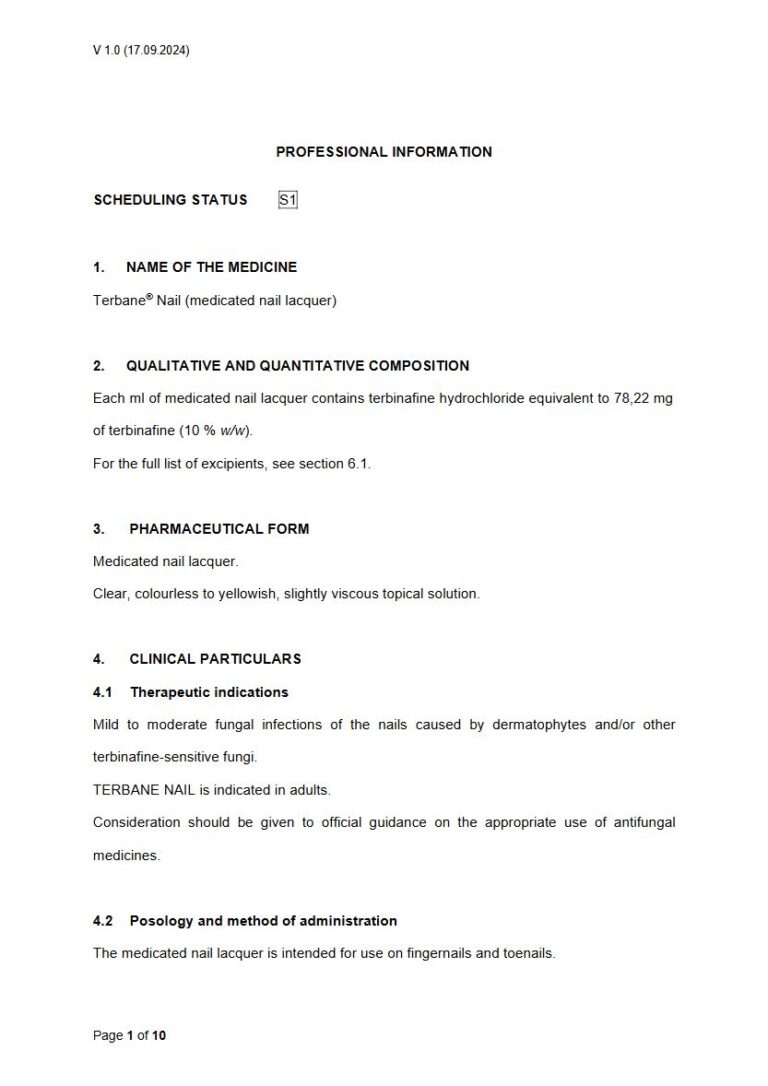
4.1 Therapeutic indications
Mild to moderate fungal infections of the nails caused by dermatophytes and/or other terbinafine-sensitive fungi. TERBANE NAIL is indicated in adults. Consideration should be given to official guidance on the appropriate use of antifungal medicines.
4.2 Posology and method of administration
The medicated nail lacquer is intended for use on fingernails and toenails.
Posology: After an initial 4-week period of daily treatment, TERBANE NAIL should be applied to the affected nails once weekly. In general, the treatment duration for fingernails is about 6 months while for toenails it is about 9 to 12 months. An additional oral therapy should be considered in cases of inadequate response to topical treatment at the end of the treatment period and in cases of severe nail infection, including one or more finger- and/or toenails and/or matrix involvement. In these situations, medical advice should be sought.
Dosing in special populations: Paediatric population: The safety and efficacy of TERBANE NAIL in children and adolescents aged below 18 years have not yet been established.
Method of administration: Cutaneous use only (for application on the nails). Before application of TERBANE NAIL, remove any nail polish or other cosmetic product from the nails and immediately adjacent skin. Clean and dry the affected areas thoroughly. A thin layer of TERBANE NAIL using the applicator should be applied over the entire surface of the affected nails, 5 mm of surrounding skin and, if possible, under the free nail edge as well as the skin under the nail. The patient should wait about 30 seconds until the lacquer has completely dried. The treated nails should not be washed or get wet for at least 6 hours. Therefore, application in the evening before going to bed and after showering or bathing is recommended. After that time, normal hygienic practices can be followed. TERBANE NAIL does not need to be removed by any solvent or abrasives (i.e., nail filing). It is sufficient to carefully wash the nails with water.
4.3 Contraindications
Hypersensitivity to the active substance or to any of the excipients listed in section 6.1.
4.4 Special warnings and precautions for use
In case of involvement of more than 3 nails or more than half of the nail plate is altered or nail matrix is involved, and in cases of predisposing factors, such as diabetes and immune disorders, the addition of a systemic therapy should be considered. Duration of disease, extent of involvement of the nail plate and nail thickness may influence results of therapy. TERBANE NAIL is for external use only. Patients with a history of diabetes, immune disorders, peripheral vascular disease, injured, painful or seriously damaged nails, skin conditions such as psoriasis or any other chronic skin condition, and yellow nail syndrome (oedema in the lower limbs, breathing disorders and yellow nail discolouration) should seek medical advice prior to commencing treatment. Contact with any part of the body different from the affected area should be avoided until the lacquer is completely dried. Irritation may occur in case of accidental contact with the eyes or mucous membranes. In case of accidental contact with these areas, rinse thoroughly with running water. The impact of nail polish or other cosmetic nail products on the efficacy of TERBANE NAIL has not been evaluated.
Paediatric population: TERBANE NAIL should not be used in children and adolescents below 18 years of age due to a lack of clinical experience in this age group. TERBANE NAIL contains 616 mg alcohol (ethanol) in each ml of solution. It may cause a burning sensation on damaged skin.
4.5 Interaction with other medicines and other forms of interaction
No interaction studies have been performed. However, after application as recommended, the systemic bioavailability of terbinafine is considered negligible (see section 5.2), thus no systemic interactions are foreseen. Other medicines should not be used on the affected areas.
4.6 Fertility, pregnancy and lactation
Pregnancy: There are no available data on the use of terbinafine in pregnant women. Animal studies do not indicate any harmful effects with respect to pregnancy or the health of the foetus (see section 5.3). TERBANE NAIL should not be used during pregnancy unless clearly necessary.
Breastfeeding: Terbinafine is excreted into breastmilk. After topical use only low systemic exposure is expected. TERBANE NAIL use during breastfeeding is not recommended. Infants must not be allowed to come into contact with any treated area.
Fertility: No effects of terbinafine on fertility have been seen in animal studies (see section 5.3).
4.7 Effects on ability to drive and use machines
TERBANE NAIL has no influence on the ability to drive and use machines.
4.8 Undesirable effects
Summary of the safety profile: Adults: The safety profile of TERBANE NAIL in adults is based on pooled data from 2 randomised, double-blind, vehicle-controlled studies (PM1331 and PM0731) in patients with mild to moderate onychomycosis. A total of 556 patients were treated with TERBANE NAIL at the recommended dose regimen and 454 patients were treated with the vehicle. The most commonly reported adverse drug reaction was erythema (0,9 % in the TERBANE NAIL arm; no events of erythema were reported in the vehicle arm) at the site of application. All events of erythema were mild and transient.
Table 1: Adverse reactions in onychomycosis patients treated with TERBANE NAIL
System Organ Class Frequency Adverse reaction
Skin and subcutaneous tissue disorders Frequent Nail discolouration, Onycholysis, Onychomadesis, Paronychia, Contact Dermatitis, Erythema.
Less frequent* Skin irritation, Dermatitis, Nail disorder, Pruritus.
* Less frequent adverse reactions affected either the treated nails or the surrounding skin. These reactions were similar to the frequent adverse reactions included in the table or can be described as skin irritation, dermatitis or nail disorders.
Reporting of suspected adverse reactions: Reporting suspected adverse reactions after authorisation of TERBANE NAIL is important. It allows continued monitoring of the benefit/risk balance of TERBANE NAIL. Health care providers are asked to report any suspected adverse reactions to SAHPRA via the Med Safety APP (Medsafety X SAHPRA) and eReporting platform (who-umc.org) found on SAHPRA website. Suspected adverse reactions can also be reported directly to the HCR via https://pvi1j.solutions.iqvia.com or the e-mail address, [email protected].
4.9 Overdose
Due to the route of administration, overdose is very unlikely. No systemic signs of overdose are expected following topical application of TERBANE NAIL. In the event of accidental oral ingestion, appropriate symptomatic measures should be taken.
