
Depo-Testosterone 100 mg Solution for injection.
PDF Leaflet Revision Date: 11 February 2021
Clinical Summary
Quick overview from the medicine insert
Indication
Replacement therapy in adult males with testosterone deficiency.
Dosage (summary)
50 - 400 mg every 2-4 weeks, adjusted based on response.
Special Populations
- Elderly patients
- Paediatric population
Pregnancy & Breastfeeding
Contraindicated in pregnancy and lactation.
Key Drug Interactions
- Increases sensitivity to oral anticoagulants
- May decrease insulin requirements
Contraindications
- Hypersensitivity to testosterone cypionate
- Carcinoma of the breast
- Carcinoma of the prostate
- Serious cardiac disease
- Pregnancy
- Liver function impairment
Common side effects
- Oedema
- Gynaecomastia
- Increased libido
- Headache
- Nausea
Counselling Points
- Report any unusual symptoms
- Not for athletic performance enhancement
- Monitor for signs of abuse
Serious warnings
- Risk of venous thromboembolic events
- Potential for serious hepatic complications
- Increased risk of prostatic hypertrophy and carcinoma in elderly
Important Disclaimer
The Depo-Testosterone 100 mg Solution for injection. professional information leaflet below is the property of Pfizer Laboratories and is provided on Medinsert exactly as issued, with no.. alterations or editorial changes. We make every effort to keep content current by updating documents as soon as new versions become available. Medinsert serves as a trusted access point for healthcare professionals, but does not replace official sources or clinical judgement. For more details, please read our full disclaimer. read more>>
 Healthcare Professionals Only
This content is for registered healthcare professionals
Sign in or create a free account to read the full package insert.
Free for HPCSA-registered professionals. Powered by Medinsert.
Clinical Particulars
Section 4 of the official insert — extracted exactly as issued, no alterations
4.1. Therapeutic indications
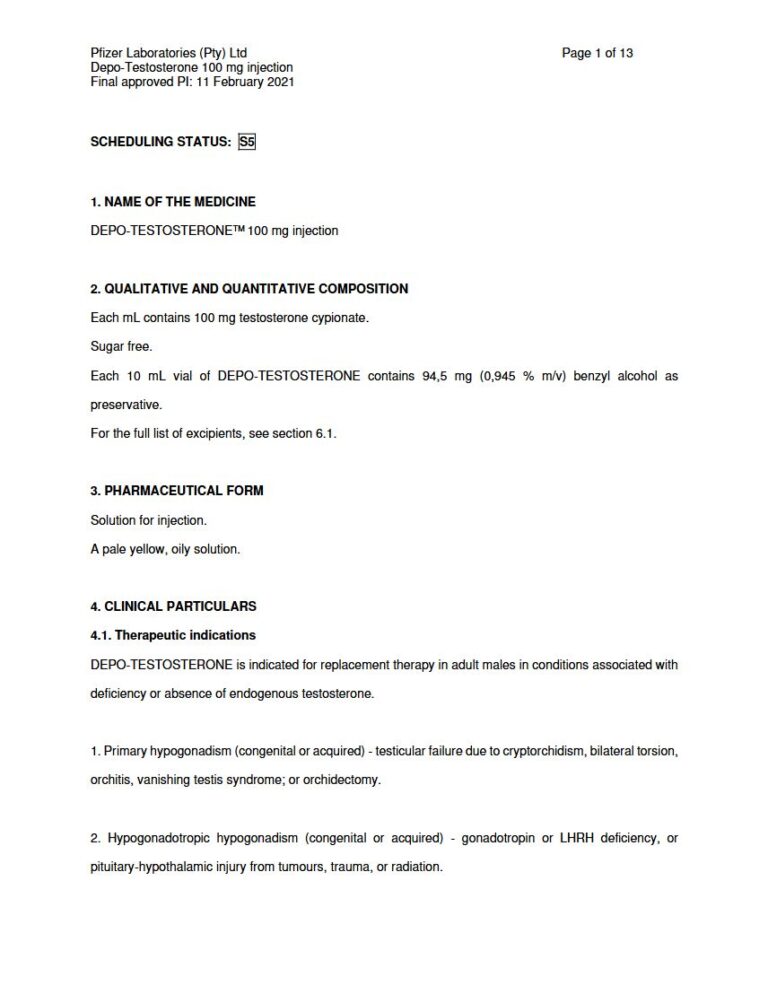
DEPO-TESTOSTERONE is indicated for replacement therapy in adult males in conditions associated with deficiency or absence of endogenous testosterone. 1. Primary hypogonadism (congenital or acquired) - testicular failure due to cryptorchidism, bilateral torsion, orchitis, vanishing testis syndrome; or orchidectomy. 2. Hypogonadotropic hypogonadism (congenital or acquired) - gonadotropin or LHRH deficiency, or pituitary-hypothalamic injury from tumours, trauma, or radiation.
DEPO-TESTOSTERONE should not be used in children with delayed puberty or in adult men with age related hypogonadism as safety and efficacy have not been established (see section 4.4).
4.2 Posology and method of administration
Posology Prior to initiating DEPO-TESTOSTERONE, confirm the diagnosis of hypogonadism by ensuring that serum testosterone concentrations have been measured in the morning on at least two separate days and that these serum testosterone concentrations are below the normal range. Dosage will vary depending upon the age and diagnosis of the individual patient. Dosage is adjusted according to the patientu2019s response and the appearance of adverse reactions. For replacement in the hypogonadal male, 50 - 400 mg should be administered every two to four weeks.
Special populations Elderly population Elderly patients treated with DEPO-TESTOSTERONE may be at increased risk of developing prostatic hypertrophy and prostatic carcinoma (see section 4.4). Paediatric population Safety and effectiveness in children have not been established. DEPO-TESTOSTERONE should be inspected visually for particulate matter and discolouration prior to administration, whenever solution and container permit. Warming and shaking the vial should re-dissolve any crystals that may have formed during storage at temperatures lower than recommended.
Method of administration DEPO-TESTOSTERONE is for intramuscular use only. DEPO-TESTOSTERONE should not be given intravenously. Intramuscular injections should be given deep in the gluteal muscle.
4.3 Contraindications
- Hypersensitivity to testosterone cypionate or to any of the excipients in DEPO-TESTOSTERONE (listed in section 6.1)
- Males with carcinoma of the breast
- Males with known or suspected carcinoma of the prostate gland
- Patients with serious cardiac, hepatic or renal disease
- Hypercalcaemia
- Liver function impairment
- Pre-pubertal males
- Pregnancy and lactation (see section 4.6)
- Females of child-bearing potential
4.4 Special warnings and precautions for use
Hypercalcaemia may occur, especially in immobilised patients. Prolonged use of high doses of DEPO-TESTOSTERONE has been associated with development of hepatic adenomas, hepatocellular carcinoma, and peliosis hepatis - all potentially life-threatening complications.
Elderly patients treated with DEPO-TESTOSTERONE may be at an increased risk of developing prostatic hypertrophy and prostatic carcinoma. There have been post-marketing reports of venous thromboembolic events, including deep vein thrombosis (DVT) and pulmonary embolism (PE) in patients using DEPO-TESTOSTERONE. Evaluate patients who report symptoms of pain, oedema, warmth and erythema in the lower extremity for DVT and those who present with acute shortness of breath for PE. If a venous thromboembolic event is suspected, discontinue treatment with DEPO-TESTOSTERONE and initiate appropriate workup and management.
Epidemiologic studies and randomised controlled trials have been inconclusive for determining the risk of major adverse cardiovascular events (MACE), such as non-fatal myocardial infarction, non-fatal stroke, and cardiovascular death, with the use of DEPO-TESTOSTERONE compared to non-use. There is some evidence of an increased risk of MACE in association with use of testosterone replacement therapy in men especially with the use of testosterone as contained in DEPO-TESTOSTERONE for unapproved indications and/or with unapproved dosages (see section 4.8). Patients should be informed of this possible risk when deciding whether to use or to continue to use DEPO-TESTOSTERONE.
Abuse of DEPO-TESTOSTERONE and monitoring of serum testosterone concentrations DEPO-TESTOSTERONE has been subject to abuse, typically at doses higher than recommended for the approved indication and in combination with other anabolic, androgenic steroids. Anabolic, androgenic steroid abuse can lead to serious cardiovascular and psychiatric adverse reactions (see section 4.8, Medicine abuse and dependence). If DEPO-TESTOSTERONE abuse is suspected, check serum testosterone concentrations to ensure they are within therapeutic range. However, testosterone levels may be in the normal or subnormal range in men abusing synthetic testosterone derivatives. Counsel patients concerning the serious adverse reactions associated with abuse of DEPO-TESTOSTERONE and anabolic, androgenic steroids. Conversely, consider the possibility of DEPO-TESTOSTERONE and anabolic, androgenic steroid abuse in suspected patients who present with serious cardiovascular or psychiatric adverse events. DEPO-TESTOSTERONE should not be used concomitantly with anabolic, androgenic steroids.
Oedema, with or without congestive heart failure, may occur especially in patients with pre-existing cardiac, renal or hepatic disease (see section 4.3). Due to the prolonged action of DEPO-TESTOSTERONE, it should be administered with caution to patients with organic heart disease of debilitation (see section 4.3). Gynaecomastia may develop in patients being treated with DEPO-TESTOSTERONE for hypogonadism. DEPO-TESTOSTERONE treatment can cause chorioretinopathy. Chorioretinopathy can lead to visual disturbances. Androgen therapy should not be used in healthy males with delayed puberty. In children, androgen treatment may accelerate bone maturation without producing compensatory gain in linear growth. This adverse effect may result in compromised adult stature.
DEPO-TESTOSTERONE should not be used for the enhancement of athletic performance, because of the potential risk of serious adverse health effects.
General Patients with benign prostatic hypertrophy given DEPO-TESTOSTERONE may develop acute urethral obstruction. Priapism or excessive sexual stimulation may develop. Oligospermia and reduced ejaculatory volume may occur after prolonged administration or excessive dosage. Hypersensitivity and gynaecomastia may occur. If any of these effects appear, DEPO-TESTOSTERONE should be stopped.
DEPO-TESTOSTERONE should not be used interchangeably with testosterone propionate, enanthate or phenylacetate because of differences in duration of action.
DEPO-TESTOSTERONE is not for intravenous use. Patients should be instructed to report any of the following: nausea, vomiting, changes in skin colour, ankle swelling, too frequent or persistent erections of the penis.
Laboratory tests Haemoglobin and haematocrit levels (to detect polycythaemia) should be checked periodically in patients receiving long-term DEPO-TESTOSTERONE administration. Serum cholesterol may increase during DEPO-TESTOSTERONE therapy.
4.5 Interaction with other medicines and other forms of interaction
DEPO-TESTOSTERONE may increase sensitivity to oral anticoagulants. Dosage of the anticoagulant may require reduction in order to maintain satisfactory therapeutic hypoprothrombinaemia. In diabetic patients, the metabolic effects of DEPO-TESTOSTERONE may decrease blood glucose and, therefore, insulin requirements.
Medicine/laboratory test interferences DEPO-TESTOSTERONE may decrease levels of thyroxine-binding globulin, resulting in decreased total T4 serum levels and increased resin uptake of T3 and T4. Free thyroid hormone levels remain unchanged, however, and there is no clinical evidence of thyroid dysfunction.
4.6 Fertility, pregnancy and lactation
DEPO-TESTOSTERONE is contraindicated in pregnancy and lactation (see section 4.3). Benzyl alcohol can cross the placenta (see section 4.4).
4.7 Effects on ability to drive and use machines
Not applicable.
4.8 Undesirable effects
The following adverse reactions in males may occur:
- Blood and the lymphatic system disorders: Suppression of clotting factors II, V, VII, and X, bleeding in patients on concomitant anticoagulant therapy, polycythaemia
- Immune system disorders: Hypersensitivity, including skin manifestations and anaphylactoid reactions
- Metabolism and nutrition disorders: Retention of sodium, chloride, water, potassium, calcium, and inorganic phosphates, hypercalcaemia
- Psychiatric disorders: Increased or decreased libido, headache, anxiety, depression
- Nervous system disorders: Paraesthesia
- Eye disorders: Chorioretinopathy (see section 4.4)
- Cardiac disorders: Myocardial infarction, stroke
- Vascular disorders: Deep vein thrombosis, pulmonary embolism
- Gastrointestinal disorders: Nausea
- Hepato-biliary disorders: Cholestatic jaundice, alterations in liver function tests, hepatocellular benign and malignant neoplasms, peliosis hepatis (see section 4.4)
- Skin and subcutaneous tissue disorders: Hirsutism, male pattern of baldness, seborrhoea, acne
- Reproductive system and breast disorders: Gynaecomastia, excessive frequency and duration of penile erections, priapism, decreased ejaculatory volume. Oligospermia may occur at high dosages
- General disorders and administration site conditions: Oedema, inflammation and pain at the site of intramuscular injection
The Penile Brachial Index (PBI) may increase during DEPO-TESTOSTERONE therapy without clinical significance.
Medicine abuse and dependence Abuse Abuse and misuse of DEPO-TESTOSTERONE may occur often in combination with other anabolic androgenic steroids (AAS). Abuse-related adverse reactions have been reported in individuals who abuse anabolic, androgenic steroids and include:
- Psychiatric disorders: Serious psychiatric manifestations, including major depression, mania, paranoia, psychosis, delusions, hallucinations, hostility and aggression
- Nervous system disorders: Cerebrovascular accident
- Cardiac disorders: Cardiac arrest, myocardial infarction, hypertrophic cardiomyopathy, congestive heart failure
- Hepato-biliary disorders: Hepatotoxicity
The following adverse reactions have also been reported in men:
- Psychiatric disorders: Hypomania, irritability
- Nervous system disorders: Transient ischaemic attacks, convulsions
- Reproductive system and breast disorders: Testicular atrophy, subfertility, infertility
Investigations Dyslipidaemias The following additional adverse reactions have been reported in women:
- Endocrine disorders: Virilisation
- Respiratory, thoracic and mediastinal disorders: Deepening of voice
- Skin and subcutaneous tissue disorders: Hirsutism, male-pattern baldness
- Reproductive system and breast disorders: Clitoral enlargement, breast atrophy, menstrual irregularities
The following adverse reactions have been reported in male and female adolescents:
- Endocrine disorders: Precocious puberty
- Musculoskeletal, connective tissue and bone disorders: Premature closure of bony epiphyses with termination of growth
Because these reactions are reported voluntarily from a population of uncertain size and may include abuse of other medicines, it is not always possible to reliably estimate their frequency or establish a causal relationship to medicine exposure.
Reporting of suspected adverse reactions Reporting suspected adverse reactions after authorisation of the medicine is important. It allows continued monitoring of the benefit/risk balance of the medicine. Health care providers are asked to report any suspected adverse reactions to SAHPRA via the u201c6.04 Adverse Drug Reactions Reporting Formu201d, found online under SAHPRAu2019s publications: https://www.sahpra.org.za/Publications/Index/8
4.9 Overdose
Treatment should be symptomatic and supportive.
