
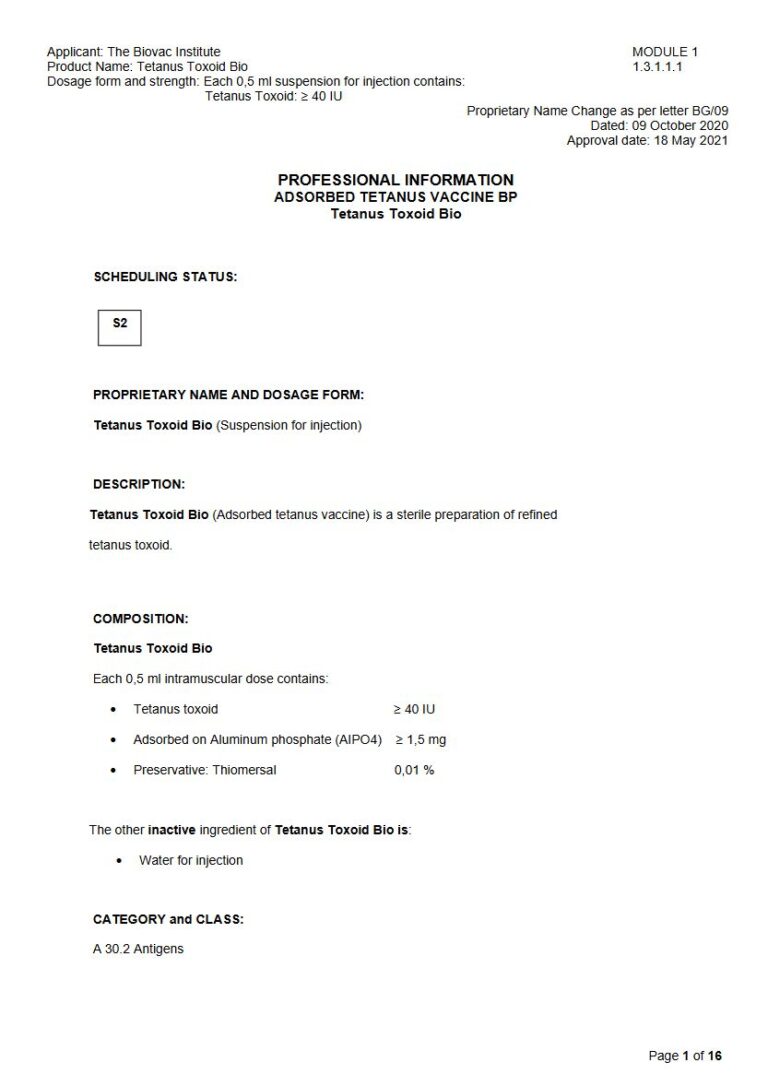
Tetanus Toxoid Bio 0,5 ml Suspension
PDF Leaflet Revision Date: 18 May 2021
Clinical Summary
Quick overview from the medicine insert
Indication
Active immunisation against tetanus.
Dosage (summary)
0.5 ml IM for adults and children >7 years; 2 doses 4-8 weeks apart, followed by a booster after 6-12 months.
Special Populations
- Pregnant women
- Immunocompromised patients
Pregnancy & Breastfeeding
Safe during pregnancy; no teratogenic effects reported.
Key Drug Interactions
- Chloramphenicol
- Cyclosporine
Contraindications
- Hypersensitivity to components
- Neurological reactions to previous doses
Common side effects
- Anaphylactic reactions
- Fever
- Local reactions
Counselling Points
- Shake vial before use
- Monitor for allergic reactions
- Use sterile equipment
Serious warnings
- Increased reactions with frequent boosters
- Risk of Guillain-Barru00e9 Syndrome
Important Disclaimer
The Tetanus Toxoid Bio 0,5 ml Suspension professional information leaflet below is the property of The Biovac Institute and is provided on Medinsert exactly as issued, with no.. alterations or editorial changes. We make every effort to keep content current by updating documents as soon as new versions become available. Medinsert serves as a trusted access point for healthcare professionals, but does not replace official sources or clinical judgement. For more details, please read our full disclaimer. read more>>
 Healthcare Professionals Only
This content is for registered healthcare professionals
Sign in or create a free account to read the full package insert.
Free for HPCSA-registered professionals. Powered by Medinsert.
Clinical Particulars
Section 4 of the official insert — extracted exactly as issued, no alterations
4.1 Therapeutic indications
Tetanus Toxoid Bio is indicated for use in:
- Tetanus prophylaxis.
- Post exposure prophylaxis of tetanus.
- Neonatal tetanus prevention.
- Tetanus Prophylaxis in Wound Management.
Tetanus prophylaxis: Tetanus Toxoid Bio is indicated for active immunisation against tetanus in adults and children over the age of 7 (seven) years. In children less than 7 years of age, the use of diphtheria, tetanus and pertussis vaccine combination is recommended unless pertussis vaccine is contraindicated. If pertussis is contraindicated, then the use of diphtheria and tetanus toxoids (DT) is recommended. Tetanus Toxoid Bio is indicated for booster active immunisation for long term prophylaxis of tetanus in adults.
Post exposure prophylaxis of tetanus: Immunity is not conferred to persons who contract tetanus due to the fact that only a very small amount of toxin is required to produce illness. Persons recovering from tetanus should begin or complete active immunisation with a tetanus-toxoid containing vaccine during convalescence.
Neonatal tetanus prevention: Neonatal tetanus prophylaxis in countries where neonatal tetanus is common for women of reproductive age. If vaccination is required, Tetanus Toxoid Bio can be used during pregnancy. Tetanus Toxoid Bio should be given to inadequately immunised pregnant women because it affords protection against neonatal tetanus. Teratogenic effects have not been reported with tetanus toxoid in humans. Waiting until the second trimester to administer tetanus vaccine is a reasonable precaution for minimising any concern regarding the theoretical possibility of adverse reactions.
Tetanus Prophylaxis in Wound Management: Tetanus Toxoid Bio can also be used prophylactically for wound management in persons 7 years of age and older; tetanus and diphtheria toxoid (Td) is preferred, to maintain adequate levels of diphtheria immunity.
4.2 Posology and method of administration
The vaccine vial should be shaken before use to homogenise the suspension. A sterile needle and a sterile syringe should be used for each injection (see Warnings and Special Precautions). Immunisation schedule of Tetanus Toxoid Bio:
FOR TETANUS PROPHYLAXIS: The primary immunising course for unimmunised individuals 7 years of age or older consists of two intramuscular (IM) doses of 0,5 ml each. These doses should be given 4 to 8 weeks apart followed by a third (reinforcing) dose of 0,5 ml. This dose should be given 6 to 12 months after the second dose. The reinforcing dose is an integral part of the primary immunising course. Individuals who have not completed primary immunisation against tetanus, or whose immunisation history is unknown or uncertain, should be immunised with a tetanus-toxoid containing product.
FOR NEONATAL TETANUS PREVENTION: Antenatal immunisation is recommended for the prevention of neonatal tetanus in the previously unimmunised mother (see Human reproduction). A previously unimmunised pregnant woman who may deliver her child under non-hygienic circumstances and/or surroundings should receive two doses of a tetanus toxoid-containing preparation before delivery (4 to 8 weeks apart), preferably during the last 2 trimesters. Incompletely immunised pregnant women should complete the 3-dose series. Those immunised more than 10 years previously should have a booster dose.
IN TETANUS PROPHYLAXIS IN WOUND MANAGEMENT: The need for active immunisation with a tetanus toxoid-containing preparation, with or without passive immunisation with TIG (Human tetanus immune globulin) depends on both the condition of the wound and the patient's vaccination history. Tetanus Toxoid Bio is used alone (1 dose) in low-risk wounds (clean or minor wounds) in individuals in whom primary immunisation is incomplete or uncertain, or in individuals who have had full primary immunisation but who have received no booster dosage for 10 years. Tetanus Toxoid Bio used in conjunction with tetanus immune globulin is recommended for prophylactic contaminated wound management in unimmunised, uncertain, or incomplete immunisation status patients. A thorough attempt must be made to determine whether a patient has completed primary immunisation. Individuals who have completed primary immunisation against tetanus, and who sustain wounds which are minor and uncontaminated, should receive a booster dose of a tetanus toxoid-containing preparation only if they have not received tetanus toxoid within the preceding 10 years. For tetanus prone wounds (e.g., wounds contaminated with dirt, faeces, soil, and saliva, puncture wounds; avulsions and wounds resulting from missiles, crushing, burns, and frostbite), a booster is appropriate if the patient has not received a tetanus toxoid-containing preparation within the preceding 5 years. Interruption of the recommended schedule with a delay between doses does not interfere with the final immunity achieved, nor does it necessitate starting the series over again, regardless of the length of time elapsed between doses.
4.3 Contraindications
Tetanus Toxoid Bio is contraindicated for use in:
- Patients with a known hypersensitivity to any component of the vaccine, including thiomersal, which is a mercury derivative (see COMPOSITION).
- Patients who develop any type of neurological symptoms or signs following administration of Tetanus Toxoid Bio (see Warnings and Special Precautions).
- Those patients who develop systemic hypersensitivity or neuralgic reactions to a previous injection with Tetanus Toxoid Bio, should only be given passive immunisation using Tetanus Immune Globulin (Human) (TIG). The attending physician should consider risk/benefit ratio at all times.
- Also, routine immunisation should be deferred during an outbreak of poliomyelitis, provided that the patient has not sustained an injury that increases the risk of tetanus.
4.4 Special warnings and precautions for use
WARNINGS: The administration of booster doses more frequently than recommended may be associated with increased incidence and severity of reactions. There is evidence that the incidence of allergic reactions is higher in individuals with high titres of tetanus antitoxin antibody at time of reimmunisation. Persons who experience Arthus-type hypersensitivity reactions or temperature greater than 39 u00b0C after a previous dose of tetanus toxoid usually have very high serum tetanus antitoxin levels and should not be given even emergency doses of tetanus toxoid more frequently than every 10 years, even if they have a wound that is neither clean nor minor. Evidence mainly from case reports and uncontrolled studies favoured a causal relationship between vaccination with single-antigen tetanus vaccines and Guillain-Barru00e9 Syndrome. The data came primarily from immunocompromised patients. However, a later analysis of active epidemiological studies of Guillain-Barru00e9 and tetanus vaccination history concluded that if an association exists, it must be extremely rare and not of public health significance. Should not be given to individuals with thrombocytopenia or any coagulation disorder that would contraindicate intramuscular injection, unless the potential benefit clearly outweighs the risk of administration. Patients with impaired immune responsiveness may have a reduced antibody response to active immunisation procedures. Special care should be taken to ensure that the injection does not enter into a blood vessel.
SPECIAL PRECAUTIONS: General precautions regarding Tetanus Toxoid Bio: Patients with any acute infection or any febrile illness. Immunisation should be deferred in these patients. A minor afebrile illness such as a mild upper respiratory infection is not usually a contraindication to defer immunisation and may be considered when indicated based on clinical judgment. Prior to administration of any dose of vaccine, the parent, guardian, or adult patient should be asked about the recent health status and immunisation history of the patient to be immunised in order to determine the existence of any contraindication to immunisation. When the patient returns for the next dose in a series, the parent, guardian, or adult patient should be questioned concerning occurrence of any symptom and/or sign of an adverse reaction after the previous dose. Before the injection of any biological product, the physician should take all precautions known for prevention of allergic or any other side reactions. This should include: a review of the patient's history regarding possible sensitivity, the ready availability of epinephrine 1:1000 and other appropriate agents used for control of immediate allergic reactions. A separate sterile syringe and needle or a sterile disposable unit should be used for each individual patient to prevent transmission of hepatitis or other infectious agents from one person to another (see Dosage and Directions for use).
4.5 Interactions with other medicines
General: There is no evidence of safety and immunogenicity following concomitant use with other vaccines and medications. Patients receiving immunosuppressant therapy, including antineoplastics or therapeutic doses of corticosteroids, may also display a reduced response to vaccines and deferral of immunisation is advised. If possible, delay the administration of vaccines in immunosuppressed patients. However, the clinical judgment of the responsible physician should prevail. It should be noted that the benefits of vaccination will outweigh any risks in the management of a tetanus prone wound. Tetanus immunoglobulins will neutralise tetanus toxoid and should not be injected into the same site or in the same syringe as a tetanus vaccine. The following medicines may also cause an inadequate immunological response to Tetanus Toxoid Bio: Chloramphenicol. Cyclosporine. It should be noted that the benefits of vaccination with Tetanus Toxoid Bio will outweigh any risks in the management of a tetanus prone wound. When using chloramphenicol, administer Tetanus Toxoid Bio either before or after chloramphenicol therapy. When possible, immunisation should occur two to four weeks before initiating therapy with cyclosporine.
4.6 Fertility, pregnancy and lactation
Tetanus Toxoid Bio: Animal reproductive studies have not been conducted. There is no evidence that the vaccine is teratogenic. The vaccine should be given to inadequately immunised pregnant women because it affords protection against neonatal tetanus (see Dosage and Directions for use). Waiting until the second trimester is a reasonable precaution to minimise any theoretical concern. The effect on the nursing infant is unknown.
4.7 Effects on ability to drive and use machines
The safety of Tetanus Toxoid Bio on the ability to drive and operate machinery has not been established.
4.8 Undesirable effects
Tetanus Toxoid Bio may have side effects.
Immune system disorders: Frequency unknown: Severe anaphylactic reactions (with skin erythema and generalised pruritus accompanied by sweating, dizziness and dyspnoea with subsequent loss of consciousness) and immune hypersensitivity reactions (consisting of pain, oedema, erythema and local adenopathy); Influenza-like symptoms; systemic reactions such as fever, chills, malaise, arthralgia, and lymphadenopathy; granulomatous disorder.
Nervous system disorders: Frequency unknown: Neurological complications such as convulsions, encephalopathy, headache, various mono and polyneuropathies including Guillain-Barru00e9 syndrome, optic neuritis, acute transverse myelitis and brachial myelitis and neuritis.
Ear and labyrinth disorders: Frequency unknown: Ototoxicity.
Skin and subcutaneous tissue disorders: Frequency unknown: Local reactions such as erythema, induration, warmth, oedema and tenderness (usually self-limiting and require no therapy). Arthus type hypersensitivity reactions or high fever may occur in patients who have very high serum antitoxin antibodies due to frequent injections of toxoid. Urticaria, erythema multiforme or other rashes and a severe anaphylactic reaction (i.e., urticaria with swelling of the mouth, difficulty in breathing, hypotension, or shock) have been reported.
Musculoskeletal, connective tissue and bone disorders: Frequency unknown: Arthralgias.
Renal and urinary disorders: Frequency unknown: Haematuria.
General disorders and administrative site conditions: Frequency unknown: Nodule, sterile abscess formation or subcutaneous atrophy.
4.9 Overdose
Tetanus Toxoid Bio: In case of overdose, it is recommended that the vaccinee should be monitored in accordance with established medical practice. There is no information on the effects of overdose.
