
Aggrastet Injection
Clinical Summary
Quick overview from the medicine insert
Indication
Used for the prevention of thrombotic events in patients with acute coronary syndrome and those undergoing percutaneous coronary intervention.
Dosage (summary)
The recommended dose is an initial bolus of 0.4 mcg/kg/min for 30 minutes, followed by a continuous infusion of 0.1 mcg/kg/min.
Onset of Action / Duration
Onset of action is typically within 30 minutes, with effects lasting for several hours after discontinuation.
Special Populations
- Elderly patients
- Patients with renal impairment
- Patients with hepatic impairment
Pregnancy & Breastfeeding
Use during pregnancy only if the potential benefit justifies the potential risk to the fetus. Caution is advised during lactation.
Key Drug Interactions
- Increased risk of bleeding when used with anticoagulants such as heparin or warfarin.
- May interact with antiplatelet agents like aspirin and clopidogrel.
Contraindications
- Active bleeding or bleeding disorders
- Severe thrombocytopenia
- History of hypersensitivity to Tirofiban or any component of the formulation
Common side effects
- Bleeding complications
- Thrombocytopenia
- Nausea
- Headache
- Hypotension
Counselling Points
- Inform patients about the signs of bleeding and to report any unusual bruising or bleeding immediately.
- Advise patients to avoid activities that may increase the risk of injury.
- Discuss the importance of adherence to follow-up appointments and monitoring.
Serious warnings
- Monitor platelet counts regularly during treatment.
- Use with caution in patients with a history of gastrointestinal bleeding.
- Discontinue use if significant bleeding occurs.
Important Disclaimer
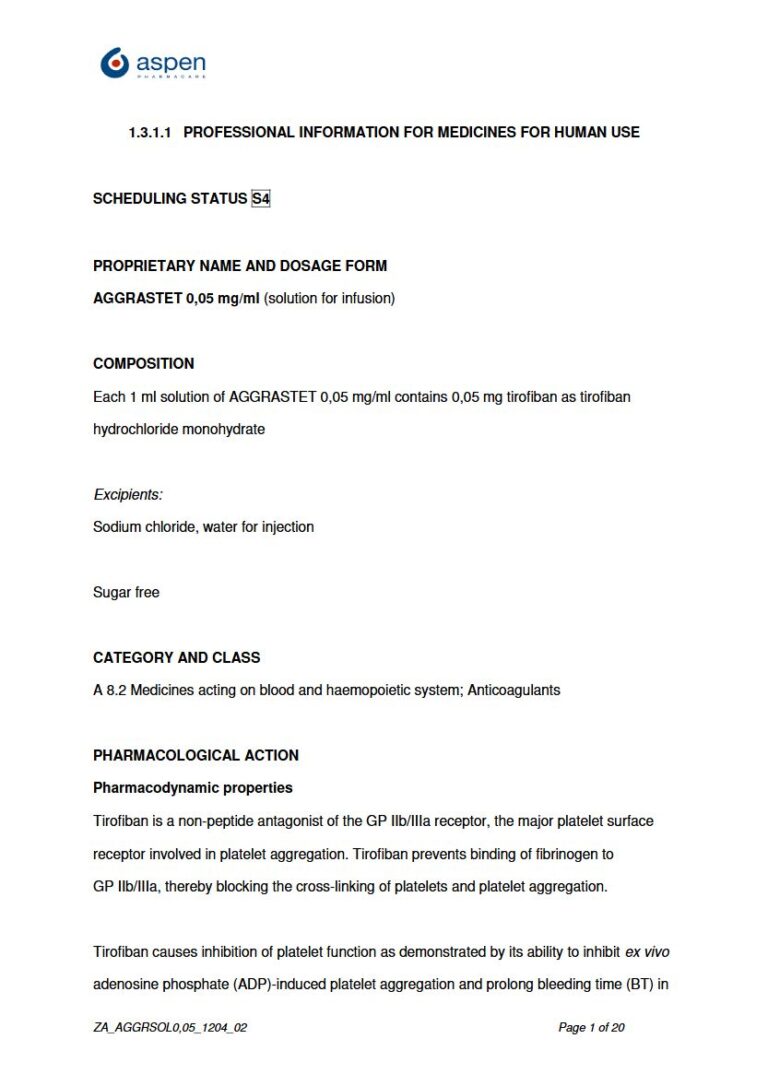
The Aggrastet Injection professional information leaflet below is the property of Aspen Pharmacare and is provided on Medinsert exactly as issued, with no.. alterations or editorial changes. We make every effort to keep content current by updating documents as soon as new versions become available. Medinsert serves as a trusted access point for healthcare professionals, but does not replace official sources or clinical judgement. For more details, please read our full disclaimer. read more>>
 Healthcare Professionals Only
This content is for registered healthcare professionals
Sign in or create a free account to read the full package insert.
Free for HPCSA-registered professionals. Powered by Medinsert.
Clinical Particulars
Section 4 of the official insert — extracted exactly as issued, no alterations
4.1 Therapeutic indications
AGGRASTET 0,05 mg/ml, in combination with heparin, is indicated for patients with unstable angina or non-Q-wave myocardial infarction, presenting with ECG abnormalities or elevated cardiac enzymes, to prevent cardiac ischaemic events and is also indicated for patients with coronary ischaemic syndromes undergoing coronary angioplasty or atherectomy to prevent cardiac ischaemic complications related to abrupt closure of the treated coronary artery (see DOSAGE AND DIRECTIONS FOR USE).
4.2 Posology and method of administration
AGGRASTET 0,05 mg/ml is for intravenous use only using sterile equipment. AGGRASTET 0,05 mg/ml may be co-administered with heparin through the same line. AGGRASTET 0,05 mg/ml is recommended for use with calibrated infusion device. Care should be taken to avoid a prolonged loading infusion. Care should also be taken in calculating the bolus dose and infusion rates based on patient weight. In clinical studies patients received aspirin, unless contraindicated.
Unstable Angina Pectoris or Non-Q-Wave Myocardial Infarction
In patients who are to be managed medically for unstable angina/non-Q-wave myocardial infarction and who may continue on to angioplasty or atherectomy, AGGRASTET 0,05 mg/ml should be administered intravenously, in combination with heparin, at the initial infusion rate of 0,4 microgram/kg/min for 30 minutes. Upon completion of the initial infusion, AGGRASTET 0,05 mg/ml should be continued at a maintenance infusion rate of 0,1 microgram/kg/min. Patients with severe renal insufficiency (creatinine clearance less than 30 ml/min) should receive half the usual rate of infusion.
Angioplasty/Atherectomy
In patients in whom AGGRASTET 0,05 mg/ml is initiated in the setting of angioplasty/atherectomy, AGGRASTET 0,05 mg/ml should be administered intravenously, in combination with heparin, as an initial bolus of 10 microgram/kg administered over 3 minutes followed by a maintenance infusion rate of 0,15 microgram/kg/min. Patients with severe renal insufficiency (creatinine clearance less than 30 ml/min) should receive half the usual dosage.
4.3 Contraindications
AGGRASTET 0,05 mg/ml is contraindicated in patients with:
- Known hypersensitivity to any component of the product;
- active internal bleeding or history of bleeding diathesis within the previous 30 days;
- a history of intracranial haemorrhage, intracranial neoplasm, arteriovenous malformation or aneurysm;
- a history of thrombocytopenia following prior exposure to AGGRASTET 0,05 mg/ml;
- major surgical procedure or severe physical trauma within the previous month;
- history of stroke within 30 days or any history of haemorrhagic stroke;
- history, symptoms, or findings suggestive of aortic dissection;
- severe hypertension (systolic blood pressure more than 180 mmHg and/or diastolic blood pressure more than 110 mmHg);
- acute pericarditis;
- concomitant use of another parenteral GP IIb/IIIa;
- recent epidural procedure;
- chronic haemodialysis;
- prolonged INR.
4.4 Special warnings and precautions for use
Bleeding is the most common complication encountered during therapy with AGGRASTET 0,05 mg/ml. Administration of AGGRASTET 0,05 mg/ml is associated with an increase in bleeding events classified as both major and minor bleeding events by criteria developed by the Thrombolysis in Myocardial Infarction Study group (TIMI). Most major bleeding associated with AGGRASTET 0,05 mg/ml occurs at the arterial access site for cardiac catheterisation. Because AGGRASTET 0,05 mg/ml inhibits platelet aggregation, caution should be employed when it is used with other medicines that affect haemostasis. The safety of AGGRASTET 0,05 mg/ml when used in combination with thrombolytic agents has not been established. During therapy with AGGRASTET 0,05 mg/ml, patients should be monitored for potential bleeding. When bleeding cannot be controlled with pressure, infusion of AGGRASTET 0,05 mg/ml and heparin should be discontinued. When treatment of bleeding is required, discontinuation of AGGRASTET 0,05 mg/ml should be considered. Consideration may also be given to transfusions. Fatal bleedings have been reported (see SIDE EFFECTS).
Laboratory Monitoring: Platelet counts, haemoglobin and hematocrit should be monitored prior to treatment, within 6 hours following the bolus or loading infusion, and at least daily thereafter during therapy with AGGRASTET 0,05 mg/ml (or more frequently if there is evidence of significant decline). AGGRASTET 0,05 mg/ml should be used with caution in patients with platelet count less than 150 000 cells/mm 3 and in patients with haemorrhagic retinopathy. If the patient experiences a platelet count decrease to less than 90 000 cells/mm 3, additional platelet counts should be performed to exclude pseudothrombocytopenia. If thrombocytopenia is confirmed, AGGRASTET 0,05 mg/ml and heparin should be discontinued and the condition appropriately monitored and treated.
4.5 Interactions with other medicines
AGGRASTET 0,05 mg/ml has been studied on a background of aspirin and heparin. The use of AGGRASTET 0,05 mg/ml, in combination with heparin and aspirin, has been associated with an increase in bleeding compared to heparin and aspirin alone (see SIDE EFFECTS). Caution should be employed when AGGRASTET 0,05 mg/ml is used with other medicines that affect haemostasis (e.g. warfarin) (see WARNINGS AND SPECIAL PRECAUTIONS, Bleeding). AGGRASTET 0,05 mg/ml has been used concomitantly in clinical studies with beta-blockers, calcium channel blockers, non-steroidal anti-inflammatory agents (NSAIDs) and nitrate preparations without evidence of clinically significant adverse interactions.
4.6 Fertility, pregnancy and lactation
Safety and efficacy in pregnancy and lactation has not been established. AGGRASTET 0,05 mg/ml should not be used during lactation.
4.7 Effects on ability to drive and use machines
Not specified in the provided text.
4.8 Undesirable effects
Bleeding is the most common adverse event reported during therapy with AGGRASTET 0,05 mg/ml when used concomitantly with heparin and aspirin, was bleeding (usually reported by the investigators as oozing or mild). The incidences of major and minor bleeding using the TIMI Criteria in the PRISM PLUS (Platelet Receptor Inhibition for Ischemic Syndrome Management - Patients Limited by Unstable Signs and Symptoms) and RESTORE (Randomized Efficacy Study of Tirofiban for outcomes and Restenosis) studies are shown below:
- Major Bleeding (TIMI Criteria): 1.4% AGGRASTET + Heparin, 0.8% Heparin
- Minor Bleeding (TIMI Criteria): 10.5% AGGRASTET + Heparin, 8.0% Heparin
Female patients and elderly patients receiving AGGRASTET 0,05 mg/ml with heparin or heparin alone had a higher incidence of bleeding complications than male patients or younger patients, respectively.
4.9 Overdose
Symptoms: In clinical trials, inadvertent overdosage with tirofiban occurred in doses up to 5 times and 2 times the recommended dose for bolus administration and loading infusion, respectively. The most frequently reported manifestation of overdosage was bleeding, primarily minor mucocutaneous bleeding events and minor bleeding at the sites of cardiac catheterisation.
Treatment: Overdosage of AGGRASTET 0,05 mg/ml should be treated by assessment of the patientu2019s clinical condition and cessation or adjustment of the AGGRASTET 0,05 mg/ml infusion as appropriate. AGGRASTET 0,05 mg/ml can be removed by haemodialysis.
