
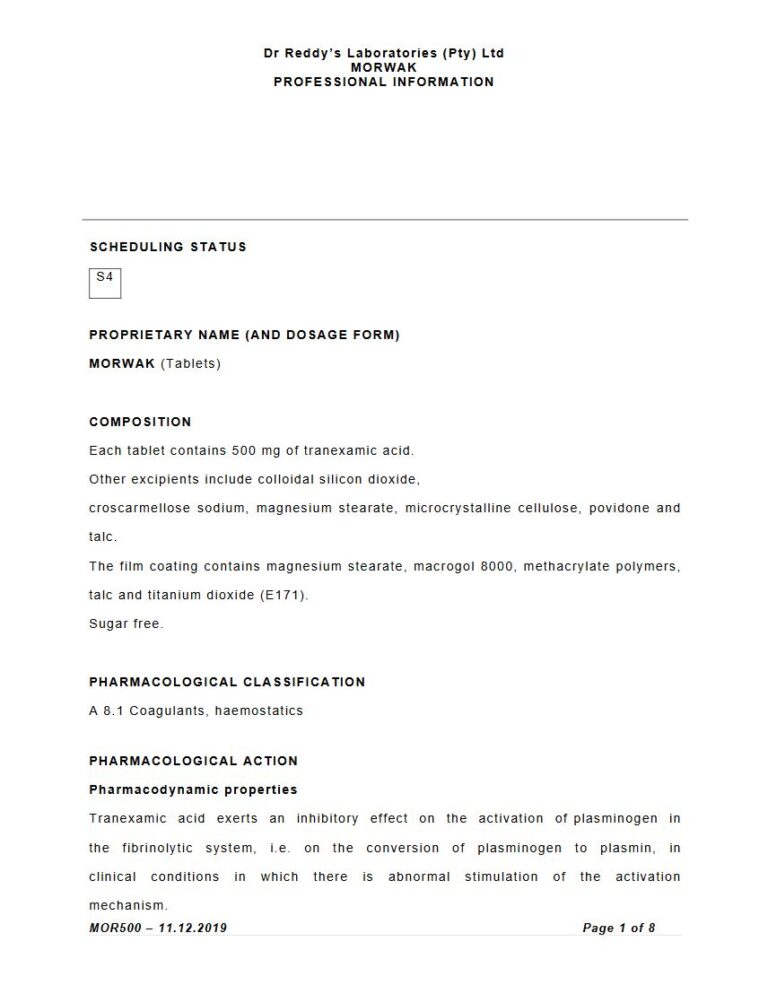
Morwak 250mgg, 500mg,750mg Tablets
PDF Leaflet Revision Date: 11 December 2019
Clinical Summary
Quick overview from the medicine insert
Indication
Short-term treatment of hyperemia and established coagulopathies.
Dosage (summary)
Adults: 1-1.5 g every 8 hours for 6-7 days; adjust for renal impairment.
Special Populations
- Renal impairment
Pregnancy & Breastfeeding
Safety not established; caution in lactating women as it passes into breast milk.
Key Drug Interactions
- Caution with other hemostatic agents
- Increased thrombus formation risk with estrogens
Contraindications
- Hypersensitivity to tranexamic acid
- History of thrombosis
- Severe renal impairment
Common side effects
- Nausea
- Vomiting
- Diarrhea
Counselling Points
- Take with plenty of fluids
- Monitor for signs of thrombosis
- Report any unusual bleeding
Serious warnings
- Not recommended in massive hematuria
- Risk of accumulation in renal insufficiency
Important Disclaimer
The Morwak 250mgg, 500mg,750mg Tablets professional information leaflet below is the property of Dr Reddy’S Laboratories and is provided on Medinsert exactly as issued, with no.. alterations or editorial changes. We make every effort to keep content current by updating documents as soon as new versions become available. Medinsert serves as a trusted access point for healthcare professionals, but does not replace official sources or clinical judgement. For more details, please read our full disclaimer. read more>>
 Healthcare Professionals Only
This content is for registered healthcare professionals
Sign in or create a free account to read the full package insert.
Free for HPCSA-registered professionals. Powered by Medinsert.
Clinical Particulars
Section 4 of the official insert — extracted exactly as issued, no alterations
4.1 Indications
1. Short term use in the treatment of hyphaema and in patients with established coagulopathies who are undergoing minor surgery.
2. Management of dental extraction in haemophiliacs.
3. Hereditary angioedema.
4. Menorrhagia.
4.3 Contraindications
MOR WAK is contraindicated in:
- patients who are hypersensitive to tranexamic acid or to any of the excipients of MOR WAK (see COMPOSITION).
- history of acute venous or arterial thrombosis.
- patients who suffer from massive urinary tract haemorrhage.
- severe renal impairment because of risk of accumulation.
- active thromboembolic disease.
- fibrinolytic conditions following consumption coagulopathy except in those with predominant activation of the fibrinolytic system with acute severe bleeding.
- history of convulsions.
4.4 Warnings and special precautions
MOR WAK is not recommended in patients suffering massive haematuria from the upper urinary tract (especially haemophilia) as ureteric obstruction has been reported occasionally (see CONTRAINDICATIONS).
Care should be taken:
- when prescribing MOR WAK to patients with renal insufficiency because of the risk of accumulation (see CONTRAINDICATIONS);
- when disseminated intravascular coagulation is in progress; Regular eye examination (e.g. visual acuity, slit lamp, intra-ocular pressure, visual fields) and liver function tests should be undertaken during long-term treatment of patients with hereditary angioedema. Dosages should be reduced in patients with renal impairment. (See DOSAGE AND DIRECTIONS FOR USE).
4.5 Interactions
Medicines with actions on haemostasis should be given with caution to patients on antifibrinolytic therapy such as MOR WAK. The potential for thrombus formation may be increased by oestrogens, for example, or the action of the fibrinolytic antagonised by compounds such as the thrombolytic. Concomitant chlorpromazine and tranexamic acid, as in MOR WAK, therapy of subarachnoid haemorrhage has been reported to result in cerebral vasospasm and cerebral ischemia, and possibly a reduction in cerebral blood flow. It is not recommended to use MOR WAK concomitantly with highly activated prothrombin products.
4.6 Fertility, pregnancy and lactation
The safety of MOR WAK in pregnant and lactating women has not been established. MOR WAK passes into breast milk to a concentration of approximately one hundredth of the concentration in the maternal blood. Caution should be exercised when MOR WAK is given to lactating women.
4.8 Undesirable effects
Immune system disorders
Less frequent: Hypersensitivity reactions including anaphylaxis
Nervous System Disorders
Less frequent: Convulsions, particularly in case of misuse
Eye disorders
Less frequent: Visual disturbances including impaired colour vision, retinal vein/artery occlusion
Vascular disorders
Less frequent: Thromboembolic events, malaise with hypotension, with or without loss of consciousness (generally following a too fast intravenous injection, exceptionally after oral administration), arterial or venous thrombosis at any sites
Gastrointestinal disorders
Frequent: Nausea, vomiting, diarrhoea
Skin and subcutaneous tissue disorders
Less frequent: Allergic skin reactions
4.9 Overdose
Symptoms of overdose may be nausea, vomiting, orthostatic symptoms and/or hypotension. Initiate vomiting, then charcoal therapy. Maintain a high fluid intake to promote renal excretion.
