
Triamist 55 μg Nasal Spray
PDF Leaflet Revision Date: 31 August 2023
Clinical Summary
Quick overview from the medicine insert
Indication
Preventative treatment of seasonal and perennial allergic rhinitis.
Dosage (summary)
Adults: 220 u03bcg (2 sprays in each nostril once daily); Children 6-12 years: 110 u03bcg (1 spray in each nostril daily).
Onset of Action / Duration
Onset: 3-4 days, Duration: up to 24 hours
Special Populations
- Children under 6 years
- Patients on corticosteroids
Pregnancy & Breastfeeding
Not recommended during pregnancy; safety during lactation not established.
Key Drug Interactions
- Increased risk of adrenal suppression with oral corticosteroids
Contraindications
- Hypersensitivity to triamcinolone
- Children under 6 years
Common side effects
- Headache
- Rhinitis
- Pharyngitis
- Nasal irritation
- Nasal candidiasis
Counselling Points
- Shake well before use
- Do not exceed prescribed dosage
- Monitor for signs of adrenal insufficiency
Serious warnings
- Potential for growth suppression in children
- Caution in patients with infections
Important Disclaimer
The Triamist 55 μg Nasal Spray professional information leaflet below is the property of Cipla Medpro and is provided on Medinsert exactly as issued, with no.. alterations or editorial changes. We make every effort to keep content current by updating documents as soon as new versions become available. Medinsert serves as a trusted access point for healthcare professionals, but does not replace official sources or clinical judgement. For more details, please read our full disclaimer. read more>>
 Healthcare Professionals Only
This content is for registered healthcare professionals
Sign in or create a free account to read the full package insert.
Free for HPCSA-registered professionals. Powered by Medinsert.
Clinical Particulars
Section 4 of the official insert — extracted exactly as issued, no alterations
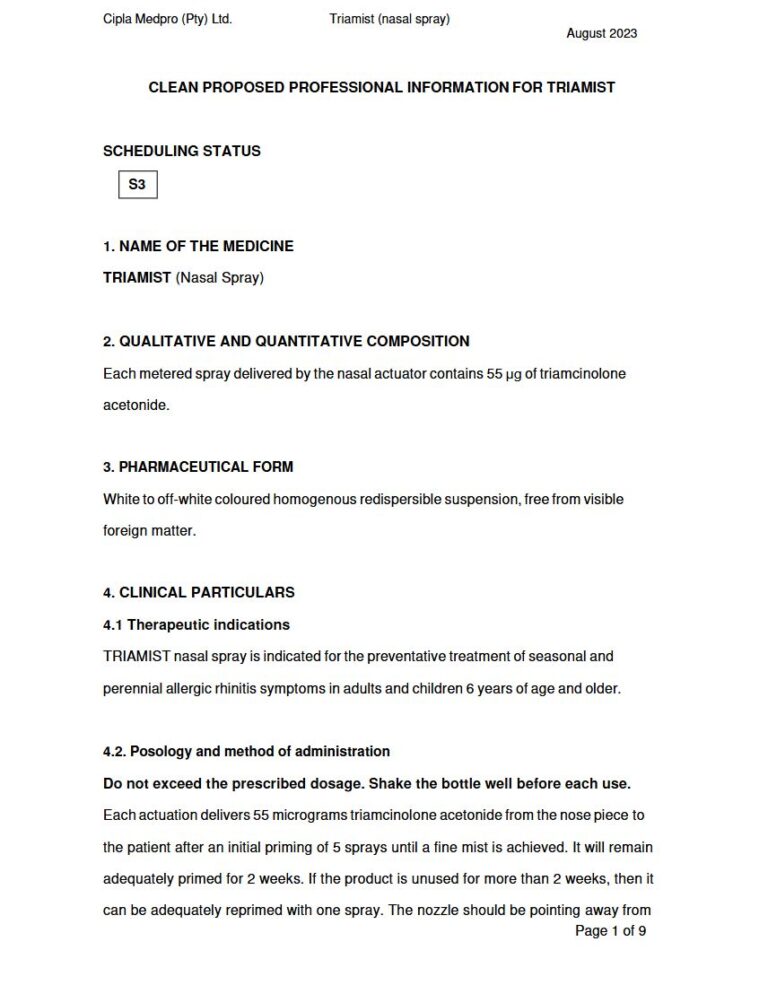
4.1 Therapeutic indications
TRIAMIST nasal spray is indicated for the preventative treatment of seasonal and perennial allergic rhinitis symptoms in adults and children 6 years of age and older.
4.2. Posology and method of administration
Do not exceed the prescribed dosage. Shake the bottle well before each use. Each actuation delivers 55 micrograms triamcinolone acetonide from the nose piece to the patient after an initial priming of 5 sprays until a fine mist is achieved. It will remain adequately primed for 2 weeks. If the product is unused for more than 2 weeks, then it can be adequately reprimed with one spray. The nozzle should be pointing away from the patient while the patient is priming the device.
Adults and children 12 years of age and older: It is recommended that dosing be started at 220 u03bcg as two sprays in each nostril once daily for adults and children 12 years and older.
Paediatric patients aged 6 to 12 years: The recommended dose is 110 u03bcg as 1 spray in each nostril daily. In patients with more severe symptoms, a dose of 220 u03bcg (2 sprays in each nostril once daily) may be used. But once symptoms are controlled, patients should be maintained on the lowest effective dose. Continuous use beyond 3 months in children under 12 years is not recommended.
Initial assessment for response should be made during the first three to four days and periodically until the patient's symptoms are stabilised. Some relief can be obtained in approximately two thirds of patients in that time. If adequate relief of symptoms has not been obtained after 3 weeks of treatment, TRIAMIST nasal spray should be discontinued, and consideration to alternative forms of treatment should be given. It is always desirable to titrate an individual patient to the minimum effective dose to reduce the possibility of side-effects. When the maximum benefit has been achieved and symptoms have been controlled, reducing the dose to 110 u03bcg (one spray in each nostril once per day) has been shown to be effective in maintaining control of the allergic rhinitis symptoms in patients who were initially controlled on 220 u03bcg/day.
Cleaning instructions TRIAMIST should be cleaned at least once a week or more often if it gets blocked.
To clean TRIAMIST:
- Pull the nozzle upwards to detach from the bottle.
- Soak the nozzle and dust cap in warm water for a few minutes.
- Rinse the nozzle and dust cap under clean running water.
- Shake off excess water and allow to dry at room temperature before refitting onto the bottle.
- Do not use a pin or other sharp object to unblock.
- Re-fit the nozzle and dust cap.
- Prime the unit as necessary until a fine mist is produced and then use as normal.
4.3 Contraindications
TRIAMIST is contra-indicated in patients with known hypersensitivity to triamcinolone acetonide or any of the other ingredients in the formulation. In children below the age of 6 years.
4.4 Special warnings and precautions for use
Safety and effectiveness have not been established in children below the age of 6 years. Oral corticosteroids have been shown to cause growth suppression in children and teenagers, particularly with higher doses over extended periods. If a child or teenager on any corticosteroid appears to have growth suppression, the possibility that they are particularly sensitive to this effect of steroids should be considered.
The use of TRIAMIST in combination with oral corticosteroids could increase the likelihood of hypothalamic-pituitary-adrenal axis suppression compared to a therapeutic dose of either one alone. Therefore, TRIAMIST should be used with caution in patients already receiving corticosteroids.
The replacement of a systemic corticosteroid with a topical corticoid, such as TRIAMIST nasal spray, can be accompanied by signs of adrenal insufficiency and, in addition, some patients may experience symptoms of withdrawal, e.g. joint and/or muscular pain, lassitude and depression. Patients previously treated for prolonged periods with systemic corticosteroids and transferred to topical corticoids such as TRIAMIST nasal spray should be carefully monitored for acute adrenal insufficiency in response to stress. In those patients who have asthma or other clinical conditions requiring long-term systemic corticosteroid treatment, too rapid a decrease in systemic corticosteroids may cause a severe exacerbation of their symptoms.
Patients who are on immunosuppressant doses of corticosteroids should take particular care to avoid exposure to chickenpox and measles. In susceptible patients, specific immunoglobulin or antiviral therapy may be indicated.
Infections of the nose and pharynx with Candida albicans may occur. When such an infection develops it may require treatment with appropriate local or systemic therapy and discontinuance of treatment with TRIAMIST nasal spray.
TRIAMIST nasal spray should be used with caution, if used at all, in patients with active or quiescent tuberculous infections of the respiratory tract or in patients with untreated fungal, bacterial, or systemic viral infections or ocular herpes simplex.
Because of the inhibitory effect of corticosteroids on wound healing in patients who have experienced recent nasal septal ulcers, nasal surgery or trauma, TRIAMIST nasal spray should be used with caution until healing has occurred.
Nasal septal perforations have been reported in rare instances. When used at excessive doses, systemic corticosteroid effects such as hypercorticism and adrenal suppression may appear. If such changes occur, TRIAMIST nasal spray should be discontinued slowly, consistent with accepted procedures for discontinuing oral steroid therapy.
4.5 Interaction with other medicines and other forms of interaction
Corticosteroids have an inhibitory effect on wound healing and should be used with caution in conjunction with TRIAMIST (see Section 4.4).
4.6 Fertility, pregnancy and lactation
Pregnancy Corticosteroids have been shown to be teratogenic in animals following topical application. Therefore, TRIAMIST should not be used during pregnancy. Hypoadrenalism may occur in infants born to mothers receiving corticosteroids during pregnancy. Such infants should be carefully observed.
Lactation Safety of TRIAMIST during lactation has not been established, therefore women should not breastfeed their infants.
4.7 Effects on ability to drive and use machines
TRIAMIST has no or negligible influence on the ability to drive and use machines.
4.8 Undesirable effects
The most commonly reported adverse reactions included those involving the mucous membranes of the nose and throat.
Nervous system disorders: Frequent: Headache.
Eye disorders: Less frequent: Ocular hypertension.
Respiratory, thoracic and mediastinal disorders: Frequent: Rhinitis and pharyngitis, burning, dryness or other irritation inside the nose. Less frequent: Crusting inside nose or epistaxis, sore throat, ulceration of nasal mucosa, nasal candidiasis, pharyngeal candidiasis, nasal septal perforation, burning or stinging continuing after use of spray, as well as sneezing and sinus congestion, stuffy nose and throat discomfort.
Frequency unknown: Dry mucous membrane.
Reporting of suspected adverse reactions Reporting suspected adverse reactions after authorisation of the medicine is important. It allows continued monitoring of the benefit/risk balance of the medicine. Health care providers are asked to report any suspected adverse reactions to SAHPRA via the u201c6.04 Adverse Drug Reactions Reporting Formu201d, found online under SAHPRAu2019s publications: https://www.sahpra.org.za/Publications/Index/8 and to Cipla Medpro (Pty) Ltd at [email protected] or telephone 080 222 6662 (toll free).
4.9 Overdose
In the event of the entire contents of the bottle being administered all at once, either via oral or nasal application. The patient may experience some gastrointestinal upset. Overdosage should be treated symptomatically and supportively.
