
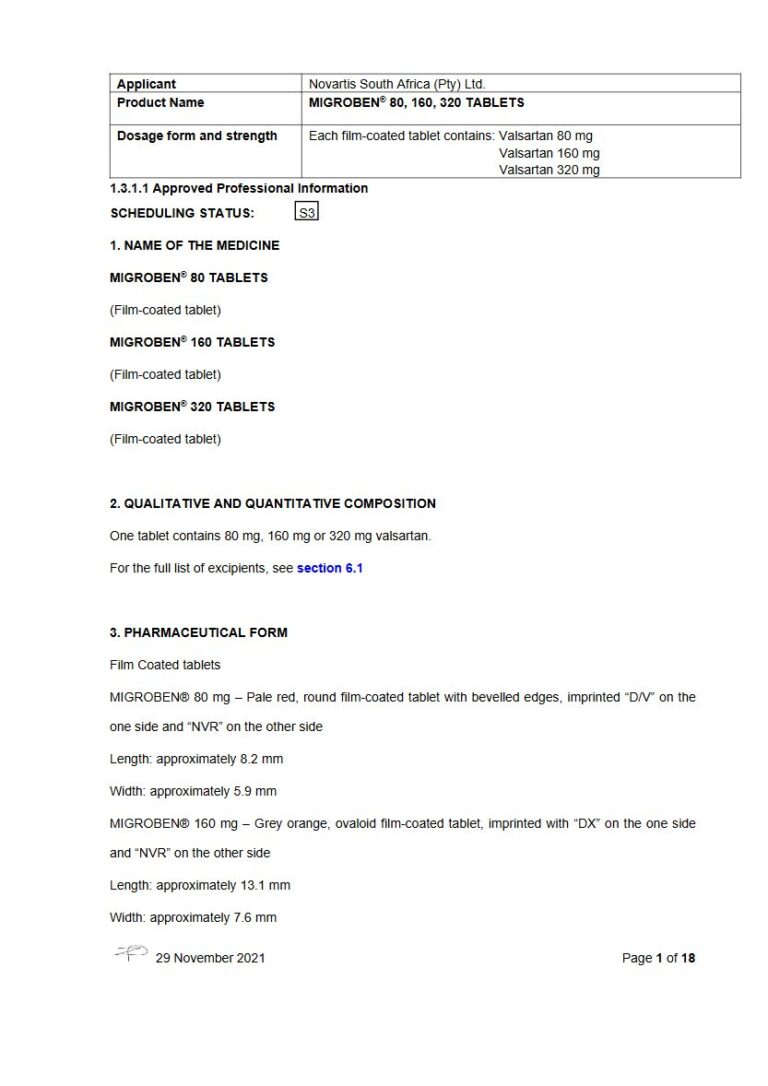
Migroben 80, 160, 320 Tablets 80 mg, 160 mg or 320 mg FC tablets
PDF Leaflet Revision Date: 07 February 2022
Clinical Summary
Quick overview from the medicine insert
Indication
Treatment of mild to moderate essential hypertension in adults.
Dosage (summary)
80 mg or 160 mg once daily; may increase to 320 mg if needed.
Onset of Action / Duration
Onset: 2 weeks, Duration: Maximal effect at 4 weeks
Special Populations
- Renal impairment
- Hepatic impairment
Pregnancy & Breastfeeding
Not recommended in pregnancy; discontinue if pregnancy occurs. Unknown if excreted in breast milk.
Key Drug Interactions
- Potassium-sparing diuretics
- Lithium
- NSAIDs
- Aliskiren in Type 2 diabetes
Contraindications
- Hypersensitivity to valsartan
- History of angioedema
- Severe renal impairment
- Bilateral renal artery stenosis
- Aortic and mitral valve stenosis
Common side effects
- Fatigue
- Cough
- Abdominal pain
- Vertigo
Counselling Points
- Monitor blood pressure regularly
- Avoid potassium supplements
- Discontinue if pregnancy is confirmed
Serious warnings
- Risk of hypotension in volume-depleted patients
- Angioedema risk
- Caution in renal artery stenosis
Important Disclaimer
The Migroben 80, 160, 320 Tablets 80 mg, 160 mg or 320 mg FC tablets professional information leaflet below is the property of Novartis South Africa and is provided on Medinsert exactly as issued, with no.. alterations or editorial changes. We make every effort to keep content current by updating documents as soon as new versions become available. Medinsert serves as a trusted access point for healthcare professionals, but does not replace official sources or clinical judgement. For more details, please read our full disclaimer. read more>>
 Healthcare Professionals Only
This content is for registered healthcare professionals
Sign in or create a free account to read the full package insert.
Free for HPCSA-registered professionals. Powered by Medinsert.
Clinical Particulars
Section 4 of the official insert — extracted exactly as issued, no alterations
4.1 Therapeutic Indications
Hypertension: Treatment of mild to moderate essential hypertension in adult patients (18 years and older).
4.2 Posology and method of administration
Posology: Hypertension: The recommended dose of MIGROBEN is 80 mg or 160 mg once daily. The antihypertensive effect is substantially present within 2 weeks and maximal effects are seen after 4 weeks. In patients whose blood pressure is not adequately controlled, the daily dose may be increased to 320 mg, or a diuretic may be added. MIGROBEN may also be administered with other antihypertensive medicines.
Special population
Renal impairment
NOTE: No dosage adjustment is required for patients with mild and moderate renal impairment (where the creatinine clearance is above 30 to less than 90 ml/min). (see section 4.4). A lower dose should be considered for patients with a history of hepatic impairment. (see section 4.4).
Paediatric population
The safety and efficacy of MIGROBEN have not been established in children. Currently available data are described in section 5.1 and 5.2 but no recommendation on a posology can be made.
4.3 Contraindications
- Hypersensitivity to valsartan and any of MIGROBEN excipients
- A history of angioedema related to previous therapy with ACE inhibitors or angiotensin receptor blockers (ARBs): These patients must never again be given these medicines.
- Heredity or idiopathic angioedema.
- Hypertrophic obstructive cardiomyopathy (HOCM)
- Severe renal function impairment (creatinine clearance less than 30 ml/min)
- Bilateral renal artery stenosis
- Renal artery stenosis in patients with a single kidney
- Aortic valve stenosis
- Mitral valve stenosis
- Concomitant therapy with potassium sparing diuretics such as spironolactone, triamterene, amiloride (see section 4.5).
- Porphyria
- Lithium therapy: Concomitant administration with MIGROBEN may lead to toxic serum concentrations of lithium (see section 4.5).
- Pregnancy and lactation (see section 4.6).
- Concomitant use of MIGROBEN with aliskiren in patients with Type 2 diabetes mellitus.
4.4 Special warnings and precautions for use
Should a woman become pregnant while receiving MIGROBEN, the treatment should be stopped promptly and switched to a different class of antihypertensive medicine. (see section 4.3 and section 4.6)
Sodium- and/or volume-depleted patients: In sodium-depleted and/or volume-depleted patients, such as those receiving high doses of diuretics, and/or patients with moderate to severe renal impairment, symptomatic hypotension may occur after initiation of therapy with MIGROBEN. Sodium- and/or volume- depletion should be corrected before starting treatment with MIGROBEN for example, by reducing the diuretic dose. If hypotension occurs, the patient should be placed in the supine position and, if necessary, given an intravenous infusion of normal saline. Treatment can be continued once blood pressure has stabilised. Reduced doses must be considered in patients with hepatic impairment.
Renal artery stenosis: Since other medicines that affect the renin-angiotensin-aldosterone system such as MIGROBEN may increase serum urea and serum creatinine in patients with bilateral or unilateral renal artery stenosis; MIGROBEN should not be used in patients with bilateral renal artery stenosis or unilateral renal artery stenosis, aortic valve stenosis, mitral valve stenosis or hypertrophic obstructive cardiomyopathy (see section 4.3)
Impaired renal function: No dosage adjustment is required for patients with mild to moderate renal impairment. MIGROBEN is contraindicated in severe renal function impairment (creatinine clearance less than 30 ml/min (see section 4.3). Since hyperkalaemia may occur, serum-potassium concentrations should be monitored especially in the elderly and patients with renal impairment and the concomitant use of potassium-sparing diuretics should be avoided (see section 4.3 and section 4.5). The use of MIGROBEN with aliskiren should be avoided in patients with severe renal impairment (GFR < 30 mL/min) (see section 4.5, subsection dual blockade of the RAAS).
Hepatic impairment: MIGROBEN is mostly eliminated unchanged in the bile, and patients with biliary obstructive disorders showed lower MIGROBEN clearance (see section 5.2). Particular caution should be exercised when administering MIGROBEN to patients with biliary obstructive disorders. In patients with mild (Child-Pugh Class A) to moderate (Child-Pugh Class B) hepatic impairment without cholestasis, the maximum recommended dose is 80 mg valsartan.
Angioedema: Angioedema, including swelling of the larynx and glottis, causing airway obstruction and/or swelling of the face, lips, pharynx, and/or tongue has been reported in patients treated with valsartan; some of these patients previously experienced angioedema with other drugs including ACE inhibitors. MIGROBEN should be immediately discontinued in patients who develop angioedema, and MIGROBEN should not be re-administered.
Patients with heart failure/post-myocardial infarction: In patients whose renal function may depend on the activity of the renin-angiotensin-aldosterone system (e.g. patients with severe congestive heart failure), treatment with angiotensin receptor antagonists (e.g. valsartan as contained in TN) has been associated with oliguria and/or progressive uraemia, and with acute renal failure and/or death. Evaluation of patients with heart failure or with history of recent myocardial infarction should always include assessment of renal function.
Dual Blockade of the Renin-Angiotensin - Aldosterone System (RAAS): Caution is required while co-administering ARBs, including MIGROBEN, with other medicines blocking the RAAS such as ACEIs or aliskiren (see section 4.3 and 4.5, subsection dual blockade of the RAAS).
4.5 Interaction with other medicines and other forms of interaction
Dual blockade of the Renin-Angiotensin-Aldosterone-System (RAAS) with ARBs, ACEIs, or aliskiren: The concomitant use of MIGROBEN, with other medicines acting on the RAAS is associated with an increased incidence of hypotension, hyperkalemia, and changes in renal function compared to monotherapy. It is recommended to monitor blood pressure, renal function and electrolytes in patients on MIGROBEN and other medicines that affect the RAAS (see section 4.4).
The concomitant use of ARBs - including MIGROBEN - or of ACEIs with aliskiren, should be avoided in patients with severe renal impairment (GFR < 30 ml/min) (see section 4.4). The concomitant use of ARBs - including MIGROBEN - or ACEIs with aliskiren is contraindicated in patients with Type 2 diabetes (see section 4.3).
Potassium: Concomitant use of potassium-sparing diuretics (e.g. spironolactone, triamterene, amiloride), potassium supplements, or salt substitutes containing potassium may lead to increases in serum potassium, and in patients with heart failure to increase in serum creatinine (see section 4.3).
Non-Steroidal Anti-Inflammatory Agents (NSAIDs) including Selective Cyclooxygenase-2 Inhibitors (COX-2 Inhibitors): When angiotensin II antagonists are administered simultaneously with NSAIDs, attenuation of the antihypertensive effect may occur. Furthermore, in elderly patients, volume-depleted (including those on diuretic therapy), or with compromised renal function, concomitant use of angiotensin II antagonists and NSAIDs may lead to an increased risk of worsening of renal function. Therefore, monitoring of renal function is recommended when initiating or modifying the treatment in patients on valsartan who are taking NSAIDs concomitantly.
Lithium: Reversible increases in serum lithium concentrations and toxicity have been reported during concomitant administration of lithium with ACE inhibitors or angiotensin II receptor antagonists, including MIGROBEN. Therefore, careful monitoring of serum lithium levels is recommended during concomitant use. If a diuretic is also used, the risk of lithium toxicity may presumably be increased further with MIGROBEN.
Transporters: The results from an in vitro study with human liver tissue indicate that valsartan is a substrate of the hepatic uptake transporter OATP1B1 and the hepatic efflux transporter MRP2. Co-administration of inhibitors of the uptake transporter (e.g., rifampin, ciclosporin) or efflux transporter (e.g., ritonavir) may increase the systemic exposure to valsartan. No interactions of clinical significance have been found. Compounds studied in clinical trials include: cimetidine, warfarin, furosemide, digoxin, atenolol, hydrochlorothiazide, amlodipine and glibenclamide. As MIGROBEN is not metabolised to a significant extent, clinically relevant interactions in the form of metabolic induction or inhibition of the cytochrome P450 system are not expected with valsartan. Although valsartan is highly bound to plasma proteins, in vitro studies have not shown any interaction at this level with a range of molecules which are also highly protein-bound, such as diclofenac, furosemide and warfarin. Concurrent use with sympathomimetics may reduce the antihypertensive effect of MIGROBEN.
4.6 Fertility, pregnancy and lactation
Women of childbearing potential / Contraception in males and females: MIGROBEN acts directly on the RAAS and therefore should not be used in women planning to become pregnant. Healthcare professionals prescribing MIGROBEN should counsel women of childbearing potential about the potential risk during pregnancy. Women of childbearing age should ensure effective contraception.
Pregnancy: When pregnancy is planned or confirmed MIGROBEN should be discontinued as soon as possible. Not to be used in pregnancy as teratogenicity has been shown in experimental animals. Medicines affecting the renin-angiotensin-aldosterone system, such as MIGROBEN, can cause embryonal toxicity, foetal and neonatal morbidity and mortality when administered to pregnant women. Safety in pregnancy and lactation has not been established (see section 4.3). In case of accidental exposure to MIGROBEN, appropriate foetal monitoring should be considered. Infants whose mothers have taken MIGROBEN should be closely observed for hypotension. There have been reports of spontaneous abortion, oligohydramnios and newborn renal dysfunction when pregnant women have inadvertently taken valsartan.
Breastfeeding: It is not known whether valsartan is excreted in human milk. Since valsartan was excreted in the milk of lactating rats, mothers taking MIGROBEN should not breastfeed their infants.
Fertility: There is no information on the effects of MIGROBEN on human fertility. Studies in rats did not show any effects of valsartan on fertility.
4.7 Effects on ability to drive and use machines
Patients treated with MIGROBEN should be advised to take into account that somnolence, headache, dizziness or fatigue can occur. Therefore, their ability to drive and use machinery may be impaired.
4.8 Undesirable effects
Frequencies are defined as: very common (u2265 1/10); Common (u2265 1/100, <1/10); uncommon (u2265 1/100, < 1/1 000); rare (u2265 1/ 10 000, < 1/1 000); very rare (< 1/10 000)
Table 1: Adverse drug reactions in Hypertension from clinical trials
- Ear and labyrinth system disorders: Uncommon Vertigo
- Respiratory, thoracic and mediastinal disorders: Uncommon Cough
- Gastrointestinal disorders: Uncommon Abdominal pain
- General disorders and administration site conditions: Uncommon Fatigue
Table 2: Adverse drug reactions from Post Marketing Surveillance Frequency: Unknown
- Blood and lymphatic system disorders: Haemoglobin decreased, haematocrit decreased, neutropenia, thrombocytopenia
- Immune system disorders: Hypersensitivity including serum sickness
- Metabolism and nutrition disorders: Serum potassium increased
- Vascular disorders: Vasculitis
- Hepato-biliary disorders: Liver function test abnormal including serum bilirubin increase
- Skin and subcutaneous tissue disorders: Angioedema, dermatitis bullous, rash, pruritus
- Musculoskeletal and connective tissue disorders: Myalgia
- Renal and urinary disorders: Renal failure and impairment, serum creatinine increased
The following events have also been observed during clinical trials in hypertensive patients irrespective of their causal association with the study drug: Arthralgia, asthenia, back pain, diarrhoea, dizziness, headache, insomnia, libido decrease, nausea, oedema, pharyngitis, rhinitis, sinusitis, upper respiratory tract infection, viral infections.
4.9 Overdose
Overdose with MIGROBEN may result in marked hypotension, which could lead to depressed level of consciousness, circulatory collapse and/or shock. If the ingestion is recent, vomiting should be induced if the patient is conscious. Otherwise, the usual treatment would be intravenous infusion of normal saline solution. MIGROBEN is unlikely to be removed by haemodialysis.
