
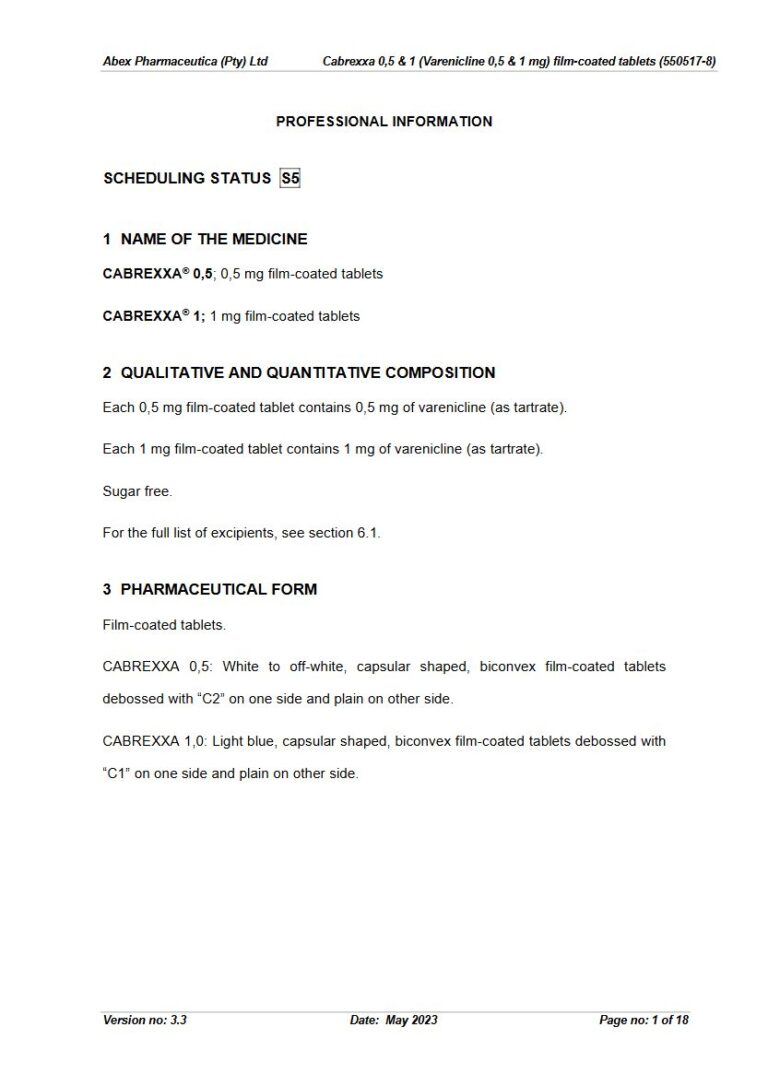
Cabrexxa 0,5mg & 1mg Tablet
PDF Leaflet Revision Date: May 2023
Clinical Summary
Quick overview from the medicine insert
Indication
Aid to smoking cessation in motivated patients.
Dosage (summary)
1 mg twice daily after 1-week titration.
Special Populations
- Renal impairment
- Hepatic impairment
- Elderly
Pregnancy & Breastfeeding
Not recommended in pregnancy or breastfeeding.
Key Drug Interactions
- Warfarin
- Cimetidine
- Alcohol
Contraindications
- Hypersensitivity to varenicline
Common side effects
- Nausea
- Insomnia
- Headache
- Dizziness
Counselling Points
- Monitor for mood changes.
- Do not drive if affected.
- Set a quit date before starting.
Serious warnings
- Serious neuropsychiatric symptoms
- Seizures
- Cardiovascular events
Important Disclaimer
The Cabrexxa 0,5mg & 1mg Tablet professional information leaflet below is the property of Abex Pharmaceutica and is provided on Medinsert exactly as issued, with no.. alterations or editorial changes. We make every effort to keep content current by updating documents as soon as new versions become available. Medinsert serves as a trusted access point for healthcare professionals, but does not replace official sources or clinical judgement. For more details, please read our full disclaimer. read more>>
 Healthcare Professionals Only
This content is for registered healthcare professionals
Sign in or create a free account to read the full package insert.
Free for HPCSA-registered professionals. Powered by Medinsert.
Clinical Particulars
Section 4 of the official insert — extracted exactly as issued, no alterations
4.1 Therapeutic indications
CABREXXA is indicated as an aid to smoking cessation in patients committed to stop smoking, in addition to a behaviour modification programme, for 12 weeks. Efficacy beyond 12 weeks has not been determined.
4.2 Posology and method of administration
All smoking cessation therapies are more likely to succeed in patients who are motivated to stop smoking and who are provided with additional advice and continuous support.
Posology
Patients should be treated with CABREXXA for 12 weeks. The recommended dose is 1 mg CABREXXA twice daily following a 1-week titration as follows:
- Days 1 u2013 3: 0,5 mg once daily in the evening
- Days 4 u2013 7: 0,5 mg twice daily
- Day 8 to end of treatment: 1 mg twice daily
The patient should set a date to stop smoking. CABREXXA dosing should usually start at 1-2 weeks before this date. Patients who do not succeed in stopping smoking during 12 weeks of initial therapy, or who relapse after treatment, should be encouraged to make another attempt once factors contributing to the failed attempt have been identified and addressed. Dose tapering of CABREXXA is not required at the end of treatment.
Special populations
Renal impairment
No dosage adjustment is necessary for patients with mild to moderate renal impairment. For patients with severe renal impairment, the recommended dose of CABREXXA is 1 mg once daily. Dosing should begin at 0,5 mg once daily for the first 3 days then increased to 1 mg once daily (see section 5.2).
Hepatic impairment
No dosage adjustment is necessary for patients with hepatic impairment (see section 5.2).
Elderly
No dosage adjustment is necessary for elderly patients (see section 5.2). Because elderly patients are more likely to have decreased renal function, medical practitioners should consider the renal status of an elderly patient.
Paediatric population
CABREXXA is not recommended for use in patients under 18 years of age because safety and efficacy in this population have not been established (see section 5.2).
Method of administration
CABREXXA is for oral use and the tablets should be swallowed whole with water. CABREXXA can be taken with or without food.
4.3 Contraindications
Hypersensitivity to varenicline or to any of the excipients of CABREXXA, listed in section 6.1.
4.4 Special warnings and precautions for use
Effect of smoking cessation
Physiological changes resulting from smoking cessation, with or without treatment with CABREXXA, may alter the pharmacokinetics or pharmacodynamic properties of some medicines, for which dosage adjustment may be necessary (examples include theophylline, warfarin and insulin). Cases of increased international normalised ratio (INR) have been reported. INR should be monitored more frequently and the warfarin dose adjusted while taking CABREXXA, and after discontinuation of CABREXXA (see section 4.5).
As smoking induces CYP1A2, smoking cessation may result in an increase of plasma levels of CYP1A2 substrates.
Neuropsychiatric symptoms
Serious neuropsychiatric symptoms have been reported in patients being treated with varenicline (as in CABREXXA). Changes in mood (including depression and mania), psychosis, hallucinations, paranoia, delusions, hostility, agitation, anxiety, panic, mood swings, aggressive behaviour, suicidal ideation and behaviour and suicide attempts (including completed suicide u2013 see section 4.8) have been reported in patients attempting to quit smoking with CABREXXA in the post-marketing experience. Depressed mood, rarely including suicidal ideation and suicide attempt, may be a symptom of nicotine withdrawal.
Some reported cases may have been complicated by the symptoms of nicotine withdrawal in patients who stopped smoking. Depressed mood may be a symptom of nicotine withdrawal. Depression, rarely including suicidal ideation, has been reported in smokers trying to stop smoking without medicinal treatment. However, some of these symptoms have occurred in patients taking varenicline (as in CABREXXA) who continued to smoke. When symptoms were reported, most were during varenicline treatments, but some were following discontinuation of varenicline (as in CABREXXA) treatment. These events have occurred in patients with and without pre-existing psychiatric disease; some patients have experienced worsening of their psychiatric illnesses.
Medical practitioners should be aware of the possible emergence of serious neuropsychiatric symptoms in patients attempting to quit smoking with or without treatment. If serious neuropsychiatric symptoms occur while on CABREXXA treatment, patients should discontinue CABREXXA immediately and contact a healthcare professional for re-evaluation of treatment. In many post-marketing cases, resolution of symptoms after discontinuation of varenicline (as in CABREXXA) was reported, although in some cases the symptoms persisted, therefore, ongoing monitoring and supportive care should be provided until symptoms resolve.
History of psychiatric disorders
Smoking cessation, with or without pharmacotherapy, has been associated with exacerbation of underlying psychiatric illness (e.g. depression). Neuropsychiatric adverse events were reported more frequently in patients with a history of psychiatric disorders compared to those without a history of psychiatric disorders, regardless of treatment (see section 5.1). Care should be taken with patients with a history of psychiatric illness and patients should be advised accordingly.
Seizures
There have been reports of seizures in patients with or without a history of seizures, treated with varenicline, as in CABREXXA. CABREXXA should be used cautiously in patients with a history of seizures or other conditions that potentially lower the seizure threshold.
Treatment discontinuation
At the end of treatment, discontinuation of varenicline (as in CABREXXA) was associated with an increase in irritability, urge to smoke, depression, and/or insomnia in up to 3 % of patients. The prescriber should inform the patient accordingly and discuss or consider the need for dose tapering.
Cardiovascular events
After cessation of smoking, cardiovascular events were reported more frequently in patients with stable cardiovascular disease that were treated with varenicline (as in CABREXXA). Cardiovascular events occurred primarily in patients with known cardiovascular disease. Patients taking CABREXXA should be instructed to notify their medical practitioner of new or worsening cardiovascular symptoms and to seek immediate medical attention if they experience signs and symptoms of myocardial infarction or stroke (see section 5.1).
Angioedema and hypersensitivity reactions
There have been post-marketing reports of hypersensitivity reactions including angioedema in patients treated with varenicline (as in CABREXXA). Clinical signs included swelling of the face, mouth (tongue, lips, and gums), neck (throat and larynx) and extremities. There were infrequent reports of life-threatening angioedema requiring urgent medical attention due to respiratory compromise. Patients experiencing these symptoms should discontinue treatment with CABREXXA and contact a healthcare provider immediately.
Serious skin reactions
There have also been post-marketing reports of serious skin reactions, including Stevens-Johnson syndrome and erythema multiforme in patients taking varenicline (as in CABREXXA); see section 4.8. As these skin reactions can be life-threatening, patients should discontinue treatment at the first sign of a skin rash or skin reaction and contact a healthcare provider immediately.
4.5 Interaction with other medicines and other forms of interaction
Based on varenicline characteristics and clinical experience to date, CABREXXA has no clinically meaningful medicine interactions. No dosage adjustment of CABREXXA or co-administered medicines listed below is recommended.
In vitro studies indicate that varenicline is unlikely to alter the pharmacokinetics of compounds that are primarily metabolised by cytochrome P450 enzymes. Furthermore, since metabolism of varenicline represents less than 10 % of its clearance, active substances known to affect the cytochrome P450 system are unlikely to alter the pharmacokinetics of varenicline (see section 5.2) and therefore a dose adjustment of CABREXXA would not be required.
In vitro studies demonstrate that varenicline does not inhibit human renal transport proteins at therapeutic concentrations. Therefore, active substances that are cleared by renal secretion (e.g., metformin - see below) are unlikely to be affected by CABREXXA.
Metformin
Varenicline did not affect the pharmacokinetics of metformin. Metformin had no effect on varenicline pharmacokinetics.
Cimetidine
Co-administration of cimetidine, with varenicline increased the systemic exposure of varenicline by 29 % due to a reduction in varenicline renal clearance. No dosage adjustment is recommended based on concomitant cimetidine administration in patients with normal renal function or in patients with mild to moderate renal impairment. In patients with severe renal impairment, the concomitant use of cimetidine and CABREXXA should be avoided.
Digoxin
Varenicline did not alter the steady-state pharmacokinetics of digoxin.
Warfarin
Varenicline did not alter the pharmacokinetics of warfarin. Prothrombin time (INR) was not affected by varenicline (as in CABREXXA). Smoking cessation itself may result in changes to warfarin pharmacokinetics (see section 4.4). However, in post-marketing data there were cases of increased INR. INR should be monitored more frequently and the warfarin dose adjusted while using CABREXXA, and after discontinuation of CABREXXA (see section 4.4).
Alcohol
There are limited clinical data on any potential interaction between alcohol and varenicline. There have been post-marketing reports of increased intoxicating effects of alcohol in patients treated with varenicline. A causal relationship between these events and varenicline use has not been established.
Use with other therapies for smoking cessation
Bupropion
Varenicline did not alter the steady-state pharmacokinetics of bupropion. However, the incidence of nausea is doubled with co-administration.
Nicotine replacement therapy (NRT)
When varenicline and transdermal NRT were co-administered to smokers for 12 days, there was a statistically significant decrease in average systolic blood pressure (mean 2,6 mmHg) measured on the final day of the study. In this study, the incidence of nausea, headache, vomiting, dizziness, dyspepsia, and fatigue was greater for the combination than for NRT alone. Safety and efficacy of CABREXXA in combination with other smoking cessation therapies have not been studied.
4.6 Fertility, pregnancy and lactation
Women of child-bearing potential
Where therapy is indicated, treatment should be timed such that the course is completed before conception occurs.
Pregnancy
The safety of CABREXXA in human pregnancy has not been established. The use of CABREXXA in pregnant women is not recommended.
Lactation
The safety of CABREXXA during lactation has not been established. Mothers on CABREXXA should therefore not breastfeed their infants.
Fertility
There are no clinical data on the effects of varenicline on fertility.
4.7 Effects on ability to drive and use machines
CABREXXA may have minor or moderate influence on the ability to drive and use machines. However, CABREXXA may cause dizziness, somnolence and transient loss of consciousness, and therefore may influence the ability to drive and use machines.
Patients are advised not to drive, operate complex machinery or engage in other potentially hazardous activities until it is known whether this medicine affects their ability to perform these activities.
4.8 Undesirable effects
a. Summary of the safety profile
Smoking cessation with or without treatment is associated with various symptoms. No attempt has been made in either the design or the analysis of the CABREXXA studies to distinguish between adverse reactions associated with study medicine treatment or those possibly associated with nicotine withdrawal.
In patients treated with the recommended dose of 1 mg twice daily following an initial titration period the adverse event most frequently reported was nausea (28,6 %). In the majority of cases nausea occurred early in the treatment period, and was mild to moderate in severity.
b. Tabulated summary of adverse reactions
System organ class Adverse reactions
Infections and infestations
Frequent Nasopharyngitis, bronchitis, sinusitis
Less frequent Fungal infection, viral infection
Immune system disorders
Not known Hypersensitivity reactions, angioedema
Blood and lymphatic system disorders
Less frequent Platelet count decreased
Metabolism and nutrition disorders
Frequent Weight increased, increased appetite, decreased appetite
Less frequent Hyperglycaemia, diabetes mellitus, polydipsia
Psychiatric disorders
Frequent Abnormal dreams, insomnia
Less frequent Suicidal ideation, aggression, panic reaction, thinking abnormal, restlessness, mood swings, depression*, anxiety*, hallucinations*, libido increased, libido decreased, psychosis, somnambulism, abnormal behaviour, dysphoria, bradyphrenia
Nervous system disorders
Frequent Headache, somnolence, dizziness, dysgeusia
Less frequent Seizure, tremor, lethargy, hypoaesthesia, cerebrovascular accident, hypertonia, dysarthria, coordination abnormal, hypogeusia, circadian rhythm sleep disorder
Not known Transient loss of consciousness
Eye disorders
Less frequent Conjunctivitis, eye pain, scotoma, scleral discolouration, mydriasis, photophobia, myopia, lacrimation increased
Ear and labyrinth disorders
Less frequent Tinnitus
Cardiac disorders
Less frequent Myocardial infarction, angina pectoris, tachycardia, palpitations, heart rate increased, atrial fibrillation, electrocardiogram ST segment depression, electrocardiogram T wave amplitude decreased
Vascular disorders
Less frequent Blood pressure increased, hot flush
Respiratory, thoracic and mediastinal disorders
Frequent Dyspnoea, cough
Less frequent Upper respiratory tract inflammation, respiratory tract congestion, dysphonia, rhinitis allergic, throat irritation, sinus congestion, upper-airway cough syndrome, rhinorrhoea, laryngeal pain, snoring
Gastrointestinal disorders
Frequent Nausea, gastroesophageal reflux disease, vomiting, constipation, diarrhoea, abdominal distension, abdominal pain, toothache, dyspepsia, flatulence, dry mouth
Less frequent Haematochezia, gastritis, change of bowel habit, eructation, aphthous stomatitis, gingival pain, haematemesis, abnormal faeces, tongue coated
Skin and subcutaneous tissue disorders
Frequent Rash, pruritus
Less frequent Erythema, acne, hyperhidrosis, night sweats, severe cutaneous reactions, including Stevens-Johnson syndrome and erythema multiforme
Musculoskeletal and connective tissue disorders
Frequent Arthralgia, myalgia, back pain
Less frequent Muscle spasms, musculoskeletal chest pain, joint stiffness, costochondritis
Renal and urinary disorders
Less frequent Pollakiuria, nocturia, glycosuria, polyuria
Reproductive system and breast disorders
Less frequent Menorrhagia, vaginal discharge, sexual dysfunction
General disorders and administration site conditions
Frequent Chest pain, fatigue
Less frequent Chest discomfort, influenza like illness, pyrexia, asthenia, malaise, feeling cold, cyst
Investigations
Frequent Liver function test abnormal
Less frequent Semen analysis abnormal, C-reactive protein increased, blood calcium decreased.
Reporting of suspected adverse reactions
Reporting suspected adverse reactions after authorisation of the medicine is important. It allows continued monitoring of the benefit/risk balance of the medicine. Healthcare providers are asked to report any suspected adverse reactions to SAHPRA via the u201c6.04 Adverse Drug Reaction Reporting formu201d, found online under SAHPRAu2019s publications: https://www.sahpra.org.za/Publications/Index/8.
4.9 Overdose
No cases of overdose were reported in pre-marketing clinical trials. In case of overdose, standard supportive measures should be instituted as required. Varenicline has been shown to be dialysed in patients with end stage renal disease (see section 5.2), however, there is no experience in dialysis following overdose.
