
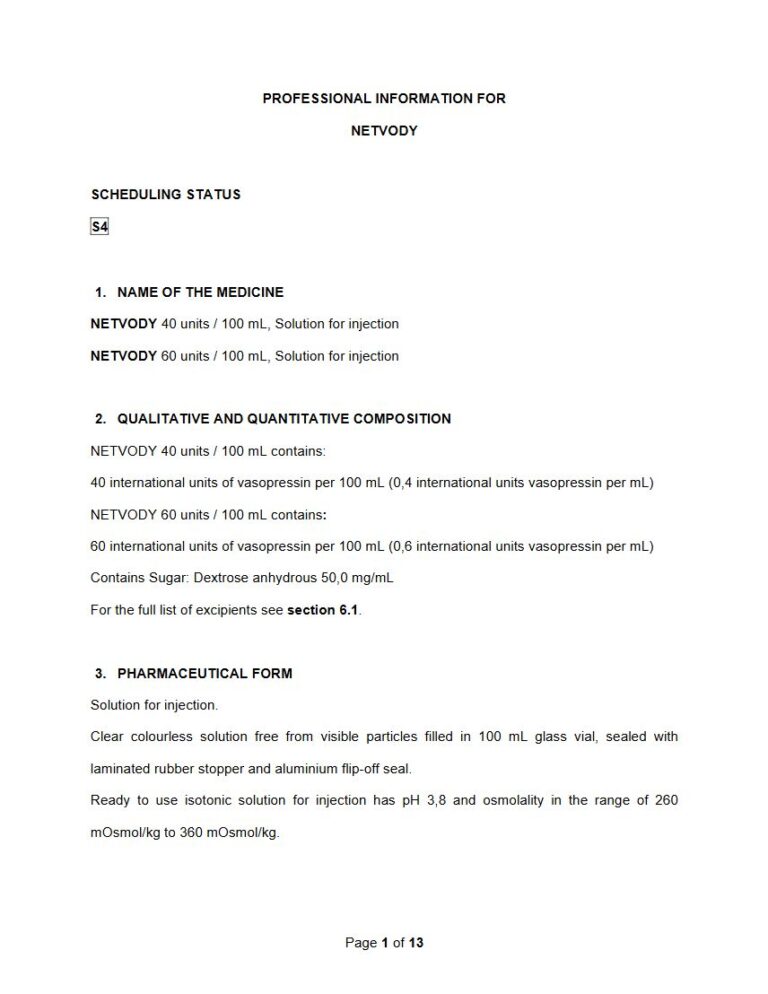
Netvody 40 Units/100 Ml/60 Units Solution
PDF Leaflet Revision Date: Not applicable
Clinical Summary
Quick overview from the medicine insert
Indication
Increase blood pressure in adults with vasodilatory shock.
Dosage (summary)
Starting dose: 0.01-0.03 units/min; titrate as needed.
Onset of Action / Duration
Onset: 15 mins, Duration: 20 mins
Special Populations
- Elderly patients
- Renal impairment
- Hepatic impairment
Pregnancy & Breastfeeding
Increased clearance in pregnancy; caution advised.
Key Drug Interactions
- Catecholamines
- Indomethacin
- Ganglionic Blocking Medicines
- Medicines causing SIADH
- Medicines causing Diabetes Insipidus
Contraindications
- Allergy to vasopressin or excipients
Common side effects
- Hyponatremia
- Reversible diabetes insipidus
- Cardiac arrhythmias
Counselling Points
- Monitor blood pressure and electrolytes.
- Taper dose after target blood pressure is achieved.
- Report any signs of ischemia.
Serious warnings
- Worsening cardiac function
- Ischemic events
- Vasopressin withdrawal effects
Important Disclaimer
The Netvody 40 Units/100 Ml/60 Units Solution professional information leaflet below is the property of Cipla Medpro and is provided on Medinsert exactly as issued, with no.. alterations or editorial changes. We make every effort to keep content current by updating documents as soon as new versions become available. Medinsert serves as a trusted access point for healthcare professionals, but does not replace official sources or clinical judgement. For more details, please read our full disclaimer. read more>>
 Healthcare Professionals Only
This content is for registered healthcare professionals
Sign in or create a free account to read the full package insert.
Free for HPCSA-registered professionals. Powered by Medinsert.
Clinical Particulars
Section 4 of the official insert — extracted exactly as issued, no alterations
4.1 Therapeutic indications
NETVODY is indicated to increase blood pressure in adults with vasodilatory shock who remain hypotensive despite fluids and catecholamines.
4.2 Posology and method of administration
Posology
NETVODY is available as 40 units / 100 mL and 60 units / 100 mL ready to use vials.
Method of administration
In general, titrate to the lowest dose compatible with a clinically acceptable response. The recommended starting dose is:
Post-cardiotomy shock: 0,03 units/minute
Septic Shock: 0,01 units/minute
Titrate up by 0,005 units/minute at 10- to 15-minute intervals until the target blood pressure is reached. There are limited data for doses above 0,1 units/minute for post-cardiotomy shock and 0,07 units/minute for septic shock. Adverse reactions are expected to increase with higher doses.
After target blood pressure has been maintained for 8 hours without the use of catecholamines, taper NETVODY by 0,005 units/minute every hour as tolerated to maintain target blood pressure.
Special populations
Pregnancy:
Dose adjustments during pregnancy and the postpartum period: Because of increased clearance of vasopressin in the second and third trimester, the dose of NETVODY may need to be increased). Because of a spill over into blood of placental vasopressinase, the clearance of exogenous and endogenous vasopressin increases gradually over the course of a pregnancy. During the first trimester of pregnancy, the clearance is only slightly increased. However, by the third trimester the clearance of vasopressin is increased about 4-fold and at term up to 5-fold. After delivery, the clearance of vasopressin returns to preconception baseline within two weeks.
Elderly patients:
In general, dose selection for an elderly patient should be cautious, usually starting at the low end of the dosing range, reflecting the greater frequency of decreased hepatic, renal, or cardiac function, and of concomitant disease or other drug therapy. (See section 4.8)
Paediatric use
Safety and effectiveness of NETVODY in paediatric patients aged less than 18 years with vasodilatory shock have not been established.
Renal impairment:
As no clinical studies have been carried out in patients with renal impairment, the treatment recommendations are not established for patients with renal impairment.
Hepatic impairment:
As no clinical studies have been carried out in patients with hepatic impairment, the treatment recommendations are not established for patients with hepatic impairment.
4.3 Contraindications
NETVODY is contraindicated in patients with known allergy or hypersensitivity to 8-L-arginine vasopressin or to any of the excipients used in the formulation of NETVODY (see section 6.1).
4.4 Special warnings and precautions for use
- Worsening Cardiac Function
A decrease in cardiac index may be observed with the use of NETVODY. - Reversible Diabetes Insipidus
Patients may experience reversible diabetes insipidus, manifested by the development of polyuria, a dilute urine, and hypernatremia, after cessation of treatment with NETVODY. Monitor serum electrolytes, fluid status and urine output after NETVODY discontinuation. Some patients may require re-administration of NETVODY or administration of desmopressin to correct fluid and electrolyte shifts. - Ischemic events:
The skin condition should be monitored in patients with peripheral vascular disease for the signs of ischemia (pain, changes in color, temperature, or sensation, absence of pulse in the extremities). - Vasopressin withdrawal:
Direct effects will resolve within minutes of withdrawal of treatment.
4.5 Interaction with other medicines and other forms of interaction
Effects of other medicines on NETVODY
u2022 Catecholamines
Use with catecholamines is expected to result in an additive effect on mean arterial blood pressure and other hemodynamic parameters. Hemodynamic monitoring is recommended; adjust the dose of NETVODY as needed.
u2022 Indomethacin
Use with indomethacin may prolong the effect of NETVODY on cardiac index and systemic vascular resistance. Hemodynamic monitoring is recommended; adjust the dose of NETVODY as needed.
u2022 Ganglionic Blocking Medicines
Use with ganglionic blocking medicines may increase the effect of NETVODY on mean arterial blood pressure. Hemodynamic monitoring is recommended; adjust the dose of NETVODY as needed.
u2022 Medicines Suspected of Causing Syndrome of Inappropriate Antidiuretic Hormone (SIADH)
Use with medicines suspected of causing Syndrome of Inappropriate Antidiuretic Hormone (SIADH) (e.g., SSRIs, tricyclic antidepressants, haloperidol, chlorpropamide, enalapril, methyldopa, pentamidine, vincristine, cyclophosphamide, ifosfamide, felbamate) may increase the pressor effect in addition to the antidiuretic effect of NETVODY. Hemodynamic monitoring is recommended; adjust the dose of NETVODY as needed.
u2022 Medicines Suspected of Causing Diabetes Insipidus
Use with medicines suspected of causing diabetes insipidus (e.g., demeclocycline, lithium, foscarnet, clozapine) may decrease the pressor effect in addition to the antidiuretic effect of NETVODY. Hemodynamic monitoring is recommended; adjust the dose of NETVODY as needed.
4.6 Fertility, pregnancy, and lactation
Pregnancy:
There are no available data on NETVODY use in pregnant women to inform a drug associated risk of major birth defects, miscarriage, or adverse maternal or foetal outcomes. Animal reproduction studies have not been conducted with vasopressin. Dose adjustments during pregnancy and the postpartum period: Because of increased clearance of vasopressin in the second and third trimester, the dose of NETVODY may need to be increased. Maternal adverse reactions: NETVODY may produce tonic uterine contractions that could threaten the continuation of pregnancy.
Breastfeeding:
There are no data on the presence of NETVODY in either human or animal milk, the effects on the breastfed infant, or the effects on milk production.
Fertility
No formal carcinogenicity or fertility studies with vasopressin have been conducted in animals. Vasopressin was found to be negative in the in vitro bacterial mutagenicity (Ames) test and the in vitro Chinese hamster ovary (CHO) cell chromosome aberration test. In mice, vasopressin has been reported to have an effect on function and fertilizing ability of spermatozoa.
4.7 Effects on ability to drive and use machines
No data available.
4.8 Undesirable effects
The following adverse reactions associated with the use of vasopressin were identified in the literature. Because these reactions are reported voluntarily from a population of uncertain size, it is not possible to estimate their frequency reliably or to establish a causal relationship to drug exposure. The following adverse reactions have been classified according to the following categories, frequent, less frequent and frequency unknown.
Tabulated summary of adverse reactions
MedDRA System Organ Class (SOC) Frequency Adverse reaction
Blood and lymphatic system disorders frequency unknown Haemorrhagic shock, decreased platelets, intractable bleeding.
Cardiac disorders frequency unknown Right heart failure, atrial fibrillation, bradycardia, myocardial ischemia.
Gastrointestinal disorders frequency unknown Mesenteric ischemia.
Hepatobiliary disorders frequency unknown Increased bilirubin levels.
Renal and urinary disorders frequency unknown Acute renal insufficiency.
Vascular disorders frequency unknown Distal limb ischemia.
Metabolism and nutrition disorders frequency unknown Hyponatremia.
Skin and subcutaneous tissue disorders frequency unknown Skin and subcutaneous tissue disorders. frequency unknown (cannot be estimated from the available data).
Postmarketing Experience: Reversible diabetes insipidus
Reporting of suspected adverse reactions
Reporting suspected adverse reactions after authorisation of the medicine is important. It allows continued monitoring of the benefit/risk balance of the medicine. Healthcare professionals are asked to report any suspected adverse reactions to SAHPRA via the Med Safety APP (Medsafety X SAHPRA) and eReporting platform (who-umc.org) found on the SAHPRA website, or to Cipla Medpro (Pty) Ltd. by email: [email protected] or telephone: 080 222 6662 (toll free).
4.9 Overdose
Overdosage with NETVODY can be expected to manifest as consequences of vasoconstriction of various vascular beds (peripheral, mesenteric, and coronary) and as hyponatremia. In addition, overdosage may lead less commonly to ventricular tachyarrhythmias (including Torsade de Pointes), rhabdomyolysis, and non-specific gastrointestinal symptoms.
