
Sabril Tablets 500 mg FC tablets
PDF Leaflet Revision Date: 16 March 2023
Clinical Summary
Quick overview from the medicine insert
Indication
Treatment of resistant partial epilepsy.
Dosage (summary)
Starting dose: 1 g/day (2 tablets), max 3 g/day.
Special Populations
- Elderly
- Renal impairment
Pregnancy & Breastfeeding
Contraindicated in pregnancy and lactation due to teratogenicity.
Key Drug Interactions
- Clonazepam may exacerbate sedation.
Contraindications
- Hypersensitivity to vigabatrin
- Pregnancy
- Lactation
- Renal impairment (creatinine clearance < 60 mL/min)
Common side effects
- Visual field defects
- Sedation
- Fatigue
- Dizziness
Counselling Points
- Regular ophthalmological exams required
- Report any visual changes immediately
- Gradual withdrawal recommended to avoid rebound seizures
Serious warnings
- Risk of irreversible visual field defects
- Monitor for psychiatric symptoms
Important Disclaimer
The Sabril Tablets 500 mg FC tablets professional information leaflet below is the property of Sanofi-Aventis and is provided on Medinsert exactly as issued, with no.. alterations or editorial changes. We make every effort to keep content current by updating documents as soon as new versions become available. Medinsert serves as a trusted access point for healthcare professionals, but does not replace official sources or clinical judgement. For more details, please read our full disclaimer. read more>>
 Healthcare Professionals Only
This content is for registered healthcare professionals
Sign in or create a free account to read the full package insert.
Free for HPCSA-registered professionals. Powered by Medinsert.
Clinical Particulars
Section 4 of the official insert — extracted exactly as issued, no alterations
4.1 Therapeutic indications
Treatment in combination with other anti-epileptic medicines for patients with resistant partial epilepsy with or without secondary generalisation, that is where all other appropriate medicine combinations have proved inadequate or have not been tolerated.
4.2 Posology and method of administration
Posology
SABRIL treatment should only be initiated by a specialist in neurology, paediatric neurology or paediatricians who treat patients with epilepsy for which SABRIL is indicated. Follow-up should be arranged under supervision of a specialist in one of the above-mentioned fields.
SABRIL is for oral administration once or twice daily. The recommended daily starting dose is 1 g (2 tablets) which should be added on to the patientu2019s current anti-epileptic medicine regimen. The highest recommended dose is 3 g/day. The maximum recommended dose should not be exceeded.
Use in children: Clinical experience suggests a relatively higher SABRIL dose in children. The recommended starting dose in children is 40 mg/kg/day. For maintenance dosing, the recommendations are:
Body mass:
10 u2013 15 kg: 0,5 u2013 1 g/day
15 u2013 30 kg: 1 u2013 1,5 g/day
30 u2013 50 kg: 1,5 u2013 3 g/day
> 50 kg: 2 u2013 3 g/day
The maximum recommended dose should not be exceeded.
Use in the elderly and patients with renal impairment: Since SABRIL is eliminated via the kidneys, caution should be exercised when administrating SABRIL to elderly and in patients with impaired renal function. See sections 4.3 and 4.4.
Administration: Doses may be taken before or after meals.
4.3 Contraindications
- Hypersensitivity to vigabatrin or any excipient in SABRIL (see section 6.1).
- SABRIL is contraindicated in pregnant and lactating women as teratogenicity has been seen in animals.
- SABRIL is contraindicated in patients with renal impairment with creatinine clearance less than 60 mL/min.
4.4 Special warnings and precautions for use
SABRIL should not be initiated as monotherapy.
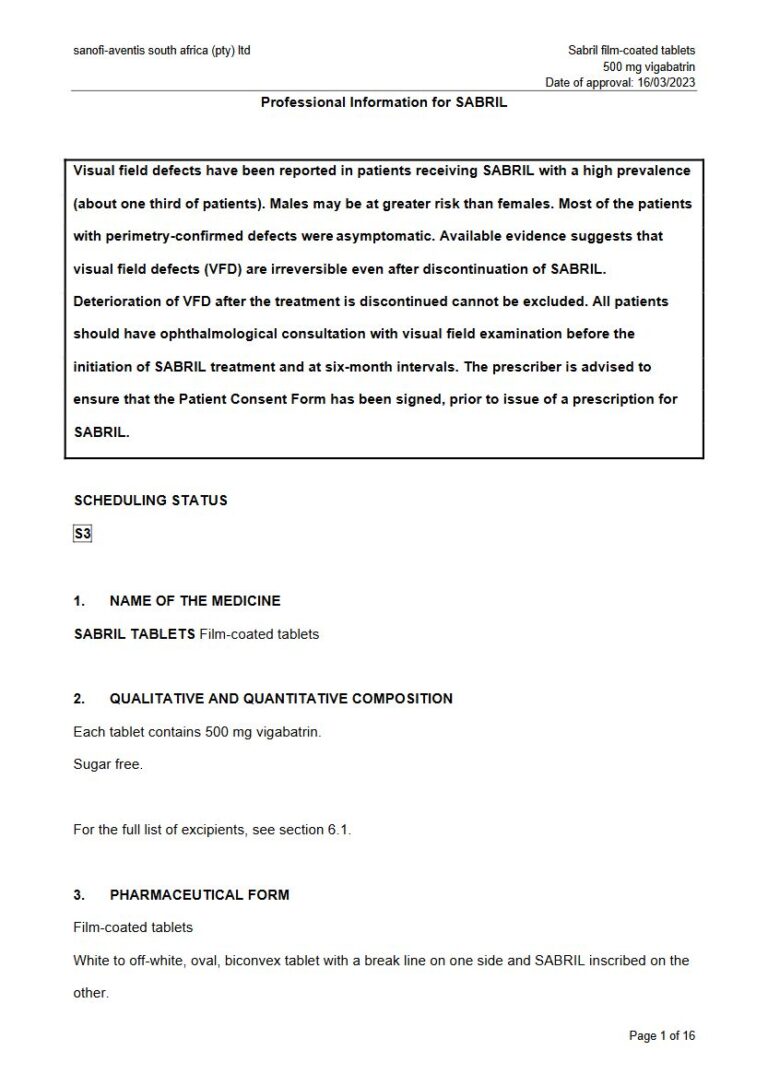
Visual field defects: Visual field defects have been reported in patients receiving SABRIL with a high prevalence (about one third of patients). Males may be at greater risk than females. SABRIL is not recommended for use in patients with any pre-existing clinically significant visual field defect. All patients should have ophthalmological consultation with visual field examination before the initiation of SABRIL treatment and at six-month intervals. Based on currently available data, the usual pattern is a concentric constriction of the visual field of both eyes, which is generally more marked nasally than temporally. In the central visual field (within 30 degrees of eccentricity), frequently an annular nasal defect is seen. Central visual acuity is not impaired. Severe cases may be characterised by tunnel vision. Most of the patients with perimetry-confirmed defects were asymptomatic. Hence, this undesirable effect can only be reliably detected by systematic perimetry. To detect visual field defects, if possible, appropriate visual field testing by using a standardised static perimetry (such as Humphrey or Octopus) or kinetic perimetry (such as Goldmann) must be performed. Static perimetry is the preferred method for detecting vigabatrin associated visual field defect. Perimetry can seldom be performed in children less than 9 years of developmental age. Currently, no established method is available to diagnose and establish or exclude visual field defects in children less than 9 years of developmental age, in whom a standardised perimetry cannot be confirmed. Electroretinography may be useful but should be used only in adults who are unable to cooperate with perimetry or in the very young. Based on the available data, the first oscillatory potential and 30 Hz flicker responses of the electroretinogram appear to be correlated with a SABRIL associated visual field defect. These responses are delayed and reduced beyond the normal limits. Such changes have not been seen in SABRIL treated patients without a visual field defect. Available evidence suggests that VFD are irreversible even after discontinuation of SABRIL. A deterioration of VFD after the treatment is discontinued cannot be excluded. The onset is after months to years of SABRIL therapy.
The association between the risk of visual field defects and the extent of vigabatrin exposure, both in terms of daily dose (from 1 gram to more than 3 grams) and in terms of duration of treatment has been shown in an open clinical study. The patient and/or caregiver must be given a thorough description of the frequency and implications of the development of visual field defects during SABRIL treatment. Patients should be instructed to report any new visual problems and symptoms, which may be associated with visual field constriction. If visual symptoms develop, the patient should be referred to an ophthalmologist. If visual field defects are identified during follow-up, the decision to continue or discontinue SABRIL should be based on an individual benefit-risk assessment. If the decision to continue treatment is made, consideration should be given to more frequent follow-up in order to detect progression or sight threatening defects. SABRIL should not be used concomitantly with retinotoxic medicines. Based on currently available data, the visual field defects may result from increased levels of GABA in the retina. In view of the results of the animal safety studies, it is recommended that patients treated with SABRIL are closely observed for adverse effects on neurological function. Microvacuolation (intramyelinic oedema) has been observed in the white matter tracts of the rat, mouse and dog. In the rat and the dog, the changes were reversible on stopping SABRIL treatment and even with continued treatment histologic regression was observed. In rodents however, residual changes consisting of swollen axons (eosinophilic spheroids) and mineralised bodies have been observed.
Visual acuity Retinal disorder, blurred vision, optic atrophy or optic neuritis may lead to decrease in visual acuity. Visual acuity should be assessed during ophthalmological consultations.
Neurological and psychiatric conditions Rare reports of encephalopathic symptoms such as marked sedation, stupor and confusion in association with non-specific slow wave activity on electroencephalogram have been described soon after the initiation of vigabatrin treatment. Risk factors for the development of these reactions include higher than recommended starting dose, faster dose escalation at higher steps than recommended and renal failure. These events have been reversible following dose reduction or discontinuation of vigabatrin. Cases of abnormal brain MRI findings have been reported, in particular in young infants treated for infantile spasms with high doses of vigabatrin. The clinical significance of these findings is currently unknown. Additionally, cases of intramyelinic oedema (IME) have been reported, particularly in infants treated for infantile spasms (see section 4.8). IME has been reported to be reversible following medicine discontinuation, and it is therefore recommended to progressively discontinue vigabatrin when IME is observed. Movement disorders including dystonia, dyskinesia and hypertonia have been reported in patients treated for infantile spasms. The benefit/risk of vigabatrin should be evaluated on an individual patient basis. If new movement disorders occur during treatment with vigabatrin, consideration should be given to dose reduction or a gradual discontinuation of treatment. Some patients may experience an increase in seizure frequency, including status epilepticus with vigabatrin, or the onset of new types of seizures with vigabatrin. New onset myoclonus and exacerbation of existing myoclonus may occur in rare cases. Abrupt withdrawal may lead to rebound seizures; therefore, it is recommended that withdrawal from SABRIL treatment occur by gradual dose reduction over a 2 to 4-week period.
SABRIL should be used with caution in patients with a history of psychosis, depression or behavioural problems. Psychiatric events (e.g., agitation, depression, abnormal thinking, paranoid reactions) have been reported during SABRIL therapy. These events occurred in patients with and without a psychiatric history and were usually reversible when vigabatrin doses were reduced or gradually discontinued. In clinical trials, depression occurred in less than 10 % of patients and seldom required discontinuation of vigabatrin. Less common events included psychotic symptoms.
Suicidal ideation and behaviour: Suicidal ideation and behaviour have been reported in patients treated with anti-epileptic medicines in several indications. A meta-analysis of randomised placebo-controlled trials of anti-epileptic medicines has also shown a small increased risk of suicidal ideation and behaviour. The mechanism of this effect is not known. Therefore, patients should be monitored for signs of suicidal ideation and behaviour, and appropriate treatment should be considered. Patients (and caregivers of patients) should be advised to seek medical advice immediately should signs of suicidal ideation or behaviour emerge.
Interference with laboratory tests: SABRIL may lead to a decrease in measured plasma activity of alanine transaminase (ALT) and to a lesser extent, aspartate transaminase (AST). The magnitude of suppression for ALT has been reported to vary between 30 and 100 %. Therefore, these liver tests may be quantitatively unreliable in patients taking SABRIL. SABRIL may increase the amount of amino acids in the urine, possibly leading to a false positive test for certain rare genetic metabolic diseases (e.g. alpha aminoadipic aciduria). Nuclear magnetic resonance imaging scan interference has been reported in young children.
4.5 Interaction with other medicines and other forms of interaction
As SABRIL is neither metabolised, nor protein bound and is not an inducer of cytochrome P450 or drug-metabolising enzymes, interactions with other medicines are unlikely. During concurrent vigabatrin administration, a decrease in phenytoin levels has been reported in some trials but not in others. In those trials in which phenytoin levels decreased, the mean decreases varied between 16 % and 33 %. The exact nature of this interaction is presently not understood; however, in these studies the interaction did not appear to be clinically relevant. The plasma concentrations of carbamazepine, phenobarbital (phenobarbitone), primidone, and sodium valproate have also been monitored during controlled clinical trials and no clinically significant interactions have been detected. The concomitant use of vigabatrin and clonazepam may exacerbate the sedative effect or lead to coma (see section 4.4).
4.6 Fertility, pregnancy and lactation
SABRIL is contraindicated in pregnant and lactating women.
Pregnancy
The risk of congenital defects is increased from 2 to 3-fold in children born from mothers treated with an anti-epileptic; those more frequently reported are cleft lip, cardiovascular defects and neural tube defects. Polytherapy may be associated with a higher risk of congenital malformations than monotherapy, therefore it is important that monotherapy is practiced whenever possible. Abnormal outcomes (congenital anomalies or spontaneous abortion) were reported in the offspring of mothers taking SABRIL. Specialist advice should be provided to all patients who could begin a pregnancy or who are in the fertile age. The need of antiepileptic treatment must be re-evaluated when a patient plans a pregnancy. If a patient is already pregnant, anti-epileptic therapy should not be suddenly interrupted due to the hazard of epileptic attack relapse that might have serious outcomes both for the mother and the child.
Breastfeeding
Vigabatrin is excreted into breast milk in low concentrations and is contraindicated in women breastfeeding their infants.
4.7 Effects on ability to drive and use machines
As a general rule, patients who do not have well-controlled epilepsy are not allowed to drive or handle potentially dangerous machinery. Drowsiness has been observed with SABRIL in clinical trials and patients should be cautioned of this possibility before treatment. Visual field defects, which can significantly affect the ability to drive and use machines, have been frequently reported in association with SABRIL. Patients should be evaluated for the presence of visual field defects. Special care should be taken by patients driving, operating machinery or performing any hazardous task.
4.8 Undesirable effects
Pooled data from prevalence surveys suggests that one third or more patients receiving SABRIL therapy develop visual field defects. Adverse events are mainly central nervous system (CNS) related and probably a secondary consequence of the increase in GABA caused by SABRIL. The undesirable effects were mostly central nervous system related such as sedation, somnolence, fatigue and impaired concentration. The most commonly reported adverse effects in children are excitation and agitation. The incidence of these undesirable effects is generally higher at the beginning of treatment and decreases with time. Some patients may experience an increase in seizure frequency, including status epilepticus with SABRIL. Patients with myoclonic seizures may be particularly liable to this effect. New onset myoclonus and exacerbation of existing myoclonus may occur. Visual field defects ranging from mild to severe have been reported frequently in patients receiving SABRIL. Severe cases are potentially disabling. The following side-effects are ranked according to frequency within each system organ class using the following convention: Very common ( u2265 1/10), common ( u2265 1/100, < 1/10), uncommon ( u2265 1/1 000, < 1/100), rare ( u2265 1/10 000) and very rare (< 1/10 000).
Blood and lymphatic system disorders
Common: Anaemia
Psychiatric disorders: Very common: Excitation and agitation (children)* Common: Agitation, aggression, nervousness, depression, paranoid reaction*, insomnia Uncommon: Hypomania, mania and psychotic disorder* Rare: Suicide attempt Very rare: Hallucination * Psychiatric reactions have been reported during SABRIL therapy. These reactions occurred in patients with and without a psychiatric history and were usually reversible when SABRIL doses were reduced or gradually discontinued. Depression was a common psychiatric reaction in clinical trials but seldom required discontinuation of SABRIL.
Nervous system disorders: Very common: Somnolence Common: Speech disorder, headache, dizziness, paraesthesia, disturbance in attention and memory impairment and mental impairment (thought disturbance), tremor Uncommon: Coordination abnormal (ataxia), movement disorder, including dystonia, dyskinesia and hypertonia, either alone or in association with abnormalities in nuclear magnetic resonance imaging. Cases of cytotoxic oedema or related abnormal magnetic resonance imaging findings/increase in signal intensity have been reported, especially in young children. Rare: Encephalopathy** Very rare: Optic neuritis Not known: Cases of brain MRI abnormalities have been reported. Intramyelinic oedema (particularly in infants) (see section 4.4). ** Rare reports of encephalopathic symptoms such as marked sedation, stupor and confusion in association with non-specific slow wave activity on electroencephalogram have been described soon after the initiation of SABRIL treatment. Such reactions have been fully reversible following dose reduction or discontinuation of SABRIL (see section 4.4).
Eye disorders: Very common: Visual field defect Common: Blurred vision, diplopia and nystagmus Rare: Retinal disorder (mainly peripheral) Very rare: Optic atrophy
Gastrointestinal disorders: Common: Nausea, vomiting and abdominal pain
Skin and subcutaneous tissue disorders: Common: Alopecia Uncommon: Rash Rare: Angioedema, urticaria
Musculoskeletal and connective tissue disorders Very common: Arthralgia
General disorders and administration site conditions : Very common: Drowsiness, sedation, fatigue and asthenia Common : Oedema, irritability
Investigations*: Common : Weight increase * Chronic treatment with SABRIL may be associated with a decrease in haemoglobin.
4.9 Overdose
See section 4.4.
Symptoms: SABRIL overdose has been reported, most commonly between 7,5 to 30 g; however, ingestions up to 90 g have been reported. The most common symptoms included drowsiness or coma; other less frequently reported symptoms included vertigo, headache, psychosis, respiratory depression or apnoea, bradycardia, hypotension, agitation, irritability, confusion, abnormal behaviour or speech disorder. None of the reported overdoses resulted in death.
Management: There is no specific antidote. The usual supportive measures should be employed. Measures to remove unabsorbed medicine should be considered. Activated charcoal has been shown to not significantly adsorb vigabatrin in an in vitro study. The effectiveness of haemodialysis in the treatment of vigabatrin overdose is unknown. In isolated case reports in renal failure patients receiving therapeutic doses of vigabatrin, haemodialysis reduced vigabatrin plasma concentrations by 40 % to 60 %.
