
Otrivin Plus 0.5 mg/0.6 mg Solution
PDF Leaflet Revision Date: 23 February 2021
Clinical Summary
Quick overview from the medicine insert
Indication
Symptomatic treatment of nasal congestion and rhinorrhea in adults.
Dosage (summary)
1 puff in each nostril up to 3 times daily, max 7 days.
Onset of Action / Duration
Onset: 5-10 mins, Duration: 6-8 hours
Special Populations
- Elderly (> 70 years)
- Children under 18
Pregnancy & Breastfeeding
Not proven safe in pregnancy; avoid breastfeeding.
Key Drug Interactions
- MAO inhibitors
- Tri- and tetra-cyclic antidepressants
- Other anticholinergic drugs
Contraindications
- Hypersensitivity to active substances
- Glaucoma
- Rhinitis sicca
- Post-surgical dura mater penetration
Common side effects
- Epistaxis
- Nasal dryness
- Dizziness
- Headache
Counselling Points
- Do not exceed 3 applications daily
- Avoid contact with eyes
- Report any severe side effects
Serious warnings
- Caution in hypertension, cardiovascular diseases
- Risk of rebound congestion with prolonged use
Important Disclaimer
The Otrivin Plus 0.5 mg/0.6 mg Solution professional information leaflet below is the property of Haleon South Africa and is provided on Medinsert exactly as issued, with no.. alterations or editorial changes. We make every effort to keep content current by updating documents as soon as new versions become available. Medinsert serves as a trusted access point for healthcare professionals, but does not replace official sources or clinical judgement. For more details, please read our full disclaimer. read more>>
 Healthcare Professionals Only
This content is for registered healthcare professionals
Sign in or create a free account to read the full package insert.
Free for HPCSA-registered professionals. Powered by Medinsert.
Clinical Particulars
Section 4 of the official insert — extracted exactly as issued, no alterations
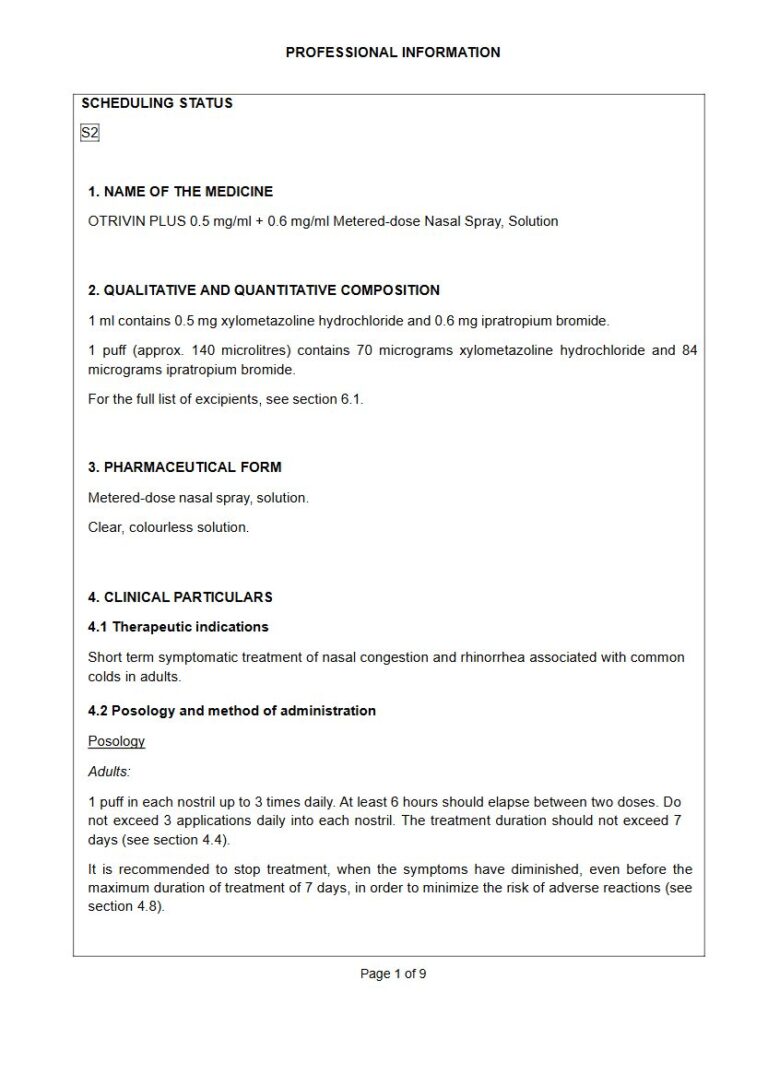
4.1 Therapeutic indications
Short term symptomatic treatment of nasal congestion and rhinorrhea associated with common colds in adults.
4.2 Posology and method of administration
Posology
Adults: 1 puff in each nostril up to 3 times daily. At least 6 hours should elapse between two doses. Do not exceed 3 applications daily into each nostril. The treatment duration should not exceed 7 days (see section 4.4). It is recommended to stop treatment, when the symptoms have diminished, even before the maximum duration of treatment of 7 days, in order to minimize the risk of adverse reactions (see section 4.8).
Paediatric Population
OTRIVIN PLUS is not recommended for use in children and adolescents below 18 years of age due to lack of sufficient documentation.
Elderly (> 70 years)
There is only limited experience of use in patients above 70 years of age.
Method of administration
Before the first application, prime the pump by actuating 4 times. Once primed the pump will normally remain charged throughout regular daily treatment periods. Should the spray not be ejected during the full actuation stroke, or if the product has not been used for longer than 6 days, the pump will need to be reprimed with 4 actuations as initially performed.
4.3 Contraindications
- OTRIVIN PLUS should not be given to children under the age of 18 due to lack of sufficient documentation.
- Hypersensitivity to the active substances or to any of the excipients listed in section 6.1.
- Known hypersensitivity to atropine or similar substances, e.g. hyoscyamine and scopolamine.
- After surgical operations where dura mater may have been penetrated, e.g. transsphenoidal hypophysectomy or other transnasal operations.
- In patients with glaucoma.
- In patients with rhinitis sicca.
4.4 Special warnings and precautions for use
The medicinal product must be administered with caution to patients with:
- hypertension, cardiovascular diseases
- hyperthyroidism, diabetes mellitus
- hypertrophy of the prostate, stenosis of the bladder bar
- phaeochromocytoma
Caution is recommended in patients predisposed to:
- angle closure glaucoma
- epistaxis (e.g. elderly)
- paralytic ileus
- cystic fibrosis
Immediate hypersensitivity including urticaria, angioedema, rash, bronchospasm, pharyngeal oedema and anaphylaxis may occur. The medicinal product must be used with caution in patients who are sensitive to adrenergic substances, which may give symptoms such as sleeping disturbances, dizziness, tremor, cardiac dysrhythmias or elevated blood pressure. The treatment duration should not exceed 7 days, as chronic treatment with xylometazoline hydrochloride may cause swelling of the nasal mucosa and hypersecretion because of increased sensibility in the cells, rebound effectu201d (rhinitis medicamentosa). Patients should be instructed to avoid spraying OTRIVIN PLUS in or around the eye. If OTRIVIN PLUS gets in contact with the eyes, the following may occur: temporary blurred vision, irritation, pain, red eyes. Aggravation of angle closure glaucoma may also develop. The patient should be instructed to rinse their eyes with cold water if OTRIVIN PLUS gets in direct contact with the eyes and to contact a doctor if they experience pain in the eyes or blurred vision.
4.5 Interaction with other medicinal products and other forms of interaction
Monoaminoxidase inhibitors (MAO inhibitors): Concomitant use or use within the last 2 weeks of sympathomimetic preparations may induce severely elevated blood pressure and is therefore not recommended. Sympathomimetic preparations release catecholamine, which results in a major release of noradrenaline which in turn has a vasoconstrictive effect resulting in elevated blood pressure. In critical cases of elevated blood pressure, treatment with OTRIVIN PLUS should be discontinued and the elevated blood pressure treated.
Tri- and tetra-cyclic antidepressants: Concomitant use or use within the last 2 weeks of tri-cyclic antidepressants and sympathomimetic preparations may result in an increased sympathomimetic effect of xylometazoline and is therefore not recommended.
Concomitant administration of other anticholinergic drugs may enhance the anticholinergic effect of ipratropium bromide. The above interactions have been studied individually for both of the active substances of OTRIVIN PLUS, not in combination. No formal interaction studies with other substances have been performed.
4.6 Fertility, pregnancy and lactation
Pregnancy
Safe use during pregnancy has not been proven. There are no adequate data from the use of OTRIVIN PLUS in pregnant women. Animal studies are insufficient with respect to effects on pregnancy, embryonal/foetal development, parturition and postnatal development. The potential risk for humans is unknown.
Breast-feeding
It is not known whether ipratropium bromide and xylometazoline hydrochloride are excreted in the motheru2019s milk. Therefore, mothers using OTRIVIN PLUS are advised not to breastfeed their infants.
4.7 Effects on ability to drive and use machines
Visual disturbances (including blurred vision and mydriasis), dizziness and fatigue have been reported with OTRIVIN PLUS. Patients should be advised that if affected they should not drive, operate machinery or take part in activities where these symptoms may put themselves or others at risk.
4.8 Undesirable effects
a) Summary of the safety profile
The most commonly reported adverse reactions are epistaxis occurring in 14.8 % and nasal dryness occurring in 11.3 % of patients.
b) Tabulated list of adverse reactions
The following adverse reactions were reported in two randomised clinical studies and one noninterventional post-marketing study with the product as well as from post-marketing surveillance. The adverse reactions are listed below by system organ class and frequency. Frequencies are defined as: Very common (u22651/10) Common (u22651/100 t<1/10) Uncommon(u22651/1000and<1/100) Rare (u22651/10000 and <1/1000) Very rare (< 1/10,000) Not known (cannot be estimated from the available data)
Immune system disorders
Not known: hypersensitivity
Psychiatric disorders
Uncommon: insomnia
Nervous system disorders
Common: dysgeusia, headache
Uncommon: parosmia, dizziness, tremor
Eye disorders
Uncommon: eye irritation, dry eye
Not known: accommodation disorder, aggravation of angle closure glaucoma, eye pain, photopsia, intraocular pressure increased, blurred vision, mydriasis, halo vision
Cardiac disorders
Uncommon: Palpitations, tachycardia
Not known: Atrial fibrillation
Respiratory, thoracic and mediastinal disorders
Very common: epistaxis, nasal dryness
Common: nasal discomfort, nasal congestion, dry throat, throat irritation, rhinalgia
Uncommon: Nasal ulcer, sneezing, oropharyngeal pain, cough, dysphonia
Rare: Rhinorrhoea
Not known: Paranasal sinus discomfort, laryngospasm, pharyngeal oedema
Gastrointestinal disorders
Common: dry mouth
Uncommon: dyspepsia, nausea
Not known: dysphagia
Skin and subcutaneous disorders
Not known: pruritis, rash, urticaria
Renal and urinary disorders
Not known: urine retention
General disorders and administration site conditions
Uncommon: discomfort, fatigue
Not unknown: chest discomfort, thirst
c) Description of selected adverse reaction
Several of the adverse reactions listed under u201cNot knownu201d have only been reported once for the product in clinical trials or are reported from post marketing surveillance only, thus an estimate of the frequency based on the present number of patient treated with OTRIVIN PLUS cannot be given.
Reporting of suspected adverse reactions
Reporting suspected adverse reactions after authorisation of the medicine is important. It allows continued monitoring of the benefit/risk balance of the medicine. Health care providers are asked to report any suspected adverse reactions to SAHPRA via the u201c6.04 Adverse Drug Reactions Reporting Formu201d, found online under SAHPRAu2019s publications: https://www.sahpra.org.za/Publications/Index/8
4.9 Overdose
Overdose of oral or excessive administration of xylometazoline hydrochloride may cause severe dizziness, perspiration, severely lowered body temperature, headache, bradycardia, hypertension, respiratory depression, coma and convulsions. Hypertension may be followed by hypotension. The treatment is symptomatic and supportive.
Overdose of oral or excessive administration of ipratropium bromide may cause dry mouth, accommodation difficulties and tachycardia. The treatment is symptomatic and supportive. A considerable overdose may cause anticholinergic CNS symptoms such as hallucinations, which must be treated with cholinesterase inhibitors. Appropriate supportive measures should be initiated in all individuals suspected of an overdose of OTRIVIN PLUS, and urgent symptomatic treatment under medical supervision is indicated when warranted. This would include observation of the individual for at least 6 hours. In the event of a severe overdose with cardiac arrest, resuscitation should be continued for at least 1 hour.
