
Adco Nebrafen 4 ml Inhalant solution
PDF Leaflet Revision Date: 01 July 2025
Clinical Summary
Quick overview from the medicine insert
Indication
Treatment of reversible airways obstruction.
Dosage (summary)
One ampoule for symptom relief; 3-4 times daily for long-term treatment.
Onset of Action / Duration
Onset: Rapid, Duration: ~6 hours
Special Populations
- Elderly
- Children under 18
Pregnancy & Breastfeeding
Safety in pregnancy and lactation not established.
Key Drug Interactions
- Beta-blockers may reduce effect
- Concomitant use with other bronchodilators may potentiate effects
Contraindications
- Hypersensitivity to active substances
- Hypertrophic obstructive cardiomyopathy
- Tachyarrhythmia
Common side effects
- Tremor
- Dizziness
- Headache
- Hypokalaemia
Counselling Points
- Use only as directed
- Monitor for side effects
- Avoid mist entering eyes
Serious warnings
- Overdosage may cause cardiac effects
- Caution in severe asthma
- Risk of hypokalaemia
Important Disclaimer
The Adco Nebrafen 4 ml Inhalant solution professional information leaflet below is the property of Adcock Ingram Critical Care and is provided on Medinsert exactly as issued, with no.. alterations or editorial changes. We make every effort to keep content current by updating documents as soon as new versions become available. Medinsert serves as a trusted access point for healthcare professionals, but does not replace official sources or clinical judgement. For more details, please read our full disclaimer. read more>>
 Healthcare Professionals Only
This content is for registered healthcare professionals
Sign in or create a free account to read the full package insert.
Free for HPCSA-registered professionals. Powered by Medinsert.
Clinical Particulars
Section 4 of the official insert — extracted exactly as issued, no alterations
4.1 Therapeutic indications
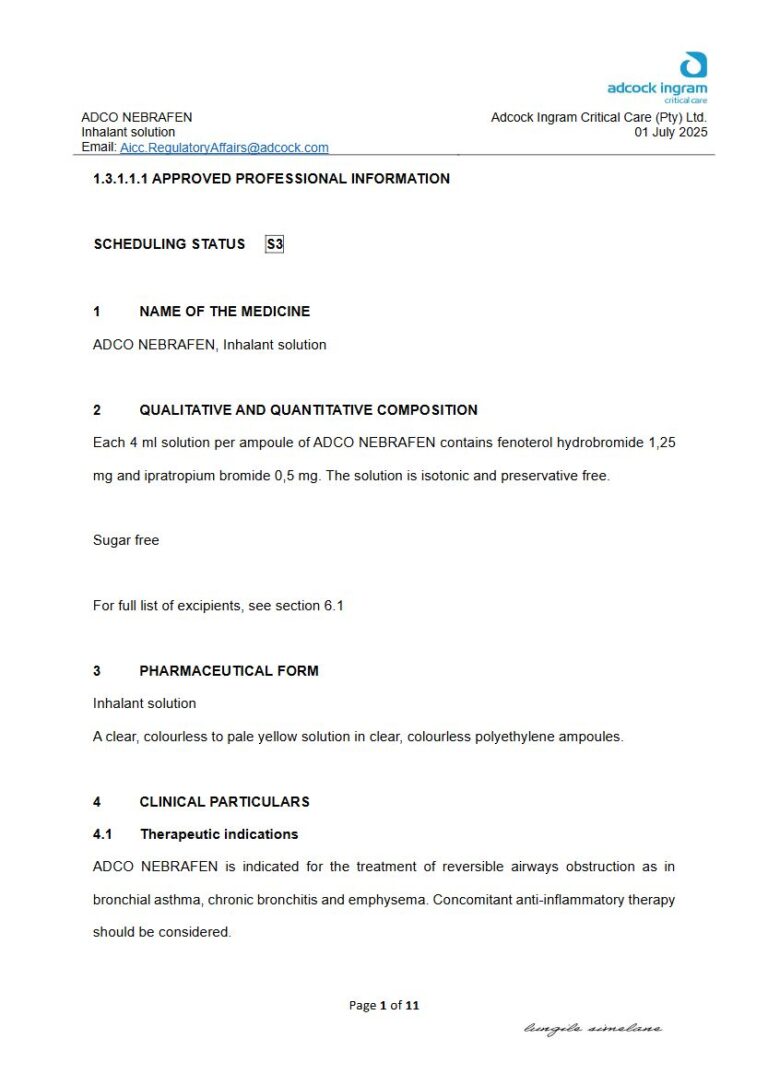
ADCO NEBRAFEN is indicated for the treatment of reversible airways obstruction as in bronchial asthma, chronic bronchitis and emphysema. Concomitant anti-inflammatory therapy should be considered.
4.2 Posology and method of administration
Posology
Unless otherwise prescribed, the recommended dosage for adults is:
Treatment of attacks: One ampoule of ADCO NEBRAFEN is sufficient for prompt symptom relief in most cases. If, in very severe cases, two unit dose vials are required for symptom relief, these should be administered under medical supervision.
Intermittent and long-term treatment: One ampoule of ADCO NEBRAFEN three to four times daily.
Prolonged use: On demand treatment (symptom oriented) may be preferable to regular use. Particularly in the case of regular use, patients should be re-evaluated for the addition or the increase of anti-inflammatory therapy (e.g. inhaled corticosteroids) to control airway inflammation and to prevent long-term damage. It is inappropriate and possibly hazardous to simply increase the use of beta-agonists, such as ADCO NEBRAFEN, beyond the recommended dose over extended periods. The use of high amounts of beta-agonists on a regular basis to control symptoms of bronchial obstruction may suggest declining disease control. In this situation, the patientu2019s therapy plan, and in particular the adequacy of anti-inflammatory therapy, should be reviewed to prevent potentially life-threatening deterioration of disease control. DO NOT EXCEED THE RECOMMENDED DOSE.
Paediatric population
Safety has not been established in children under 18 years of age.
Method of administration
For oral inhalation only. Solution is ready for use and requires no dilution. ADCO NEBRAFEN may be used by intermittent administration from an intermittent positive pressure ventilator or from suitable nebulisers. Where wall oxygen is available, the solution is best administered at a flow rate of 6 u2013 8 litres per minute.
Instructions for use :
1. Prepare the nebuliser for filling, according to the instructions provided by the manufacturer or your doctor.
2. Remove one ampoule by detaching from the adjacent one.
3. Flick the top of the ampoule to dispel any fluid in the neck.
4. Detach top portion by twisting.
5. Squeeze the contents of the ampoule into the reservoir of the nebuliser.
6. Assemble the nebuliser and use as directed. After use throw away any solution left in the reservoir and clean the nebuliser, following the manufacturer's instructions.
Since the ampoules do not contain a preservative, it is important that the contents of each ampoule are used up immediately after opening and that a fresh ampoule is used for each administration to avoid microbial contamination. Partly used, opened or damaged ampoules should be discarded.
4.3 Contraindications
Hypersensitivity to the active substances or to any of the excipients listed in section 6.1.
Hypertrophic obstructive cardiomyopathy and tachyarrhythmia.
Use should be avoided shortly before childbirth due to the uterine relaxant effect of fenoterol.
Safety has not been established in children under 18 years of age.
4.4 Special warnings and precautions for use
Overdosage may cause cardiac effects. High dosages may increase the risk of serious side effects, including cardiac dysrhythmias. This risk is further aggravated if administered concomitantly with other medicines that cause hypokalaemia and cardiac dysrhythmias or in the presence of hypoxia and acidosis. Potentially serious hypokalaemia may result from beta-2-agonist therapy. Particular caution is advised in severe asthma, as this effect may be potentiated by concomitant treatment with xanthine derivatives, steroids and diuretics. Additionally, hypoxia may aggravate the effects of hypokalaemia on cardiac rhythm. It is recommended that serum potassium levels are monitored in such situations. Other symptoms of overdosage include hyperthermia, hypertension, increased respiratory rate, and nausea and vomiting may occur. A rash may appear on the face or upper trunk. Toxic doses also cause CNS stimulation marked by restlessness, confusion, excitement, ataxia, inco-ordination, paranoid and psychotic reactions, hallucinations and delirium, and occasionally seizures. However, in severe intoxication, central stimulation may give way to CNS depression, coma, circulatory and respiratory failure, and death. The maximum dose should not be exceeded: Ventricular disturbances or angina pectoris have also been observed. Caution is advised in diabetic patients, serious cardiovascular disorders, susceptibility to QT-interval prolongation, myocardial insufficiency, hypertension, closed angle glaucoma or hypertrophy of the prostate.
Ocular complications have been reported in isolated cases, with mydriasis, increased intraocular pressure, angle-closure glaucoma and eye pain, when nebulised ipratropium bromide solution or mist, either alone or in combination with a beta-agonist, has escaped into the eyes. Patients must be instructed on the correct administration of ADCO NEBRAFEN ampoules. Care must be taken not to allow the mist to enter the eyes. Should ocular complications develop, treatment with miotic drops should be initiated immediately and specialist advice sought.
Use of anticholinergic medicines such as ipratropium bromide may precipitate urinary retention, in particular in patients with pre-existing urethral obstruction. Caution is advised in patients with or at risk of urinary retention (including those with prostatic enlargement), and in those with paralytic ileus or pyloric stenosis. In patients with ulcerative colitis, its use may lead to ileus or megacolon, and its effects on the lower oesophageal sphincter may exacerbate reflux. Caution is generally advisable in any patient with diarrhoea. It should also be used cautiously in patients with fever. ADCO NEBRAFEN needs to be used with caution in conditions characterised by tachycardia such as thyrotoxicosis, heart failure, and in cardiac surgery, where they may further accelerate the heart rate. Care is required in patients with acute myocardial infarction, as ischaemia and infarction may be made worse, and in patients with hypertension. ADCO NEBRAFEN may cause confusion, especially in the elderly. In the treatment of parkinsonism, increases in dosage and transfer to other forms of treatment should be gradual and anticholinergics should not be withdrawn abruptly. Minor reactions may be controlled by reducing the dose until tolerance has developed. Persons with Downu2019s syndrome appear to have an increased susceptibility to some of the actions of anticholinergics, whereas those with albinism may have a reduced susceptibility.
Safe use in children and in the elderly especially cardiac patients, has not been established.
4.5 Interaction with other medicines and other forms of interaction
A potentially serious reduction in the therapeutic effect may result from the concurrent use of ADCO NEBRAFEN and beta-blockers. Simultaneous treatment with beta-adrenergics, anticholinergics, xanthine derivatives and corticosteroids may potentiate the effect of ADCO NEBRAFEN. Due to the possible interaction between sympathomimetic amines and monoamine oxidase inhibitors or tricyclic antidepressants, care should be observed if these medicines are used concurrently with ADCO NEBRAFEN.
4.6 Fertility, pregnancy and lactation
Safety of use in pregnancy and lactation has not been established.
4.7 Effects on ability to drive and use machines
ADCO NEBRAFEN may affect mental and/or physical abilities to perform or execute tasks or activities requiring mental alertness, judgment and/or sound coordination and vision.
4.8 Undesirable effects
b. Tabulated summary of adverse reactions
System organ class Frequency Adverse reaction
Immune system disorders Frequency unknown Allergic reaction; hypersensitivity reactions including paradoxical bronchoconstriction, angioedema, urticaria, hypotension and collapse
Metabolism and nutrition disorders Frequency unknown Hypokalaemia
Nervous system disorders Frequency unknown Tremor; restlessness; dizziness; headache
Eye disorders Frequency unknown Dilatation of the pupils (mydriasis) with loss of accommodation (cycloplegia) and photophobia; acute angle-closure glaucoma
Cardiac disorders Frequency unknown Transient bradycardia followed by tachycardia, with palpitations and dysrhythmias
Vascular disorders Frequency unknown Peripheral vasodilation
Respiratory, thoracic, and mediastinal disorders Frequency unknown Reduced bronchial secretions; cough
Gastrointestinal disorders Frequency unknown Dryness of the mouth with difficulty in swallowing and talking; thirst; throat irritation; reduction in the tone and motility of the gastrointestinal tract leading to constipation
Skin and subcutaneous tissue disorders Frequency unknown Flushing and dryness of the skin
Musculoskeletal and connective tissue disorders Frequency unknown Muscle cramps; tenseness
Renal and urinary disorders Frequency unknown Difficulty in micturition
General disorders and administration site conditions Frequency unknown Fatigue; sweating
Reporting of suspected adverse reactions
Reporting suspected adverse reactions after authorisation of the medicine is important. It allows continued monitoring of the benefit/risk balance of the medicine. Health-care providers are asked to report any suspected adverse reactions to SAHPRA via the Med Safety APP (Medsafety X SAHPRA) and eReporting platform (who-umc-org) found on SAHPRA website. For reporting of side effects directly to the Holder of the Certificate of Registration, contact +27 11 635 0134 or email [email protected].
4.9 Overdose
Symptoms : Flushing, tremor of the fingers, nausea, restlessness, tachycardia, palpitation, dizziness, headache, increase in systolic blood pressure, a feeling of pressure in the chest, excitation and possibly extrasystoles may occur following overdose.
Treatment : Administration of sedatives, tranquillisers, in severe cases intensive therapy. Beta-receptor blockers, preferably beta-1-selective, are suitable as specific antidotes; however, the use of beta blockers is dangerous in asthmatic patients as they may precipitate or increase bronchial obstruction. Further treatment should be symptomatic and supportive.
