
Iprabut 2,5 ml Solution for nebulisation
PDF Leaflet Revision Date: 28 September 2021
Clinical Summary
Quick overview from the medicine insert
Indication
Management of reversible bronchospasm associated with obstructive pulmonary disease.
Dosage (summary)
Adults: 1 unit dose vial for acute attacks; 1 vial 3-4 times daily for maintenance.
Onset of Action / Duration
Onset: 30 mins, Duration: 4-6 hours
Special Populations
- Elderly
- Renal impairment
- Hepatic impairment
Pregnancy & Breastfeeding
Safety in pregnancy and lactation not established; potential fetal harm at high doses.
Key Drug Interactions
- Xanthine derivatives
- Beta-blockers
- Monoamine oxidase inhibitors
- Tricyclic antidepressants
Contraindications
- Hypersensitivity to components
- Hypertrophic obstructive cardiomyopathy
- Children under 12
Common side effects
- Headache
- Throat irritation
- Cough
- Dry mouth
- Dizziness
Counselling Points
- Use as directed
- Avoid eye exposure
- Monitor for worsening symptoms
Serious warnings
- Paradoxical bronchospasm
- Ocular complications
- Cardiovascular effects
Important Disclaimer
The Iprabut 2,5 ml Solution for nebulisation professional information leaflet below is the property of Pharmacare and is provided on Medinsert exactly as issued, with no.. alterations or editorial changes. We make every effort to keep content current by updating documents as soon as new versions become available. Medinsert serves as a trusted access point for healthcare professionals, but does not replace official sources or clinical judgement. For more details, please read our full disclaimer. read more>>
 Healthcare Professionals Only
This content is for registered healthcare professionals
Sign in or create a free account to read the full package insert.
Free for HPCSA-registered professionals. Powered by Medinsert.
Clinical Particulars
Section 4 of the official insert — extracted exactly as issued, no alterations
4.1. Therapeutic indications
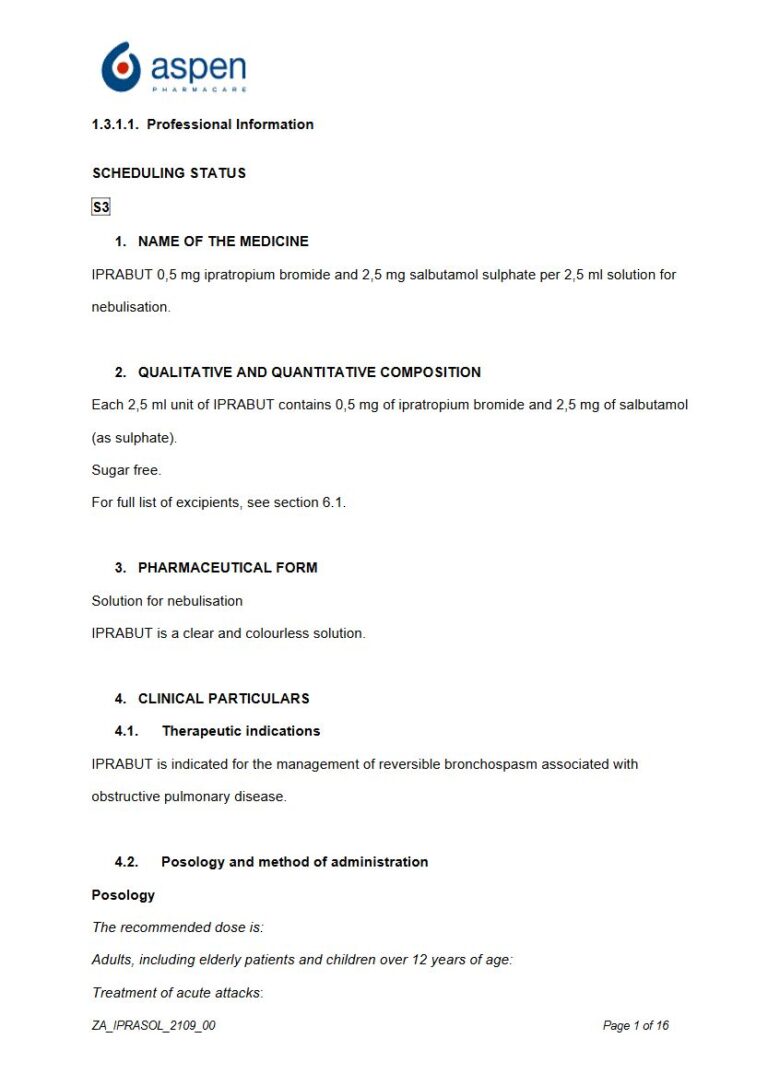
IPRABUT is indicated for the management of reversible bronchospasm associated with obstructive pulmonary disease.
4.2. Posology and method of administration
Posology
The recommended dose is:
Adults, including elderly patients and children over 12 years of age:
Treatment of acute attacks:
1 (One) Unit dose vial is sufficient for prompt symptom relief in many cases. In severe cases if an attack has not been relieved by one-unit dose vial, two-unit dose vials may be required. In these cases, patients should consult their doctor or the nearest hospital immediately.
Maintenance treatment:
1 (One) Unit dose vial three or four times daily. Do not exceed the recommended dose.
Paediatric population
There is no experience in the use of IPRABUT in children under 12 years of age.
Method of administration
IPRABUT solution for nebulisation may be administered from a suitable nebuliser or an intermittent positive pressure ventilator. IPRABUT should not be taken orally or administered parenterally.
u2022 Since the unit dose vials contain no preservative, it is important that the contents are used soon after opening and that a fresh vial is used for each administration to avoid microbial contamination. Partly used, opened or damaged unit dose vials should be discarded.
u2022 It is strongly recommended not to mix IPRABUT solution for inhalation with other medicines in the same nebuliser reservoir.
u2022 If dilution is necessary, this should be carried out using ONLY sterile sodium chloride 0,9 % solution as instructed by a medical practitioner.
4.3. Contraindications
IPRABUT is contraindicated in:
u2022 Patients with hypersensitivity to salbutamol (as sulphate), ipratropium bromide, atropine or its derivatives or to any excipients in IPRABUT listed in section 6.1.
u2022 Patients with hypertrophic obstructive cardiomyopathy or tachydysrhythmia.
u2022 Children under 12 years of age.
4.4. Special warnings and precautions for use
Hypersensitivity
Immediate hypersensitivity reactions may occur after administration of IPRABUT, as demonstrated by less frequent cases of urticaria, angio-oedema, rash, bronchospasm and oropharyngeal oedema.
Paradoxical bronchospasm
As with other inhalation therapy paradoxical bronchospasm may occur with an immediate increase in wheezing and shortness of breath after dosing. Paradoxical bronchospasm responds to a rapid-acting inhaled bronchodilator and should be treated straightaway. IPRABUT should be discontinued immediately, the patient should be assessed, and alternative therapy instituted if necessary.
Ocular complications
Ocular complications (i.e. mydriasis, increased intraocular pressure, narrow-angle glaucoma, eye pain) may occur when aerosolised ipratropium bromide either alone or in conjunction with a beta 2 -agonist, has escaped into the eyes. Eye pain or discomfort, blurred vision, visual halos or coloured images in association with red eyes from conjunctival congestion and corneal oedema may be signs of acute narrow-angle glaucoma. Should any combination of these symptoms develop, treatment with miotic drops should be initiated and specialist advice sought immediately. Patients must be instructed in the correct use of IPRABUT (see section 4.2). Care must be taken not to expose the eyes to the solution or mist of IPRABUT. It is recommended that the nebulised solution be administered via a mouthpiece. If this is not available and a nebuliser mask is used, it must fit properly. Patients who may be predisposed to glaucoma should be warned specifically to protect their eyes.
Conditions at risk
In the following conditions IPRABUT should only be used after careful risk/benefit assessment, especially when doses higher than recommended are used: insufficiently controlled diabetes mellitus, recent myocardial infarction and/or severe organic heart or vascular disorders, hyperthyroidism, pheochromocytoma, risk of narrow-angle glaucoma, prostatic hypertrophy or bladder-neck obstruction.
Cardiovascular effects
There is some evidence from post-marketing data and published literature of occurrences of myocardial ischaemia associated with salbutamol. Patients with underlying heart disease (ischaemic heart disease, tachydysrhythmia or severe heart failure) who are receiving salbutamol for respiratory disease, should be warned to seek medical advice if they experience chest pain or other symptoms of worsening heart disease.
Dyspnoea
The patient should be instructed to consult a doctor immediately in the event of acute, rapidly worsening dyspnoea.
Hypokalaemia
Potentially serious hypokalaemia may result from beta 2 -agonist therapy. Particular caution is advised in severe airway obstruction as this effect may be potentiated by concomitant treatment with xanthine derivatives, steroids and diuretics. Additionally, hypoxia may aggravate the effects of hypokalaemia on cardiac rhythm (especially in patients receiving digoxin, see section 4.5). It is recommended that serum potassium levels are monitored in such situations.
Porphyria
Safety in porphyria has not been established.
Gastrointestinal motility disturbances
Patients with cystic fibrosis may be more prone to gastrointestinal motility disturbances.
Lactic acidosis
Lactic acidosis has been reported in association with high therapeutic doses of intravenous and nebulised short-acting beta-agonist therapy, mainly in patients being treated for an acute exacerbation of bronchospasm in severe asthma or chronic obstructive pulmonary disease (see section 4.8 and 4.9). Increase in lactate levels may lead to dyspnoea and compensatory hyperventilation, which could be misinterpreted as a sign of asthma treatment failure and lead to inappropriate intensification of short-acting beta-agonist treatment. It is therefore recommended that patients are monitored for the development of elevated serum lactate and consequent metabolic acidosis in this setting.
Interference with laboratory tests or other diagnostic measures
The use of IPRABUT may lead to positive results with regards to salbutamol in tests for non-clinical substance abuse, e.g. in the context of athletic performance enhancement (doping).
Higher than recommended dose
If higher than recommended doses of IPRABUT are required to control symptoms, the patientu2019s therapy plan should be reviewed by a medical practitioner. The maximum dose should not be exceeded (see section 4.2).
Paediatric population
The safety and efficacy of IPRABUT in children less than 12 years has not been established (see section 4.3).
4.5. Interaction with other medicines and other forms of interaction
u2022 Concurrent administration of xanthine derivatives (e.g. theophylline) as well as other beta-adrenergics and anticholinergics may increase the side effects.
u2022 Beta-agonist induced hypokalaemia may be increased by concomitant treatment with xanthine derivatives, glucocorticosteroids and diuretics. This should be taken into account particularly in patients with severe airway obstruction. (see section 4.4).
u2022 A potentially serious reduction in bronchodilator effect may occur during concurrent administration of beta-blockers.
u2022 Salbutamol, as contained in IPRABUT, should be administered with caution to patients being treated with monoamine oxidase inhibitors or tricyclic antidepressants, since the action of beta-adrenergic agonists may be enhanced.
u2022 Inhalation of halogenated hydrocarbon anaesthetics such as halothane, trichloroethylene and enflurane may increase the susceptibility to the cardiovascular effects of beta-agonists.
u2022 Anticholinergic effects of other medicines may be enhanced.
u2022 Digoxin may increase the hypokalaemic effect of u00df2 agonists and lead to an increased disposition to dysrhythmias in patients treated with digoxin (see section 4.4).
4.6. Fertility, pregnancy and lactation
The safety of IPRABUT in pregnancy and lactation has not been established.
Pregnancy
The safety of IPRABUT in pregnancy has not been established. There is inadequate published evidence of safety in the early stages of human pregnancy but there has been evidence of some harmful effects on the foetus at very high dose levels.
Breastfeeding
The safety of IPRABUT during breastfeeding has not been established.
Fertility
No data available.
4.7. Effects on ability to drive and use machines
IPRABUT has a moderate influence on the ability to drive and use machines. Since adverse reactions such as dizziness, accommodation disorder, mydriasis and blurred vision have been reported in patients receiving IPRABUT, patients should not drive, use machinery or perform any tasks that require concentration, until they are certain that IPRABUT does not adversely affect their ability to do so (see section 4.4 and section 4.8).
4.8. Undesirable effects
a) Summary of the safety profile
u2022 Many of the listed undesirable effects can be assigned to the anticholinergic and beta 2 u2013 sympathomimetic properties of IPRABUT. As with all inhalation therapy IPRABUT may show symptoms of local irritation.
u2022 The most frequent side effects reported during clinical trials of salbutamol (as a sulphate) and ipratropium bromide were headache, throat irritation, cough, dry mouth, gastrointestinal motility disorders (including constipation, diarrhoea and vomiting), nausea and dizziness.
b) Tabulated list of adverse reactions
System organ class Frequent Less frequent Frequency unknown (cannot be estimated from the available data) Immune system disorders Anaphylactic reaction 1 , hypersensitivity 1 , angioedema 2 of the tongue, lips and face 1 Angioedema Metabolism and nutrition disorders Hypokalaemia 2# , hyperglycaemia (with large doses) Lactic acidosis 2 (see section 4.4) Psychiatric disorders Nervousness, mental disorder, agitation, restlessness, anxiety, sleep disturbances Hyperactivity 2 Nervous system disorders Dizziness 1 , headache 1,2 , tremor 2 Eye disorders Accommodation disorder 1 , corneal oedema 1 , angle closure glaucoma*, eye pain 1 *, increased intraocular pressure 1 *, mydriasis 1 *, blurred vision 1 , conjunctival hyperaemia 1 , halo vision 1 Vascular disorders Hypotension and collapse 2 , increased systolic blood pressure Peripheral vasodilation 2 Cardiac disorders Palpitations 1,2 , tachycardia 2 , atrial fibrillation 1,2 , dysrhythmia, myocardial ischaemia 2 , Extrasystoles 2 supraventricular tachycardia 1,2 , decreased diastolic blood pressure Respiratory, thoracic and mediastinal disorders Cough 1 , dysphonia, throat irritation 1 , bronchospasm 1,2 , paradoxical bronchospasm $1,2 , dry throat 1 , laryngospasm 1 , pharyngeal oedema 1 Gastrointestinal disorders Dry mouth 1, Nausea 1 , Mouth and throat irritation 2 gastrointestinal motility disorder e.g. diarrhoea 1 , constipation 1 , vomiting 1 , mouth oedema, stomatitis 1 , dyspepsia, abdominal pain Skin and subcutaneous tissue disorders Skin reactions, hyperhidrosis, rash 1 , urticaria 1,2 , pruritus 1 , sweating Musculoskeletal and connective tissue disorders Muscle spasms 2 , muscular weakness, myalgia Renal and urinary disorders Urinary retention ^1 General disorders and administrative site conditions Asthenia 1) Side effects experienced with ipratropium bromide 2) Side effects experienced with salbutamol c) Description of selected adverse reactions
* Ocular complications with symptoms mentioned above may occur when aerosolised ipratropium bromide either alone or in combination with an adrenergic beta 2 -agonist, has escaped into the eyes.
$ As with other inhalation therapy paradoxical bronchospasm may occur with an immediate increase in wheezing and shortness of breath after dosing. Paradoxical bronchospasm responds to a rapid-acting inhaled bronchodilator and should be treated straightaway. IPRABUT should be discontinued immediately, the patient should be assessed, and alternative therapy instituted if necessary (see section 4.4).
^ The risk of urinary retention may be increased in patients with pre-existing urinary outflow tract obstruction.
# Potentially serious hypokalaemia may result from beta 2 agonist therapy.
Reporting of suspected adverse reactions
Reporting suspected adverse reactions after authorisation of the medicine is important. It allows continued monitoring of the benefit/risk balance of the medicine. Healthcare providers are asked to report any suspected adverse reactions to: SAHPRA: https://www.sahpra.org.za/health-products-vigilance/ and to Aspen Pharmacare: E-mail: [email protected] Tel: 0800 118 088
4.9. Overdose
Symptoms
The effects of overdosage are expected to be primarily related to salbutamol. The expected symptoms with overdosage are those of excessive beta-adrenergic stimulation, the most prominent being tachycardia, palpitation, tremor, hypertension, hypotension, widening of the pulse pressure, anginal pain, dysrhythmias and flushing.
Treatment
Administration of sedatives, tranquillisers and, in severe cases, intensive therapy. Beta-receptor blockers, preferably beta 1 -selective, are suitable as specific antidotes; however, a possible increase in bronchial obstruction must be taken into account and the dose should be adjusted carefully in patients suffering from bronchial asthma. Further treatment is symptomatic and supportive.
