
Geodon Capsules
PDF Leaflet Revision Date: 09 May 2022
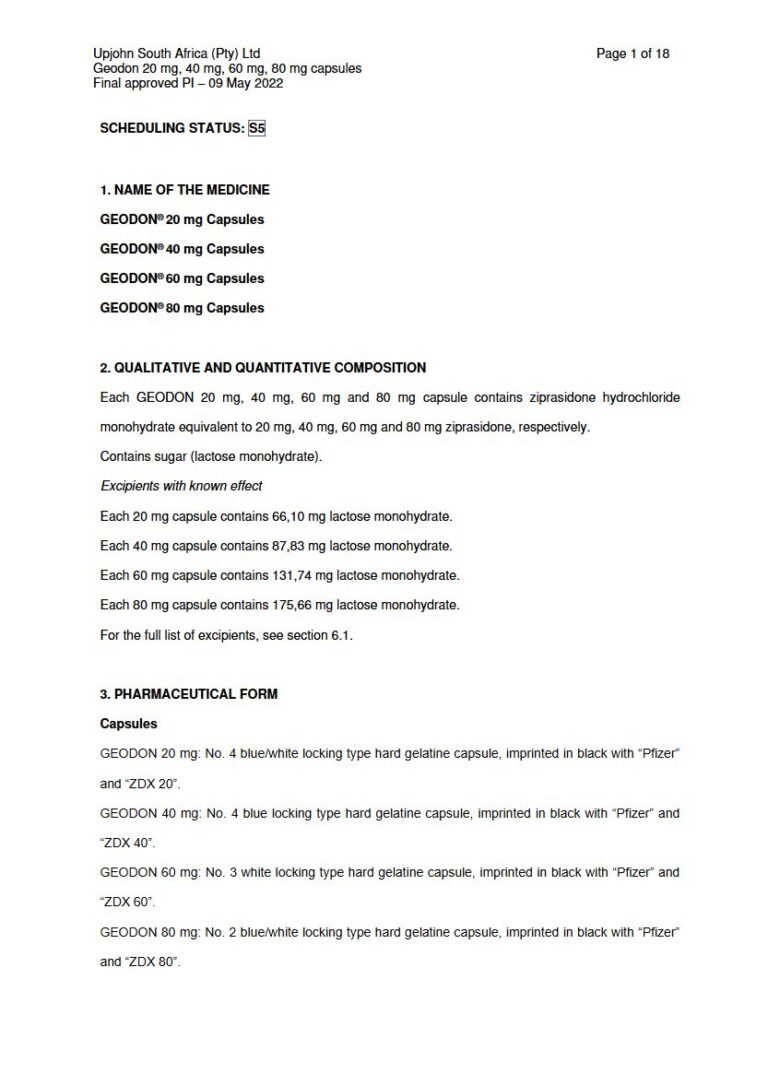
Clinical Summary
Quick overview from the medicine insert
Indication
Treatment of schizophrenia.
Dosage (summary)
Initial: 40 mg twice daily with food; max: 80 mg twice daily.
Onset of Action / Duration
Onset: 6-8 hours, Duration: 12 hours
Special Populations
- Elderly: use with caution
- Renal impairment: no adjustment needed
- Hepatic impairment: lower doses in mild to moderate cases
Pregnancy & Breastfeeding
Not recommended; teratogenicity in animal studies.
Key Drug Interactions
- QT prolonging agents
- CNS depressants
- Serotonergic medicines
Contraindications
- Hypersensitivity to ziprasidone
- QT-interval prolongation
- Recent myocardial infarction
- Uncompensated heart failure
Common side effects
- Somnolence
- Akathisia
- Dizziness
- Nausea
Counselling Points
- Take with food
- Monitor for QT prolongation
- Avoid alcohol and CNS depressants
Serious warnings
- QT prolongation risk
- Neuroleptic malignant syndrome
- Severe cutaneous adverse reactions
Important Disclaimer
The Geodon Capsules professional information leaflet below is the property of Upjohn South Africa and is provided on Medinsert exactly as issued, with no.. alterations or editorial changes. We make every effort to keep content current by updating documents as soon as new versions become available. Medinsert serves as a trusted access point for healthcare professionals, but does not replace official sources or clinical judgement. For more details, please read our full disclaimer. read more>>
 Healthcare Professionals Only
This content is for registered healthcare professionals
Sign in or create a free account to read the full package insert.
Free for HPCSA-registered professionals. Powered by Medinsert.
Clinical Particulars
Section 4 of the official insert — extracted exactly as issued, no alterations
4.1 Therapeutic indications
Schizophrenia GEODON is indicated in the treatment of acute exacerbations and in maintaining the clinical improvement during continuation therapy in patients with schizophrenia.
4.2 Posology and method of administration
Posology Use in adults The recommended initial dose is 40 mg twice daily taken with food. Daily dosage may subsequently be adjusted on the basis of individual clinical status up to a maximum of 80 mg twice daily. If indicated, the maximum recommended dose of 80 mg twice daily may be reached as early as day 3 of treatment.
Special populations Use in the elderly There is only limited clinical information in the elderly. Caution should be exercised when GEODON is administered in the elderly. Use in renal impairment No dosage adjustment is required in patients with impaired renal function. Use in hepatic impairment In patients with mild to moderate hepatic insufficiency, lower doses should be considered. There is a lack of experience in patients with severe hepatic insufficiency, and GEODON should be used with caution in this group. Use in smokers No dosage adjustment is required in patients who smoke (see section 5.2). Paediatric population Safety and efficacy in children under 18 years have not been established.
Method of administration GEODON capsules are for oral use. Capsules should be taken with food and swallowed whole without chewing, crushing or opening beforehand because it may affect the absorption of the medicine.
4.3 Contraindications
GEODON is contraindicated in patients with:
- Known hypersensitivity to ziprasidone or to any of the excipients of GEODON.
- Known QT-interval prolongation including congenital or acquired long QT syndrome.
- Recent myocardial infarction.
- Uncompensated heart failure.
- Cardiac dysrhythmias requiring treatment with Class IA and III anti-dysrhythmic medicines (see section 4.4).
- Pharmacokinetic/pharmacodynamic studies between GEODON and other medicines that prolong the QT interval have not been performed. An additive effect of GEODON and other medicines that prolong the QT interval cannot be excluded. Therefore, GEODON should not be given with dofetilide, sotalol, quinidine, mesoridazine, thioridazine, chlorpromazine, droperidol, pimozide, sparfloxacin, gatifloxacin, moxifloxacin, halofantrine, mefloquine, pentamidine, arsenic trioxide, levomethadyl acetate, dolasetron mesylate, probucol or tacrolimus. GEODON is also contraindicated with medicines that have demonstrated QT prolongation as one of their pharmacodynamic effects (see section 4.4).
- Pregnancy and lactation, as teratogenicity has been demonstrated in animal studies (see section 4.6).
- The safety and efficacy of GEODON has not been evaluated in children under the age of 18 years.
4.4 Special warnings and precautions for use
QT interval GEODON use should be avoided in combination with other medicines that are known to prolong the QT c interval (see sections 4.3 and 4.5). Additionally, medical practitioners should be alert to the identification of other medicines that have been consistently observed to prolong the QT c interval. Such medicines should not be prescribed with GEODON. GEODON should also be avoided in patients with congenital long QT syndrome and in patients with a history of cardiac dysrhythmias (see section 4.3).
A study directly comparing the QT/QT c prolonging effect of oral GEODON with several other medicines effective in the treatment of schizophrenia was conducted in patient volunteers. In the first phase of the trial, ECGs were obtained at the time of maximum plasma concentration when the medicine was administered alone. In the second phase of the trial, ECGs were obtained at the time of maximum plasma concentration while the medicine was co-administered with an inhibitor of the CYP4503A4 metabolism of the medicine. In the first phase of the study, the mean change in the mean QT c from baseline was calculated for each medicine, using a sample-based correction that removes the effect of heart rate on the QT interval. The mean increase in QT c from baseline for GEODON ranged from approximately 9 to 14 msec greater than for four of the comparator medicines (risperidone, olanzapine, quetiapine and haloperidol), but was approximately 14 msec less than the prolongation observed for thioridazine. In the second phase of the study, the effect of GEODON on QT c length was not augmented by the presence of a metabolic inhibitor (ketoconazole 200 mg twice daily).
In placebo-controlled trials, oral GEODON increased the mean QT c interval compared to placebo by approximately 10 msec at the highest recommended daily dose of 160 mg. Patients with low serum potassium and/or magnesium should be repleted with those electrolytes before proceeding with treatment. It is essential to periodically monitor serum electrolytes in patients for whom diuretic therapy is introduced during GEODON treatment. Persistently prolonged QT c intervals may also increase the risk of further prolongation and dysrhythmia, but it is not clear that routine screening ECG measures are effective in detecting such patients. Rather, GEODON should be avoided in patients with histories of significant cardiovascular illness e.g. QT prolongation, recent acute myocardial infarction, uncompensated heart failure or cardiac dysrhythmia (see section 4.3). GEODON should be discontinued in patients who are found to have persistent QT c measurements > 500 msec.
For patients taking GEODON who experience symptoms that could indicate the occurrence of Torsade de Pointes e.g. dizziness, palpitations, or syncope, the medical practitioner should initiate further evaluation e.g. Holter monitoring may be useful. There have been post-marketing reports of Torsade de Pointes in patients with multiple confounding risk factors taking GEODON. A causal relationship with GEODON has not been established.
Venous thromboembolism Cases of venous thromboembolism (VTE) have been reported with antipsychotic medicines. Since patients treated with antipsychotics often present with acquired risk factors for VTE, all possible risk factors for VTE should be identified before and during treatment with GEODON and preventive measures undertaken.
Neuroleptic malignant syndrome (NMS) Neuroleptic Malignant Syndrome (NMS), a potentially fatal complex has been reported in association with GEODON. The management of NMS should include immediate discontinuation of all antipsychotic medicines, including GEODON.
Severe cutaneous adverse reactions Drug reaction with eosinophilia and systemic symptoms (DRESS) has been reported with GEODON exposure. DRESS consists of a combination of three or more of the following: cutaneous reaction (such as rash or exfoliative dermatitis), eosinophilia, fever, lymphadenopathy and one or more systemic complications such as hepatitis, nephritis, pneumonitis, myocarditis, and pericarditis. Other severe cutaneous adverse reactions, such as Stevens-Johnson syndrome, have been reported with GEODON exposure. Severe cutaneous adverse reactions are sometimes fatal. Discontinue GEODON if severe cutaneous adverse reactions occur.
Tardive dyskinesia Although in clinical trials the incidence of treatment emergent tardive dyskinesia was comparable in patients receiving GEODON and placebo, the risk of tardive dyskinesia may increase with long-term exposure. Therefore, if signs or symptoms of tardive dyskinesia appear in a patient on GEODON, a dose reduction or discontinuation of GEODON should be considered. These symptoms can temporarily deteriorate or even arise after discontinuation of treatment.
Falls GEODON may cause somnolence, dizziness, postural hypotension, gait disturbance, which may lead to falls. Caution should be taken when treating patients at higher risk, and a lower starting dose should be considered (e.g. elderly or debilitated patients) (see section 4.2).
Seizures Caution is recommended when treating patients with a history of seizures.
Suicide Close supervision of high-risk patients for suicide should accompany GEODON therapy.
Increased mortality in elderly patients with dementia-related psychosis Elderly patients with dementia-related psychosis have been shown to be at an increased risk of death compared with placebo when treated with some atypical antipsychotic medicines. GEODON is not approved for the treatment of elderly patients with dementia-related psychosis.
Cardiovascular disease Safety and effectiveness in patients with cardiovascular disease have not been established (see section 4.3).
Priapism Cases of priapism have been reported with antipsychotic use, including GEODON. This adverse reaction, as with other psychotropic medicines, did not appear to be dose-dependent and did not correlate with the duration of treatment.
Hyperprolactinaemia As with other medicines that antagonise dopamine D2 receptors, GEODON may elevate prolactin levels. Disturbances such as galactorrhoea, amenorrhoea, gynaecomastia and impotence have been reported with prolactin-elevating medicines. Long-standing hyperprolactinaemia when associated with hypogonadism may lead to decreased bone density.
Hyperglycaemia and diabetes mellitus Hyperglycaemia, in some cases extreme and associated with ketoacidosis or hyperosmolar non-ketotic coma or death, has been reported in patients treated with GEODON. Patients with an established diagnosis of diabetes mellitus who are started on GEODON should be monitored regularly for worsening of glucose control. Patients with risk factors for diabetes mellitus (e.g. obesity, family history of diabetes) who are starting treatment with GEODON should be monitored for symptoms of hyperglycaemia including polydipsia, polyuria, polyphagia, and weakness. Patients who develop symptoms of hyperglycaemia during treatment with GEODON should undergo fasting blood glucose testing. In some cases, hyperglycaemia has resolved when GEODON was discontinued; however, some patients required continuation of anti-diabetic treatment despite discontinuation of the suspect medicine.
Contains lactose Patients with rare hereditary problems of galactose intolerance, total lactase deficiency or glucose-galactose malabsorption should not take this medicine.
4.5 Interaction with other medicines and other forms of interaction
Class IA and III anti-dysrhythmics u2013 See sections 4.3 and 4.4. Concomitant use with other medicines that prolong QT interval u2013 See sections 4.4 and 4.8. CNS medicines/alcohol Given the primary CNS effects of GEODON, caution should be used when GEODON is taken in combination with other centrally acting medicines, including alcohol and medicines acting on the dopaminergic and serotonergic systems.
Effect of GEODON on other medicines Using human liver microsomes, GEODON demonstrated no inhibitory effect on CYP1A2, CYP2C9 or CYP2C19. The concentration of GEODON required to inhibit CYP2D6 and CYP3A4 in vitro is at least 1 000-fold higher than the free concentration that can be expected in vivo. GEODON is unlikely to cause clinically important medicine interactions mediated by these enzymes.
Dextromethorphan The pharmacokinetics and metabolism of dextromethorphan, a CYP2D6 substrate, was unaffected by GEODON.
Oral contraceptives GEODON administration resulted in no significant change to the pharmacokinetics of estrogen (ethinylestradiol, a CYP3A4 substrate), or progesterone components.
Lithium Co-administration of GEODON has no effect on the steady state or renal clearance of lithium.
Protein binding GEODON extensively binds to plasma proteins. The in vitro plasma protein binding of GEODON was not altered by warfarin or propranolol, two highly protein-bound medicines, nor did GEODON alter the binding of these medicines in human plasma. Thus, the potential for interactions with GEODON due to displacement is unlikely.
Effect of other medicines on GEODON GEODON is metabolised by aldehyde oxidase and to a lesser extent by CYP3A4. There are no known clinically relevant inhibitors or inducers of aldehyde oxidase. Ketoconazole (400 mg/day), a potent inhibitor of CYP3A4, produced an increase of approximately 35 % in GEODON exposure (AUC and C max). These changes produced by ketoconazole are unlikely to be clinically relevant. Other inhibitors of CYP3A4 would be expected to have similar effects.
In vitro data indicate that GEODON is a P-glycoprotein (P-gp) substrate. The in vivo relevance is unknown. Co-administration with inducers of CYP3A4 and P-gp such as carbamazepine, rifampicin and St Johnu00b4s Wort could cause decreased concentrations of GEODON. Carbamazepine 200 mg twice daily, an inducer of CYP3A4, produced a decrease of 36 % in GEODON exposure. These changes produced by carbamazepine are unlikely to be clinically relevant.
Cimetidine, a non-specific CYP inhibitor, did not significantly alter the pharmacokinetics of GEODON. Antacid Multiple doses of aluminium- and magnesium-containing antacid did not affect the pharmacokinetics of GEODON. In addition, pharmacokinetic screening of patients in clinical trials has not revealed any evidence of clinically significant interactions with propranolol or lorazepam. Pharmacokinetic studies have demonstrated that the bioavailability of GEODON is significantly increased in the presence of food. It is therefore recommended that GEODON should be taken with food.
Serotonergic medicines In isolated cases, there have been reports of serotonin syndrome temporally associated with the therapeutic use of GEODON in combination with other serotonergic medicines such as SSRIs (see section 4.8). The features of serotonin syndrome can include confusion, agitation, fever, sweating, ataxia, hyperreflexia, myoclonus and diarrhoea.
4.6 Fertility, pregnancy and lactation
Pregnancy GEODON is not recommended in pregnancy and lactation (see section 4.3). Safety in pregnancy and lactation has not been demonstrated u2013 teratogenicity was demonstrated in animal studies (see section 4.3). Women of childbearing potential Women of childbearing potential receiving GEODON should be advised to use an appropriate method of contraception. Neonates Neonates exposed to antipsychotic medicines during the third trimester of pregnancy are at risk for extrapyramidal and/or withdrawal symptoms following delivery. There have been reports of agitation, hypertonia, hypotonia, tremor, somnolence, respiratory distress and feeding disorder in these neonates. Breastfeeding It is not known whether GEODON is excreted in breast milk. Patients should be advised not to breastfeed an infant if they are receiving GEODON.
4.7 Effects on ability to drive and use machines
GEODON may cause somnolence. Patients likely to drive or operate other machines should therefore be cautioned appropriately.
4.8 Undesirable effects
Summary of the safety profile GEODON capsules have been administered in clinical trials to approximately 6 500 subjects. The most common adverse reactions in schizophrenia clinical trials were sedation and akathisia. In other clinical trials, the most common adverse reactions were sedation, akathisia, extrapyramidal disorder and dizziness.
Tabulated summary of adverse reactions The table below contains adverse events based on combined short-term (4 u2013 6 week), fixed dose, schizophrenia studies and short-term (3 week), flexible dose studies with a probable or possible relationship to treatment with GEODON and which occur at an incidence greater than placebo. All adverse reactions are listed by class and frequency: very common (u2265 1/10); common (u2265 1/100 to < 1/10); uncommon (u2265 1/1 000 to < 1/100); rare (u2265 1/10 000 and < 1/1 000); very rare (< 1/10 000). The adverse reactions listed below may also be associated with the underlying disease and/or concomitant medicines.
MedDRA System Organ Class Frequency Adverse reactions Infections and infestations Rare Rhinitis Metabolism and nutrition disorders Uncommon Increased appetite Rare Hypocalcaemia Psychiatric disorders Very common Insomnia Common Restlessness, anxiety Uncommon Nightmare, nervousness, libido decreased Rare Panic attack, depressive symptom, bradyphrenia, flat affect, anorgasmia Nervous system disorders Very common Somnolence, headache Common Dystonia, akathisia, extrapyramidal disorder, parkinsonism (including cogwheel rigidity, bradykinesia, hypokinesia), tremor, dizziness, dyskinesia, hypertonia Uncommon Generalised tonic clonic seizures, drooling, ataxia, dysarthria, disturbance in attention, hypersomnia, hypoaesthesia, paraesthesia, lethargy Rare Paresis, akinesia, restless legs syndrome Blood and lymphatic system Rare Lymphopenia disorders Cardiac disorders Uncommon Palpitations Eye disorders Common Vision blurred, visual impairment, abnormal vision Uncommon Oculogyric crisis, photophobia Rare Amblyopia, visual disturbance, eye pruritus, dry eyes Ear and labyrinth disorders Uncommon Vertigo, tinnitus Rare Ear pain Vascular disorders Uncommon Hypertensive crisis, hypertension, hypotension Rare Systolic hypertension, diastolic hypertension, labile blood pressure Respiratory, thoracic and mediastinal disorders Uncommon Dyspnoea, sore throat Rare Laryngospasm, hiccups Gastrointestinal disorders Common Nausea, vomiting, constipation, dyspepsia, dry mouth, salivary hypersecretion Uncommon Diarrhoea, gastritis, gastrointestinal discomfort, tongue disorder, flatulence Rare Gastroesophageal reflux, loose stools Skin and subcutaneous tissue disorders Uncommon Urticaria, rash macula-papular, acne Rare Psoriasis, dermatitis allergic, alopecia, swelling face, erythema, rash papular, skin irritation Musculoskeletal and connective tissue disorders Common Muscle rigidity Uncommon Torticollis, musculoskeletal discomfort, muscle cramp, pain in extremity, joint stiffness Rare Trismus Renal and urinary disorders Rare Urinary retention, dysuria Reproductive system and breast disorders Common Male sexual dysfunction Uncommon Gynaecomastia Rare Erectile dysfunction, increased erection General disorders and administration site conditions Common Asthenia Uncommon Chest discomfort, gait abnormal, pain, thirst Rare Pyrexia, feeling hot Investigations Uncommon Increased hepatic enzyme Rare Liver function test abnormal, blood lactate dehydrogenase increased, eosinophil count increased In short-term and long-term GEODON schizophrenia clinical trials, the incidence of tonic-clonic seizures and hypotension was uncommon, occurring in less than 1 % of GEODON-treated patients. Other findings In long-term maintenance treatment in schizophrenia clinical trials, prolactin levels in patients treated with GEODON were sometimes elevated, but, in most patients, levels returned to normal ranges without cessation of treatment. In addition, potential clinical manifestations (e.g. gynaecomastia and breast enlargement) were rare.
Post-marketing experience The following adverse reactions have been reported during post-marketing experience: MedDRA System organ class Adverse reactions Immune system disorders Hypersensitivity Endocrine disorders Hyperprolactinaemia Psychiatric disorders Mania/hypomania, agitation Nervous system disorders Syncope, facial weakness, neuroleptic malignant syndrome (see section 4.4), serotonin syndrome (alone or in combination with serotonergic medicines), sedation, tardive dyskinesia (see section 4.4), facial droop Cardiac disorders Tachycardia, Torsade de Pointes (see section 4.4 u2013 QT interval) Vascular disorders Orthostatic hypotension, venous thromboembolism (VTE) (see section 4.4) Gastrointestinal disorders Dysphagia, tongue oedema Skin and subcutaneous tissue disorders Angioedema, rash, drug reaction with eosinophilia and systemic symptoms (DRESS) Renal and urinary disorders Enuresis, urinary incontinence Reproductive system and breast disorders Priapism, galactorrhoea, amenorrhoea General disorders and administration site conditions Fatigue Investigations Electrocardiogram QT prolonged, weight decreased, weight increased Reporting of suspected adverse reactions Reporting suspected adverse reactions after authorisation of the medicine is important. It allows continued monitoring of the benefit/risk balance of the medicine. Health care providers are asked to report any suspected adverse reactions to SAHPRA via the u201c6.04 Adverse Drug Reactions Reporting Formu201d, found online under SAHPRAu2019s publications: https://www.sahpra.org.za/Publications/Index/8.
4.9 Overdose
Experience with GEODON overdosage is limited. The largest confirmed single ingestion is 12 800 mg. In this case, extrapyramidal symptoms and a QT c interval of 446 msec (with no cardiac sequelae) were reported. In overdose cases in general, the most commonly reported symptoms are extrapyramidal symptoms, somnolence, tremor and anxiety. In cases of suspected overdose, treatment is symptomatic and supportive. The possibility of multiple medicine involvement should be considered. Administration of activated charcoal together with a laxative should be considered. The possibility of obtundation, seizures or dystonic reaction of the head and neck following overdose may create a risk of aspiration with induced emesis. Cardiovascular monitoring should commence immediately and should include continuous electrocardiographic monitoring to detect possible dysrhythmias. Given the high protein binding of GEODON, haemodialysis is unlikely to be beneficial in the treatment of overdose. Close medical monitoring and supervision should continue until the patient recovers. There is no specific antidote to GEODON.
