
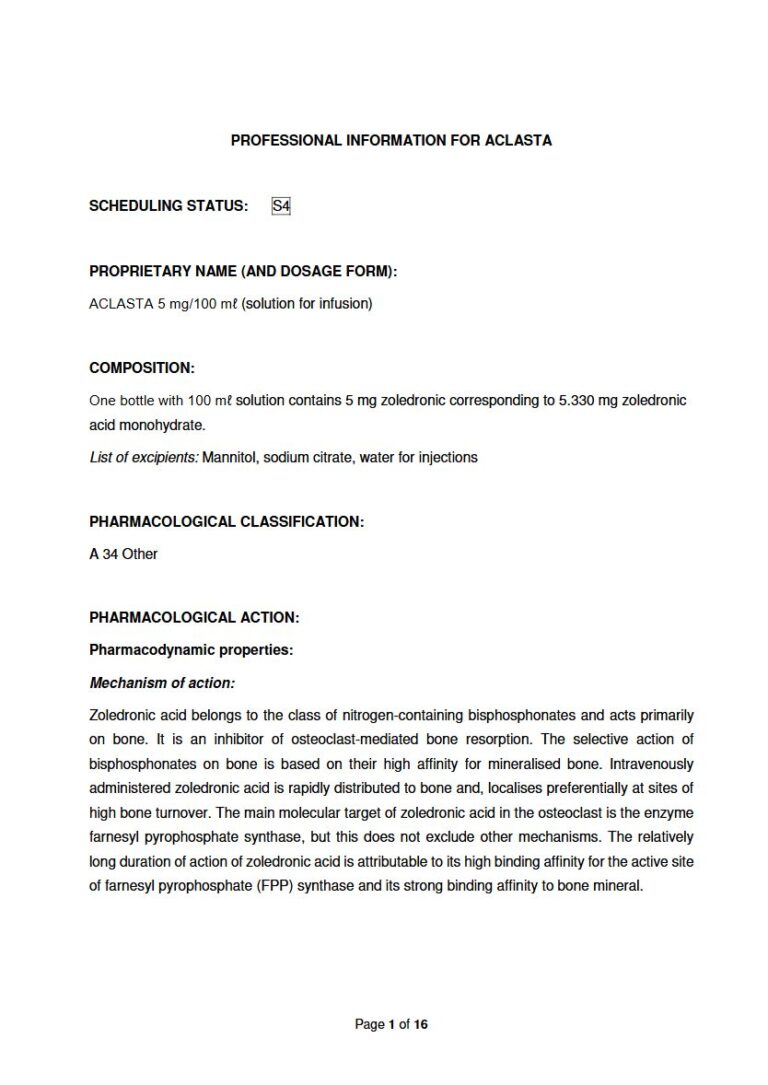
Aclasta 5 mg/100 mg Solution for infusion
Clinical Summary
Quick overview from the medicine insert
Indication
Treatment of osteoporosis in postmenopausal women and in men at high risk of fracture, Paget's disease of bone, and prevention of skeletal-related events in patients with bone metastases from solid tumors.
Dosage (summary)
5 mg administered as a single intravenous infusion over at least 15 minutes once a year for osteoporosis; for Paget's disease, a single dose of 5 mg may be sufficient.
Onset of Action / Duration
The onset of action for bone density increase may be observed within 3 months, with maximum effects typically seen after 1-2 years of treatment.
Special Populations
- Elderly patients
- Patients with renal impairment
- Patients with a history of hypocalcemia
Pregnancy & Breastfeeding
Use during pregnancy is not recommended. It is unknown if zoledronic acid is excreted in human milk; caution should be exercised when administering to nursing mothers.
Key Drug Interactions
- Other bisphosphonates
- Non-steroidal anti-inflammatory drugs (NSAIDs)
- Aminoglycosides
- Calcium supplements
Contraindications
- Hypersensitivity to zoledronic acid or any of its excipients
- Pregnancy
- Severe renal impairment (creatinine clearance < 35 mL/min)
- Hypocalcemia
Common side effects
- Flu-like symptoms
- Fever
- Headache
- Nausea
- Fatigue
- Hypocalcemia
- Renal impairment
Counselling Points
- Ensure adequate hydration before administration.
- Monitor renal function before each dose.
- Advise patients to report any signs of hypocalcemia (e.g., muscle spasms, tingling).
- Inform patients about potential flu-like symptoms post-infusion.
Serious warnings
- Risk of osteonecrosis of the jaw, particularly in cancer patients.
- Risk of atypical femur fractures.
- Monitor for signs of renal impairment during treatment.
Important Disclaimer
The Aclasta 5 mg/100 mg Solution for infusion professional information leaflet below is the property of Sandoz Sa and is provided on Medinsert exactly as issued, with no.. alterations or editorial changes. We make every effort to keep content current by updating documents as soon as new versions become available. Medinsert serves as a trusted access point for healthcare professionals, but does not replace official sources or clinical judgement. For more details, please read our full disclaimer. read more>>
 Healthcare Professionals Only
This content is for registered healthcare professionals
Sign in or create a free account to read the full package insert.
Free for HPCSA-registered professionals. Powered by Medinsert.
Clinical Particulars
Section 4 of the official insert — extracted exactly as issued, no alterations
4.1 Therapeutic indications
Treatment of osteoporosis in postmenopausal women to reduce the incidence of hip, vertebral and non-vertebral fractures and to increase bone mineral density. In patients with a recent low trauma hip fracture, ACLASTA reduces the incidence of new clinical fractures. Treatment of osteoporosis in men. Treatment of glucocorticoid-induced osteoporosis. Treatment of Paget's disease of bone.
4.2 Posology and method of administration
The recommended dose is a single intravenous infusion of 5 mg ACLASTA administered once a year. Patients must be appropriately hydrated prior to administration of ACLASTA. This is especially important in the elderly and for patients receiving diuretic therapy.
4.3 Contraindications
Hypersensitivity to the active substance or to any of the excipients or to any bisphosphonates. Hypocalcaemia. Pregnancy and lactation. Severe impairment of renal function (creatinine clearance of < 35 mu2113/min): the safety and efficacy in patients with severe renal impairment have not been established.
4.4 Special warnings and precautions for use
The dose of 5 mg ACLASTA must be administered over at least 15 minutes. Patients treated with another bisphosphonate should not receive ACLASTA. Pre-existing hypocalcaemia must be treated by adequate intake of calcium and vitamin D before initiating therapy with ACLASTA. Renal impairment: ACLASTA is contra-indicated for patients with renal impairment (creatinine clearance < 35 mu2113/min) due to limited clinical safety data in such patients. Patients should have serum creatinine measured before receiving ACLASTA. Renal dysfunction has been observed following the administration of ACLASTA, especially in patients with pre-existing renal compromise or additional risk factors. The following precautions should be taken into account to minimize the risk of renal adverse reactions: ACLASTA should not be used in patients with severe renal impairment. Serum creatinine should be measured before each ACLASTA dose. Patients, especially those receiving diuretic therapy, should be appropriately hydrated prior to administration of ACLASTA.
4.5 Interactions with other medicines
Caution is indicated when ACLASTA is administered in conjunction with medicinal products that can significantly impact renal function (e.g. aminoglycosides or diuretics that may cause dehydration). Specific medicine interaction studies have not been conducted with ACLASTA. ACLASTA is not systemically metabolised and does not affect human cytochrome P450 enzymes in vitro. ACLASTA is eliminated by renal excretion.
4.6 Fertility, pregnancy and lactation
ACLASTA is contraindicated during pregnancy and in breast-feeding women.
4.7 Effects on ability to drive and use machines
Not stated in the provided text.
4.8 Undesirable effects
ACLASTA has been most commonly associated with the following post-dose symptoms: fever, myalgia, flu-like symptoms, arthralgia, and headache, the majority of which occur within the first 3 days following ACLASTA administration. The incidence of post-dose symptoms occurring within the first 3 days after administration of ACLASTA can be reduced by approximately 50 % with the administration of paracetamol or ibuprofen shortly following ACLASTA administration as needed.
4.9 Overdose
Clinical experience with acute overdosage is limited. Patients who have received doses higher than those recommended should be carefully monitored. In the event of overdose leading to clinically significant hypocalcaemia, reversal may be achieved with supplemental oral calcium and/or an infusion of calcium gluconate.
