
Dronamyl 4 mg/5 ml Concentrate for dilution for infusion
PDF Leaflet Revision Date: 09 February 2024
Clinical Summary
Quick overview from the medicine insert
Indication
Treatment of tumour-induced hypercalcaemia and skeletal conditions in advanced malignancies.
Dosage (summary)
4 mg IV infusion every 3-4 weeks; hydration required.
Special Populations
- Renal impairment
- Hepatic impairment
Pregnancy & Breastfeeding
Contraindicated in pregnancy and breastfeeding.
Key Drug Interactions
- Aminoglycosides
- Calcitonin
- Loop diuretics
- Nephrotoxic medicines
Contraindications
- Hypersensitivity to zoledronic acid
- Severe renal impairment
- Pregnancy
- Lactation
- Children
Common side effects
- Renal impairment
- Bone pain
- Nausea
- Fever
- Acute phase reaction
Counselling Points
- Maintain hydration
- Monitor renal function
- Report any thigh or groin pain
- Avoid invasive dental procedures
Serious warnings
- Risk of renal dysfunction
- Osteonecrosis of the jaw
- Hypocalcaemia
- Atypical femur fractures
Important Disclaimer
The Dronamyl 4 mg/5 ml Concentrate for dilution for infusion professional information leaflet below is the property of Viatris Healthcare and is provided on Medinsert exactly as issued, with no.. alterations or editorial changes. We make every effort to keep content current by updating documents as soon as new versions become available. Medinsert serves as a trusted access point for healthcare professionals, but does not replace official sources or clinical judgement. For more details, please read our full disclaimer. read more>>
 Healthcare Professionals Only
This content is for registered healthcare professionals
Sign in or create a free account to read the full package insert.
Free for HPCSA-registered professionals. Powered by Medinsert.
Clinical Particulars
Section 4 of the official insert — extracted exactly as issued, no alterations
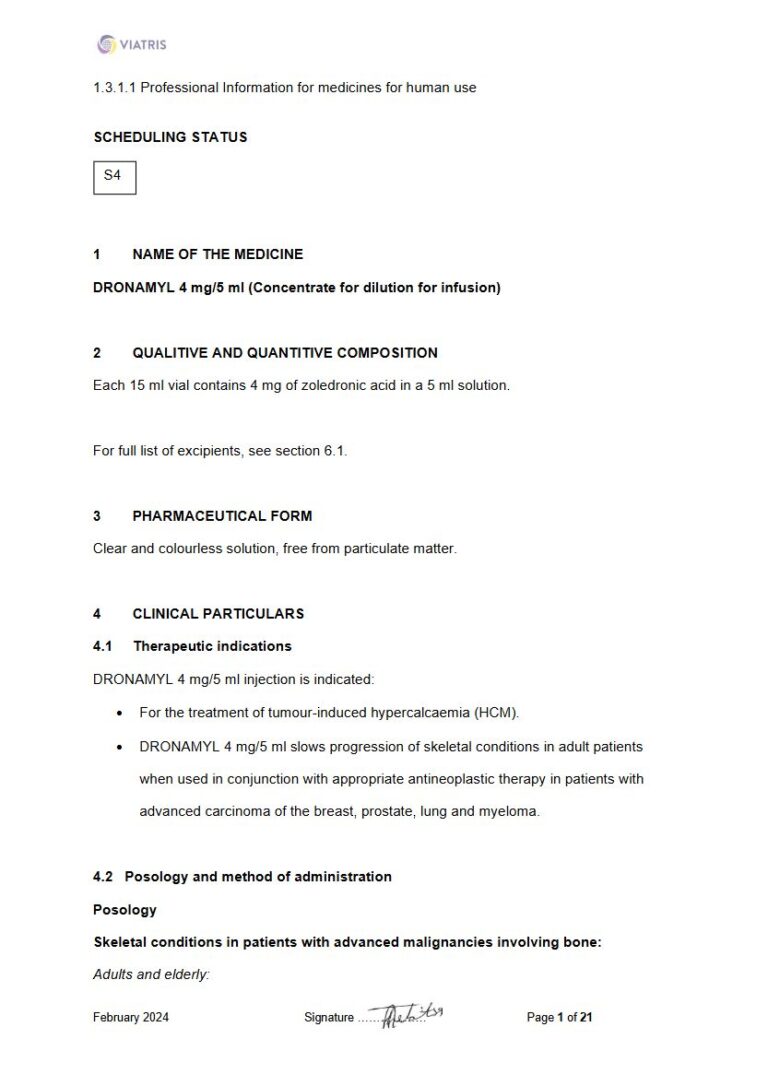
4.1 Therapeutic indications
DRONAMYL 4 mg/5 ml injection is indicated:
- For the treatment of tumour-induced hypercalcaemia (HCM).
- DRONAMYL 4 mg/5 ml slows progression of skeletal conditions in adult patients when used in conjunction with appropriate antineoplastic therapy in patients with advanced carcinoma of the breast, prostate, lung and myeloma.
4.2 Posology and method of administration
Posology
Skeletal conditions in patients with advanced malignancies involving bone:
Adults and elderly:
- The recommended dose is 4 mg.
- The concentrate must further be diluted with 100 ml sterile 0,9 % w/v sodium chloride or 5 % w/v glucose solution and given as an intravenous infusion lasting no less than 15 minutes, every 3 u2013 4 weeks.
- Patients should also be administered an oral calcium supplement of 500 mg and 400 IU vitamin D daily.
Treatment of tumour-induced hypercalcaemia:
Adults and elderly:
- The recommended dose in hypercalcaemia (albumin-corrected serum calcium u2265 12,0 mg/dl or 3,0 mmol/l) is 4 mg.
- The concentrate must be diluted with 100 ml sterile 0,9 % w/v sodium chloride or 5 % w/v glucose solution and given as a single intravenous infusion in no less than 15 minutes.
- Patients must be maintained well hydrated prior to and following DRONAMYL 4 mg/5 ml.
Renal impairment:
Treatment of tumour-induced hypercalcaemia:
- DRONAMYL 4 mg/5 ml treatment in hypercalcaemia patients who also have severe renal impairment should be considered only after evaluating the risks and benefits of treatment.
- No dose adjustment is necessary in tumour-induced hypercalcaemia patients with serum creatinine < 400 micromol/l or < 4,5 mg/dl (see section 4.4).
Skeletal-related events in patients with advanced malignancies involving bone:
- When initiating treatment with DRONAMYL 4 mg/5 ml in patients with multiple myeloma or metastatic bone lesions from solid tumours, serum creatinine levels and creatinine clearance (CLcr) should be determined. CLcr is calculated from serum creatinine levels using the Cockcroft-Gault formula.
- DRONAMYL 4 mg/5 ml is not recommended for patients presenting with severe renal impairment prior to initiation of therapy, which is defined for this population as CLcr < 30 ml/min.
- In patients with bone metastases presenting with mild to moderate renal impairment prior to initiation of therapy, which is defined for this population as Crcl 30u201360 ml/min, the following DRONAMYL 4 mg/5 ml doses are recommended (see section 4.4).
Baseline creatinine clearance (ml/min) DRONAMYL 4 mg/5 ml recommended dose*
- > 60 4,0 mg
- 50u201360 3,5 mg*
- 40u201349 3,3 mg*
- 30u201339 3,0 mg*
* Doses have been calculated assuming target AUC of 0,66 (mgu2022hr/l) (CLcr = 75 ml/min). The reduced doses for patients with renal impairment are expected to achieve the same AUC as that seen in patients with creatinine clearance of 75 ml/min.
- Following initiation of therapy, serum creatinine should be measured prior to each dose of DRONAMYL 4 mg/5 ml and treatment should be withheld, if renal function has deteriorated.
- Treatment may be resumed only when the creatinine level returned to within 10 % of the baseline value. DRONAMYL 4 mg/5 ml treatment should be resumed at the same dose as that given prior to treatment interruption.
Instructions on preparing reduced doses of DRONAMYL 4 mg/5 ml:
- Withdraw an appropriate volume of the reconstituted solution (4 mg/5 ml) as needed:
- 4,4 ml for 3,5 mg dose
- 4,1 ml for 3,3 mg dose
- 3,8 ml for 3,0 mg dose
- For information on the reconstitution and dilution of DRONAMYL 4 mg/5 ml refer to u2018Instructions for use and handlingu2019.
- The withdrawn amount of liquid concentrate must be further diluted in 100 ml of sterile 0,9 % w/v sodium chloride solution or 5 % w/v glucose solution.
- The dose must be given as a single intravenous infusion of no less than 15 minutes.
Instructions for use and handling:
- DRONAMYL 4 mg/5 ml concentrate for solution for infusion is for intravenous use only.
- Prior to administration, 5,0 ml concentrate from one vial or the volume of the concentrate withdrawn as required must be further diluted with 100 ml of calcium-free infusion solution (0,9 % w/v sodium chloride or 5 % w/v glucose solution).
- If refrigerated, the solution must be allowed to reach room temperature before administration (see section 4.2).
Incompatibilities:
- Studies with glass bottles, as well as several types of infusion bags and infusion lines made from polyvinyl chloride, polyethylene and polypropylene (pre-filled with 0,9 % sodium chloride solution or 5 % glucose solution) showed no incompatibility with DRONAMYL 4 mg/5 ml.
- To avoid potential incompatibilities, DRONAMYL 4 mg/5 ml concentrate is to be diluted with 0,9 % sodium chloride solution or 5 % glucose solution.
- DRONAMYL 4 mg/5 ml concentrate must not be mixed with calcium-containing solutions such as Ringeru2019s solution.
Method of administration
Intravenous route.
4.3 Contraindications
DRONAMYL 4 mg/5 ml is contraindicated in patients with a history of hypersensitivity to zoledronic acid, other biphosphonates or any of the inactive ingredients of DRONAMYL 4 mg/5 ml as listed in section 6.1.
DRONAMYL 4 mg/5 ml is also contraindicated in:
- Pregnancy and lactation (see section 4.6).
- Children aged 1 year to 17 years, as safety and efficacy have not been established.
- Severe renal function impairment (creatinine clearance less than 30 ml/min).
4.4 Special warnings and precautions for use
Patients must be assessed prior to administration of DRONAMYL 4 mg/5 ml to ensure that they are adequately hydrated. Overhydration should be avoided in patients at risk of cardiac failure.
DRONAMYL 4 mg/5 ml should not be given together with other bisphosphonates since the combined effects of these medicines are unknown. Standard hypercalcaemia-related metabolic parameters, such as serum levels of calcium, phosphate and magnesium, should be carefully monitored after initiating DRONAMYL 4 mg/5 ml therapy. If hypocalcaemia, hypophosphataemia, or hypomagnesaemia occurs, short-term supplemental therapy may be necessary. Untreated hypercalcaemia patients generally have some degree of renal function impairment, therefore careful renal function monitoring should be considered.
Renal impairment:
Patients with tumour-induced hypercalcaemia and evidence of deterioration in renal function should be appropriately evaluated. The decision to treat patients with bone metastases for the prevention of skeletal-related events should consider that the onset of treatment effect is 2 u2013 3 months. DRONAMYL 4 mg/5 ml has been associated with reports of renal dysfunction. Factors that may increase the potential for deterioration in renal function include dehydration, pre-existing renal impairment, multiple cycles of DRONAMYL 4 mg/5 ml and other bisphosphonates as well as use of other nephrotoxic medicines. While the risk is reduced with a dose of 4 mg of DRONAMYL 4 mg/5 ml administered over 15 minutes, deterioration in renal function may still occur. Renal deterioration, progression to renal failure and dialysis have been reported in patients after the initial dose or a single dose of 4 mg zoledronic acid. Increases in serum creatinine also occur in some patients with chronic administration of DRONAMYL 4 mg/5 ml at recommended doses for prevention of skeletal-related events, although less frequently.
Patients should have their serum creatinine levels assessed prior to each dose of DRONAMYL 4 mg/5 ml. Upon initiation of treatment in patients with bone metastases with mild to moderate renal impairment, lower doses of DRONAMYL 4 mg/5 ml are recommended. In patients who show evidence of renal deterioration during treatment with DRONAMYL 4 mg/5 ml, treatment should only resume when the creatinine level returns to within 10 % of the baseline value (see section 4.2). DRONAMYL 4 mg/5 ml treatment should be resumed at the same dose as that given prior to treatment interruption. Because of the potential impact on renal function, the use of DRONAMYL 4 mg/5 ml is not recommended in patients with severe renal impairment (see section 4.3).
Hepatic impairment:
Limited clinical data is available in patients with severe hepatic insufficiency, therefore, no specific recommendations can be given for these patients.
Osteonecrosis of the jaw:
There have been reports of osteonecrosis of the jaw (ONJ) in patients with cancer receiving treatment regimens including DRONAMYL 4 mg/5 ml. The start of treatment or of a new course of treatment should be delayed in patients with unhealed open soft tissue lesions in the mouth, except in medical emergencies. Many of these patients were also receiving chemotherapy and corticosteroids. Most of the cases reported have been associated with dental procedures (tooth extraction). Many had signs of local infection including osteomyelitis. A dental examination with appropriate preventative dentistry and an individual benefit-risk assessment is recommended prior to treatment with bisphosphonates in patients with concomitant risk factors. If possible, patients should avoid invasive dental procedures while receiving DRONAMYL 4 mg/5 ml.
The following risk factors should be considered when evaluating an individualu2019s risk of developing ONJ:
- Potency of the bisphosphonate (higher risk for highly potent compounds), route of administration (higher risk for parenteral administration) and cumulative dose of bisphosphonate.
- Cancer, co-morbid conditions (e.g. anaemia, coagulopathies, infection), smoking.
- Concomitant therapies: chemotherapy, angiogenesis inhibitors, radiotherapy to neck and head, corticosteroids.
- History of dental disease, poor oral hygiene, periodontal disease, invasive dental procedures (e.g. tooth extractions) and poorly fitting dentures.
All patients should be encouraged to maintain good oral hygiene, undergo routine dental check-ups, and immediately report any oral symptoms such as dental mobility, pain or swelling, or non-healing of sores or discharge during treatment with DRONAMYL 4 mg/5 ml. While on treatment, invasive dental procedures should be performed only after careful consideration and be avoided in close proximity to zoledronic acid administration. For patients who develop osteonecrosis of the jaw while on bisphosphonate therapy, dental surgery may exacerbate the condition. For patients requiring dental procedures, there are no data available to suggest whether discontinuation of bisphosphonate treatment reduces the risk of osteonecrosis of the jaw. The management plan for patients who develop ONJ should be set up in close collaboration between the treating doctor and a dentist or oral surgeon with expertise in ONJ. Temporary interruption of zoledronic acid treatment should be considered until the condition resolves and contributing risk factors are mitigated where possible.
Osteonecrosis of the external auditory canal:
Osteonecrosis of the external auditory canal has been reported with bisphosphonates, mainly in association with long-term therapy. Possible risk factors for osteonecrosis of the external auditory canal include steroid use and chemotherapy and/or local risk factors such as infection or trauma. The possibility of osteonecrosis of the external auditory canal should be considered in patients receiving bisphosphonates who present with ear symptoms including chronic ear infections.
Musculoskeletal pain:
In post-marketing experience, severe and occasionally incapacitating bone, joint, and/or muscle pain have been reported, however, such reports have been infrequent. The time to onset of symptoms varied from one day to several months after starting treatment. Most patients had relief of symptoms after stopping treatment. A subset had recurrence of symptoms when rechallenged with bisphosphonate treatment.
Atypical fractures of the femur:
Atypical subtrochanteric and diaphyseal femoral fractures have been reported with DRONAMYL 4 mg/5 ml therapy, primarily in patients receiving long-term treatment for osteoporosis. These transverse or short oblique fractures can occur anywhere along the femur from just below the lesser trochanter to just above the supracondylar flare. These fractures occur after minimal or no trauma and some patients experience thigh or groin pain, often associated with imaging features of stress fractures, weeks to months before presenting with a completed femoral fracture. Fractures are often bilateral, therefore, the contra-lateral femur should be examined in DRONAMYL 4 mg/5 ml-treated patients who have sustained a femoral shaft fracture. Poor healing of these fractures has also been reported. Discontinuation of DRONAMYL 4 mg/5 ml therapy in patients suspected to have an atypical femur fracture should be considered pending on evaluation of the patient. The patient should receive appropriate orthopedic care. During DRONAMYL 4 mg/5 ml treatment patients should be advised to report any thigh, hip or groin pain and any patient presenting with such symptoms should be evaluated for an incomplete femur fracture.
Hypocalcaemia:
Hypocalcaemia has been reported in patients treated with DRONAMYL 4 mg/5 ml. Cardiac arrhythmias and neurologic adverse events (including convulsions, hypoaesthesia and tetany) have been reported secondary to cases of severe hypocalcaemia. Cases of severe hypocalcaemia requiring hospitalisation have been reported. In some instances, the hypocalcaemia may be life-threatening. Caution is advised when DRONAMYL 4 mg/5 ml is administered with medicines known to cause hypocalcaemia, as they may have a synergistic effect resulting in severe hypocalcaemia. Serum calcium should be measured and hypocalcaemia must be corrected before initiating DRONAMYL 4 mg/5 ml therapy. Patients should be adequately supplemented with calcium and vitamin D.
Atrial fibrillation:
There are reports of atrial fibrillation in post-menopausal women.
Acute phase reaction:
Acute phase reaction consists of a constellation of symptoms that includes fever, myalgia, headache, extremity pain, nausea, vomiting, diarrhoea and arthralgia. The onset time is u2264 3 days post-DRONAMYL 4 mg/5 ml infusion, and the reaction is also referred to using the terms u201cflu-likeu201d or u201cpost-doseu201d symptoms.
4.5 Interactions with other medicines
Caution is advised when DRONAMYL 4 mg/5 ml is administered with aminoglycosides, calcitonin or loop diuretics, since both medicines may have an additive effect, resulting in a lower serum calcium level for longer periods than required. Caution is indicated when DRONAMYL 4 mg/5 ml is used with other potentially nephrotoxic medicines. Attention should also be paid to the possibility of hypomagnesaemia developing during treatment. Caution is advised when DRONAMYL 4 mg/5 ml is administered with anti-angiogenic medicines as an increase in incidence of ONJ has been observed in patients treated concomitantly with these medicines. In multiple myeloma patients, the risk of renal dysfunction may be increased when DRONAMYL 4 mg/5 ml is used in combination with thalidomide. Cancer patients receiving treatment regimens including biphosphates such as DRONAMYL 4 mg/5 ml and also receiving chemotherapy and corticosteroids may be at risk of osteonecrosis of the jaw (see section 4.4). There may be an increased risk of hypocalcaemia when DRONAMYL 4 mg/5 ml is used with loop diuretics.
4.6 Fertility, pregnancy and lactation
Women of childbearing potential/Contraception in males and females
Women of child-bearing potential should be advised to avoid becoming pregnant and advised of the potential hazard to the foetus while receiving DRONAMYL 4 mg/5 ml. There may be a risk of foetal harm (e.g. skeletal and other abnormalities) if a woman becomes pregnant (see section 4.3) while receiving bisphosphonate therapy.
Pregnancy
DRONAMYL 4 mg/5 ml should not be used during pregnancy as safety has not been established (see section 4.3).
Breastfeeding
DRONAMYL 4 mg/5 ml should not be used during breastfeeding, as safety has not been established (see section 4.3).
Fertility
No data available.
4.7 Effects on ability to drive and use machines
Undesirable effects such as dizziness and somnolence reported with the use of DRONAMYL 4 mg/5 ml may influence the ability to drive or use machinery and caution is therefore necessary. The patients should therefore be careful when driving, using machinery or performing other tasks that need full attention. It is not always possible to predict to what extent DRONAMYL 4 mg/5 ml may interfere with the daily activities of a patient. Patients should ensure that they do not engage in the above activities until they are aware of the extent to which DRONAMYL 4 mg/5 ml affects them.
4.8 Undesirable effects
Summary of the safety profile
Within three days after DRONAMYL 4 mg/5 ml administration, an acute phase reaction has commonly been reported, with symptoms including bone pain, fever, fatigue, arthralgia, myalgia, rigors and arthritis with subsequent joint swelling. These symptoms usually resolve within a few days (see section 4.4).
The following are the important identified risks with DRONAMYL 4 mg/5 ml in the approved indications: renal function impairment, osteonecrosis of the jaw, acute phase reaction, hypocalcaemia, atrial fibrillation, anaphylaxis, interstitial lung disease.
The frequencies for each of these identified risks are shown in the table below.
Tabulated list of adverse reactions
Blood and lymphatic system disorders
- Frequent: Anaemia
- Less frequent: Thrombocytopenia, leucopenia, pancytopenia
Immune system disorders
- Less frequent: Hypersensitivity reaction, angioedema
Psychiatric disorders
- Less frequent: Anxiety, sleep disturbance, confusion
Nervous system disorders
- Frequent: Headache
- Less frequent: Dizziness, paraesthesia, taste disturbance, hypoaesthesia, hyperaesthesia, tremor, somnolence, convulsions, tetany (secondary to hypocalcaemia)
Eye disorders
- Frequent: Conjunctivitis
- Less frequent: Blurred vision, scleritis, orbital inflammation, uveitis, episcleritis
Cardiac disorders
- Less frequent: Hypertension, hypotension, atrial fibrillation, hypotension leading to syncope or circulatory collapse, bradycardia, cardiac dysrhythmia (secondary to hypocalcaemia)
Respiratory, thoracic and mediastinal disorders
- Less frequent: Dyspnoea, cough, bronchoconstriction, interstitial lung disease
Gastrointestinal disorders
- Frequent: Nausea, vomiting, anorexia, decreased appetite
- Less frequent: Diarrhoea, constipation, abdominal pain, dyspepsia, stomatitis, dry mouth
Skin and subcutaneous tissue disorders
- Less frequent: Pruritus, rash (including erythematous and macular rash), increased sweating
Musculoskeletal, connective tissue and bone disorders
- Frequent: Bone pain, myalgia, arthralgia, generalised pain, joint stiffness
- Less frequent: Muscle cramps, osteonecrosis of the jaw, osteonecrosis of the auditory canal
Renal and urinary disorders
- Frequent: Renal impairment
- Less frequent: Acute renal failure, haematuria, proteinuria, acquired Fanconi syndrome
General disorders and administration site conditions
- Frequent: Fever, flu-like syndrome (including fatigue, rigors, malaise and flushing)
- Less frequent: Asthenia, peripheral oedema, injection site reactions (including pain, irritation, swelling, induration), chest pain, weight increase, anaphylactic reaction/shock, urticarial, arthritis and joint swelling as a symptom of acute phase reaction
Investigations
- Frequent: Hypophosphataemia, blood creatinine and blood urea increased, hypocalcaemia
- Less frequent: Hypomagnesaemia, hypokalaemia, hyperkalaemia, hypernatraemia
Description of selected adverse reactions
Renal function impairment: Factors that may increase the potential for deterioration in renal function include dehydration, pre-existing renal impairment, multiple cycles of DRONAMYL 4 mg/5 ml or other bisphosphonates, as well as concomitant use of nephrotoxic medicines or using a shorter infusion time than currently recommended. Renal deterioration, progression to renal failure and dialysis have been reported in patients after the initial dose or a single dose of DRONAMYL 4 mg/5 ml (see section 4.4).
Osteonecrosis of the jaw: Cases of osteonecrosis (primarily of the jaws) have been reported predominantly in cancer patients treated with bisphosphonates, such as DRONAMYL 4 mg/5 ml. Many of these patients had signs of local infection including osteomyelitis. The majority of the reports refer to cancer patients following tooth extractions or other dental surgeries. Osteonecrosis of the jaws has multiple well documented risk factors including a diagnosis of cancer, concomitant therapies (e.g. chemotherapy, radiotherapy, corticosteroids) and co-morbid conditions (e.g. anaemia, coagulopathies, infection, pre-existing oral disease). Although causality cannot be determined, it is prudent to avoid dental surgery as recovery may be prolonged (see section 4.4).
Osteonecrosis of other anatomical sites: Cases of osteonecrosis of other anatomical sites including the hip, femur and external auditory canal have been reported predominantly in adult cancer patients treated with bisphosphonates, including DRONAMYL 4 mg/5 ml.
Acute phase reaction: This adverse drug reaction consists of a constellation of symptoms that includes fever, fatigue, bone pain, chills, myalgia, headache, extremity pain, nausea, vomiting, diarrhoea, arthralgia and arthritis with subsequent joint swelling. The onset time is u2264 3 days post-DRONAMYL 4 mg/5 ml infusion, and the reaction is also referred to using the terms u201cflu-likeu201d or u201cpost-doseu201d symptoms. These symptoms usually resolve within a few days.
Atypical fractures of the femur: During post-marketing experience the following reactions have been reported (frequency rare): Atypical subtrochanteric and diaphyseal femoral fractures (bisphosphonate class adverse reaction).
Hypocalcaemia-related ADRs: Hypocalcaemia is an important identified risk with DRONAMYL 4 mg/5 ml in the approved indications. Based on post-marketing cases, there is sufficient evidence to support an association between DRONAMYL 4 mg/5 ml therapy, the reported event of hypocalcaemia, and the secondary development of cardiac dysrhythmia. Furthermore, there is evidence of an association between hypocalcaemia and secondary neurological events reported in these cases including: convulsions, hypoaesthesia and tetany (see section 4.4).
Reporting of suspected adverse reactions
Reporting suspected adverse reactions after authorisation of the medicine is important. It allows continued monitoring of the benefit/risk balance of the medicine. Healthcare providers are asked to report any suspected adverse reactions to SAHPRA via the u201c6.04 Adverse Drug Reactions Reporting Formu201d, found online under SAHPRAu2019s publications: https://www.sahpra.org.za/Publications/Index/8
4.9 Overdose
In overdose, side effects can be precipitated and/or be of increased severity (see section 4.8). Clinical experience with acute overdose is limited and there is no known specific antidote to DRONAMYL 4 mg/5 ml. Treatment is symptomatic and supportive.
